Solutions · Application Scenarios
Acid and alkali recovery: diffusion dialysis and bipolar membrane loops
Electromembrane and diffusion-based recovery with explicit bleed and impurity purge streams. Lower chemical purchase and a documented purge/disposal path for…
Use this guide within its scope
This page supports technical research and option comparison and is marked 2026. Illustrative values are not a quotation, completed process design, certification conclusion, or performance guarantee. Check current regulations, feed data, tests, and OEM records.
Problem
Spent acid/alkali becomes an opex and discharge liability.
Technology
Electromembrane and diffusion-based recovery with explicit bleed and impurity purge streams.
Results
Lower chemical purchase and a documented purge/disposal path for accumulated contaminants.
Engineering decision card
Use when
Spent acid/alkali becomes an opex and discharge liability.
Evaluate first
Electromembrane and diffusion-based recovery with explicit bleed and impurity purge streams.
Inputs still required
Feed source and variability, capacity, target quality, operating hours, discharge or reuse boundary, available space, and utilities.
Comparison output
Lower chemical purchase and a documented purge/disposal path for accumulated contaminants. The final decision still needs feed data, mass balance, and any necessary testing.
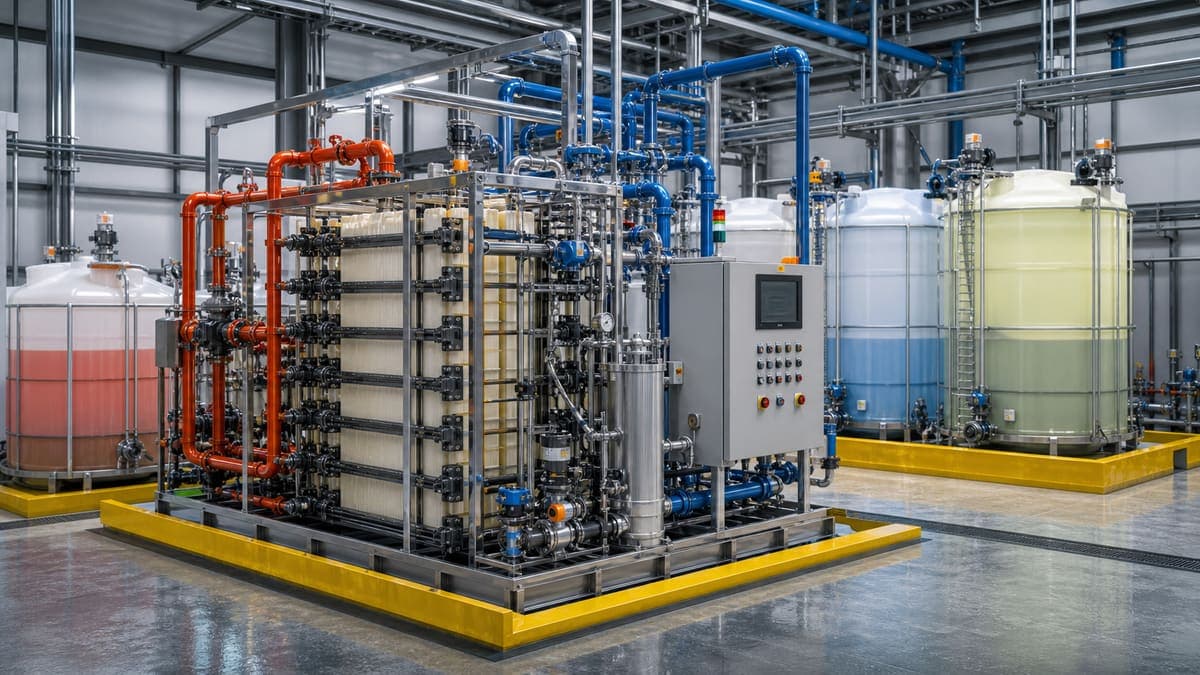
Process context & when this scenario is the right entry point
Industrial processes across numerous sectors—including metal finishing, electroplating, semiconductor manufacturing, chemical production, and textile dyeing—generate significant volumes of acidic and alkaline waste streams. These streams often contain valuable dissolved salts, heavy metals, or organic contaminants, making direct discharge environmentally problematic and economically undesirable due to the loss of expensive reagents and high disposal costs.
This scenario focuses on advanced membrane-based separation technologies, specifically Diffusion Dialysis (DD) and Bipolar Membrane Electrodialysis (BPMED), for the recovery and reconcentration of acids and alkalis from these complex waste streams. It's a critical entry point when:
- Minimizing chemical reagent consumption is a strategic goal.
- Regulatory drivers mandate reduced hazardous waste generation and resource recovery.
- Conventional neutralization leads to high sludge volumes and ongoing disposal costs.
- High-purity acid or base streams are required for reuse.
- Achieving Zero Liquid Discharge (ZLD) or near-ZLD targets for process effluents.
These technologies enable the separation of strong acids (e.g., HCl, H₂SO₄) from metal salts, or the splitting of neutral salts into their constituent acids and bases, thereby closing the loop on valuable chemical resources and reducing environmental impact.
Feed characteristics & key risks
Feed streams for acid and alkali recovery are highly diverse and present significant challenges. Typical characteristics include:
- Extreme pH: Often pH < 1 or pH > 13.
- High ionic strength: High concentrations of target acids/bases, metal salts, and other dissolved solids (TDS).
- Contaminants: Heavy metals (Cr, Ni, Cu, Zn, Fe), organic acids/bases, suspended solids, oils, and complexing agents.
- Temperature: Often elevated, impacting membrane stability and transport rates.
Key risks to be managed for successful operation include:
- Membrane degradation: Exposure to extreme pH, high temperatures, and aggressive chemical species can compromise membrane integrity and lifespan.
- Fouling: Particulates, colloids, and certain organic compounds can foul membrane surfaces, leading to reduced flux and increased differential pressure.
- Scaling: Precipitation of metal hydroxides (especially in pH transition zones within bipolar membranes), calcium sulfate, or silica can occur, particularly when concentrating reject streams or under specific operating conditions. The Langelier Saturation Index (LSI) is not directly applicable in highly acidic/alkaline feeds, but the solubility limits of specific metal salts and precipitates at various pH conditions must be rigorously assessed.
- Osmotic limits: While DD and BPMED are not pressure-driven like RO, downstream concentration steps (e.g., RO for salt reject) will be limited by osmotic pressure.
- Co-ion permeation: In DD, undesirable co-ions can sometimes permeate with the acid, reducing purity. In BPMED, proton/hydroxide leakage can reduce current efficiency.
Concentrate / reject routing
A fundamental principle of water treatment is mass balance. For acid/alkali recovery, the permeate is the recovered acid or base, while the "concentrate" or "reject" is the stream containing the undesirable components.
In Diffusion Dialysis (DD), the recovered acid/base diffuses through the membrane into a receiving stream, while the bulk of the metal salts and other impurities are retained in the original stream, becoming the DD reject or retentate. This reject stream, often still acidic and rich in metal salts (e.g., spent pickling liquor containing iron salts), requires further treatment. Typical routing for this DD reject includes:
- Metal precipitation: pH adjustment to precipitate heavy metals as hydroxides, followed by clarification and sludge dewatering. The supernatant can then be further treated (e.g., by RO for water recovery) or discharged.
- Evaporation/Crystallization: For ZLD applications, the highly concentrated salt reject can be sent to evaporators and crystallizers to recover solid salts for disposal or potential reuse, yielding a high-purity distillate for recycle.
- Specific ion exchange: For selective removal of certain problematic ions before discharge or further processing.
In Bipolar Membrane Electrodialysis (BPMED), a neutral salt solution is split into an acid and a base stream. The diluate (depleted salt solution) from the BPMED stack is the primary reject. This diluate stream, while lower in salt concentration, still contains residual salts and impurities. Its disposition depends on the overall ZLD strategy and target recovery:
- Conventional RO/NF: For further concentration of the residual salts, reducing the volume of water associated with them. The RO/NF permeate can be recycled or discharged, and the RO/NF concentrate then routed to evaporation/crystallization.
- Recycle to upstream processes: If the diluate's purity and concentration are suitable, it might be recycled to the initial process where the salt was formed, reducing makeup water demand.
- Discharge: If the diluate meets discharge limits, it can be sent to a wastewater treatment plant.
Any periodic electrode rinse solutions from BPMED, containing residual salts and potentially scale inhibitors, must also be collected and routed for treatment or disposal. The key is to manage all resultant streams to minimize waste volume and maximize resource recovery, ensuring no material "disappears" from the mass balance.
Reference process train options
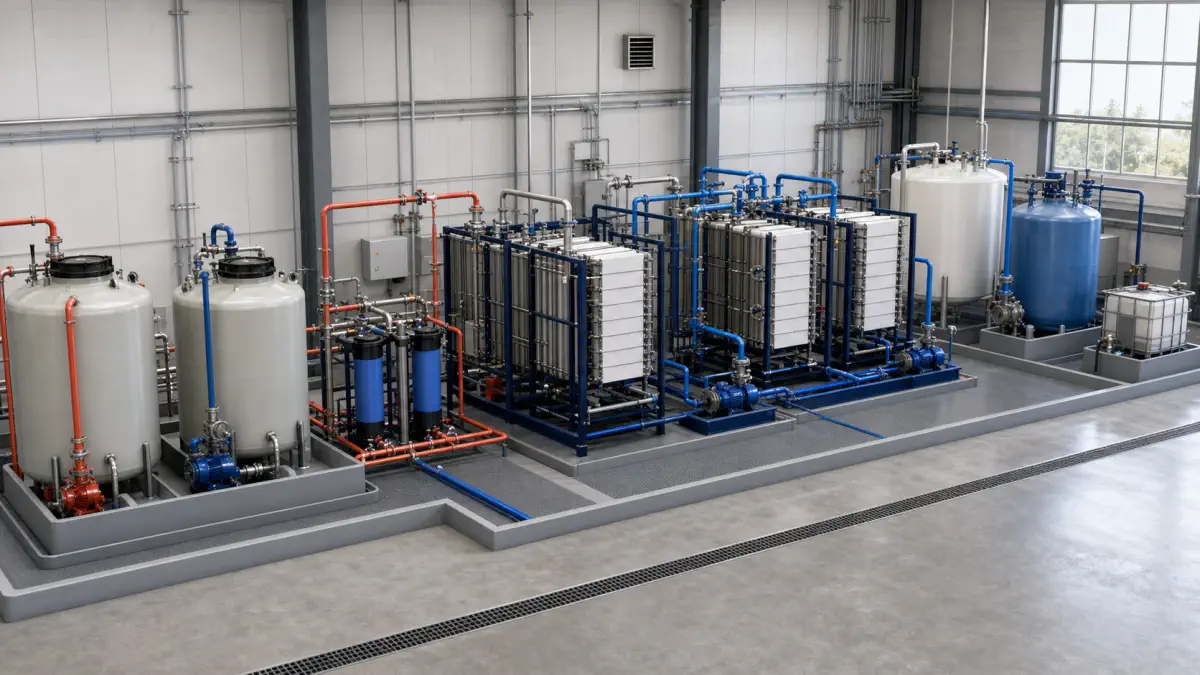
The selection and configuration of the process train depend heavily on the specific feed chemistry, desired product purity, and recovery targets.
Operating parameters
Effective operation and maintenance of DD and BPMED systems require diligent monitoring of key parameters:
- SDI₁₅: While not directly impacting the diffusion or electrodialysis process in the same way it affects RO, maintaining SDI₁₅ < 5 (ideally <3) for the feed to the membrane stacks is crucial. High particulate loads can lead to channeling, increased pressure drop, and abrasion of membrane surfaces. Pretreatment with MF/UF is essential.
- Scaling Indices: As noted, LSI is less relevant. Instead, comprehensive solubility modeling based on feed chemistry (e.g., concentrations of Ca, Mg, Ba, Sr, Si, heavy metals, sulfates, carbonates) at various pH and temperature conditions is used. Preventative measures include pH control, chemical inhibitors, or feed softening. For BPMED, managing the pH in the dilute and concentrate channels is critical to avoid metal hydroxide precipitation, which manifests as increased electrical resistance and ΔP.
- Flux / Recovery Rate:
- DD: "Flux" is typically expressed as the acid recovery rate, e.g., 100-300 g/m²·h for HCl. This is optimized by feed acid concentration, temperature, and hydraulic residence time.
- BPMED: Performance is characterized by current density (e.g., 50-150 mA/cm²) and current efficiency (typically 70-90%). Energy consumption (kWh/kg product) is a key metric.
- Differential Pressure (ΔP): Monitoring the pressure drop across individual membrane stacks and the entire system is vital. An increasing ΔP (e.g., exceeding 0.5-1.0 bar across a stack for BPMED, or significant increases over baseline for DD) is an indicator of fouling or scaling within the membrane channels, necessitating cleaning cycles. Consistent flow distribution across the stacks is also monitored via individual flow meters.
Digital twin & instrumentation
Instrumentation & Sensors:
- Flow meters: Electromagnetic or ultrasonic flow meters on all feed, product, and reject lines to track volumes and mass balance.
- Pressure transducers: At the inlet and outlet of each membrane stack, as well as inter-stage, to monitor ΔP and identify fouling or flow distribution issues.
- Conductivity sensors: On feed, recovered acid/base, and reject streams to monitor separation efficiency and product purity.
- pH probes: In feed, product, and reject streams to verify process chemistry and control pH adjustments.
- Temperature sensors: Throughout the system, especially before membrane stacks, to ensure optimal operating conditions and membrane protection.
- Voltage and Amperage transducers: For BPMED systems, to monitor power consumption and control current density.
- Level sensors: In all tanks (feed, product, cleaning solutions) for inventory management and automated operation.
Pilot-Scale vs Industrial RO
The choice between pilot-scale RO and industrial RO depends on the scale, complexity, and permanence of the acid/alkali recovery requirement. pilot-scale RO systems are highly suitable for pilot-scale studies, process validation, and treating smaller, often variable, waste streams. Their compact footprint and modularity make them ideal for laboratory applications, mobile deployment for temporary recovery needs, or testing novel chemistries before full-scale commitment. For robust, high-volume, continuous industrial operations, industrial RO provides multi-stage, fully automated, and highly integrated solutions. These systems are designed for large-scale production facilities seeking ZLD-class performance, full SCADA integration with plant Distributed Control Systems (DCS), and long-term reliability in aggressive chemical environments.
FAQ
Q1: What are the primary advantages of Diffusion Dialysis (DD) compared to other acid recovery methods like evaporation? A1: DD offers lower energy consumption as it's a diffusion-driven process, not phase change. It's relatively simple to operate, has a smaller footprint, and can achieve high recovery efficiencies for strong acids from metal salt solutions without the high capital and operational costs of evaporators.
Q2: When is Bipolar Membrane Electrodialysis (BPMED) the preferred technology over Diffusion Dialysis? A2: BPMED is preferred when you need to convert a neutral salt into both an acid and a base (e.g., NaCl into HCl and NaOH), or when DD's selectivity is insufficient to achieve the desired purity for the recovered acid. It's also used for pH adjustment without adding external chemicals.
Q3: Can these technologies handle highly mixed waste streams containing both acids, bases, and various salts? A3: While DD and BPMED are powerful, highly mixed streams increase complexity. Effective pre-separation (e.g., selective precipitation, ion exchange, or initial rough concentration) is often required before applying these membrane technologies to ensure optimal performance and membrane lifespan.
Q4: What is the typical lifespan for DD and BPMED membranes? A4: Membrane lifespan is highly dependent on feed quality, operating conditions (pH, temperature, presence of oxidizers), and cleaning regimens. DD membranes can often last 3-5 years or more. BPMED membranes, operating under an electrical field and often at higher pH transitions, typically have a lifespan of 2-4 years, though advancements are continually extending this.
Related equipment & product lines
These categories typically support the approach above—open any line to compare brands and models.
For a closer review, use the engineering inquiry form to share feed, capacity, target, and project stage. Submission does not constitute a completed design or performance commitment.