Solutions · Application Scenarios
Energy recovery integration: cutting kWh/m³ on high-pressure RO
Recover energy from the concentrate stream where hydraulic head is real. Lower specific energy with transparent measurement boundaries.
Use this guide within its scope
This page supports technical research and option comparison and is marked 2026. Illustrative values are not a quotation, completed process design, certification conclusion, or performance guarantee. Check current regulations, feed data, tests, and OEM records.
Problem
High salinity means energy is the operating line item.
Technology
Recover energy from the concentrate stream where hydraulic head is real.
Results
Lower specific energy with transparent measurement boundaries.
Engineering decision card
Use when
High salinity means energy is the operating line item.
Evaluate first
Recover energy from the concentrate stream where hydraulic head is real.
Inputs still required
Feed source and variability, capacity, target quality, operating hours, discharge or reuse boundary, available space, and utilities.
Comparison output
Lower specific energy with transparent measurement boundaries. The final decision still needs feed data, mass balance, and any necessary testing.
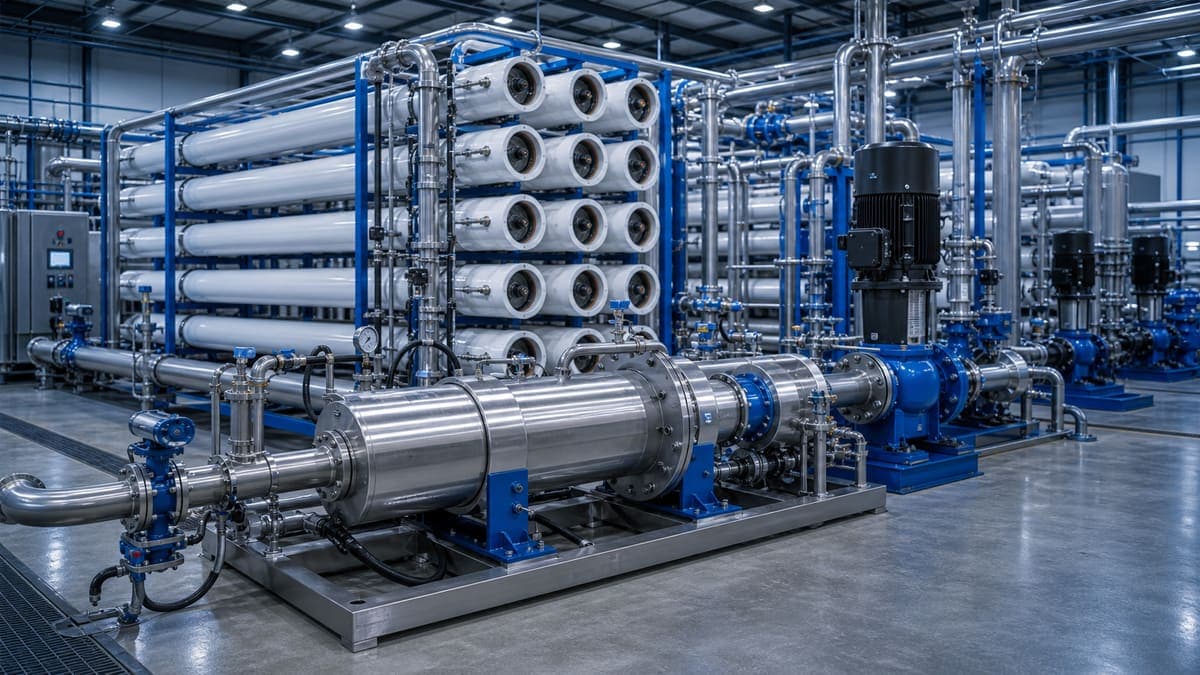
Process context & when this scenario is the right entry point
High-pressure Reverse Osmosis (RO) systems, particularly those treating seawater (SWRO) or high-TDS industrial wastewater, are inherently energy-intensive due to the significant osmotic pressure that must be overcome. The feed pressures can range from 55 to 80 bar (800-1160 psi), requiring powerful high-pressure pumps. This scenario is crucial for optimizing operational expenditure (OPEX) by recovering a substantial portion of the energy from the high-pressure concentrate stream.
Integrating energy recovery devices (ERDs) is a critical design consideration for any new high-pressure RO plant aiming for low specific energy consumption (kWh/m³). It is also a prime candidate for retrofit projects in existing facilities seeking to reduce their carbon footprint and improve economic viability. This playbook focuses on the engineering principles and practical implementation of ERDs to achieve hydraulic balance and maximize energy recovery in such systems.
Feed characteristics & key risks
High-pressure RO feeds are typically characterized by high total dissolved solids (TDS), often exceeding 30,000 mg/L, and consequently, high osmotic pressure. Seawater is a common example, with TDS ranging from 35,000 to 45,000 mg/L. Industrial applications can present even higher TDS and a more complex ionic profile.
Key risks associated with these feed characteristics include:
- High Osmotic Pressure: Demands extremely high feed pressures, directly impacting energy consumption.
- Scaling: Concentration of sparingly soluble salts like calcium carbonate (CaCO₃), calcium sulfate (CaSO₄), barium sulfate (BaSO₄), strontium sulfate (SrSO₄), and silica (SiO₂) in the concentrate stream can lead to severe membrane scaling.
- Fouling: High-TDS feedwaters often contain suspended solids, colloids, organic matter, and microorganisms, leading to particulate, organic, or biological fouling of the membranes.
- Corrosion: High salinity combined with potential oxidizing agents (e.g., chlorine residuals from pretreatment) can accelerate corrosion in metallic components of the high-pressure system.
- Membrane Degradation: Exposure to extreme pH, oxidizing agents, or uncontrolled scaling/fouling can irreversibly damage membrane performance and lifespan.
Concentrate / reject routing
The mass balance principle dictates that all dissolved solids removed from the permeate are concentrated in the reject stream. For high-pressure RO applications, the disposition of this concentrate is a critical design and regulatory consideration.
In seawater desalination, the high-pressure concentrate (brine) is most commonly returned to the ocean. This discharge is typically regulated to ensure sufficient dilution and dispersion, minimizing localized environmental impact on salinity, temperature, and residual chemical concentrations. Diffusers are often used to rapidly mix the brine with ambient seawater.
For industrial high-TDS wastewater applications, concentrate management options are more varied and often more complex:
- Further Treatment: The concentrate may be routed to a secondary RO stage (e.g., a brine concentrator RO) to achieve higher overall water recovery, or to a Nanofiltration (NF) stage if selective removal of specific ions is desired before further treatment.
- Evaporation/Crystallization: For zero liquid discharge (ZLD) goals, the concentrate is often fed to evaporators (mechanical vapor recompression, multiple effect distillation) followed by crystallizers to recover solid salts for disposal or beneficial reuse.
- Deep Well Injection: Where geological conditions and regulatory permits allow, the brine can be injected into deep, non-potable aquifers.
- Haul-off: For smaller volumes or specific industrial concentrates, it may be transported off-site for disposal at permitted facilities.
- Permitted Surface Water Discharge: In rare cases and with stringent permits, diluted industrial concentrate may be discharged to receiving water bodies if the environmental impact is deemed acceptable.
Crucially, the energy recovery device operates on this high-pressure concentrate stream before its final disposition, extracting hydraulic energy for reuse.
Reference process train options
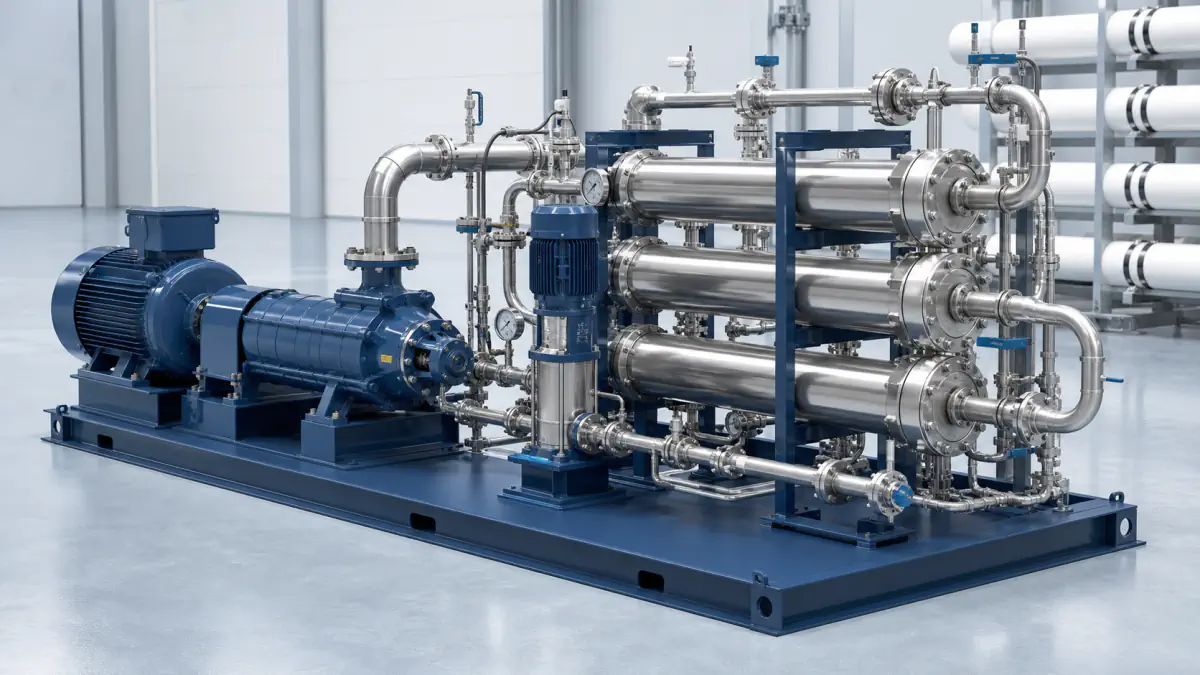
A typical high-pressure RO train integrating energy recovery for seawater or high-TDS industrial wastewater often includes:
- Pretreatment: Essential for protecting the RO membranes. This commonly involves screening, coagulation/flocculation, sedimentation or dissolved air flotation (DAF), followed by robust filtration such as multi-media filtration (MMF), dual-media filtration (DMF), or increasingly, ultrafiltration (UF) or microfiltration (MF) to achieve a consistently low SDI₁₅ (<3, ideally <1-2). Cartridge filters (5-10 micron) act as a final guard filter.
- Chemical Dosing: Antiscalants are injected to inhibit scaling, biocides for microbiological control, and pH adjustment chemicals (acid/caustic) as needed.
- High-Pressure Pump (HPP): Boosts the pretreated feed water to the required RO operating pressure.
- RO Membrane Array: Configured in one or two stages depending on recovery and permeate quality targets.
- Energy Recovery Device (ERD): Recovers hydraulic energy from the high-pressure concentrate stream. Common ERD types include:
- Pressure Exchanger (PX): Isobaric device that transfers energy directly from the high-pressure concentrate to the low-pressure feed. Highly efficient (up to 98%).
- Turbocharger (Pelton Wheel or Francis Turbine): A turbine coupled with a booster pump. The concentrate drives the turbine, which in turn drives a pump to boost the feed pressure. Efficiency typically 80-90%.
- Booster Pump (if applicable): For turbochargers, a booster pump is often integral to the ERD, increasing the feed pressure to match the RO system requirements. For PX devices, a smaller booster pump might be used on the low-pressure side to compensate for pressure losses.
- Post-Treatment: Permeate is typically disinfected (e.g., UV, chlorination) and pH-adjusted to meet final water quality requirements for drinking water, industrial process water, or other uses.
Operating parameters
Effective operation of high-pressure RO with energy recovery hinges on stringent control of several parameters:
- SDI₁₅ (Silt Density Index): Maintaining feed water SDI₁₅ below 3, and ideally consistently below 1-2, is paramount to minimize colloidal and particulate fouling. Deviations above this target directly increase membrane cleaning frequency and reduce membrane life, impacting OPEX.
- LSI (Langelier Saturation Index) and Other Scaling Indices: Continuous monitoring and control of scaling potential are critical. Antiscalant dosing is optimized to maintain the LSI and other saturation indices (e.g., for CaSO₄, SiO₂) below their saturation limits in the concentrate stream, which is where these salts are highest. This often involves modeling the concentration factor across the RO system to predict saturation levels accurately. For high-TDS feeds, specialized indices like the Stiff-Davis index may also be considered.
- Flux (LMH): The design permeate flux (liters per square meter per hour, L/(m²·h)) for high-pressure RO systems is typically conservative to mitigate fouling and scaling. For SWRO, design flux ranges from 8 to 15 LMH. Higher fluxes lead to increased permeate production but also elevated transmembrane pressures, faster fouling rates, and higher specific energy consumption. Optimal flux balances permeate output with membrane longevity and cleaning frequency.
- DP (Differential Pressure): Monitoring the differential pressure (ΔP) across individual RO elements and stages is crucial. A gradual increase in ΔP (e.g., >10-15% above the normalized baseline) signifies fouling or scaling, triggering a chemical cleaning event. Monitoring ΔP across the ERD and its associated piping is also important to detect blockages or efficiency drops. Sudden ΔP changes can indicate hydraulic imbalances or mechanical issues within the ERD itself.
Digital twin & instrumentation
Instrumentation & Sensors:
- Flow meters: Installed on feed, permeate, concentrate, and chemical dosing lines to precisely measure volumetric flows.
- Pressure transducers: Strategically placed at the inlet and outlet of the high-pressure pump, before and after each RO stage, across the ERD, and on both the high-pressure and low-pressure sides of the system to capture hydraulic performance and DP.
- Conductivity sensors: Monitor feed, permeate, and concentrate conductivity to track salt rejection and overall system performance.
- Temperature probes: Measure feed and ambient temperatures, as temperature significantly influences RO performance and scaling potential.
- Online analyzers: pH, ORP (oxidation-reduction potential), and turbidity sensors are critical for pretreatment monitoring. SDI monitors provide real-time assessment of colloidal fouling potential.
Pilot-Scale vs Industrial RO
The choice between pilot-scale RO and industrial RO depends primarily on scale, complexity, and integration requirements.
pilot-scale RO units are ideal for pilot-scale testing of high-pressure RO with energy recovery, allowing for site-specific performance validation, membrane selection, and optimization of chemical dosing before full-scale deployment. They are also suitable for smaller industrial applications (e.g., 50-500 m³/day) where energy recovery is critical but a compact footprint and mobile deployment are advantageous, or for temporary high-TDS water treatment needs.
Common engineering mistakes & pilot KPIs
Common Engineering Mistakes:
- Underestimating Pretreatment: Inadequate or inconsistently operated pretreatment is the leading cause of premature membrane fouling, necessitating frequent cleanings and reducing membrane lifespan. Failing to meet SDI₁₅ targets reliably is a critical error.
- Ignoring Hydraulic Balancing: Incorrect sizing or improper hydraulic integration of ERDs can lead to energy losses, unstable operation, and reduced overall system efficiency. The hydraulic balance between the HPP and ERD is crucial.
- Insufficient Anti-Scaling Program: Neglecting detailed scaling potential analysis, especially for silica, or inadequate antiscalant dosing, leads to irreversible membrane scaling and performance decline.
- Poor Membrane Cleaning Strategy: Delaying cleaning until severe fouling occurs makes recovery more difficult. Using incorrect cleaning chemicals or procedures can permanently damage membranes.
- Neglecting Concentrate Disposal: Failing to secure proper permitting and viable disposal/reuse pathways for the concentrated brine during the design phase can stall projects or lead to costly retrofits.
- Ignoring Seasonal Variations: Feedwater quality (temperature, TDS, organic load) can vary seasonally, impacting RO performance and ERD efficiency. Design must account for these variations.
Key Performance Indicators (KPIs) for Pilot Projects:
- Specific Energy Consumption (SEC): kWh/m³ of permeate produced, directly measuring energy recovery efficiency.
- Permeate Recovery: % of feed water converted to permeate.
- Salt Rejection: % of dissolved salts removed from the permeate.
- Normalized Flux Decline Rate: Indicates fouling propensity.
- Differential Pressure (ΔP) Across Stages: Rate of increase indicates fouling/scaling.
- Antiscalant Efficacy: Measured by maintaining LSI below saturation limits in the concentrate.
- ERD Efficiency: Energy recovered relative to energy available in the concentrate stream.
- Cleaning Frequency & Effectiveness: Indicates overall membrane health and O&M costs.
FAQ
Q: How much energy can an ERD typically save in a high-pressure RO system? A: ERDs can recover 30-50% of the total energy input to the high-pressure pump, resulting in substantial reductions in specific energy consumption (kWh/m³) and corresponding operational costs. Highly efficient PX devices can achieve even greater energy savings, often leading to SECs below 2.0 kWh/m³ for SWRO.
Q: What are the primary maintenance considerations for energy recovery devices? A: While ERDs are generally robust, maintenance involves regular inspection of seals, bearings (for turbochargers), and potential for blockages from particulate matter. Pressure exchangers have few moving parts and typically require less maintenance compared to mechanical turbochargers, primarily seal replacement and cleaning.
Q: Does the integration of an ERD affect the RO system's water recovery or salt rejection? A: No, an ERD recovers energy from the concentrate stream; it does not directly influence the RO membranes' inherent water recovery rate or salt rejection capabilities. However, by significantly reducing operating energy costs, ERDs can make higher recovery targets economically more feasible, indirectly supporting enhanced water conservation.
Q: When is an ERD not cost-effective for an RO system? A: ERDs are typically not cost-effective for low-pressure RO systems (e.g., <20 bar / 300 psi) or for very small flow rates where the capital investment in the ERD outweighs the potential energy savings over the system's lifespan. The energy density of the concentrate stream needs to be high enough to justify the ERD.
Related equipment & product lines
These categories typically support the approach above—open any line to compare brands and models.
- RO MembranesReverse osmosis membrane elements for municipal and industrial desalination.View category →
- Pumps & PumpingHigh-pressure and process pump solutions for water treatment skids and plants.View category →
- Watermaker SparesSpare parts for seawater desalination and watermaker units.View category →
For a closer review, use the engineering inquiry form to share feed, capacity, target, and project stage. Submission does not constitute a completed design or performance commitment.