Solutions · Application Scenarios
Mobile water treatment units: emergency, mining, and temporary site water
Skidized pretreatment + RO with logistics for concentrate and consumables. Fast deployment without pretending concentrates vanish.
Use this guide within its scope
This page supports technical research and option comparison and is marked 2026. Illustrative values are not a quotation, completed process design, certification conclusion, or performance guarantee. Check current regulations, feed data, tests, and OEM records.
Problem
Temporary sites still need compliant water—and a real reject management plan.
Technology
Skidized pretreatment + RO with logistics for concentrate and consumables.
Results
Fast deployment without pretending concentrates vanish.
Engineering decision card
Use when
Temporary sites still need compliant water—and a real reject management plan.
Evaluate first
Skidized pretreatment + RO with logistics for concentrate and consumables.
Inputs still required
Feed source and variability, capacity, target quality, operating hours, discharge or reuse boundary, available space, and utilities.
Comparison output
Fast deployment without pretending concentrates vanish. The final decision still needs feed data, mass balance, and any necessary testing.
1. Process context & when this scenario is the right entry point
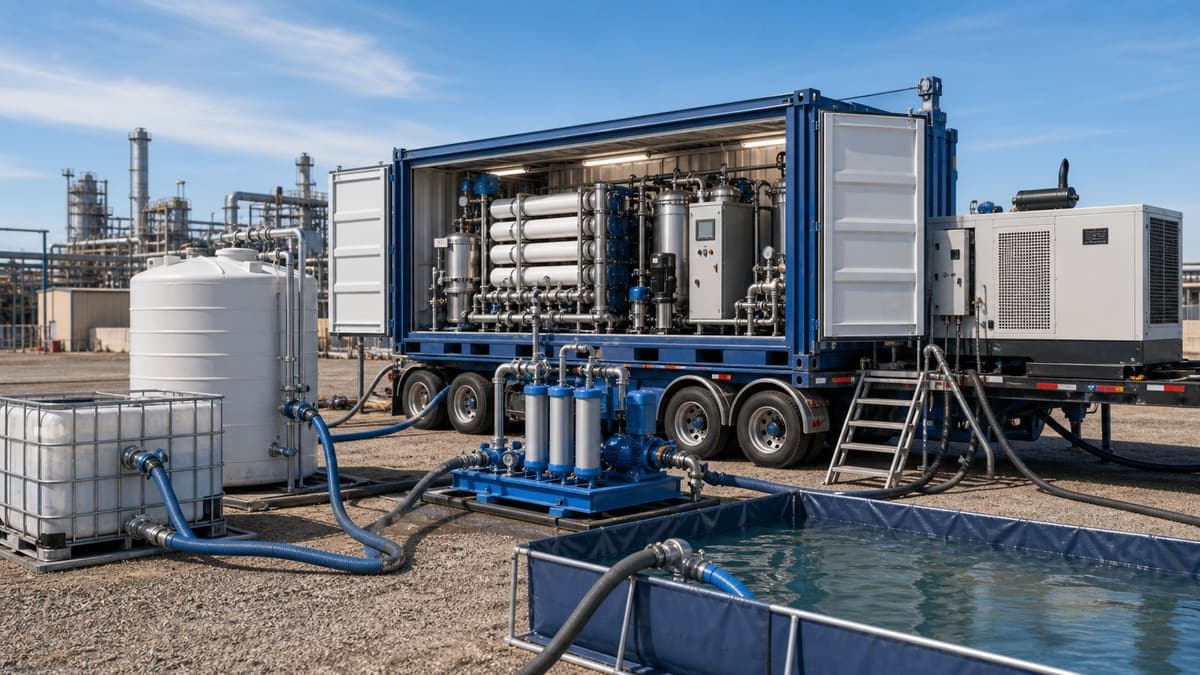
Mobile water treatment units are engineered for rapid deployment and flexibility, serving critical roles in scenarios demanding immediate or temporary water purification. This includes emergency response to natural disasters, providing potable water or process water for remote construction sites, supporting temporary mining or oil & gas exploration camps, and pilot testing for larger, permanent installations. The primary drivers are often speed of deployment, variable feed water quality, and the need for a self-contained, transportable solution that can be moved as operational needs evolve. This scenario is the appropriate entry point when fixed infrastructure is unavailable, build-out time for a permanent plant is prohibitive, or the water demand is transient.
2. Feed characteristics & key risks
Feed water to mobile units is inherently diverse and often challenging, ranging from surface waters (rivers, lakes), well water, municipal wastewater effluent, or highly impacted industrial wastewaters (e.g., mine influenced water, produced water).
Key characteristics and associated risks include:
- Variable Turbidity & Suspended Solids: Surface waters and excavation sites can introduce high and fluctuating levels of suspended matter, leading to rapid fouling of pretreatment and membrane systems. This requires robust physical separation upstream.
- Organic Loading (TOC): Natural organic matter (NOM) from surface waters or synthetic organics from industrial sources can cause membrane fouling and pose disinfection byproduct risks.
- Hardness & Scaling Ions (Ca, Mg, Ba, Sr, Silica): Groundwater sources often contain high levels of hardness and other inorganic scaling species. Concentrating these ions across membranes (particularly RO) risks severe scaling, reducing flux, and damaging membranes. LSI (Langelier Saturation Index) and other saturation indices (e.g., Stiff & Davis, Ryznar) are critical for predicting carbonate scaling, while silica solubility limits, often enhanced by pH, require careful management.
- Dissolved Solids (TDS): High TDS increases osmotic pressure, reducing effective trans-membrane pressure and increasing energy consumption. It also correlates with concentrate disposal challenges.
- Heavy Metals & Specific Contaminants: Mining or industrial sites may have specific heavy metal or radionuclide contamination requiring specialized removal steps (e.g., ion exchange, specific adsorbents).
- Temperature Fluctuations: Mobile units often operate outdoors, experiencing wide ambient temperature swings, which directly impact membrane flux and chemical efficacy.
Inadequate pretreatment or an inflexible process design for such variable feeds represents the primary operational risk for mobile water treatment.
3. Concentrate / reject routing
A critical aspect of any water treatment process, especially mobile deployments, is the management of the concentrate stream, where rejected salts and contaminants are consolidated. Water treatment does not eliminate matter; it merely separates it. For mobile units, options for concentrate disposition are often dictated by the temporary nature of the site, regulatory constraints, and logistical capabilities:
- Temporary Storage & Haul-off: For short-duration projects or small concentrate volumes, the most common method is to collect the concentrate in temporary storage tanks (e.g., frac tanks, IBCs) for periodic vacuum truck hauling to an approved industrial wastewater treatment facility or deep well injection site. This is often the default for emergency response or pilot units.
- Evaporation Ponds / Solar Evaporation: In arid climates or for longer-term temporary sites with sufficient land, concentrate can be routed to lined evaporation ponds. This reduces volume but leaves behind a solid residue that must eventually be landfilled. Pre-treatment of concentrate might be necessary to prevent biological growth or odor.
- Mechanical Vapor Compression (MVC) Evaporators / Crystallizers: For scenarios aiming for ZLD (Zero Liquid Discharge) or significantly reduced liquid discharge, and where space/energy are less constrained, modular MVC evaporators or crystallizers can be integrated. These units further concentrate the brine, producing distilled water for reuse and a solid or semi-solid waste for landfill or beneficial reuse. This is more common in larger, longer-duration mobile deployments, such as for major construction camps or specific mining operations where concentrate hauling costs are prohibitive.
- Deep Well Injection: Where permitted by regulation and geological conditions, and often requiring significant upfront permitting and well drilling, concentrate can be injected into deep, permeable geological formations. This is less common for rapid deployment mobile units but can be a long-term strategy for certain remote sites.
- Beneficial Reuse / Land Application: In some agricultural or industrial contexts, concentrate, if compliant with specific environmental regulations, might be used for dust suppression, irrigation of salt-tolerant crops, or other non-potable applications. This requires careful characterization and monitoring.
The selection of concentrate routing method is paramount and must be planned concurrently with the overall process design, considering both economic and environmental impacts.
4. Reference process train options
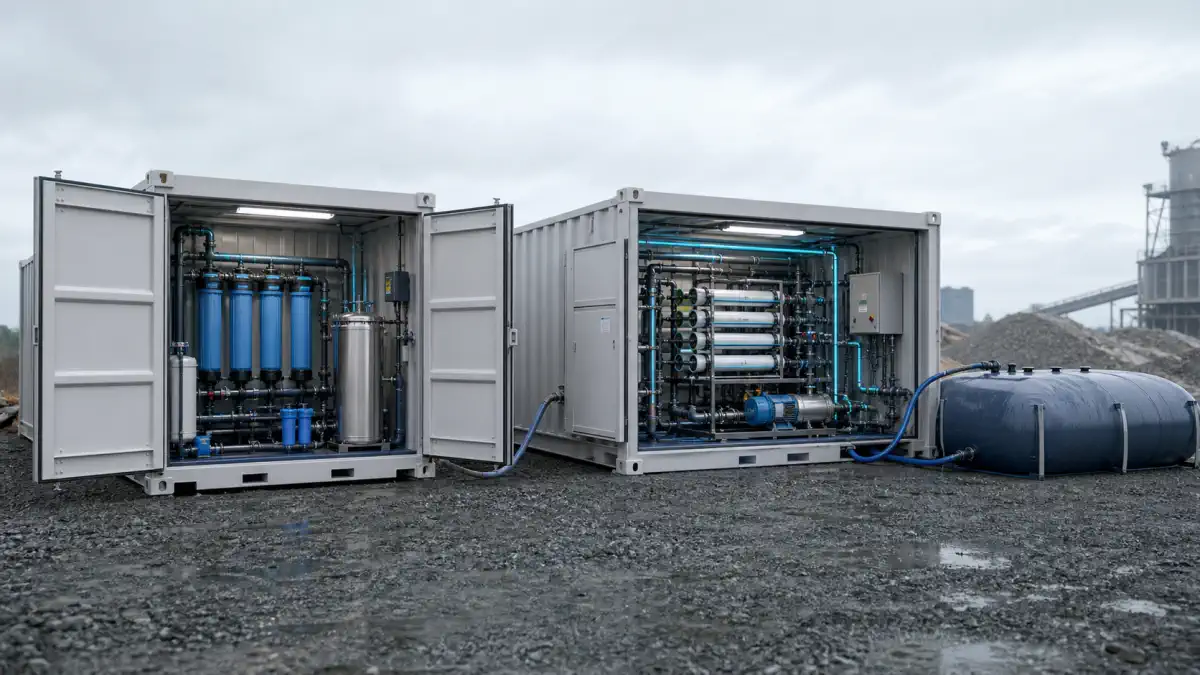
The choice of process train for mobile units emphasizes robustness, flexibility, and modularity. Due to the variable nature of feed water, multi-barrier treatment is common.
A typical pilot-scale RO or industrial RO mobile process train might include:
- Raw Water Intake: Screening to remove large debris.
- Chemical Pre-treatment:
- Coagulation/Flocculation: Dosing of coagulants (e.g., ferric chloride, alum) and polymers to destabilize colloidal particles and aid in aggregation.
- pH Adjustment: For optimal coagulation, scale control, or membrane protection (e.g., sulfuric acid for LSI reduction, caustic for silica stabilization).
- Oxidation/Disinfection: Chlorine or other oxidants for disinfection, organic degradation, and iron/manganese precipitation.
- Primary Separation:
- Clarifier / Dissolved Air Flotation (DAF): For high-turbidity waters, to remove flocs and suspended solids. Often skipped in smaller mobile units for simplicity.
- Media Filtration (Multi-Media Filters, Activated Carbon Filters): Sand, anthracite, and granular activated carbon (GAC) beds for suspended solids removal, turbidity reduction, and TOC/chlorine removal.
- Secondary Separation (Advanced Pre-treatment):
- Ultrafiltration (UF) / Microfiltration (MF): Crucial for reliable and consistent SDI reduction to protect downstream RO membranes. UF/MF membranes produce an effluent with very low turbidity and SDI, regardless of fluctuations in raw water quality, making them ideal for mobile applications.
- Membrane Desalination / Purification:
- Reverse Osmosis (RO): The core of most mobile units for high-purity water production, removing dissolved solids (salts), heavy metals, organics, and pathogens. Single-stage or two-stage RO for higher recovery or improved permeate quality.
- Nanofiltration (NF): Used when partial softening or lower TDS removal is acceptable, often with lower operating pressures than RO.
- Post-Treatment:
- Degasification: For CO₂ removal to reduce permeate conductivity or manage pH.
- pH Adjustment: For corrosion control in distribution.
- Disinfection: UV, chlorination, or chloramination for microbial control in the product water.
- EDI (Electrodeionization): For higher purity product water requirements, such as boiler feedwater, EDI offers continuous deionization without external chemical regeneration by combining ion exchange resins, ion-selective membranes, and an electric field.
This modular approach ensures that specific challenges of a site's water can be addressed by selecting and integrating the appropriate components within the mobile framework.
5. Operating parameters
Precise control and monitoring of key operating parameters are fundamental to the efficient and reliable operation of mobile water treatment units.
- SDI₁₅ (Silt Density Index): This parameter is a critical measure of the fouling potential of water, particularly for RO membranes. For robust and extended membrane life, a target SDI₁₅ of less than 5, and ideally less than 3, is maintained in the feed to the RO system. Regular SDI testing is non-negotiable for confirming the effectiveness of pretreatment.
- LSI (Langelier Saturation Index) / Scaling Posture: Scaling indices are continuously monitored or calculated based on water chemistry to prevent precipitation of inorganic salts on membrane surfaces. For calcium carbonate, an LSI value near zero or slightly negative at the concentrate side is typically targeted. Antiscalant dosing is precisely controlled to maintain scaling ions in solution, often targeting a projected LSI of up to +2.5 to +2.8 in the concentrate without precipitation, depending on the antiscalant chemistry and dosage. Silica saturation limits (often around 100-150 mg/L at pH 7, but higher at elevated pH) also dictate recovery rates and potential for scaling.
- Flux (LMH): The design flux for RO membranes in mobile units is often conservative to account for feed water variability and minimize fouling potential. Typical design fluxes range from 10 to 18 L/(m²·h) (LMH) for brackish water RO and 7 to 12 LMH for high-TDS or challenging industrial applications. Operating at lower fluxes extends membrane life and reduces cleaning frequency, a key advantage in remote or temporary settings.
- Differential Pressure (DP): Monitoring the pressure drop across individual membrane stages (ΔP) and across pretreatment filters is crucial. An increasing ΔP across a filter bank indicates particulate loading and the need for backwashing. A rising ΔP across an RO stage signals membrane fouling, often necessitating a Clean-In-Place (CIP) cycle. Alarms are typically set for a 10-15% increase over baseline ΔP to prompt operator intervention.
6. Digital twin & instrumentation
For efficient operation and predictive maintenance of mobile water treatment units, a robust instrumentation and digital twin strategy is vital. While often compact, these units benefit immensely from real-time data.
Instrumentation & Sensors:
- Flow Meters: Electromagnetic or ultrasonic flow meters on raw water intake, pretreatment effluent, permeate, and concentrate lines to track mass balance and recovery.
- Pressure Transducers: At various points, including raw water pump discharge, across pretreatment filters (ΔP), pre-membrane, inter-stage on RO, and permeate lines.
- Conductivity Sensors: On raw water, UF/MF filtrate, RO feed, RO permeate (for salt rejection monitoring), and concentrate.
- Temperature Sensors: On raw water and RO feed to correct for flux and solubility calculations.
- pH & ORP Sensors: For chemical dosing control (e.g., acid/caustic, oxidant) and corrosion monitoring.
- Turbidity Meters: Critical on raw water and UF/MF filtrate to confirm pretreatment effectiveness and SDI compliance.
- Level Transmitters: In chemical storage tanks and concentrate holding tanks.
These sensors stream real-time data (flows, pressures, conductivities, temperatures, pH, ORP, turbidity) to a backend system. Here, a digital twin of the mobile unit reconciles mass balance across each stage, allowing operators to immediately detect inconsistencies or leaks. The model continuously forecasts fouling and scaling risks by analyzing LSI and silica saturation indices, predicting when chemical cleaning (CIP) or antiscalant adjustments will be necessary. It also supports operator decisions by simulating the impact of changes in raw water quality or operational setpoints on permeate quality and system recovery, minimizing trial-and-error in dynamic environments. This proactive approach ensures operational stability and reduces unscheduled downtime.
8. Common engineering mistakes & pilot KPIs
Common Engineering Mistakes:
- Underestimating Feed Water Variability: Failing to design for the full range of potential raw water quality parameters, leading to inadequate pretreatment and membrane fouling.
- Neglecting Concentrate Management: Focusing solely on permeate production without a viable, permitted, and cost-effective plan for concentrate disposition, leading to operational bottlenecks or environmental non-compliance.
- Inadequate Pretreatment: Skipping or undersizing crucial pretreatment steps (e.g., UF/MF) in an attempt to reduce CAPEX, which inevitably leads to higher OPEX (frequent membrane cleaning, premature membrane replacement) and reduced reliability.
- Overly Optimistic Flux Rates: Designing RO systems at high flux to minimize membrane area, which accelerates fouling, scaling, and shortens membrane lifespan, especially with challenging feeds.
- Insufficient Spares & Consumables: Failure to stock adequate spare parts, membranes, and chemicals (e.g., antiscalant, cleaning chemicals) for remote or emergency operations, leading to prolonged downtime.
- Lack of Redundancy: Designing single-train systems for critical applications, leaving no backup in case of equipment failure or maintenance.
Key Performance Indicators (KPIs) for Pilot Projects:
- Reliability / Uptime: Percentage of time the unit is operational and producing treated water according to specifications.
- Permeate Quality Consistency: Meeting target conductivity, turbidity, and specific contaminant levels consistently over varying feed conditions.
- System Recovery: Actual vs. design water recovery percentage, demonstrating efficient water use.
- Membrane Fouling Rate: Monitored via ΔP increase, flux decline at constant pressure, or increased normalized differential pressure (NDP).
- Cleaning Frequency & Efficacy: How often cleaning is required and how effectively it restores membrane performance.
- Chemical Consumption: Tracking specific chemical dosages (antiscalant, coagulant, cleaning chemicals) per volume of water treated.
- Energy Consumption: kWh per m³ of treated water, for overall operational cost assessment.
- Concentrate Characteristics: Confirming composition and volume for final disposition planning.
9. FAQ
Q1: How quickly can a mobile unit be deployed and operational? A1: pilot-scale RO units can typically be deployed and operational within 24-72 hours of arrival on site, assuming pre-prepared foundations, power, and raw water/product water connections are available. More complex industrial RO units or those requiring extensive site preparation may take 1-2 weeks.
Q2: What are the typical power requirements for a mobile treatment unit? A2: Power requirements vary significantly with capacity and technology. A smaller pilot-scale RO (e.g., 100 m³/day RO) might require 25-50 kW. Larger industrial RO units (e.g., 1000 m³/day RO) could range from 200-500 kW, potentially requiring generator sets or robust grid connections, often with integrated variable frequency drives (VFDs) for energy optimization.
Q3: Can these units operate in extreme cold or hot weather? A3: Yes, modular RO mobile units are designed with climate considerations. For cold weather, units can be insulated, heated, and equipped with heat tracing for piping. For hot climates, units are typically housed in insulated containers with ventilation or air conditioning to protect equipment and optimize membrane performance. Freeze protection is standard for operations below 0°C.
Related equipment & product lines
These categories typically support the approach above—open any line to compare brands and models.
- Pilot Units TestingPilot rigs and trial modules for process validation and feasibility studies.View category →
- RO MembranesReverse osmosis membrane elements for municipal and industrial desalination.View category →
- Pumps & PumpingHigh-pressure and process pump solutions for water treatment skids and plants.View category →
For a closer review, use the engineering inquiry form to share feed, capacity, target, and project stage. Submission does not constitute a completed design or performance commitment.