Solutions · Application Scenarios
Nanofiltration (NF) fractionation: monovalent/divalent separation
NF staging with defined retention targets and a plan for retentate (concentrate) reuse or treatment. Controlled divalent removal with measurable mass flows…
Use this guide within its scope
This page supports technical research and option comparison and is marked 2026. Illustrative values are not a quotation, completed process design, certification conclusion, or performance guarantee. Check current regulations, feed data, tests, and OEM records.
Problem
You need ionic splitting, not full demineralization—NF sits between UF and RO.
Technology
NF staging with defined retention targets and a plan for retentate (concentrate) reuse or treatment.
Results
Controlled divalent removal with measurable mass flows on both permeate and retentate.
Engineering decision card
Use when
You need ionic splitting, not full demineralization—NF sits between UF and RO.
Evaluate first
NF staging with defined retention targets and a plan for retentate (concentrate) reuse or treatment.
Inputs still required
Feed source and variability, capacity, target quality, operating hours, discharge or reuse boundary, available space, and utilities.
Comparison output
Controlled divalent removal with measurable mass flows on both permeate and retentate. The final decision still needs feed data, mass balance, and any necessary testing.
1. Process context & when this scenario is the right entry point
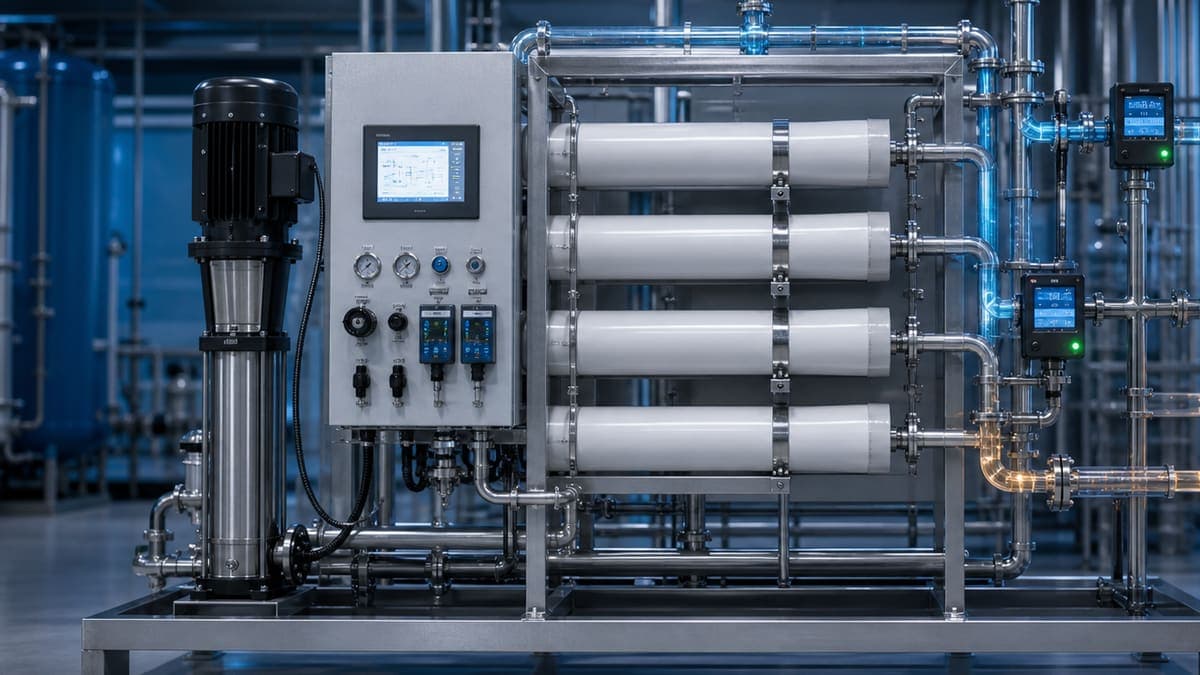
Nanofiltration (NF) stands as a selective membrane separation process, often referred to as a "loosened" reverse osmosis (RO) membrane. Its distinguishing characteristic is the ability to selectively reject multivalent ions (e.g., Ca²⁺, Mg²⁺, SO₄²⁻) significantly more than monovalent ions (e.g., Na⁺, Cl⁻) or small uncharged molecules. This preferential permeation mechanism makes NF a valuable tool for specific separation tasks where full demineralization is either unnecessary or undesirable.
This scenario is the right entry point when the process objective is:
- Selective softening: Removing hardness-causing ions from water without removing a substantial portion of monovalent salts, thus maintaining a degree of osmotic balance or alkalinity. This is particularly relevant for boiler feed water, industrial cooling water, or potable water applications where partial softening is sufficient.
- Color and natural organic matter (NOM) removal: NF membranes typically have a molecular weight cut-off (MWCO) in the range of 150-500 Daltons, effectively rejecting larger organic molecules responsible for color and fouling, while passing smaller inorganic salts.
- Targeted heavy metal removal: Certain heavy metal ions, often present in divalent or multivalent forms, can be effectively rejected.
- Specific industrial stream fractionation: Separating valuable multivalent components from monovalent ones in process waters, chemical production, or pharmaceutical manufacturing.
- Pre-treatment for RO: Reducing hardness and organic load on a subsequent RO stage, thereby reducing RO fouling and scaling potential, extending membrane life, and reducing chemical consumption.
NF operates at lower pressures than RO, leading to reduced energy consumption and potentially lower capital expenditure for certain applications, positioning it as an efficient alternative when its selective rejection profile aligns with process requirements.
2. Feed characteristics & key risks
The performance and longevity of an NF system are highly dependent on the characteristics of the feed water. Typical feed sources include surface water, groundwater, and pre-treated industrial process streams. Key feed parameters to assess include:
- Total Dissolved Solids (TDS): While NF can handle a broad range, typical applications are for feeds with TDS between 500 mg/L and 5,000 mg/L. For very high TDS, RO or thermal processes may be more appropriate for the retentate.
- Hardness (Ca²⁺, Mg²⁺): High hardness is a primary target for NF softening applications.
- Sulfate (SO₄²⁻): NF membranes typically show high rejection of sulfate, making it a key consideration for potential gypsum (CaSO₄) scaling.
- Organic Content (TOC, COD, Color): Significant levels can lead to organic fouling, particularly humic and fulvic acids.
- Suspended Solids & Colloids: High levels directly lead to physical fouling.
- Silica: While less rejected than RO, silica can still concentrate and cause scaling, especially when pH is elevated.
- Iron & Manganese: These can cause severe fouling and oxidation of membranes if not removed upstream.
Key Risks:
- Scaling: The concentration of multivalent ions in the retentate significantly increases the risk of inorganic scaling. Critical species include CaCO₃ (LSI), CaSO₄, BaSO₄, and SrSO₄. Silica scaling can also occur, particularly at higher recoveries and pH.
- Fouling:
- Organic fouling: Caused by natural organic matter, humic substances, and other large organic molecules.
- Colloidal fouling: Caused by suspended solids and fine particles.
- Biological fouling: Growth of microorganisms on the membrane surface, leading to flux decline and increased differential pressure.
- Oxidative Damage: Residual oxidants (e.g., chlorine, ozone) can irreversibly damage polyamide membranes.
- Osmotic Pressure: While generally lower than RO, the osmotic pressure across the membrane increases with increasing salt concentration in the retentate, requiring higher operating pressures to maintain flux. This is more pronounced in high-recovery systems.
3. Concentrate / reject routing
A fundamental principle of water treatment is mass balance; matter does not disappear. The concentrate (reject or retentate) stream from NF systems is enriched in the selectively rejected species and must be managed responsibly. The routing strategy depends heavily on the feed water characteristics, local regulations, and potential for valorization.
Common concentrate routing options include:
- Further Membrane Treatment: The NF concentrate, enriched in multivalent ions and some monovalents, can be sent to a subsequent high-pressure RO system to achieve higher overall water recovery and further concentrate the remaining impurities. This is common in complex industrial wastewater treatment or ZLD (Zero Liquid Discharge) pre-treatment.
- Thermal Treatment (Evaporation/Crystallization): For applications requiring ZLD or recovery of specific solid salts, the NF concentrate can be fed to evaporators or crystallizers. This allows for the recovery of ultrapure water vapor and the precipitation of solid waste or valuable byproducts.
- Resource Recovery/Valorization: In some industrial processes (e.g., chemical, pharmaceutical), the concentrated multivalent salts or organic compounds in the retentate may have value as a feedstock or by-product. Careful economic and chemical analysis is required here.
- Permitted Discharge: If the concentrated stream meets local discharge limits for specific contaminants (e.g., to a municipal sewer or permitted industrial discharge point), it can be discharged. However, the increased concentration of specific ions (e.g., sulfates, hardness) must be carefully considered against permit limits.
- Deep Well Injection: For certain highly concentrated, non-hazardous brines, deep well injection can be an option, subject to stringent geological and regulatory requirements.
- Evaporation Ponds: In arid regions with sufficient land availability, concentrate can be routed to evaporation ponds, leaving behind solid residues. This is typically a lower-cost, lower-tech option but has significant environmental footprints and regulatory implications.
The disposition of the NF concentrate is a critical design consideration and must be evaluated early in the project lifecycle to ensure environmental compliance and economic viability.
4. Reference process train options
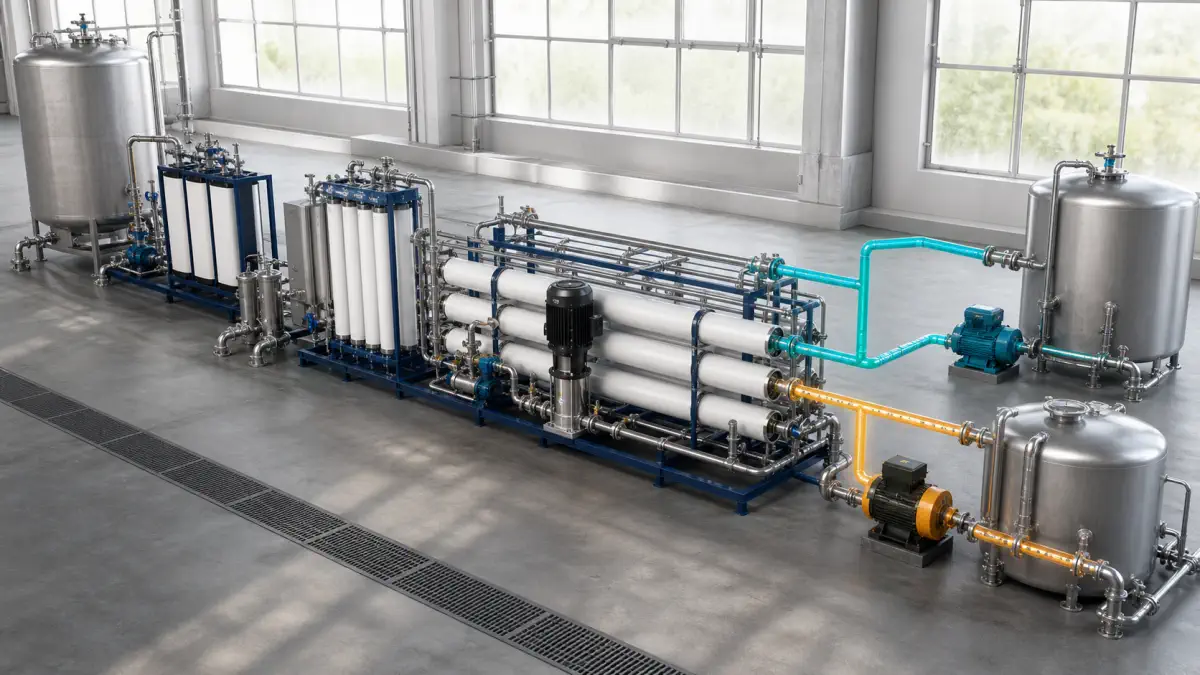
Effective NF fractionation requires a robust process train, typically involving comprehensive pretreatment followed by the NF unit itself, and sometimes post-treatment.
5. Operating parameters
Precise control and monitoring of operating parameters are paramount for stable NF operation, maximizing membrane life, and achieving desired permeate quality.
- SDI₁₅ (Silt Density Index): A critical measure of feed water particulate and colloidal fouling potential. For continuous, reliable NF operation, the SDI₁₅ should consistently be maintained below 5, and ideally below 3. Higher values lead to rapid flux decline and increased cleaning frequency.
- LSI (Langelier Saturation Index) / Scaling Posture: NF concentrate streams often have high concentrations of sparingly soluble salts. The LSI for CaCO₃ should be carefully managed, typically by pH adjustment and antiscalant dosing, aiming for LSI values below +2.0 in the concentrate. Beyond LSI, the saturation indices for other key scaling species like CaSO₄, BaSO₄, SrSO₄, and silica must be continuously monitored and controlled via antiscalant selection and dosage. NF can often tolerate slightly higher LSI values than RO due to its selective rejection characteristics, but vigilance remains critical.
- Flux (LMH): The design flux, expressed in L/(m²·h), is a crucial parameter balancing capital cost, operating pressure, and fouling rate. Typical design fluxes for NF in water treatment range from 15 to 35 LMH, depending on feed water quality, temperature, and specific membrane type. Higher fluxes lead to higher permeate production but also increase the risk of fouling and require more frequent cleaning.
- Differential Pressure (DP or ΔP): The pressure drop across each membrane vessel (element ΔP) and across the entire stage (stage ΔP) is a direct indicator of fouling or scaling. A gradual increase in ΔP over baseline operation suggests membrane surface fouling. A rapid increase can indicate severe scaling or gross fouling. A typical alarm threshold for individual element or stage ΔP is a 15% increase over the normalized clean baseline, or exceeding an absolute design limit (e.g., 50-70 psi / 3.5-4.8 bar per vessel). Sustained high ΔP can lead to membrane telescoping or damage.
- Recovery: The ratio of permeate flow to feed flow. NF systems typically operate at recoveries between 70% and 90% for water softening, depending on feed water chemistry and concentrate disposal limits. Higher recovery implies greater concentration of rejected species and thus a higher risk of scaling.
- Temperature: Membrane performance (flux, rejection) is sensitive to temperature. Systems are typically designed for specific temperature ranges, and variations require normalization for accurate performance assessment.
7. Pilot-Scale vs Industrial RO
The choice between this approach's pilot-scale RO and industrial RO product lines depends directly on the scale and complexity of the NF fractionation requirement.
The pilot-scale RO is ideally suited for pilot and demonstration projects, smaller-scale industrial processes demanding flow rates typically below 10 m³/h (approx. 45 GPM), or temporary softening needs. Its compact footprint, ease of deployment (including mobile configurations), and modular design make it perfect for validating process parameters, evaluating specific membrane performance with challenging feed waters, or addressing localized, low-volume fractionation tasks. For example, a pilot-scale RO would be selected for initial studies to determine optimal NF membrane type, flux, recovery, and antiscalant efficacy for a novel industrial wastewater stream, or for providing partial softening for a small cooling tower.
Conversely, the industrial RO is engineered for large-scale production environments, requiring robust, continuous operation at flow rates ranging from tens to thousands of m³/h. These systems feature multi-stage designs, advanced control integration with existing plant SCADA, and are built for high reliability and maximum uptime. industrial RO is the choice for primary softening in large power plants or municipal water treatment, for high-recovery industrial process stream fractionation integrated into ZLD trains, or for applications where the concentrate stream requires complex valorization or further processing. It offers sophisticated instrumentation, full digital twin integration for real-time optimization, and comprehensive safety interlocks suitable for critical infrastructure.
9. FAQ
Q1: How does Nanofiltration (NF) differ fundamentally from Reverse Osmosis (RO)? A1: The primary difference lies in their rejection capabilities. RO membranes typically reject nearly all dissolved solids (98-99% salt rejection), requiring higher operating pressures. NF membranes are "looser"; they reject multivalent ions (like Ca²⁺, Mg²⁺, SO₄²⁻) significantly more effectively than monovalent ions (Na⁺, Cl⁻) and have a lower salt rejection (often 50-90%). This selective rejection allows NF to operate at lower pressures, consume less energy, and maintain some monovalent salt content in the permeate, which is beneficial for applications like water softening without full demineralization.
Q2: Can NF systems achieve Zero Liquid Discharge (ZLD)? A2: NF systems themselves do not directly achieve ZLD. They produce a concentrated brine stream. However, NF can be a crucial pre-concentration step within a ZLD scheme. The NF concentrate, enriched in specific rejected species, can then be fed to further concentration technologies such as Reverse Osmosis, thermal evaporators, or crystallizers to ultimately achieve ZLD. NF often reduces the volume of water requiring more energy-intensive thermal treatment.
Q3: What are the primary benefits of using NF for water softening compared to ion exchange? A3: NF offers several advantages over traditional ion exchange (IX) for softening. NF continuously removes hardness without requiring chemical regeneration (brine discharge from IX), which significantly reduces chemical consumption and waste generation. NF also simultaneously removes other contaminants like color, turbidity, and certain organic matter, which IX cannot. While IX can achieve very low hardness, NF provides a constant permeate quality and a more environmentally friendly softening process by avoiding the disposal of high-salinity regeneration waste.
Q4: How critical is antiscalant dosing for NF, given its lower rejection compared to RO? A4: Antiscalant dosing is still very critical for NF, particularly when operating at higher recoveries or with feed waters containing high concentrations of sparingly soluble salts like calcium sulfate (gypsum), barium sulfate, strontium sulfate, or silica. Although NF lets some monovalent ions pass, the targeted rejection of multivalent ions like Ca²⁺ and SO₄²⁻ leads to their significant concentration in the retentate, quickly pushing saturation indices into scaling regimes if not managed. Correct antiscalant selection and dosage are essential to prevent membrane scaling and maintain stable operation.
Related equipment & product lines
These categories typically support the approach above—open any line to compare brands and models.
- RO MembranesReverse osmosis membrane elements for municipal and industrial desalination.View category →
- Ion Exchange ResinsCation/anion and mixed bed resin solutions for demineralization and polishing.View category →
- Pilot Units TestingPilot rigs and trial modules for process validation and feasibility studies.View category →
For a closer review, use the engineering inquiry form to share feed, capacity, target, and project stage. Submission does not constitute a completed design or performance commitment.