Solutions · Application Scenarios
Scaling and corrosion inhibition: hard/alkaline feeds without surprise outages
Indexed chemistry programs tied to real analyses and bleed management. Predictable heat transfer and membrane life—no “silent” saturation drift.
Use this guide within its scope
This page supports technical research and option comparison and is marked 2026. Illustrative values are not a quotation, completed process design, certification conclusion, or performance guarantee. Check current regulations, feed data, tests, and OEM records.
Problem
High hardness and alkalinity create both scale and corrosion couples.
Technology
Indexed chemistry programs tied to real analyses and bleed management.
Results
Predictable heat transfer and membrane life—no “silent” saturation drift.
Engineering decision card
Use when
High hardness and alkalinity create both scale and corrosion couples.
Evaluate first
Indexed chemistry programs tied to real analyses and bleed management.
Inputs still required
Feed source and variability, capacity, target quality, operating hours, discharge or reuse boundary, available space, and utilities.
Comparison output
Predictable heat transfer and membrane life—no “silent” saturation drift. The final decision still needs feed data, mass balance, and any necessary testing.
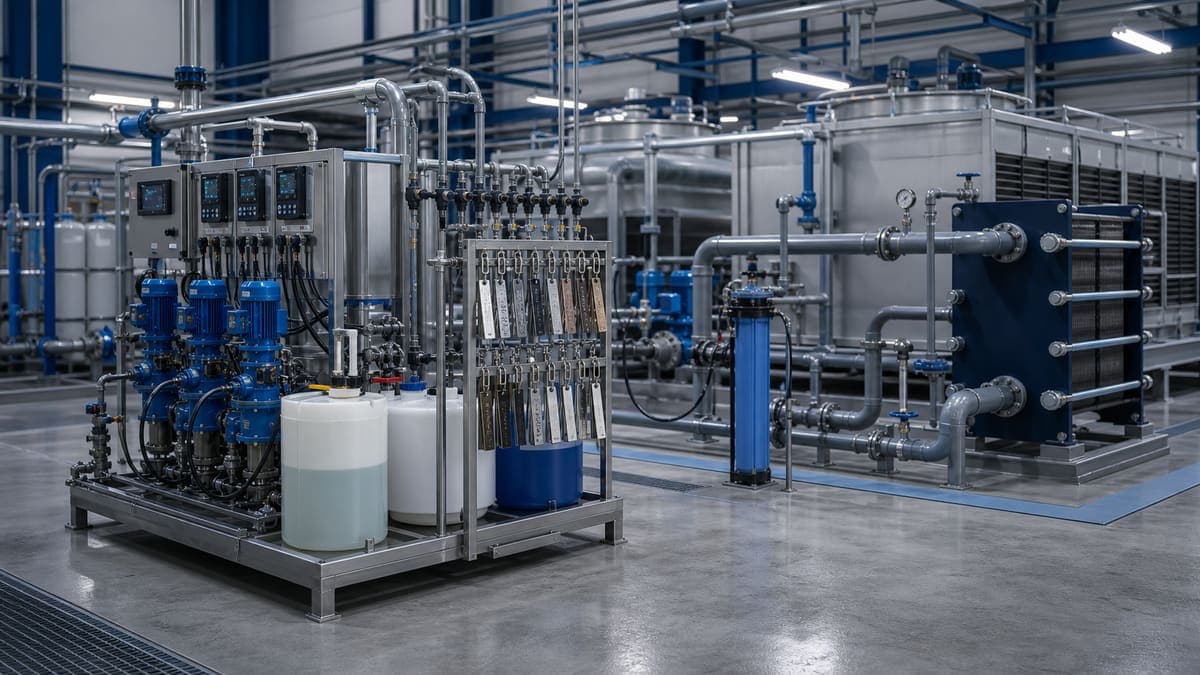
1. Process context & when this scenario is the right entry point
Industrial operations frequently encounter water sources characterized by high hardness, alkalinity, and elevated pH, often coupled with varying levels of Total Dissolved Solids (TDS). These challenging feedwaters pose significant risks to critical water treatment assets, particularly membrane systems like Reverse Osmosis (RO) and Nanofiltration (NF). Scaling, a primary concern, results from the precipitation of sparingly soluble salts (e.g., calcium carbonate, calcium sulfate, silica) on membrane surfaces, leading to flux decline, increased differential pressure across membrane stages (ΔP), and ultimately, reduced recovery and system downtime for cleaning or membrane replacement. Simultaneously, improper water chemistry can exacerbate corrosion in metallic piping, pumps, and other equipment within the pretreatment and post-treatment stages. This scenario addresses process design and operational strategies required to manage these feeds effectively, ensuring stable operation and extended asset life, making it a critical entry point for projects dealing with difficult water sources or those experiencing premature membrane fouling/scaling.
2. Feed characteristics & key risks
Hard and alkaline feedwaters are defined by high concentrations of divalent cations (Ca²⁺, Mg²⁺) and bicarbonates/carbonates. Other critical constituents include sulfates, silica, and iron. Key risks associated with such feeds are:
- Scaling: The primary risk. Calcium carbonate (CaCO₃) is highly pH-dependent; its solubility decreases as pH increases. Calcium sulfate (CaSO₄) and barium/strontium sulfates (BaSO₄/SrSO₄) have inverse solubility characteristics with temperature or concentration. Silica (SiO₂) scaling, often occurring as amorphous silica, becomes problematic at higher concentrations and pH, especially in the RO concentrate stream. Phosphate and fluoride scales can also be present. The Langelier Saturation Index (LSI) and Ryznar Stability Index (RSI) are critical tools for predicting calcium carbonate scaling potential, while other indices or direct solubility calculations are used for other scales.
- Corrosion: High alkalinity and dissolved oxygen can lead to uniform or localized corrosion of carbon steel components, while specific ions like chlorides can initiate pitting or stress corrosion cracking in stainless steel. Poorly managed acid dosing for pH adjustment can also contribute to corrosion.
- Fouling: While distinct from scaling, scaling often exacerbates fouling by providing nucleation sites or reducing membrane performance. Organic fouling, colloidal fouling (measured by SDI₁₅), and biological fouling often co-occur with scaling issues.
- Osmotic Limits: High TDS in the feed leads to higher osmotic pressure, requiring higher operating pressures for RO, increasing energy consumption, and limiting achievable recovery.
- Regulatory Drivers: Discharge limits for concentrate streams can dictate the extent of recovery and the required treatment of the reject, particularly for hardness, TDS, or specific ions.
3. Concentrate / reject routing
A robust water treatment design must explicitly define the disposition of the concentrate stream, adhering to strict mass balance principles. For hard/alkaline feeds, the concentrate will contain an elevated concentration of all dissolved solids, including the scaling ions, antiscalants, and any unreacted acids or bases used for pH adjustment. Typical routing options include:
- Reuse as Cooling Tower Make-up: If the cooling tower can tolerate the elevated TDS and specific ions (e.g., silica, chloride) and the concentrate's LSI is manageable within the cooling tower cycle chemistry, it can be a viable reuse option, effectively reducing freshwater demand. However, this often requires careful blowdown management in the cooling tower itself.
- Re-blending: Mixing the RO concentrate with raw feed or another process stream, provided the blended stream's quality is acceptable for its intended use and does not create new scaling or corrosion risks in the downstream process.
- Further Concentration (ZLD/MLD): For sites aiming for Zero Liquid Discharge (ZLD) or Minimum Liquid Discharge (MLD), the concentrate is fed to a brine concentrator, evaporator, or crystallizer to recover more water and produce a solid waste. This is common when discharge options are severely limited or water scarcity is extreme.
- Deep Well Injection: Where permitted by regulation and geological conditions, the concentrate can be injected into deep, non-potable aquifers. This option requires significant geological assessment and regulatory approvals.
- Off-site Disposal / Haul-off: In cases of low flow rates or when on-site treatment is uneconomical, the concentrate is transported off-site for disposal, which can be costly and logistically challenging.
The chosen disposition directly influences the RO/NF system's recovery rate. A higher recovery means a more concentrated reject stream, intensifying the scaling potential and demanding more aggressive antiscalant dosage or pretreatment. Conversely, a lower recovery yields a less concentrated reject, but with higher reject volume to manage.
4. Reference process train options
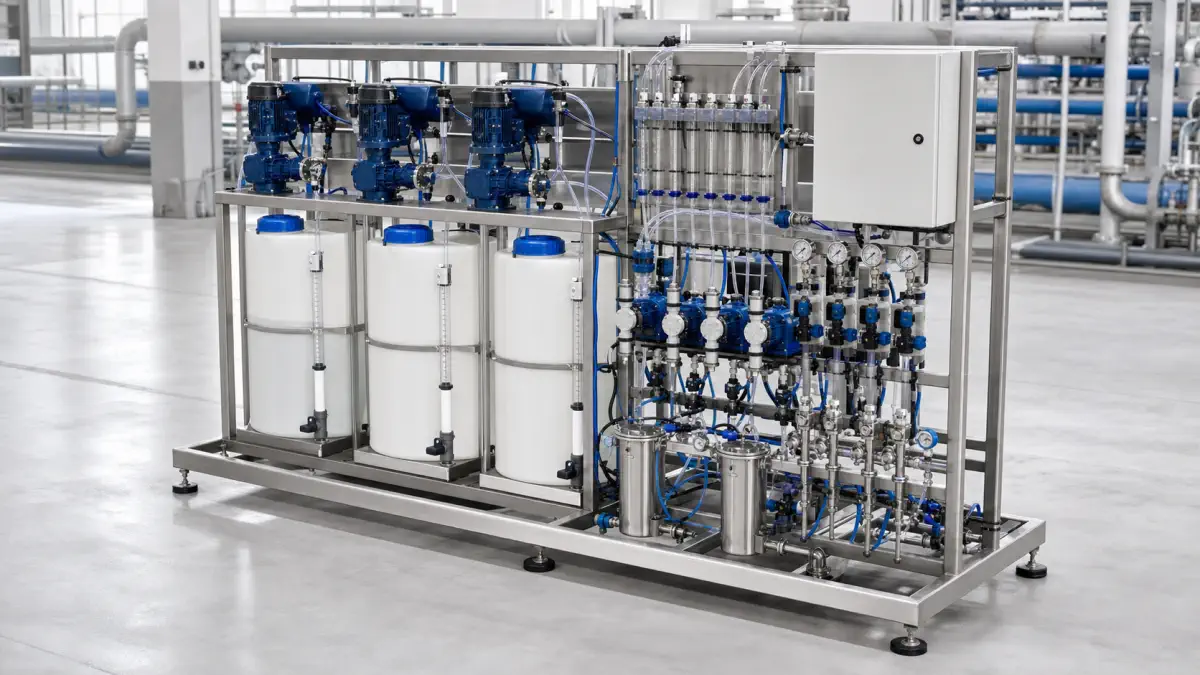
Effective management of scaling and corrosion involves a multi-barrier approach:
- Pretreatment:
- Clarification & Media Filtration: Removes suspended solids and some larger colloids.
- Softening: Often critical for very hard feeds. Lime-soda ash softening or ion exchange (IX) softening (sodium cycle) can significantly reduce calcium and magnesium hardness, thereby lowering the LSI and reducing membrane scaling risk. For IX, regenerate waste stream management is critical.
- Acid Dosing: Lowering the feed pH (e.g., using sulfuric acid) converts bicarbonate to carbonic acid, reducing calcium carbonate scaling potential and LSI. However, this increases CO₂ in the permeate (requiring degasification for boiler feed) and may increase the risk of CaSO₄ scaling if sulfate levels are high. Careful metallurgy selection for acid-resistant materials is essential.
- Antiscalant Injection: Dosing proprietary antiscalants upstream of the membrane inhibits crystal growth, disperses scaling precipitates, and often alters crystal morphology, significantly extending membrane cleaning cycles. Antiscalant selection is feed-specific and requires careful evaluation based on concentrate chemistry predictions.
- Ultrafiltration (UF) / Microfiltration (MF): Provides superior removal of suspended solids, colloids, and some organic matter compared to granular media filters, ensuring low SDI₁₅ feed to the RO/NF membranes.
- Membrane System:
- Nanofiltration (NF): Can be used as a pre-RO stage (softening NF) to remove divalent ions (hardness) while passing monovalent ions and maintaining lower osmotic pressure for the downstream RO. NF typically operates at lower pressures than RO and has higher permeate flux for a given feed pressure.
- Reverse Osmosis (RO): The primary desalination stage. Multiple stages (e.g., 2-stage or 2-pass) are used to achieve desired permeate quality and recovery.
- Post-treatment:
- pH Adjustment: Permeate pH may need to be adjusted for downstream processes (e.g., boiler feed, cooling water make-up) to prevent corrosion or meet specific requirements.
- Degasification: For boiler feed, CO₂ stripping is often needed if acid was dosed pre-RO.
- Continuous Electrodeionization (EDI): For ultra-pure water requirements, EDI polishes RO permeate without the need for external chemical regeneration of ion exchange resins.
5. Operating parameters
Precise control and monitoring of key operating parameters are paramount for preventing scaling and corrosion:
- SDI₁₅ Targets: For robust RO/NF operation, the SDI₁₅ of the membrane feed must consistently be below 5, ideally below 3. Higher SDI values indicate colloidal fouling potential, which synergizes with scaling to rapidly degrade performance. Regular SDI testing is non-negotiable.
- LSI / Scaling Posture: The LSI in the RO concentrate stream should ideally be maintained below 2.0 for CaCO₃, though effective antiscalants can allow operation at LSI values up to 2.5-2.8, or even higher for specific formulations. However, this requires careful antiscalant selection and validation. Other scaling indices and solubility limits for sulfates (e.g., CaSO₄ saturation limits often 120-150% with antiscalant), silica (typically 100-200 ppm in concentrate for amorphous silica with antiscalant), and metal hydroxides must also be continuously monitored based on real-time concentrate chemistry.
- Design Flux (LMH): The permeate flow rate per unit membrane area (L/(m²·h) or LMH) is a critical design and operating parameter. Typical design fluxes for RO range from 12 to 25 LMH for surface waters, and 8 to 15 LMH for challenging industrial wastewaters, depending on feed water quality, temperature, and scaling/fouling potential. Higher flux increases the driving force for scaling and fouling; thus, conservative flux rates are often chosen for hard/alkaline feeds to extend membrane life and cleaning intervals.
- Stage ΔP Monitoring: The differential pressure across each membrane stage, and across the entire membrane array (ΔP), is a primary indicator of membrane fouling or scaling. A sudden or sustained increase in ΔP (e.g., 10-15% over baseline in a short period) signals increased hydraulic resistance due to deposits on the membrane surface, necessitating investigation and potentially a Clean-In-Place (CIP).
7. Pilot-Scale vs Industrial RO
For pilot studies, temporary solutions, or smaller flow rates (e.g., <200 m³/day) requiring precise scaling inhibition strategies for hard/alkaline feeds, the pilot-scale RO provides a compact, flexible platform. It allows for rigorous testing of different antiscalants, pH adjustment strategies, and recovery rates to optimize operational parameters before full-scale deployment. Its modular design facilitates rapid deployment and process validation. For industrial-scale production (e.g., >200 m³/day, often multi-MGD installations) demanding high availability, advanced automation, and seamless integration into plant-wide SCADA systems, the industrial RO is the appropriate choice. These systems incorporate robust, multi-stage designs, ZLD-class capabilities, full chemical feed and cleaning systems, and are engineered for continuous, long-term operation with integrated digital twin functionalities for predictive maintenance and real-time optimization.
8. Common engineering mistakes & pilot KPIs
Common Engineering Mistakes:
- Underestimating Feed Variability: Assuming constant feed quality, especially for surface waters or industrial effluents, leads to inadequate pretreatment or antiscalant dosing, causing rapid scaling during upset conditions.
- Poor Antiscalant Selection/Dosing: Not matching the antiscalant chemistry to the specific scaling species in the concentrate, or incorrect dosage, renders the chemical ineffective. Relying solely on vendor recommendations without independent validation is risky.
- Neglecting Concentrate Disposition: Failing to adequately plan for the concentrate stream's treatment or disposal, leading to environmental non-compliance, logistical bottlenecks, or unexpected costs.
- Inadequate Pretreatment: Bypassing critical steps like softening or UF/MF to save capital cost, leading to premature membrane fouling and higher operational costs (cleaning, replacement).
- Ignoring Metallurgy: Not specifying appropriate corrosion-resistant materials for components exposed to aggressive chemicals (e.g., concentrated acid/alkali, highly corrosive concentrate), leading to equipment failure.
- Over-optimistic Recovery: Designing for excessively high recovery without fully accounting for concentrate scaling potential, leading to chronic scaling issues.
Pilot KPIs for Hard/Alkaline Feeds:
- Stable Flux Rate: Consistent permeate flow over time under constant pressure.
- Flux Decline Rate: Rate at which permeate flux decreases, indicating fouling/scaling.
- Salt Rejection: Percentage of TDS removed, indicating membrane integrity and performance.
- Cleaning Frequency & Effectiveness: How often CIP is required and how fully flux is restored.
- Antiscalant Consumption: Optimal dosage rates to prevent scaling effectively.
- Specific Energy Consumption (SEC): kWh per m³ of permeate produced, directly impacting operating costs.
- Recovery Rate: Achievable permeate volume relative to feed volume.
- Concentrate Quality & Volume: Confirming actual concentrate chemistry matches predictions for disposal/reuse, and volume aligns with mass balance.
9. FAQ
Q1: How do LSI and RSI differ, and which is more important? A1: Both LSI (Langelier Saturation Index) and RSI (Ryznar Stability Index) predict calcium carbonate scaling potential. LSI predicts the tendency (positive=scaling, negative=corrosive, zero=balanced), while RSI predicts the severity of scaling or corrosion (lower values indicate more severe scaling, higher values more severe corrosion). For RO applications, LSI is often primarily used to determine the saturation point, but considering both provides a more comprehensive picture for managing calcium carbonate precipitation and general water stability.
Q2: Can I reduce antiscalant dosage by simply lowering the pH with acid? A2: While lowering pH reduces CaCO₃ scaling potential and thus antiscalant demand for this specific scale, it can increase the risk of other scales (e.g., CaSO₄ if sulfate is present) and significantly increase CO₂ in the permeate. Moreover, excess acid dosing can accelerate corrosion of system components and adds cost. Optimal strategy involves balancing pH adjustment with antiscalant dosage, considering all scaling species and downstream permeate requirements.
Q3: What are typical SDI₁₅ values for reliable RO operation with hard feeds? A3: For hard and challenging feeds, maintaining the SDI₁₅ consistently below 3, and ideally below 2, is crucial for preventing particulate and colloidal fouling which often synergizes with scaling. While some systems may tolerate SDI up to 5, this is a higher risk threshold that can lead to more frequent membrane cleaning.
Q4: How does temperature affect scaling and corrosion in these systems? A4: Temperature significantly impacts both scaling and corrosion. For CaCO₃, solubility decreases with increasing temperature, making scaling more likely. For CaSO₄ and SiO₂, solubility generally increases with temperature, but higher temperatures also accelerate reaction kinetics. For corrosion, higher temperatures generally increase reaction rates, accelerating metallic degradation. Therefore, understanding feed temperature fluctuations is critical for predicting scaling risk and ensuring material compatibility.
Related equipment & product lines
These categories typically support the approach above—open any line to compare brands and models.
For a closer review, use the engineering inquiry form to share feed, capacity, target, and project stage. Submission does not constitute a completed design or performance commitment.