Solutions · Application Scenarios
Seawater reverse osmosis (SWRO): coastal industrial freshwater security
SWRO with robust pretreatment, ERD where justified, and explicit brine return/discharge engineering. Stable permeate quality and documented concentrate fate…
Use this guide within its scope
This page supports technical research and option comparison and is marked 2026. Illustrative values are not a quotation, completed process design, certification conclusion, or performance guarantee. Check current regulations, feed data, tests, and OEM records.
Problem
Coastal industry needs reliable freshwater when surface sources are tight or too variable.
Technology
SWRO with robust pretreatment, ERD where justified, and explicit brine return/discharge engineering.
Results
Stable permeate quality and documented concentrate fate aligned with environmental permits.
Engineering decision card
Use when
Coastal industry needs reliable freshwater when surface sources are tight or too variable.
Evaluate first
SWRO with robust pretreatment, ERD where justified, and explicit brine return/discharge engineering.
Inputs still required
Feed source and variability, capacity, target quality, operating hours, discharge or reuse boundary, available space, and utilities.
Comparison output
Stable permeate quality and documented concentrate fate aligned with environmental permits. The final decision still needs feed data, mass balance, and any necessary testing.
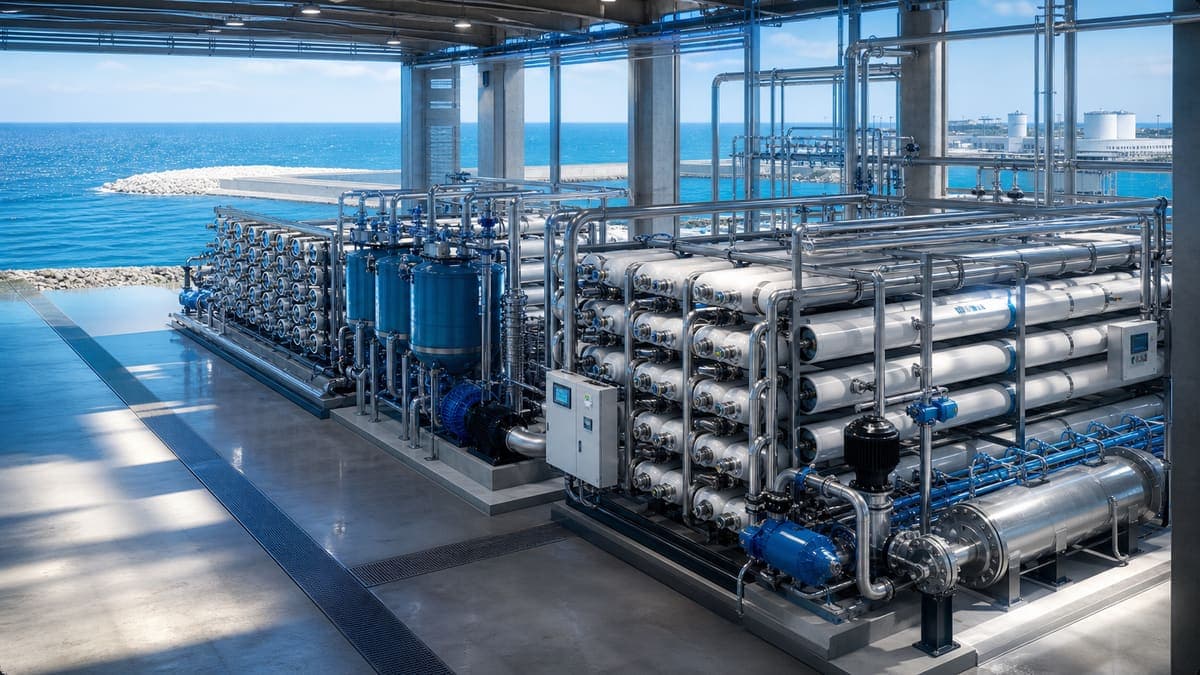
Process context & when this scenario is the right entry point
Industrial operations located in coastal regions often face escalating freshwater scarcity due to factors like climate change, population growth, and competition with agricultural and municipal demands. Seawater Reverse Osmosis (SWRO) provides a reliable, drought-proof solution by converting abundant seawater into high-quality industrial process water or even potable water. This scenario is the primary entry point when a reliable, large-volume, and high-purity water source is required in coastal or island locations where conventional freshwater sources are insufficient, cost-prohibitive, or ecologically sensitive. SWRO plants allow industries to secure their water supply independent of meteorological conditions or dwindling groundwater tables, ensuring operational continuity and enabling expansion.
Feed characteristics & key risks
Seawater is a complex feed source with several inherent challenges. Typical salinity ranges from 30,000 to 45,000 mg/L TDS (Total Dissolved Solids), dominated by NaCl, but also containing significant concentrations of calcium, magnesium, sulfate, and bicarbonate. Major risks include:
- Fouling: Characterized by suspended solids, colloidal matter, organic matter (e.g., humic substances, algae), and biological activity. These contribute to particulate and biological fouling, reducing membrane permeability and increasing operating pressure. Careful monitoring of SDI₁₅ (Silt Density Index, 15-minute test) is critical, with raw seawater often having SDI values far exceeding membrane limits, necessitating robust pretreatment.
- Scaling: Predominantly from sparingly soluble salts like calcium carbonate (CaCO₃), calcium sulfate (CaSO₄), magnesium hydroxide (Mg(OH)₂), and silica (SiO₂). The Langelier Saturation Index (LSI) and other scaling indices (e.g., Stiff & Davis, Ryznar) are used to predict CaCO₃ and CaSO₄ precipitation risk, which increases significantly with water recovery. Boron, present at 4-6 mg/L in seawater, poses a specific challenge for sensitive industrial processes or potable water, requiring specialized removal strategies.
- Osmotic Limits & Energy: High salinity results in high osmotic pressure, demanding significant hydraulic pressure (typically 55-80 bar) to achieve permeate flux. This makes energy consumption a critical factor.
- Regulatory Drivers: Discharge regulations for concentrate salinity, temperature, and residual chemicals (e.g., antiscalants, chlorine) are stringent and dictate concentrate management strategies.
Concentrate / reject routing
A critical aspect of SWRO design, adhering to the principle of mass balance, is the comprehensive management of the concentrate (also known as reject or brine). For every unit of permeate produced, a significant volume of higher-salinity water is generated.
- Energy Recovery: The high-pressure concentrate stream from the SWRO membranes typically passes through an energy recovery device (ERD), such as a pressure exchanger or Pelton turbine. This recovers a substantial portion (up to 98%) of the hydraulic energy, transferring it to the incoming feed stream, significantly reducing the overall specific energy consumption of the SWRO plant.
- Direct Discharge: The most common and economically viable route for SWRO concentrate is direct discharge back to the ocean. This requires careful consideration of environmental impact. Discharge points are designed to ensure rapid mixing and dispersion through diffusers, minimizing localized salinity increases that could harm marine ecosystems. Regulatory permits often specify discharge salinity limits, mixing zone requirements, and limits on chemical residuals from pretreatment (e.g., antiscalants, chlorine scavengers).
- Further Treatment for Near-Zero/Zero Liquid Discharge (NZLD/ZLD): In landlocked coastal areas, or where discharge regulations are exceptionally strict, or resource recovery is prioritized, the concentrate can undergo further concentration. This often involves thermal technologies like mechanical vapor compression (MVC) evaporators or multi-effect distillation (MED) to produce distilled water and a highly concentrated brine. This brine can then be sent to crystallizers to recover solid salts, achieving NZLD or ZLD. This option significantly increases capital and operating costs but eliminates liquid discharge.
- Co-mingling with Industrial Effluent: In some industrial complexes, the SWRO concentrate can be co-mingled with other treated industrial effluents, provided the combined discharge meets all regulatory parameters. This can aid in dilution, but the overall mass of salt remains.
Reference process train options
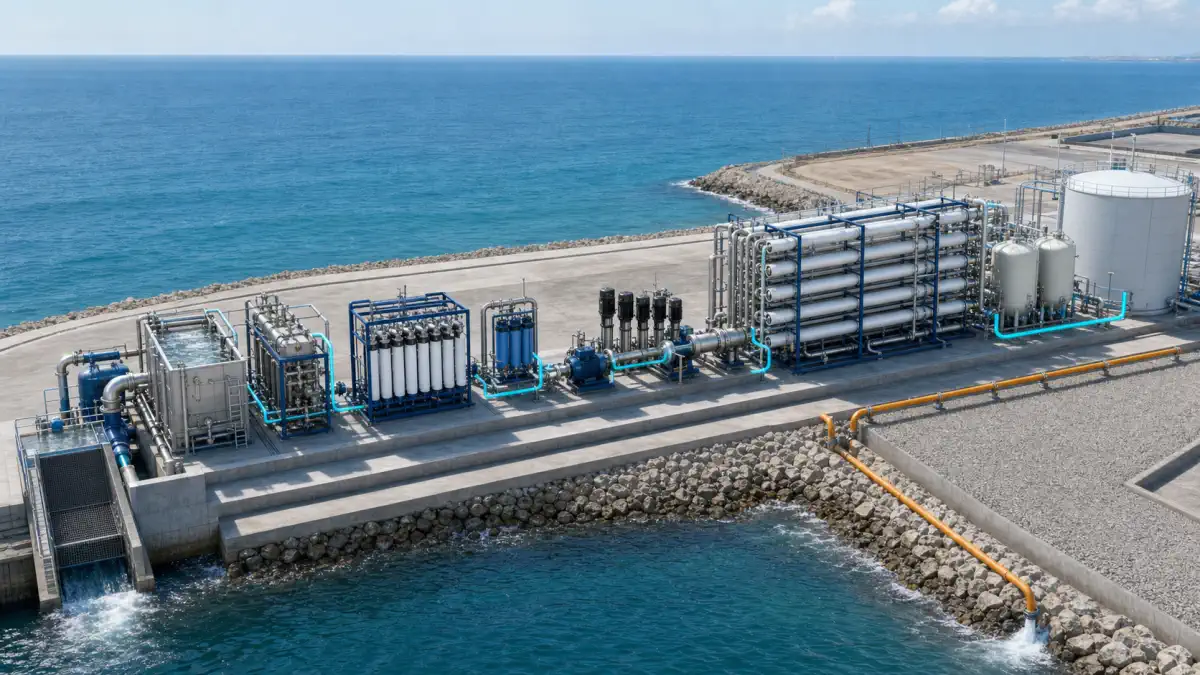
A typical SWRO process train includes:
- Intake: Open intake (with screens) or beach wells/infiltration galleries for pre-filtration. Beach wells offer better feed quality (lower SDI, organics) but have lower yield.
- Pre-treatment: Essential for protecting the RO membranes.
- Coagulation/Flocculation: Addition of chemicals to aggregate suspended solids.
- Clarification: Sedimentation or Dissolved Air Flotation (DAF) to remove larger flocs.
- Multi-Media Filtration (MMF): Granular media filters to reduce turbidity and suspended solids.
- Ultrafiltration (UF) / Microfiltration (MF): Increasingly common as primary pre-treatment due to their superior and consistent permeate quality, reliably achieving SDI₁₅ values well below 3, which is critical for membrane longevity.
- Chemical Dosing: Antiscalants to prevent scaling, acid (e.g., HCl) for pH adjustment to control CaCO₃ scaling and optimize membrane performance, and bisulfite for dechlorination.
- Cartridge Filters: Guard filters (typically 5 micron) to protect RO membranes from any remaining particulate matter.
- High-Pressure Pumping: Pumps to overcome osmotic pressure and frictional losses.
- Seawater Reverse Osmosis (SWRO) Membranes: Usually arranged in a single pass (for industrial use) or two passes (for high-purity or boron-sensitive applications). Recovery typically ranges from 40-55% for single-pass SWRO, influenced by feed salinity and scaling limits.
- Energy Recovery Devices (ERD): As discussed in concentrate routing.
- Post-treatment:
- pH Adjustment: Raising pH with caustic (NaOH) or lime to make permeate less corrosive.
- Remineralization: For potable water applications, adding minerals (e.g., calcium carbonate) for taste and stability.
- Disinfection: UV or chlorine for biological stability.
- Second Pass RO / Boron Removal: If ultra-low boron (<0.5 mg/L) or very high purity is required, a second-pass RO (often at elevated pH) or ion exchange (IX) resin specific for boron can be employed.
- EDI (Electrodeionization): For ultra-pure water (UPW) requirements, especially in electronics or pharmaceutical industries, SWRO permeate can be further polished by EDI, offering continuous deionization without the need for external chemical regeneration.
Operating parameters
Optimizing and maintaining specific operating parameters is crucial for reliable and cost-effective SWRO operation:
- SDI₁₅ Target: For robust RO operation, the SDI₁₅ of the feed to the RO membranes should consistently be < 5, and ideally < 3. Exceeding this frequently indicates inadequate pre-treatment and will lead to rapid membrane fouling.
- LSI / Scaling Posture: The saturation indices, particularly LSI, are continuously monitored. Antiscalant dosing is precisely controlled to prevent precipitation of calcium carbonate, calcium sulfate, and silica. Maintaining a negative LSI for CaCO₃ in the concentrate stream can be a target, or managing antiscalant effectiveness for supersaturated conditions. Typical recovery rates are limited by scaling potential, often around 40-55% for single pass SWRO to manage CaSO₄ and SiO₂ saturation.
- Design Flux (LMH): SWRO membranes are typically operated at conservative fluxes to minimize fouling and scaling. A common design flux range is 8-15 L/(m²·h) (LMH), depending on feed water quality, temperature, and specific membrane type. Higher fluxes increase production but escalate fouling rates and cleaning frequency.
- Differential Pressure (ΔP): The differential pressure (DP) across each RO stage, or across individual pressure vessels, is a critical indicator of membrane health. A gradual increase in ΔP signifies fouling or scaling within the elements. A rapid, sharp increase could indicate a physical issue. Trigger points for membrane cleaning are often defined by a 10-15% increase in normalized ΔP or a corresponding drop in normalized permeate flow.
Digital twin & instrumentation
The reliable operation of an SWRO plant is greatly enhanced by a sophisticated digital infrastructure. Instrumentation and sensors are strategically deployed throughout the process train to provide real-time data streams. These include:
- Flow meters: Raw intake, pre-treatment effluent, RO feed, permeate, and concentrate.
- Pressure transducers: Across filters, pumps, RO stages (feed, inter-stage, concentrate), measuring ΔP across individual elements and stages.
- Conductivity probes: Raw feed, pre-treatment effluent, RO permeate (for salt rejection monitoring), and concentrate.
- Temperature sensors: Raw feed, RO feed, and permeate.
- Turbidimeters: Raw feed, post-filtration, post-UF/MF.
- pH meters: Raw feed, pre-treatment, RO feed (post-acid dosing), and permeate.
- SDI monitors: Post-filtration/UF for RO membrane protection.
These data streams are continuously fed into a backend system, forming the foundation of an this approach digital twin. This model performs several crucial functions:
- Mass Balance Reconciliation: The digital twin continuously reconciles water and salt mass balances across the entire plant, comparing actual performance against theoretical limits and design parameters. Discrepancies flag potential leaks, sensor drifts, or unexpected process changes.
- Performance Monitoring: Tracks key performance indicators (KPIs) like normalized permeate flow, normalized salt rejection, specific energy consumption, and specific water consumption.
- Fouling/Scaling Risk Forecasting: Utilizing real-time conductivity, pH, and temperature data, the digital twin calculates saturation indices (LSI, CaSO₄, SiO₂) for the concentrate stream, predicting scaling risk and optimizing antiscalant dosing. It also monitors trends in ΔP and normalized flux to forecast organic or colloidal fouling, recommending cleaning cycles proactively.
- Operational Support: Provides operators with predictive alerts, trend analyses, and decision support tools for optimizing chemical dosages, anticipating maintenance needs, and troubleshooting anomalies, moving from reactive to proactive plant management.
Pilot-Scale vs Industrial RO
For pilot testing, temporary water supply, or small-scale industrial applications requiring up to ~500 m³/day, the pilot-scale RO offers a compact, modular, and often containerized solution. It allows for critical on-site validation of pre-treatment efficacy, membrane performance under specific feed conditions, and optimization of chemical dosing prior to full-scale investment. Its smaller footprint and mobility are ideal for evaluating different intake strategies or confirming process economics. For production-scale SWRO plants, ranging from thousands to hundreds of thousands of m³/day, requiring multi-stage RO trains, advanced energy recovery systems, comprehensive pre-treatment, and potentially ZLD-class trains, industrial RO is the appropriate solution. These systems feature robust engineering, full SCADA integration, advanced process control, and are designed for high availability and low specific energy consumption over decades of operation.
Common engineering mistakes & pilot KPIs
Common Engineering Mistakes:
- Underestimating Pre-treatment Requirements: Often, inadequate pre-treatment (especially for high SDI or organic loads) leads to rapid membrane fouling, frequent cleaning, premature membrane replacement, and increased operating costs.
- Neglecting Concentrate Disposal Strategy: Failing to secure environmentally compliant and economically viable concentrate disposal prior to design can lead to severe regulatory hurdles or necessitate costly last-minute ZLD additions.
- Inadequate Piloting: Skipping or shortening the piloting phase (especially for novel feedwaters or critical process water quality) results in design miscalculations for membrane selection, flux, recovery, and chemical dosing, leading to operational inefficiencies.
- Ignoring Energy Recovery: Omitting or under-sizing energy recovery devices in SWRO significantly increases the specific energy consumption, making the plant less competitive and environmentally sound.
- Insufficient Boron Management: For industrial processes sensitive to boron or for potable water, failing to account for boron removal needs during initial design can lead to costly retrofits or non-compliant product water.
Key Performance Indicators (KPIs) for Piloting:
- Sustained Permeate Flux: Evaluate the ability to maintain design flux over extended periods without excessive pressure normalized by temperature.
- Permeate Quality: Consistent achievement of target conductivity, TDS, and critical constituents like boron, silica, or specific ions.
- Salt Rejection: Consistently >99.5% for standard SWRO membranes.
- Normalized Differential Pressure (ΔP): Monitor increase rate to determine cleaning frequency and antiscalant effectiveness.
- Cleaning Frequency & Efficacy: Number of chemical cleanings required and the membrane's ability to recover permeability and rejection.
- Antiscalant Performance: Confirming the effectiveness of antiscalants at target recovery rates.
- Specific Energy Consumption: Quantifying kWh/m³ of permeate produced, inclusive of pre-treatment and high-pressure pumping.
- Membrane Autopsy Results: Post-pilot autopsy to identify fouling mechanisms and validate pre-treatment effectiveness.
FAQ
Q1: What is the typical recovery rate for a single-pass SWRO system? A1: Single-pass SWRO systems typically achieve a recovery rate between 40% and 55%. This range is a balance between maximizing permeate production and managing the scaling potential of the concentrate stream, particularly for sparingly soluble salts like calcium sulfate and silica.
Q2: Why is boron removal often a challenge in SWRO, and how is it addressed? A2: Boron, present as boric acid (H₃BO₃) at seawater pH, is largely uncharged and passes through standard RO membranes relatively easily. To achieve low boron levels (<0.5 mg/L), a second pass RO system, often operated at a higher pH (>9.5) to ionize boric acid into borate (B(OH)₄⁻), is commonly employed. Alternatively, specific ion exchange resins can be used as a polishing step.
Q3: How does the choice of pre-treatment impact SWRO operational costs? A3: The choice of pre-treatment significantly impacts operational costs. While conventional multi-media filtration might have lower capital costs, it can lead to higher SDI values, resulting in more frequent RO membrane cleanings, increased chemical consumption for cleaning, higher membrane replacement rates, and higher specific energy consumption due to fouling-induced pressure increases. Advanced pre-treatment like UF/MF, while having higher initial capital cost, typically delivers very low SDI and turbidity, leading to extended membrane life, reduced cleaning frequency, lower chemical usage, and more stable, efficient RO operation, translating to lower overall lifecycle costs.
Q4: Can SWRO produce water suitable for ultra-pure industrial applications? A4: Yes, SWRO is the foundational step for producing ultra-pure water (UPW). The permeate from a single or dual-pass SWRO system, having very low TDS, can then be further treated by advanced processes like continuous electrodeionization (EDI), mixed-bed ion exchange, UV sterilization, and membrane degasification to meet the stringent resistivity and contaminant requirements of industries such as semiconductors, pharmaceuticals, and power generation.
Related equipment & product lines
These categories typically support the approach above—open any line to compare brands and models.
- RO MembranesReverse osmosis membrane elements for municipal and industrial desalination.View category →
- Pumps & PumpingHigh-pressure and process pump solutions for water treatment skids and plants.View category →
- Watermaker SparesSpare parts for seawater desalination and watermaker units.View category →
For a closer review, use the engineering inquiry form to share feed, capacity, target, and project stage. Submission does not constitute a completed design or performance commitment.