Solutions · Application Scenarios
Zero liquid discharge (ZLD): membrane concentration coupled with thermal finishing
Explicit concentrate routing from RO/NF/UHPRO into thermal solids pathways. Defensible water balance and lower thermal capex when membranes do the volume…
Use this guide within its scope
This page supports technical research and option comparison and is marked 2026. Illustrative values are not a quotation, completed process design, certification conclusion, or performance guarantee. Check current regulations, feed data, tests, and OEM records.
Problem
ZLD fails when membrane and thermal blocks optimize different imaginary feeds.
Technology
Explicit concentrate routing from RO/NF/UHPRO into thermal solids pathways.
Results
Defensible water balance and lower thermal capex when membranes do the volume destruction they can own.
Engineering decision card
Use when
ZLD fails when membrane and thermal blocks optimize different imaginary feeds.
Evaluate first
Explicit concentrate routing from RO/NF/UHPRO into thermal solids pathways.
Inputs still required
Feed source and variability, capacity, target quality, operating hours, discharge or reuse boundary, available space, and utilities.
Comparison output
Defensible water balance and lower thermal capex when membranes do the volume destruction they can own. The final decision still needs feed data, mass balance, and any necessary testing.
1. Process context & when this scenario is the right entry point
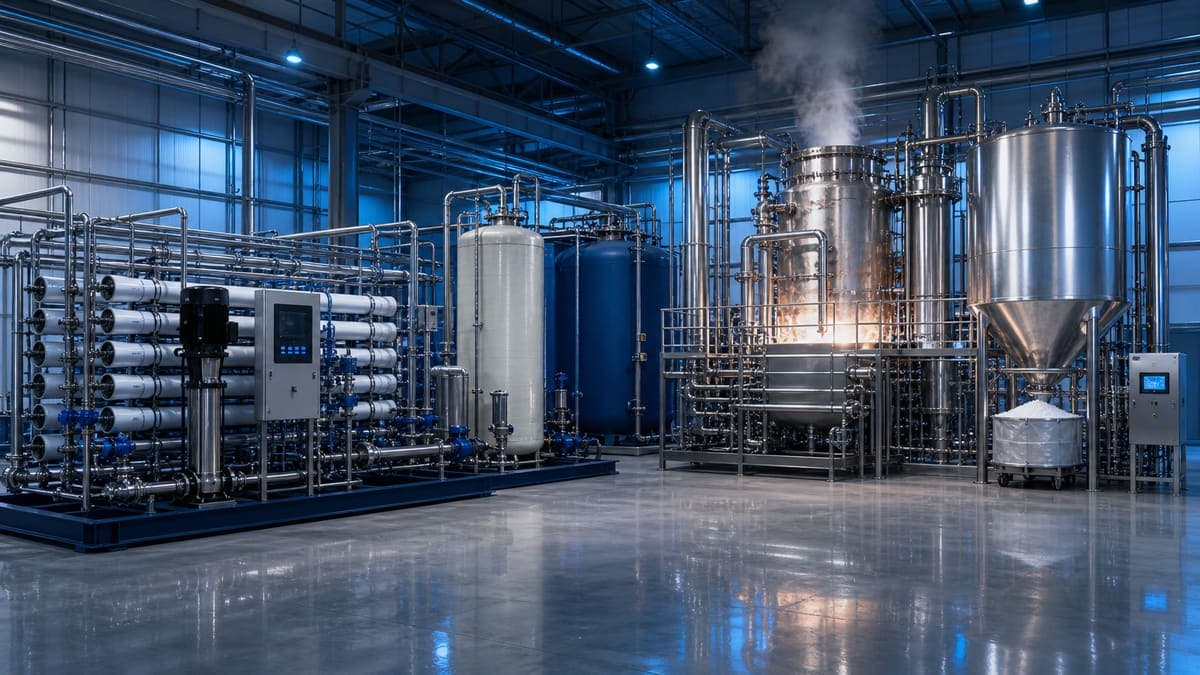
Zero Liquid Discharge (ZLD) is an advanced wastewater treatment strategy designed to recover all water for reuse and reduce the remaining dissolved solids to a concentrated solid or highly concentrated slurry. This approach eliminates liquid waste discharge, making it critical for industries facing stringent environmental regulations, severe water scarcity, or high disposal costs for their effluent. Typical applications include power generation, chemical manufacturing, mining, pulp and paper, textiles, and oil & gas, where process wastewaters are often high in Total Dissolved Solids (TDS) and diverse contaminants.
This scenario is the right entry point when environmental compliance mandates no liquid discharge, when fresh water scarcity necessitates maximum water reuse, or when the cost of conventional wastewater treatment and liquid waste disposal becomes economically prohibitive. ZLD offers a sustainable solution, often driven by the imperative to reduce environmental footprint and enhance operational resilience.
2. Feed characteristics & key risks
Feedwater to a ZLD system is typically a complex industrial effluent characterized by high and often variable TDS (e.g., >10,000 mg/L, potentially up to 100,000 mg/L or more), fluctuating pH, and a diverse profile of dissolved salts (e.g., chlorides, sulfates, carbonates of calcium, magnesium, sodium), heavy metals, silica, and organic compounds. The primary risks to ZLD membrane systems are severe scaling and fouling:
- Scaling: Precipitation of sparingly soluble salts like calcium carbonate, calcium sulfate, barium sulfate, strontium sulfate, and silica as water is concentrated. High LSI (Langelier Saturation Index) values (e.g., >2.0) or other scaling indices (e.g., Stiff-Davis) are common indicators of high scaling potential. Temperature and pH shifts further exacerbate these risks.
- Fouling: Accumulation of suspended solids, colloids, organic matter, and biological growth on membrane surfaces. This is often indicated by an elevated SDI₁₅ (Silt Density Index), typically exceeding 3-5 for standard RO membranes, and can lead to irreversible membrane damage.
- Osmotic Pressure: As TDS increases, the osmotic pressure across the membrane rises, requiring higher feed pressures and limiting the practical recovery of conventional RO systems.
- Corrosion: Highly concentrated brines can be extremely corrosive to process equipment if not properly managed, requiring specialized materials of construction.
3. Concentrate / reject routing
In a ZLD system, the journey of concentrate and reject streams is fundamental to achieving the "zero liquid" goal. Water treatment does not make matter disappear; it merely separates it.
- Initial Pretreatment Reject: Backwash water from media filters or reject from ultrafiltration/microfiltration (UF/MF) systems, containing suspended solids and colloids, is typically routed to a clarifier, sludge dewatering unit, or directly to a non-hazardous landfill if volume is minimal and solids are inert.
- Reverse Osmosis (RO) / Nanofiltration (NF) Concentrate: The concentrate from the primary RO or NF stage, while still containing significant water, is enriched in dissolved salts. This stream is not discharged but is instead directed to the next stage of concentration.
- High-Recovery RO (HRRO) / Brine Concentrator (BC) Concentrate: As the RO permeate is recycled or sent for further polishing, its concentrate, now significantly more saline (e.g., 50,000 to 100,000 mg/L TDS), becomes the feed to the thermal concentration stage. Specialized membrane systems like HRRO or vibratory shear enhanced process (VSEP) units are deployed to push membrane recovery to its limit before thermal steps.
- Thermal Evaporator / Crystallizer Brine: The highly concentrated brine from membrane systems feeds a thermal unit, such as a Mechanical Vapor Recompression (MVR) evaporator, Multi-Effect Distillation (MED) unit, or crystallizer. These systems boil off the remaining water, producing high-purity distillate (which is recycled back into the process as product water) and an extremely concentrated brine slurry or solid salt cake.
- Crystallizer Solids: The final product of a ZLD system is a solid waste stream, typically a mixed salt cake. This solid material is dewatered (e.g., via centrifuges or filter presses), then hauled off for disposal in a permitted landfill. In some cases, if specific salts can be recovered with sufficient purity (e.g., sodium sulfate), they may be considered a marketable byproduct. All non-volatile constituents originally present in the wastewater are ultimately consolidated into this solid stream.
4. Reference process train options
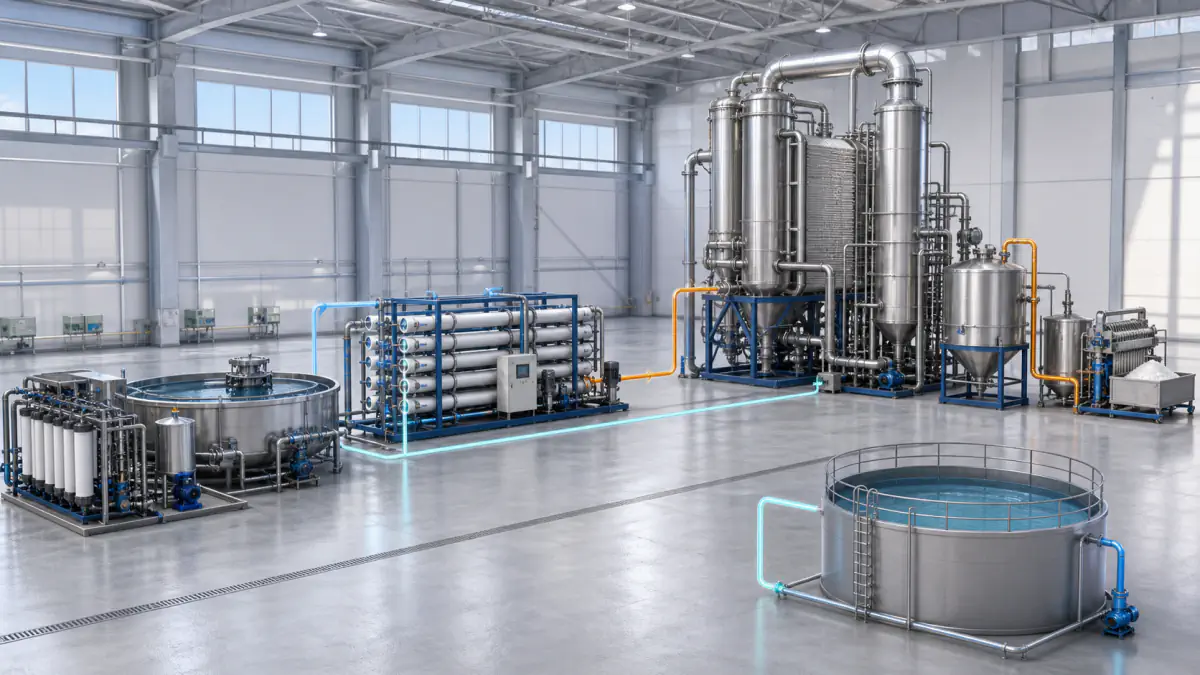
A typical ZLD process train is a multi-stage approach combining physical, chemical, and membrane separation technologies with thermal finishing:
- Pretreatment: Essential for membrane longevity. This often involves chemical coagulation/flocculation, clarification, and robust filtration (e.g., multi-media filters, activated carbon, or UF/MF). The goal is to achieve an SDI₁₅ consistently below 3, ideally below 1-2, for downstream RO. pH adjustment and antiscalant dosing are critical here.
- Primary Membrane Separation (RO/NF): The first stage of desalination and volume reduction. Standard RO systems (e.g., industrial RO configurations) typically achieve 75-85% water recovery. NF may be used if multivalent ion rejection is sufficient and monovalent salts need to pass through for downstream specific removal.
- High-Recovery Membrane Systems: To push the envelope, a second stage of specialized RO (e.g., with higher pressure capabilities or alternative configurations to handle higher osmotic pressure) or a Brine Concentrator unit follows. These systems can recover an additional 50-80% of the water from the primary RO concentrate.
- Thermal Concentration: The final concentration step, typically MVR evaporators or crystallizers. These units convert the remaining high-TDS brine into pure water vapor (condensed and recycled) and solid salts. MVR systems are energy-efficient due to heat recovery.
- Solids Handling: Includes dewatering equipment (filter presses, centrifuges) to produce a dry cake for disposal or beneficial reuse.
Chemical addition throughout the process (e.g., acids for pH control, antiscalants to prevent scaling, caustic for silica solubilization or pH adjustment) is critical for system stability and performance.
5. Operating parameters
Effective ZLD operation relies on tight control and monitoring of key parameters:
- SDI₁₅ (Silt Density Index): Maintained consistently at <3, and ideally <1 for critical high-recovery RO stages. This ensures minimal particulate fouling on membrane surfaces, minimizing ΔP increase and CIP frequency.
- LSI (Langelier Saturation Index) / Scaling Posture: For calcium carbonate, LSI is kept negative or slightly positive (e.g., -0.5 to +0.5) in the concentrate stream through pH adjustment (acid dosing) and antiscalant application. For other scalants (e.g., silica, sulfates), specialized scaling indices are employed, and antiscalant effectiveness is rigorously monitored. The design goal is to maximize concentration factor while maintaining a non-scaling environment at the membrane surface, often achieved by managing saturation indices below 1.0 (for sulfates) or below 100-150 mg/L for soluble silica.
- Flux (LMH): Design fluxes for RO in ZLD applications are conservative to mitigate fouling and scaling. Typical values range from 10 to 18 L/(m²·h) (LMH), with lower fluxes (e.g., 8-12 LMH) used for high-recovery stages or challenging feedwaters. This helps extend membrane life and reduces cleaning frequency.
- DP (Differential Pressure): Monitoring the differential pressure (ΔP) across individual membrane elements or stages is critical. An increase of 10-15% over the clean membrane ΔP typically triggers a Clean-In-Place (CIP) cycle. Excessive ΔP (e.g., >20-25%) can indicate severe fouling or scaling, potentially leading to telescoping or damage to membrane elements. Typical stage ΔP might be 0.3-0.7 bar per element in an array, with overall vessel ΔP dependent on element count.
6. Digital twin & instrumentation
- Instrumentation & Sensors:
- Flow meters: Accurate measurement of feed, permeate, and concentrate flows for each membrane stage and thermal unit.
- Pressure transducers: Monitoring feed, inter-stage, and concentrate pressures, as well as ΔP across membrane vessels.
- Conductivity/TDS probes: Real-time measurement of feed, permeate, and concentrate salinity to track salt rejection and concentration factors.
- Temperature sensors: Essential for accurate scaling potential calculations and process optimization in both membrane and thermal stages.
- pH and ORP (Oxidation-Reduction Potential) probes: Critical for chemical dosing control, antiscalant efficacy, and disinfection.
- Online SDI monitors: Continuous assessment of feed quality to prevent particulate fouling.
- Level transmitters: For tanks, clarifiers, and crystallizers.
- Digital Twin & Models: All sensor data is streamed to a backend platform. Here, advanced models perform real-time mass balance reconciliation, ensuring accountability for all water and solute streams. The digital twin continuously calculates and forecasts:
- Fouling and scaling risk: Based on actual feed chemistry, concentration factors, LSI, and other scaling indices, projecting when scaling might occur and recommending preventative actions (e.g., antiscalant adjustment, pH control).
- Membrane performance degradation: Tracking flux decline, salt passage increase, and ΔP trends to predict CIP requirements and optimize cleaning schedules.
- Energy consumption: Correlating pump pressures, flow rates, and thermal loads to specific energy consumption (kWh/m³).
- Chemical consumption: Optimizing antiscalant, acid, and caustic dosing to minimize operational costs while maintaining performance. The digital twin supports operator decisions by providing alerts, recommending parameter adjustments, and simulating the impact of operational changes on overall ZLD performance and cost.
8. Common engineering mistakes & pilot KPIs
Common Engineering Mistakes:
- Inadequate Pretreatment: Underestimating the variability and complexity of industrial wastewater leads to insufficient pretreatment, resulting in rapid membrane fouling and scaling, frequent CIPs, and premature membrane replacement.
- Over-optimistic Recovery Targets: Designing for maximum theoretical recovery without proper pilot testing can lead to an unachievable process, high operational costs, or system failure due to insurmountable scaling/fouling.
- Neglecting Concentrate Chemistry: Failing to fully characterize the brine chemistry after each concentration stage can lead to unanticipated scaling in subsequent membrane or thermal systems, or create hazardous solid waste that is difficult to dispose of.
- Poor Energy Management: ZLD is energy-intensive. Overlooking energy recovery opportunities (e.g., pressure exchangers for RO, MVR for evaporation) significantly inflates operational expenditure.
- Lack of Redundancy: ZLD systems are critical infrastructure. A lack of redundancy in key equipment can lead to costly shutdowns and non-compliance with discharge regulations.
Key Pilot KPIs for ZLD:
- Membrane Flux Stability: Consistent permeate flow rate per unit area over time (e.g., 90% flux retention over 1000 hours of operation).
- Permeate Quality: Consistent product water quality (e.g., conductivity < 10 µS/cm for RO permeate).
- Recovery Rate: Achievable water recovery per membrane stage and overall system recovery.
- Specific Energy Consumption: kWh/m³ of product water, identifying major energy consumers.
- Antiscalant Dosing Optimization: Minimum effective dose rate (mg/L) required to prevent scaling.
- CIP Frequency and Effectiveness: Hours of operation between CIPs and the degree of flux/pressure recovery post-CIP.
- Brine Concentrator Performance: Stable operation at high TDS, achievable concentration factor, and distillate quality.
- Solid Waste Characteristics: Quantity, composition, and dewaterability of the final salt cake.
9. FAQ
Q: What is the primary energy consumption in ZLD systems? A: ZLD systems are energy-intensive. The primary energy consumers are high-pressure pumps for membrane separation (RO/NF) and, more significantly, the thermal energy required for evaporation and crystallization in the final stages. MVR evaporators help mitigate thermal energy consumption through heat recovery.
Q: How do you handle mixed industrial waste streams in a ZLD system? A: Handling mixed streams often requires source segregation to simplify treatment, or a highly robust and flexible pretreatment system designed for the most challenging contaminants present. Comprehensive feed characterization is crucial to developing a single, effective chemical and physical treatment train capable of addressing all constituents without compromising membrane or thermal system performance.
Q: What is the typical footprint for a ZLD plant? A: The footprint of a ZLD plant varies significantly based on flow rate, feed complexity, and the chosen technologies. Membrane systems offer a relatively compact footprint for initial concentration, but thermal evaporators and crystallizers, along with associated solids handling, can require substantial space. A full ZLD facility often requires a considerable land area.
Q: Can ZLD generate useful byproducts? A: Yes, in some cases, ZLD can be designed to recover specific salts of commercial value, such as sodium sulfate, sodium chloride, or magnesium compounds, provided they can be separated with sufficient purity. This "resource recovery" approach can offset operational costs and contribute to a circular economy model.
Related equipment & product lines
These categories typically support the approach above—open any line to compare brands and models.
- RO MembranesReverse osmosis membrane elements for municipal and industrial desalination.View category →
- Pumps & PumpingHigh-pressure and process pump solutions for water treatment skids and plants.View category →
- Pilot Units TestingPilot rigs and trial modules for process validation and feasibility studies.View category →
For a closer review, use the engineering inquiry form to share feed, capacity, target, and project stage. Submission does not constitute a completed design or performance commitment.