Solutions · Digital & Smart O&M
Smart Labeling & Traceability: QR/RFID journey for every membrane element
Factory-to-install history, batch linkage, and cleaning records—so audits and warranty claims are evidence-based, not reconstructed from emails.
Use this guide within its scope
This page supports technical research and option comparison and is marked 2026. Illustrative values are not a quotation, completed process design, certification conclusion, or performance guarantee. Check current regulations, feed data, tests, and OEM records.
Problem
When quality disputes arise, nobody can prove which batch lived through which CIP regime.
Technology
Persistent digital IDs on elements, tied to shipment, commissioning, and service events.
Results
Faster RCA, cleaner warranty conversations, and procurement teams that trust what they installed.
Engineering decision card
Use when
When quality disputes arise, nobody can prove which batch lived through which CIP regime.
Evaluate first
Persistent digital IDs on elements, tied to shipment, commissioning, and service events.
Inputs still required
Feed source and variability, capacity, target quality, operating hours, discharge or reuse boundary, available space, and utilities.
Comparison output
Faster RCA, cleaner warranty conversations, and procurement teams that trust what they installed. The final decision still needs feed data, mass balance, and any necessary testing.
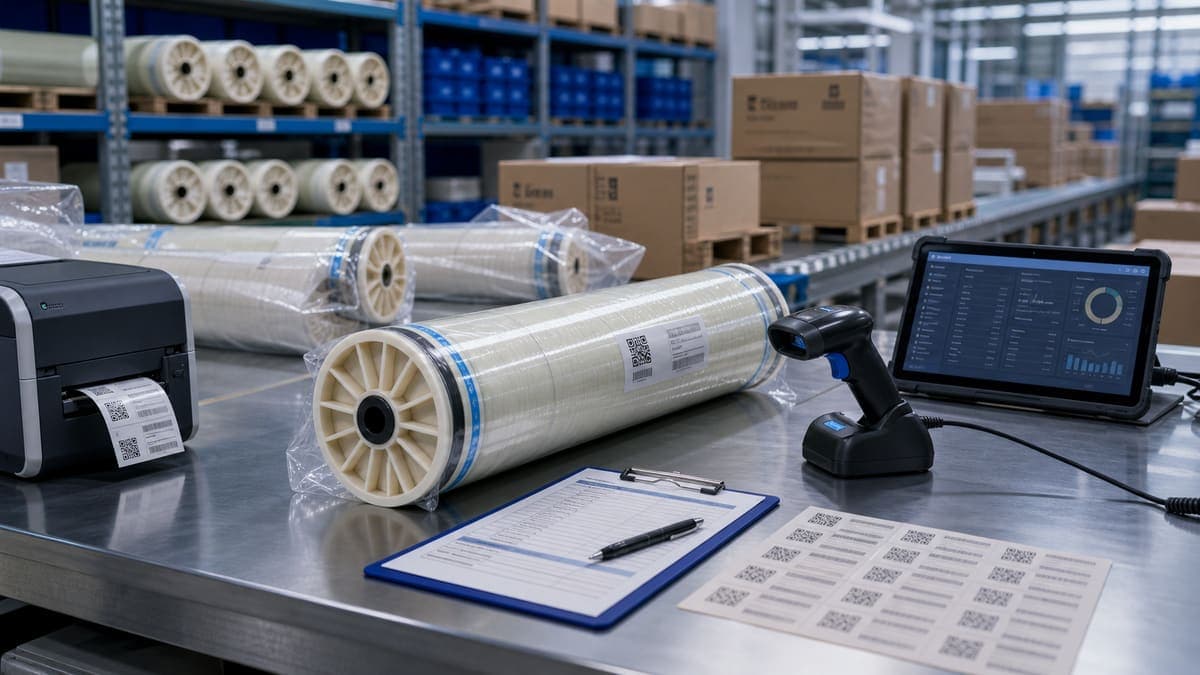
Smart Labeling & Traceability: QR/RFID Journey for Every Membrane Element
Achieving operational certainty in water treatment plants and ensuring supply-chain efficiency starts with knowing the exact history and status of every critical component. For membrane filtration systems, where performance directly impacts output and cost, this means digitalizing the full lifecycle of each membrane element – from manufacturing to disposal. By deploying smart labeling and traceability with QR codes or RFID, this approach transforms your membrane management from a reactive, estimate-driven process into a proactive, data-optimized strategy.
Traditional vs engineering evaluation path
Managing thousands of membrane elements in a large-scale reverse osmosis (RO) or ultrafiltration (UF) plant has long been a complex, manual task. The difference in operational outcomes between traditional methods and this approach's digital approach is stark.
| Traditional way | engineering evaluation path way |
|---|---|
| Manual Data Entry & Spreadsheets | Automated Data Capture |
| - Paper logs or basic spreadsheets for installation dates, cleaning cycles. | - QR/RFID scan on installation, removal, cleaning event; data automatically linked to element's digital twin. |
| - High risk of human error, transcription mistakes, data silos. | - Eliminates manual errors; ensures real-time, accurate data for each element. |
| - Difficult to track individual element performance or cleaning effectiveness over time. | - Provides a complete, immutable service history for every membrane, including operational parameters. |
| - Spare parts ordered based on historical averages or last-minute failures, leading to overstocking or shortages. | - Predictive maintenance triggers based on actual element performance, optimizing spare part inventory by 20-30%. |
| Reactive Maintenance & Guesswork | Proactive, Performance-Driven Management |
| - Membrane cleaning schedules are often fixed or based on general system pressure drop, not individual element fouling. | - AI-driven insights recommend optimal cleaning or replacement for specific elements, extending lifespan by 15-25%. |
| - Unplanned downtime due to unexpected membrane failure or sub-optimal performance, impacting production. | - Minimizes unplanned downtime through early warning of underperforming elements; maintains consistent water quality. |
| - Warranty claims difficult to prove due to incomplete or fragmented service records. | - Bolsters warranty claims with indisputable digital records of operational parameters and service history. |
| - Limited visibility into membrane performance post-installation; no feedback loop to procurement/engineering. | - Provides end-to-end visibility, enabling informed procurement decisions and design improvements based on real-world data. |
Consider a large desalination plant with 10,000 RO elements. Traditionally, identifying a batch of underperforming elements installed two years ago could take weeks of manual record digging, if possible at all. With this approach, a quick query reveals all elements from that batch, their current performance, and individual service histories, enabling targeted action in minutes and potentially preventing an entire train from underperforming.
The Digital Twin for Every Membrane Element
- Manufacturer details & batch information: Original factory data, quality control records.
- Installation date & location: When and where it was first commissioned within your plant (train, pressure vessel, position).
- Operational parameters: Flow rates, pressures, temperatures, and conductivity data recorded during its service.
- Cleaning cycles: Date, type of cleaning, chemicals used, and post-cleaning performance.
- Performance degradation: Historical trends and current efficiency, measured against its peers and benchmarks.
- Replacement & disposal: When and why it was removed from service.
This granular, element-specific data empowers plant operators to move beyond generalized maintenance schedules. Instead, they can predict remaining useful life, optimize cleaning frequency, and make data-backed decisions on replacement, maximizing the value of each membrane while maintaining consistent water quality and minimizing energy consumption.
Decisions Driven by Field Truth
Flow rates, pressure differentials, conductivity, ORP, and temperature readings from your online instruments provide the continuous feedback loop necessary to assess membrane health. This data, correlated with the membrane's digital twin, allows for immediate identification of fouling, scaling, or damage, enabling pre-emptive intervention.
engineering evaluation path Differentiation: Coordinated Efficiency
When a membrane element's performance degrades, our system doesn't merely flag it. It can automatically:
- Trigger an engineering review: Providing immediate access to the element's full history and performance trends for analysis.
- Initiate a spare parts request: Checking inventory, suggesting optimal reorder points based on predicted failure rates, and potentially integrating directly with your ERP for procurement.
- Optimize maintenance schedules: Suggesting the most efficient time to perform cleaning or replacement, considering factors like overall plant load and staff availability.
Related equipment & product lines
These categories typically support the approach above—open any line to compare brands and models.
- Instrumentation & SensorsOnline measurement and control: flow, level, pressure, and water-quality sensors indexed from the Lenntech instrumentation hub.View category →
- RO MembranesReverse osmosis membrane elements for municipal and industrial desalination.View category →
- Replacement Parts / SparesGeneral replacement parts for treatment systems and subassemblies.View category →
For a closer review, use the engineering inquiry form to share feed, capacity, target, and project stage. Submission does not constitute a completed design or performance commitment.