Solutions · Industry Solutions
Commercial & institutional: central water with monitoring and pressure stability
Malls, hospitals, and campuses: variable demand, Legionella risk awareness, pressure control, softening/RO zones, and real-time quality dashboards.
Use this guide within its scope
This page supports technical research and option comparison and is marked 2026. Illustrative values are not a quotation, completed process design, certification conclusion, or performance guarantee. Check current regulations, feed data, tests, and OEM records.
Problem
Highly variable demand causes pressure surges and stagnation zones; tenants expect reliability without understanding water risks.
Technology
VFD pumping, loop turnover design, filtration/softening/UV zones by use class, and SCADA dashboards for key parameters.
Results
Stable service pressure, documented water quality at critical taps, and fewer tenant complaints and rework.
Engineering decision card
Use when
Highly variable demand causes pressure surges and stagnation zones; tenants expect reliability without understanding water risks.
Evaluate first
VFD pumping, loop turnover design, filtration/softening/UV zones by use class, and SCADA dashboards for key parameters.
Inputs still required
Feed source and variability, capacity, target quality, operating hours, discharge or reuse boundary, available space, and utilities.
Comparison output
Stable service pressure, documented water quality at critical taps, and fewer tenant complaints and rework. The final decision still needs feed data, mass balance, and any necessary testing.
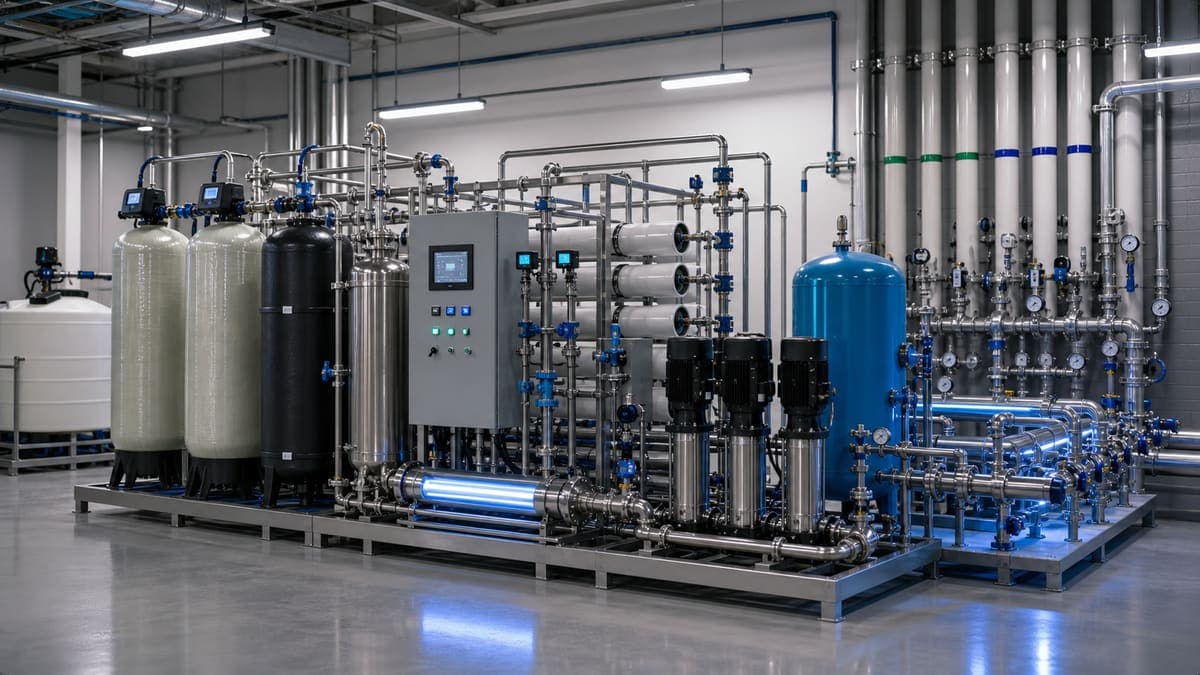
Industry Context & Regulatory/Compliance Drivers
The varied demands within commercial and institutional settings create a multifaceted regulatory landscape. Potable water supplied to these facilities must adhere to national and local health regulations, often mirroring WHO Guidelines for Drinking-water Quality or EPA Primary Drinking Water Regulations regarding microbial, chemical, and aesthetic parameters. For critical applications like boiler feedwater, compliance with ASME/IAPWS quality standards is essential to prevent scaling and corrosion, dictating limits on conductivity, dissolved oxygen, and hardness.
Healthcare and laboratory environments introduce even more stringent requirements. While ultra-pure water (UPW) systems (e.g., meeting ASTM D5127-13 Type E-1.2) are typically point-of-use for highly sensitive applications, central systems feeding these areas might need to meet preliminary quality standards such as USP <1231> Water for Pharmaceutical Purposes for Purified Water. Furthermore, Legionella risk management is a paramount concern across all water systems, influencing design, disinfection strategies, and monitoring protocols to safeguard occupant health. Peak water demand swings, combined with periods of low occupancy, can stress pumping systems, increase water age, and foster biofilm growth, leading to aesthetic complaints and elevated Legionella risk.
Water Quality Targets
this approach customizes water quality targets based on the specific end-uses within a facility:
- Domestic & Potable: Typically, aesthetic quality (taste, odor, color) and adherence to local health authority microbial and chemical limits.
- HVAC (Boilers & Cooling Towers): Reduced hardness (< 10 mg/L as CaCO₃ for boilers, < 50 mg/L for cooling towers, depending on cycles of concentration) to minimize scaling, controlled conductivity, and effective biocide dosing to prevent biofouling and corrosion.
- Kitchen & Food Service: Often requires softening for steamers and dishwashers to prevent scale, and sometimes additional filtration for beverage systems.
- Laboratory & Medical (pre-treatment to point-of-use): Low TDS (< 10 µS/cm conductivity), free from suspended solids and chlorine, serving as feed for localized UPW systems (e.g., Type I water for analytical instruments).
Operations, Monitoring, and CIP Philosophy
this approach's operational philosophy centers on proactive management and predictive maintenance. Our systems are equipped with comprehensive instrumentation, providing real-time data on critical parameters:
- Conductivity: Monitored at key points (feed, RO permeate, EDI permeate) to track demineralization performance.
- Pressure: Monitored across filter stages (MMF, UF), RO elements (ΔP), and throughout the distribution network to identify fouling, leaks, or pump issues.
- Flow Rates: Permeate flow, concentrate flow, and specific domestic/process flows are continuously measured to calculate recovery rate and track normalized permeate flow for membrane health assessment.
- ORP/Chlorine: Monitored to ensure effective disinfection and proper dechlorination before RO.
- Temperature: Important for membrane performance normalization.
Automated Cleaning-in-Place (CIP) protocols are initiated based on trends, not just fixed schedules. A sustained increase in transmembrane pressure or a decline in normalized permeate flow (e.g., 10-15% drop from baseline) triggers an alert for a potential biofouling or scaling event, prompting a CIP cycle with optimized chemical formulations. This data-driven approach minimizes chemical usage and extends membrane life.
Risks and Common Engineering Mistakes
Ignoring the diverse water quality requirements across a large facility is a common pitfall, leading to either over-treatment (costly) or under-treatment (resulting in scaling, corrosion, or health risks). Other risks include:
- Inadequate Pretreatment: Skipping MMF/UF for challenging raw water sources can lead to rapid biofouling and particulate fouling of RO membranes, increasing operational costs and reducing membrane lifespan.
- Neglecting Minimum Flow Rates: Systems designed only for peak demand can suffer from stagnation during low occupancy, increasing biofilm growth and Legionella risk in distribution loops.
- Insufficient Monitoring & Alarming: Lack of integrated monitoring for parameters like ΔP, conductivity, or ORP means issues like membrane fouling or disinfectant failure go unnoticed until they become critical.
- Poorly Managed Recovery Rates: Pushing RO recovery rate too high without adequate antiscalant dosing or considering LSI can lead to severe scaling in the concentrate stream and premature membrane failure.
- Lack of Redundancy: Critical applications require redundancy in pumping and treatment trains to ensure continuous operation.
Related equipment & product lines
These categories typically support the approach above—open any line to compare brands and models.
- Pumps & PumpingHigh-pressure and process pump solutions for water treatment skids and plants.View category →
- Control ValvesProcess control and softening valves for automated treatment trains.View category →
- Instrumentation & SensorsOnline measurement and control: flow, level, pressure, and water-quality sensors indexed from the Lenntech instrumentation hub.View category →
- UV DisinfectionUV systems and modules for pathogen inactivation and final disinfection barriers.View category →
For a closer review, use the engineering inquiry form to share feed, capacity, target, and project stage. Submission does not constitute a completed design or performance commitment.