Back to Industry Solutions

Solutions · Industry Solutions

Display & photovoltaic panel cleaning water: high flow, low particle burden

High-volume rinse and cleaning water for displays and PV: particle control, hardness, and RO/UF design for throughput and membrane protection.

2026panel cleaningPV manufacturingparticle controlUFROrecovery rate
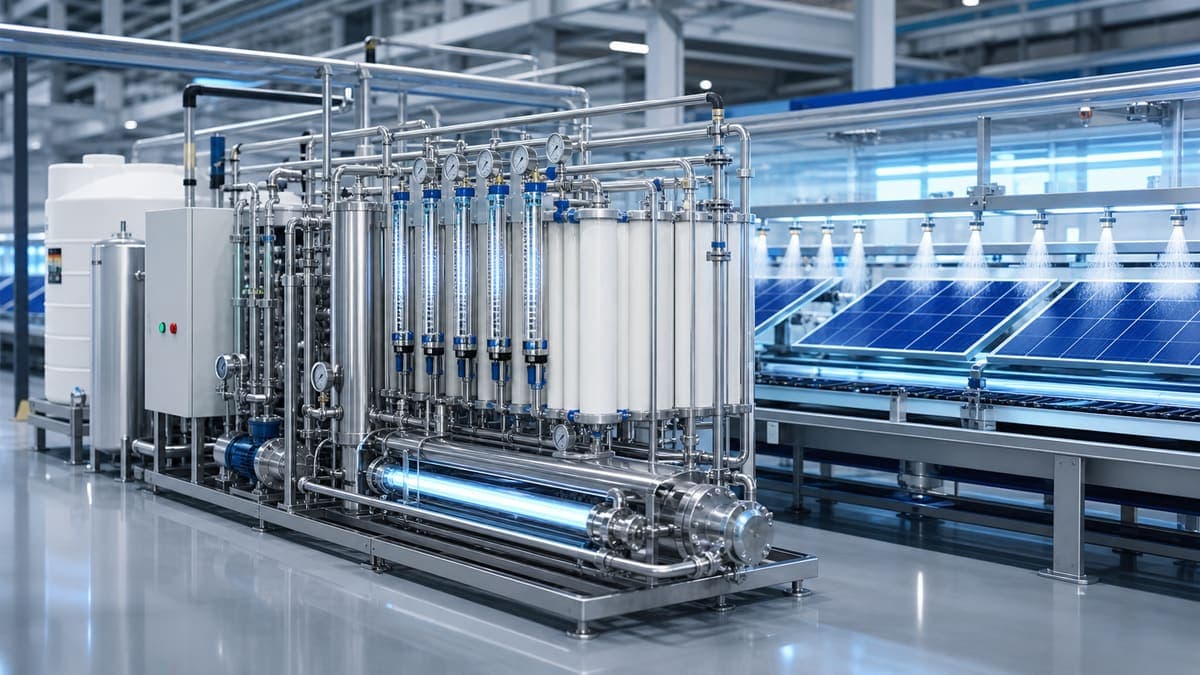
Display & photovoltaic panel cleaning water: high flow, low particle burden water treatment solution illustration

Problem

High-flow rinses demand huge water volumes; particles and hardness drive spotting, coating defects, and rapid RO fouling if pretreatment is undersized.

Technology

Multimedia or UF pretreatment, single-pass RO for demineralization, and loop sanitation discipline—with flux and recovery chosen for water cost, not hero recovery.

Results

Stable rinse quality at design throughput, fewer unplanned RO cleans, and predictable makeup water chemistry across shifts.

Display & Photovoltaic Panel Cleaning Water: High Flow, Low Particle Burden

In the highly competitive manufacturing of flat-panel displays and photovoltaic (PV) modules, water quality is not merely a utility requirement; it is a critical process input directly impacting product yield and reliability. These industries rely on continuous, high-flow rinses to meticulously remove contaminants from delicate surfaces. The water employed must possess extremely low suspended solids, precisely controlled hardness, and often ultra-low conductivity to prevent staining, spotting, and electrical reliability issues, particularly in thin-film deposition and etching steps. For some critical process steps, water quality approaches ultrapure water (UPW) specifications, drawing guidance from standards such as ASTM D5127-13 for electronic grade water (e.g., Type E-1.2 or higher resistivity grades).

The economic ramifications of suboptimal water treatment are substantial. Beyond the direct cost of makeup water, manufacturers face losses from increased blowdown rates, premature membrane replacement, and costly rework or scrap. A common challenge arises when system designs prioritize theoretical recovery rate without adequately addressing feed water quality variability, such as seasonal spikes in SDI (Silt Density Index) or organic load. Such oversights can lead to excessive concentration polarization on membrane surfaces, forcing frequent, unscheduled CIP (Clean-in-Place) cycles, which undermine the economic justification for aggressive water conservation strategies.

Industry Context & Regulatory Drivers

The global demand for high-performance displays and efficient solar cells continues to escalate, driving innovation in manufacturing processes that require ever-more stringent control over contamination. Water is used in numerous stages, from wafer slicing and substrate cleaning to chemical mechanical polishing (CMP) and final rinsing. Each step presents unique water quality demands.

Regulatory drivers often center on environmental discharge limits for concentrate streams and wastewater. Local environmental agencies impose limits on parameters like pH, suspended solids, heavy metals, and Total Dissolved Solids (TDS) for discharge. AquaChain designs systems not only to meet process water needs but also to ensure compliance with these local environmental regulations, minimizing the ecological footprint of operations.

Water Quality Targets

Achieving high yields in display and PV manufacturing necessitates highly purified water. Typical targets include:

  • Conductivity/Resistivity: For general rinsing, conductivity often needs to be below 1 µS/cm. For critical thin-film processes, resistivity can exceed 10 MΩ·cm, sometimes approaching 18.2 MΩ·cm (ultrapure water standards).
  • Particles: Extremely low particle counts, often specified by particle size and quantity (e.g., <100 particles/mL @ >0.2 µm).
  • Total Organic Carbon (TOC): Typically <50 ppb for general use, and <5 ppb for critical applications.
  • Hardness: Effectively zero (<0.01 mg/L as CaCO₃) to prevent spotting and scaling.
  • Silica: <20 ppb for RO feed, and <5 ppb in permeate for high-purity applications, to prevent scaling and film defects.
  • Dissolved Gases: Often degassed (e.g., <20 ppb O₂) for certain sensitive processes.
  • Microbial Count: <10 Colony Forming Units (CFU)/100mL for bulk, and non-detectable for critical points of use.

AquaChain's Integrated Process Train for Display & PV Water Treatment

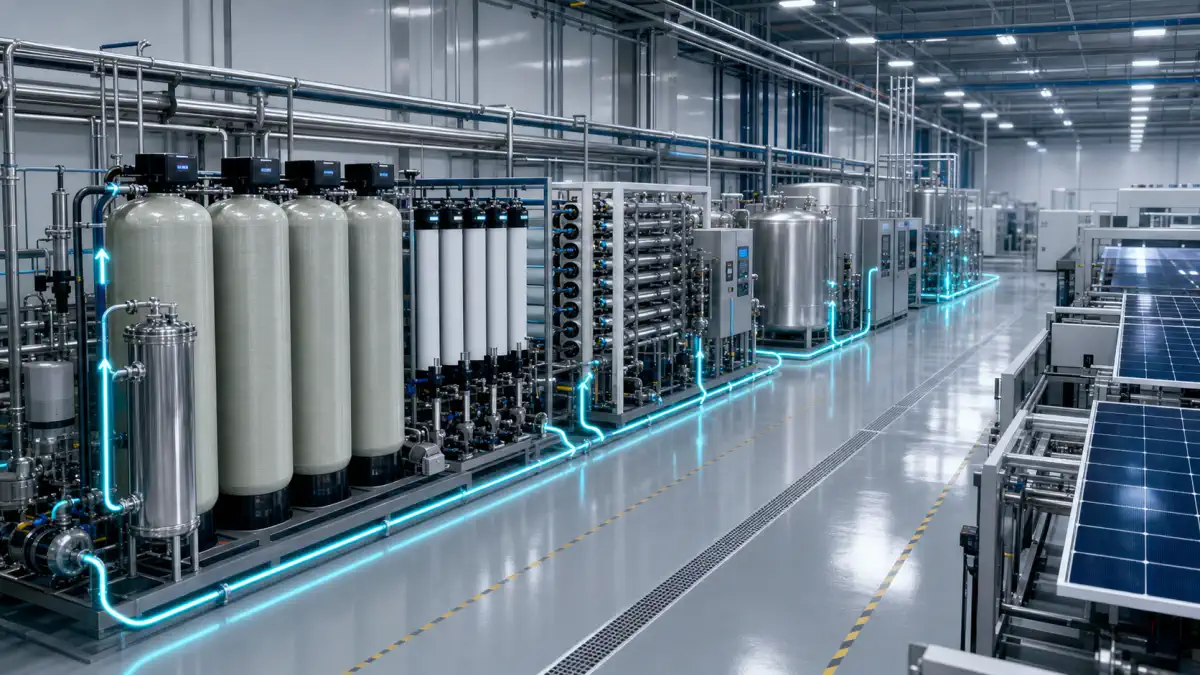
AquaChain engineers water treatment solutions as comprehensive, integrated systems, meticulously designed to meet the rigorous demands of display and PV manufacturing. Our premium industrial aesthetic, featuring integrated stainless-steel skids, ensures durability and hygienic operation, while digitally modelled flow paths optimize hydraulic performance and minimize pressure losses.

1. Pretreatment – Safeguarding Downstream Processes

The initial stages are crucial for protecting sensitive membrane technologies and ensuring consistent feed water quality.

  • Coagulation/Flocculation (Optional): For raw surface waters with high turbidity and organic loads, chemical coagulation followed by clarification can significantly reduce suspended solids.
  • Multimedia Filtration (MMF): Effectively removes larger suspended solids, reducing the SDI of the feed water.
  • Ultrafiltration (UF): For challenging surface water sources or where raw water SDI₁₅ consistently exceeds 5, ultrafiltration is mandatory. Our UF systems provide a robust barrier against suspended solids, colloids, and microorganisms, significantly reducing membrane biofouling potential and protecting downstream RO membranes from particulate fouling.
  • Chemical Dosing:
    • Antiscalant Dosing: Precisely metered to prevent scaling (e.g., calcium carbonate, silica) on RO membranes, especially as recovery rates increase and salt concentrations rise.
    • Bisulfite Dosing: To remove free chlorine, protecting polyamide RO membranes from oxidative damage.
  • Cartridge Filtration: Typically 5-micron filters act as a final "guard filter" before RO, capturing any remaining particulates.

2. Reverse Osmosis (RO) – Primary Demineralization

Reverse Osmosis (RO) is the core technology for demineralization, removing up to 99.5% of dissolved salts, organics, and microorganisms. AquaChain designs RO systems with conservative flux rates (e.g., 10-15 L/(m²·h)) when water cost and membrane longevity are paramount, ensuring extended membrane life and reduced cleaning frequency.

  • Two-Pass RO Configuration: For the high-purity requirements of display and PV, a two-pass RO system is standard. The permeate from the first pass becomes the feed for the second pass, further reducing conductivity and dissolved solids.
  • LSI Management: Our designs carefully consider the Langelier Saturation Index (LSI) in the concentrate stream, implementing robust antiscalant dosing and optimizing recovery rate to prevent mineral precipitation and scaling.
  • Cross-Flow Filtration: RO operates in a cross-flow manner, where a portion of the feed water continuously flushes the membrane surface, carrying away concentrated impurities (the concentrate stream), while the purified water (the permeate) passes through the membrane.

3. Electrodeionization (EDI) – Continuous Polishing

For applications requiring very high resistivity water, Continuous Electrodeionization (EDI) is the preferred polishing technology after RO. EDI combines ion exchange resin, ion-selective membranes, and a DC electric field to continuously remove residual ions without the need for periodic chemical regeneration.

  • Mechanism: Ions migrate through the ion exchange resins and then through ion-selective membranes towards electrodes under the influence of an electric field. The concentrate compartment continuously flushes away removed ions, while the electrode compartments contain electrodes that facilitate the ion transport and consume a small amount of water. This continuous process eliminates the downtime and chemical handling associated with conventional mixed-bed ion exchangers.
  • Benefits: EDI delivers stable, high-purity water (typically >10 MΩ·cm) and reduces operational costs and environmental impact by avoiding chemical regenerants.

4. Post-Treatment & Distribution – Maintaining Purity

The final stages ensure the water maintains its purity until the point of use.

  • UV Sterilization: A UV reactor is often integrated to destroy microorganisms and, in some cases, reduce TOC, preventing biofouling in the distribution loop.
  • Degasification (Optional): For critical applications requiring very low dissolved oxygen, vacuum degasifiers or membrane contactors are employed.
  • Polishing Mixed-Bed Ion Exchange (Optional): For the absolute highest resistivity (e.g., 18.2 MΩ·cm) or for redundancy, a final mixed-bed ion exchanger can be used, though EDI often negates its continuous need.
  • Final Particle Filtration: Point-of-use filters (e.g., 0.05 µm or 0.02 µm) are installed just before the application to capture any particles generated within the distribution system.
  • Break Tanks & Distribution Loop: AquaChain designs break tanks and distribution systems with hygienic, non-corrosive materials (e.g., PVDF, electro-polished stainless steel) and optimized flow dynamics to avoid recontamination, rust, gasket debris, and biofilm formation. Side-stream monitoring of turbidity and conductivity at the point of use ensures consistent quality.

Operations, Monitoring, and CIP Philosophy

AquaChain's philosophy centers on proactive maintenance and intelligent process control to maximize uptime and minimize operational costs.

  • Performance Monitoring: Continuous monitoring of key parameters such as transmembrane pressure (TMP), differential pressure (ΔP) across membrane stages, and normalized permeate flow is critical. These metrics provide early indicators of fouling or scaling.
  • Antiscalant & Cleaning Programs: Chemical dosing of antiscalant is precisely controlled based on feed water chemistry and real-time RO performance. Our CIP programs are not simply calendar-based; they are triggered by trend-based declines in normalized permeate flow (e.g., 10-15% reduction) or increases in ΔP, ensuring cleaning only when necessary. This optimizes chemical consumption and extends membrane life.
  • Biofouling Control: Regular bio-control measures, including biocide dosing or thermal sanitization, are implemented to mitigate biofouling risks within the entire system, from pretreatment to the distribution loop.
  • Digital Integration: AquaChain's solutions integrate advanced sensors and control systems, providing operators with real-time data for informed decision-making. Our digitally modelled flow paths are not just for design; they aid in predicting and preventing issues during operation.

Risks and Common Engineering Mistakes

Several factors can jeopardize the efficiency and reliability of display and PV water treatment systems:

  • Underestimating Raw Water Variability: Failing to account for seasonal or episodic changes in raw water quality (e.g., turbidity, organics, temperature) can lead to rapid fouling of pretreatment and RO membranes, resulting in frequent CIPs or premature membrane replacement.
  • Aggressive Recovery Rates without LSI Management: Maximizing recovery rate without proper LSI calculation and antiscalant dosing will inevitably lead to scaling on RO membranes, reducing flux and increasing operating pressure.
  • Inadequate Pretreatment: Skipping or undersizing UF or MMF when the SDI of the raw water is consistently high directly exposes RO membranes to particulate fouling, drastically shortening their lifespan.
  • Poor Distribution System Design: A highly purified water source can be recontaminated by an improperly designed or maintained distribution loop. Stagnant zones, inappropriate materials, or insufficient flushing can lead to microbial growth or particle shedding.
  • Neglecting TOC Control: For thin-film applications, high TOC can lead to defects. Without UV oxidation or specific TOC removal resins, even high-resistivity water may not be suitable.

2026 Forward-Looking Context for Water Management

As an engineering partner committed to sustainable and intelligent water solutions, AquaChain continuously integrates future-forward technologies into our designs.

Energy & ESG Optimization

The water-energy nexus is a critical consideration. AquaChain prioritizes specific energy consumption (kWh/m³ permeate) in our designs. For high-pressure RO systems operating on brackish or seawater feeds, Energy Recovery Devices (ERDs) are integrated to capture hydraulic energy from the high-pressure RO concentrate stream, significantly reducing the overall power demand of the high-pressure pumps. Our systems are designed for minimal environmental impact, aligning with stringent ESG (Environmental, Social, and Governance) goals through optimized water reuse and reduced chemical consumption.

Digital O&M and Predictive Maintenance

AquaChain's digital-first approach extends to operations and maintenance. Our industrial RO platforms incorporate advanced remote monitoring capabilities, providing real-time data on critical performance indicators such as ΔP across membrane stages, normalized permeate flow, and system pressures. Trend-based triggers alert operators to potential issues, allowing for proactive intervention. For example, a consistent decline in normalized permeate flow or an increase in transmembrane pressure can predict an impending fouling event, allowing for scheduled CIP cycles rather than reactive, emergency cleanings. This predictive maintenance strategy minimizes downtime and optimizes the lifespan of critical components.

Modular RO System Integration

The AquaChain modular RO product line offers scalable solutions for diverse industrial needs. For display and photovoltaic panel cleaning, the industrial RO series is the definitive choice. These production-scale systems are engineered for continuous, high-flow operation, featuring multi-stage treatment processes and full SCADA integration for comprehensive control and data acquisition. While pilot-scale RO units are ideal for pilot studies, lab-scale research, or prototyping of new cleaning chemistries, the robustness and capacity of industrial RO are essential for the critical, high-volume demands of fab environments, ensuring reliable and consistent water quality for maximum yield.

Frequently Asked Questions

Q: Is Ultrafiltration (UF) always required before RO in display/PV applications?

A: Not always for every source, but for surface water or any feed where SDI₁₅ frequently exceeds 5, UF is highly recommended and often mandatory. It provides a superior and more stable feed quality to the RO, drastically reducing particulate fouling and extending RO membrane life, ultimately leading to higher RO availability and lower overall operational costs. We recommend pilot testing on worst-case feed conditions to assess its necessity.

Q: How critical is the conductivity target for rinse water, and can we over-purify?

A: The conductivity target is directly tied to the process defect data and the specific requirements of each manufacturing step. While ultra-low conductivity (<0.1 µS/cm) or high resistivity (>10 MΩ·cm) is critical for certain thin-film or final rinse steps to prevent contamination and electrical shorts, over-purifying every rinse loop without a clear process benefit can significantly increase both CAPEX (for advanced treatment such as EDI) and OPEX (energy, consumables) without contributing to yield improvement. AquaChain designs are optimized to meet precise process specifications, avoiding unnecessary treatment.

Q: Can rinse water be reused or recycled?

A: Yes, with careful design and monitoring, certain rinse streams can be partially or fully recycled. This typically involves segregating rinse streams based on their contaminant load and conductivity. Lower-purity rinses might be polished and reused in less critical stages or even blended back into the pretreatment feed. However, cross-contamination controls are paramount. Reuse should always be treated as a quality decision first, not solely a water balance exercise, with appropriate monitoring (e.g., TOC, conductivity, particles) to ensure the recycled water meets the quality requirements of its intended application.

Q: What is the most common cause of premature RO membrane failure in this industry?

A: The most common causes are fouling (particulate, organic, or biological) and scaling. Particulate and organic fouling often stem from inadequate or inconsistent pretreatment (e.g., high SDI, insufficient UF protection). Biofouling is a pervasive issue that requires ongoing biocontrol. Scaling is typically caused by exceeding the solubility limits of sparingly soluble salts (like calcium carbonate, silica) on the membrane surface due to high recovery rate without sufficient antiscalant dosing or proper LSI management, leading to irreversible damage if not addressed promptly.

Call to action

AquaChain delivers advanced water treatment solutions tailored for the display and photovoltaic industries, ensuring maximum yield, operational efficiency, and environmental compliance. Need a customized process diagram for your Display & Photovoltaic Panel manufacturing facility? Consult AquaChain's engineering team today.

These categories typically support the approach above—open any line to compare brands and models.

Looking for site-specific references or lab data? Contact us—we can share case material relevant to your feed and targets.