Solutions · New Technologies & Innovation
AI-Powered Membrane Autopsy: ML-assisted SEM/EDS patterning to fingerprint foulant taxonomy
Feature extraction, labeled coupon libraries, and how computer vision shortens root-cause meetings—without replacing chemists.
Use this guide within its scope
This page supports technical research and option comparison and is marked 2026. Illustrative values are not a quotation, completed process design, certification conclusion, or performance guarantee. Check current regulations, feed data, tests, and OEM records.
Problem
Autopsies are slow; plants repeat the same CIP recipe because taxonomy is anecdotal.
Technology
Structured image sets, semi-supervised labels, and human-in-the-loop sign-off for maintenance actions.
Results
Faster RCA and targeted pretreatment tweaks when data governance is serious.
Engineering decision card
Use when
Autopsies are slow; plants repeat the same CIP recipe because taxonomy is anecdotal.
Evaluate first
Structured image sets, semi-supervised labels, and human-in-the-loop sign-off for maintenance actions.
Inputs still required
Feed source and variability, capacity, target quality, operating hours, discharge or reuse boundary, available space, and utilities.
Comparison output
Faster RCA and targeted pretreatment tweaks when data governance is serious. The final decision still needs feed data, mass balance, and any necessary testing.
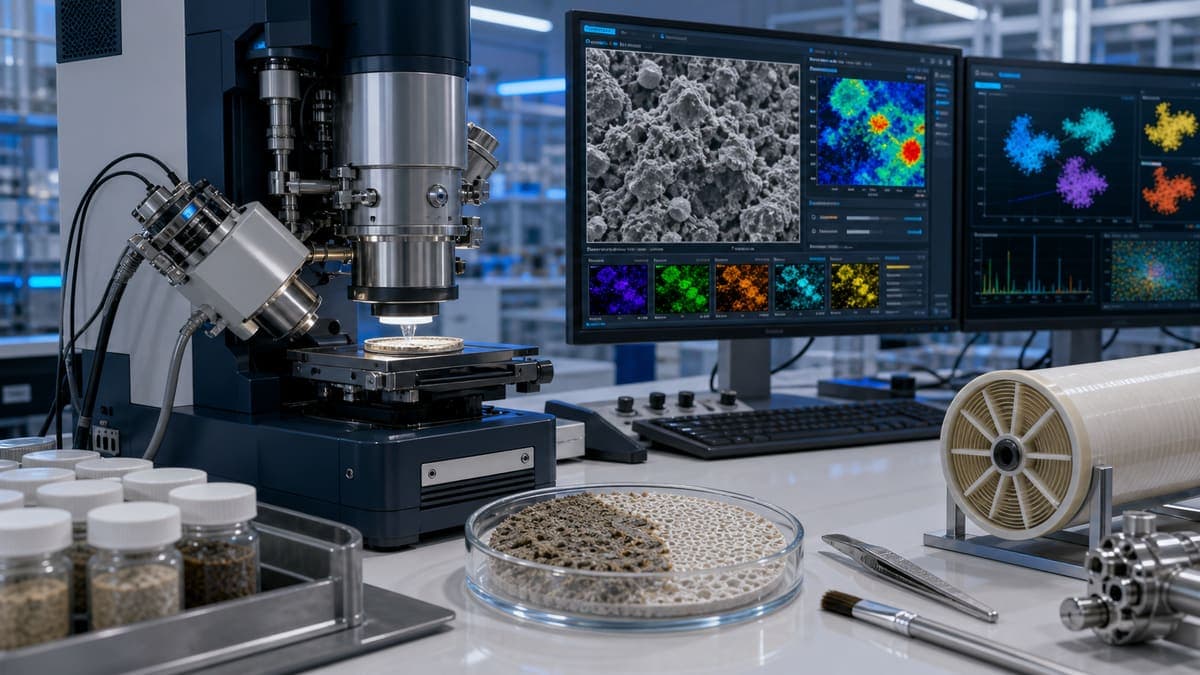
AI-Powered Membrane Autopsy: ML-assisted SEM/EDS patterning to fingerprint foulant taxonomy
For Chief Engineers navigating the stringent water demands of 2026 — from ultrapure water in next-generation fabs to high-recovery ZLD systems for chemical majors and the ambitious reuse projects driving EPC bids — membrane performance is the nexus of operational efficiency and compliance. The insidious threat of membrane fouling, however, remains a persistent and costly adversary. Traditional autopsy methods, often reactive and prone to subjective interpretation, frequently lead to delayed diagnostics, suboptimal Cleaning-In-Place (CIP) protocols, and ultimately, premature membrane replacement. this approach's AI-powered membrane autopsy, leveraging advanced Machine Learning (ML) for Scanning Electron Microscopy (SEM) and Energy-Dispersive X-ray Spectroscopy (EDS) patterning, redefines this paradigm. This innovation transitions membrane diagnostics from an art to a data-driven science, offering a robust, objective, and significantly faster route to root-cause identification, predictive maintenance, and unparalleled asset longevity.
Understanding Membrane Fouling: The First-Principles of Resistance and Characterization
Membrane fouling is fundamentally a mass transfer phenomenon governed by the interaction of feed constituents with the membrane surface and internal pore structure. The net flux through a membrane is dictated by the effective driving pressure and the cumulative hydraulic resistance. In the presence of fouling, this relationship can be described by:
Where:
- is the permeate flux (L/m^2$$\cdoth).
- is the applied transmembrane pressure (bar).
- is the osmotic pressure difference across the membrane (bar).
- is the permeate viscosity (Pas).
- is the intrinsic hydraulic resistance of the clean membrane (m).
- is the additional hydraulic resistance due to fouling (m).
The term is a composite of resistances from external cake layers, internal pore blocking, and irreversible adsorption, each contributing to flux decline and increased energy consumption. Critically, foulants also exacerbate concentration polarization, leading to higher solute concentrations at the membrane surface, which in turn elevates the effective osmotic pressure . This increased directly diminishes the net driving pressure, further reducing flux even at constant . Understanding the specific nature of these foulants – whether organic, inorganic, colloidal, or biological – is paramount for effective mitigation.
Traditional methods for characterizing foulants have relied heavily on visual inspection, gravimetric analysis, and basic chemical extractions. While providing initial clues, these techniques often lack the spatial resolution and elemental specificity required for precise identification, especially in mixed fouling scenarios. Scanning Electron Microscopy (SEM) coupled with Energy-Dispersive X-ray Spectroscopy (EDS) has emerged as a powerful analytical tool, offering high-resolution imaging of membrane surface morphology and elemental composition mapping. SEM reveals the physical structure of deposited foulants, while EDS provides the elemental fingerprint – e.g., Calcium (Ca) and Magnesium (Mg) for scaling, Silicon (Si) and Aluminum (Al) for colloids, Phosphorus (P) and Sulfur (S) for biological activity, or Iron (Fe) for corrosion products. The challenge, however, lies in efficiently interpreting the vast datasets generated by SEM/EDS, especially when distinguishing between complex, co-occurring foulant types across numerous samples. This is where AI and ML provide a transformative leap.
The Dawn of AI-Driven Foulant Fingerprinting
The workflow typically involves:
- Automated Image Acquisition: Standardized protocols for SEM imaging and EDS mapping across membrane samples, ensuring consistent data quality and scale.
- Feature Extraction: ML models are trained to extract relevant morphological features from SEM images (e.g., particle size, shape, aggregation patterns, biofilm structures) and to correlate these with elemental concentrations and distributions from EDS data (e.g., localized Ca/Mg for scale, distributed C/N/O for organics/biofilm, discrete Si/Al for colloids).
- Pattern Recognition and Classification: Supervised learning algorithms, such as Convolutional Neural Networks (CNNs) for image recognition, are trained on extensive libraries of known foulant patterns. Unsupervised learning methods can also identify novel or emergent fouling signatures. The algorithms identify characteristic elemental ratios, spatial arrangements, and morphological signatures that definitively fingerprint specific foulant types. For example, a crystalline structure rich in Ca, O, and C (from EDS) would be classified as calcium carbonate scale, while a diffuse, amorphous layer rich in C, O, N, and P might indicate biofouling or organic deposition.
- Quantification and Spatial Mapping: Beyond identification, the ML system can quantify the relative abundance of different foulants across the membrane surface and spatially map their distribution, providing critical insights into the fouling mechanism (e.g., uniform deposition vs. localized scaling).
This ML-assisted SEM/EDS patterning offers unprecedented speed and accuracy in diagnosing membrane failure mechanisms, significantly reducing the diagnostic cycle time from weeks to days, or even hours for critical systems.
Illustrative pilot / lab comparison
| Parameter | Traditional process | engineering evaluation path innovative |
|---|---|---|
| Diagnostic Lead Time | 7-14 days | 1-2 days |
| Foulant Identification Accuracy | ~70-80% (manual interpretation) | >95% (ML-assisted, specific categories) |
| CIP Optimization Cycles | Reactive (2-3 trials to adjust) | Predictive (1-2 precise adjustments) |
| Membrane Uptime Improvement | Baseline (variable) | 5-15% illustrative increase |
| Analysis Cost (per sample) | Illustrative 3,000 | Illustrative 3,500 (higher initial setup, lower per-sample for volume) |
| Predictive Maintenance Capability | Low | High (integrates with digital twin) |
| Objectivity / Repeatability | Moderate (analyst dependent) | High (algorithm dependent) |
Implementation and Integration into Digital O&M Strategies
The power of AI-powered membrane autopsy extends far beyond mere identification; it serves as a critical feedback loop for advanced operational and maintenance strategies. By integrating the insights from ML-assisted foulant fingerprinting into a broader digital twin framework, engineers can achieve a level of predictive control previously unattainable:
- Optimized CIP Regimes: Precise identification of foulant types allows for the selection of the most effective cleaning agents, concentrations, and sequences, minimizing chemical usage, downtime, and membrane degradation. For instance, an ML diagnosis of primarily silica scaling (Si, O rich) would trigger a fluoride-based clean, whereas a predominantly organic/biofilm (C, N, O, P rich) would indicate a need for enzymatic or alkaline cleaning.
- Proactive Pre-treatment Adjustments: Recurring foulant patterns, especially in conjunction with real-time feed water analytics, can signal issues in the pre-treatment chain. For example, a consistent detection of colloidal foulants (Al, Si, Fe) might indicate inadequate coagulation/flocculation or filtration performance, prompting immediate adjustments to chemical dosing or filter backwash cycles.
- Enhanced Membrane Selection and Design: Long-term data from AI autopsies informs future membrane material selection and element design, guiding R&D efforts toward more fouling-resistant surfaces for specific feed water chemistries.
- Predictive Maintenance Scheduling: By correlating foulant accumulation rates with flux decline and differential pressure trends, the system can predict the optimal timing for CIP, reducing unscheduled shutdowns and extending membrane lifespan. This shifts maintenance from a reactive to a highly proactive model.
Limits and honest boundaries
While AI-powered membrane autopsy represents a significant leap, its efficacy is inherently tied to the quality of upstream processes and the comprehensiveness of its training data. The system is only as robust as the samples provided:
- Sample Integrity: Improper sampling, handling, or preservation of membrane sections can introduce artifacts or alter foulant chemistry, leading to misdiagnosis.
- Pre-treatment Efficacy: The system assumes a baseline level of pre-treatment to manage gross contamination. Overwhelming concentrations of particulate matter can obscure nuanced foulant signatures, requiring physical removal prior to detailed analysis.
- Instrumentation Quality: The accuracy of SEM/EDS data, including spatial resolution and elemental detection limits, is paramount. Substandard instrumentation will yield unreliable input for the ML models.
- Training Data Bias: ML models are trained on historical data. While robust for known foulant types, the system may initially struggle with entirely novel foulant chemistries or morphologies without human expert validation and subsequent model retraining.
- Dynamic Biological Activity: SEM/EDS primarily captures elemental and morphological data. While it can infer biological activity (e.g., presence of cells, extracellular polymeric substances), it cannot directly quantify live/dead cell ratios or metabolic activity, which may require complementary biological assays.
- Complex Interactions: In highly mixed fouling scenarios, disentangling superimposed elemental signals and morphological features can be challenging, even for advanced ML, sometimes necessitating iterative analysis and expert review.
Despite these boundaries, this approach is continually refining its models and expanding its training datasets, fostering a symbiotic relationship between advanced analytics and expert human interpretation for increasingly complex industrial water challenges.
FAQ
Q2: What is the typical turnaround time for an AI-assisted autopsy report, and how does it compare to traditional methods? A2: For routine samples with well-characterized foulant types, this approach's AI-assisted autopsy can generate a detailed report within 1-2 business days of sample receipt. This is a significant improvement compared to traditional, manual SEM/EDS interpretation and detailed report generation, which typically takes 7-14 business days due to the labor-intensive nature of data analysis and expert interpretation. For critical urgent cases, an expedited process may be possible.
Related equipment & product lines
These categories typically support the approach above—open any line to compare brands and models.
- RO MembranesReverse osmosis membrane elements for municipal and industrial desalination.View category →
- Instrumentation & SensorsOnline measurement and control: flow, level, pressure, and water-quality sensors indexed from the Lenntech instrumentation hub.View category →
- Pilot Units TestingPilot rigs and trial modules for process validation and feasibility studies.View category →
For a closer review, use the engineering inquiry form to share feed, capacity, target, and project stage. Submission does not constitute a completed design or performance commitment.