Solutions · New Technologies & Innovation
Selective Boron Removal: meeting sub-ppb boron specs for advanced semiconductor UPW
Speciation, pH swing, and selective media: engineering boron rejection beyond single-pass RO limits without hand-waving.
Use this guide within its scope
This page supports technical research and option comparison and is marked 2026. Illustrative values are not a quotation, completed process design, certification conclusion, or performance guarantee. Check current regulations, feed data, tests, and OEM records.
Problem
Boron slips through RO when speciation favors neutral boric acid; nodes below 10 nm cannot tolerate surprise B.
Technology
Targeted IX or hybrid RO/IX trains with metered pH strategy and silica-aware limits.
Results
Outlet B tied to documented influent matrices—not generic brochure curves.
Engineering decision card
Use when
Boron slips through RO when speciation favors neutral boric acid; nodes below 10 nm cannot tolerate surprise B.
Evaluate first
Targeted IX or hybrid RO/IX trains with metered pH strategy and silica-aware limits.
Inputs still required
Feed source and variability, capacity, target quality, operating hours, discharge or reuse boundary, available space, and utilities.
Comparison output
Outlet B tied to documented influent matrices—not generic brochure curves. The final decision still needs feed data, mass balance, and any necessary testing.
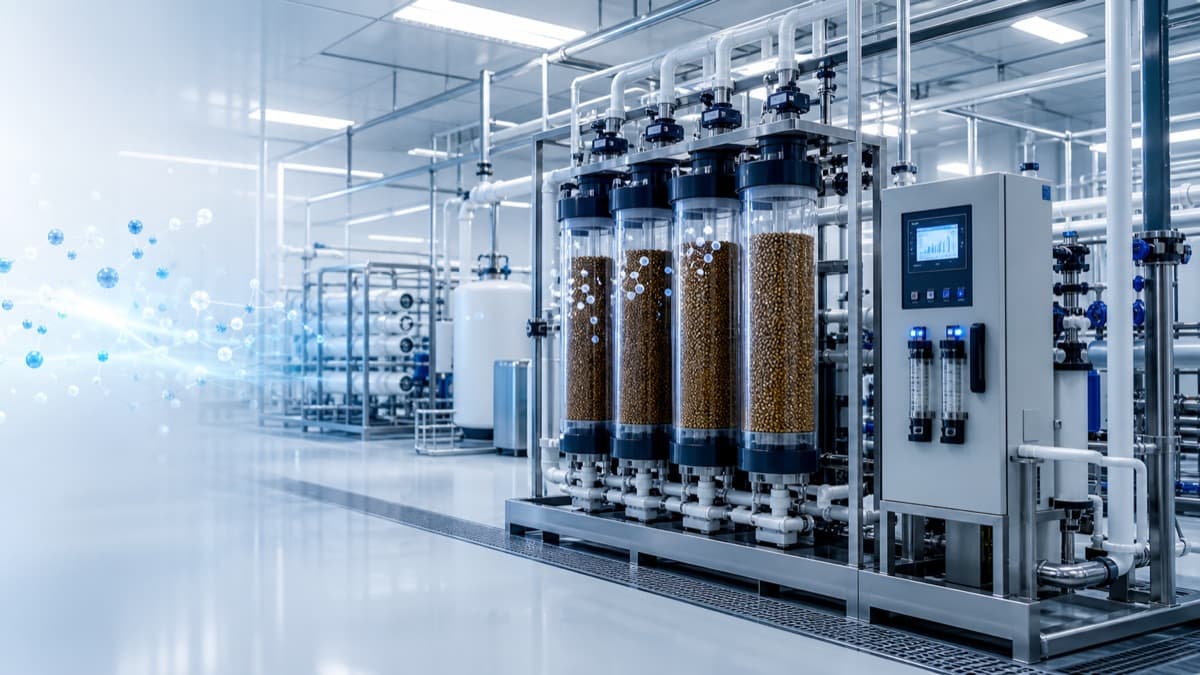
Selective Boron Removal: meeting sub-ppb boron specs for advanced semiconductor UPW
The relentless pursuit of smaller feature sizes in advanced semiconductor manufacturing has driven Ultra-Pure Water (UPW) specifications to unprecedented levels, particularly for weakly ionized species like boron. As the industry transitions to 3nm and 2nm nodes, boron, even in parts per trillion (ppt) concentrations, can significantly impact device yield and performance, particularly in front-end-of-line (FEOL) processes and epitaxial growth steps. Traditional UPW purification trains, while highly effective for strong electrolytes, often struggle to consistently achieve the sub-ppb boron levels now demanded by leading-edge fabs. Chief Engineers and R&D Leads are increasingly seeking specialized, selective solutions beyond conventional resin polishing or high-pass RO to meet these critical boundary conditions, influencing EPC bid specifications for new facilities and operational optimizations in existing plants.
The challenge with boron stems from its unique aqueous chemistry. In neutral or slightly acidic conditions, boron predominantly exists as undissociated boric acid (), a weak Lewis acid. Its low ionization constant means it largely bypasses removal mechanisms designed for charged species, such as ion exchange (IX) or electrodialysis (EDI). As the pH rises, boric acid dissociates into the borate ion (). This speciation profoundly impacts removal efficacy.
Governing Relations for Boron Speciation and Adsorption
Boron's chemical behavior in water is governed by its value and the solution's pH. At typical UPW operating temperatures (), the primary equilibrium is:
This can be simplified to:
The acid dissociation constant for this equilibrium, , is approximately at . This means that at a pH significantly below 9, boric acid () is the dominant species. Conversely, at pH values above 9, the borate ion () becomes increasingly prevalent. For instance, at pH 7, less than 0.1% of total boron exists as the borate ion. Effective selective boron removal strategies therefore often involve localized or pre-pH adjustment to convert to for capture by anion exchange resins.
For selective adsorption technologies, the equilibrium capacity of an adsorbent for boron can often be described by a Langmuir-type isotherm, assuming a finite number of active sites and monolayer adsorption. For a given solute concentration in the liquid phase, the adsorbed amount (mass of solute per mass of adsorbent) can be expressed as:
where represents the maximum adsorption capacity (at monolayer saturation, typically in mg/g or mmol/g), and is the Langmuir adsorption equilibrium constant (related to the energy of adsorption, typically in L/mg or L/mmol). This model assumes:
- Adsorption occurs on specific, identical sites.
- Each site can only accommodate one molecule (monolayer adsorption).
- Adsorption is reversible.
- Adsorbed molecules do not interact with each other.
For boron-selective resins, which often contain N-methylglucamine functional groups, is highly dependent on the pH, reflecting the need for boron to be in its borate ionic form to effectively bind to the resin sites. A higher indicates a stronger affinity of the resin for boron at a given condition, leading to higher removal efficiency at lower concentrations.
Illustrative pilot / lab comparison
Achieving sub-ppb boron levels necessitates a departure from bulk removal techniques towards highly selective polishing. The table below illustrates potential performance differences between traditional and innovative approaches.
| Parameter | Traditional process | engineering evaluation path innovative |
|---|---|---|
| Target Boron Outlet (ppt) | 100-500 | < 10 |
| Specific Energy Consumption (kWh/m³)* | 0.8-1.2 (UPW train) | 0.9-1.3 (UPW train incl. pH adj. & selective resin regeneration) |
| Regeneration Chemical Consumption (kg/m³ water produced) | 0.05-0.1 (mixed bed DI) | 0.08-0.15 (selective resin, includes acid/base) |
| System Footprint Increase (relative to DI) | 0% (integrated) | 15-25% (dedicated selective polishing skid) |
| UPW Recovery (%) | 80-90% | 85-92% (polishing loop optimized) |
| Resin Life (operating hours between full replacement) | 20,000-40,000 | 15,000-30,000 (selective resin, depends on feed quality) |
*Numbers presented in this table are illustrative composites derived from various anonymized pilot projects and literature, not reflecting any specific commercial product or site performance.
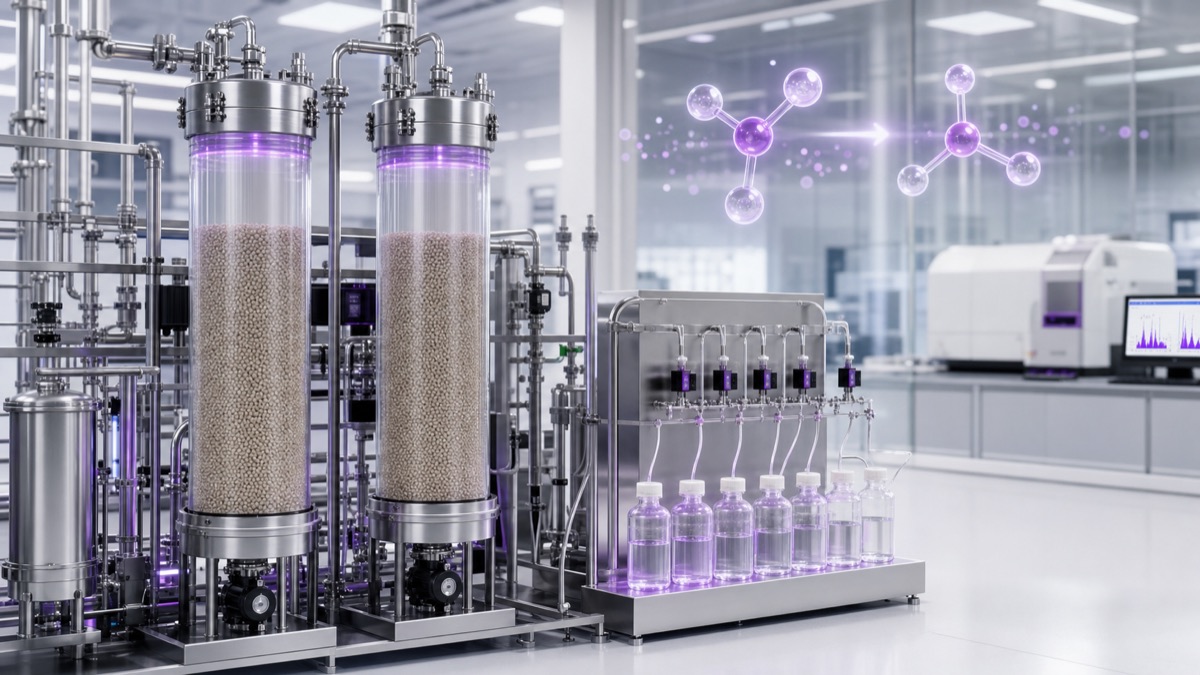
This image focuses on selective polishing columns, metered sampling, and trace-analysis context because boron removal is not just another conductivity problem. The purple trace-species motif hints at boric acid / borate speciation, while the resin beds and sample panel point to the real operating constraints: pH control, competing ions, resin breakthrough, and sub-ppb analytical validation.
Limits and honest boundaries
While highly effective, selective boron removal technologies are not without their operational limits and sensitivities. Neglecting proper pretreatment can severely compromise performance. High concentrations of competing ions, particularly silica and some organic acids, can foul the selective resin sites, reducing capacity and necessitating more frequent regenerations. Inadequate pH control upstream of the selective resin can significantly reduce boron removal efficiency by failing to convert sufficient boric acid to its more amenable borate form, leading to premature breakthrough. Moreover, the stability of the selective resin itself can be impacted by strong oxidants, requiring careful oxidant residual management. Finally, the measurement of sub-ppb boron requires advanced analytical capabilities (e.g., ICP-MS) and stringent sampling protocols to avoid contamination, as traditional conductivity or TOC sensors are insufficient for validating such trace levels. Without robust analytical feedback, optimizing and verifying the performance of these critical polishing steps becomes impossible.
FAQ
Q1: Why is boron considered a more challenging contaminant to remove to sub-ppb levels compared to other common ions in UPW? A1: Boron's challenge stems from its weak acid nature. At neutral pH, it exists predominantly as undissociated boric acid (), which is electrically neutral and thus largely unaffected by ion exchange resins or electric fields in EDI designed for charged species. This requires specific pH adjustment or specialized resins with functional groups capable of complexing with the neutral boric acid or the weakly charged borate ion, unlike strong acids/bases that readily ionize.
Q2: What is the optimal pH range for selective boron removal using functionalized ion exchange resins, and what are the trade-offs? A2: For resins specifically designed to target the borate ion, an optimal pH range is typically found between 8.5 and 10. This range maximizes the conversion of to the charged form. The primary trade-off is the increased chemical consumption for pH adjustment (e.g., caustic dosing) and subsequent neutralization, which adds to operating costs and may necessitate additional process steps. Operating at higher pH can also increase the solubility of some metals (e.g., zinc) if present, or promote silica polymerization, requiring careful water chemistry management.
Q3: How are sub-ppb boron concentrations reliably measured and validated in a production UPW environment? A3: Reliable measurement of sub-ppb boron concentrations typically requires Inductively Coupled Plasma – Mass Spectrometry (ICP-MS) with specialized sample introduction systems (e.g., desolvating nebulizers) to enhance sensitivity and minimize matrix effects. Crucially, stringent sampling protocols are required to prevent contamination from ambient air, glassware, or reagents. This includes using certified trace-metal-free containers, performing multiple rinses, and conducting regular blank measurements to establish a robust detection limit and quantification limit below the target specification. Inline analyzers are emerging but often require frequent calibration against laboratory-grade ICP-MS.
Related equipment & product lines
These categories typically support the approach above—open any line to compare brands and models.
- Ion Exchange ResinsCation/anion and mixed bed resin solutions for demineralization and polishing.View category →
- RO MembranesReverse osmosis membrane elements for municipal and industrial desalination.View category →
- Instrumentation & SensorsOnline measurement and control: flow, level, pressure, and water-quality sensors indexed from the Lenntech instrumentation hub.View category →
For a closer review, use the engineering inquiry form to share feed, capacity, target, and project stage. Submission does not constitute a completed design or performance commitment.