Solutions · New Technologies & Innovation
Ultra-High Pressure RO (UHPRO): pushing past ~120 bar to redefine ZLD brine concentration limits
Osmotic pressure, Van’t Hoff scaling, and staging economics: why UHPRO buys volume out of the thermal block—when chemistry and scaling indices are engineered honestly.
Use this guide within its scope
This page supports technical research and option comparison and is marked 2026. Illustrative values are not a quotation, completed process design, certification conclusion, or performance guarantee. Check current regulations, feed data, tests, and OEM records.
Problem
Conventional RO stalls where π dominates; evaporators inherit too much water and too much capex.
Technology
Specialty flat-sheet chemistry, high-pressure envelopes, and antiscalant discipline sized to the ionic ceiling you can defend.
Results
Smaller MVR/crystallizer duty per kg solids—when the membrane block and thermal block share one brine truth case.
Engineering decision card
Use when
Conventional RO stalls where π dominates; evaporators inherit too much water and too much capex.
Evaluate first
Specialty flat-sheet chemistry, high-pressure envelopes, and antiscalant discipline sized to the ionic ceiling you can defend.
Inputs still required
Feed source and variability, capacity, target quality, operating hours, discharge or reuse boundary, available space, and utilities.
Comparison output
Smaller MVR/crystallizer duty per kg solids—when the membrane block and thermal block share one brine truth case. The final decision still needs feed data, mass balance, and any necessary testing.
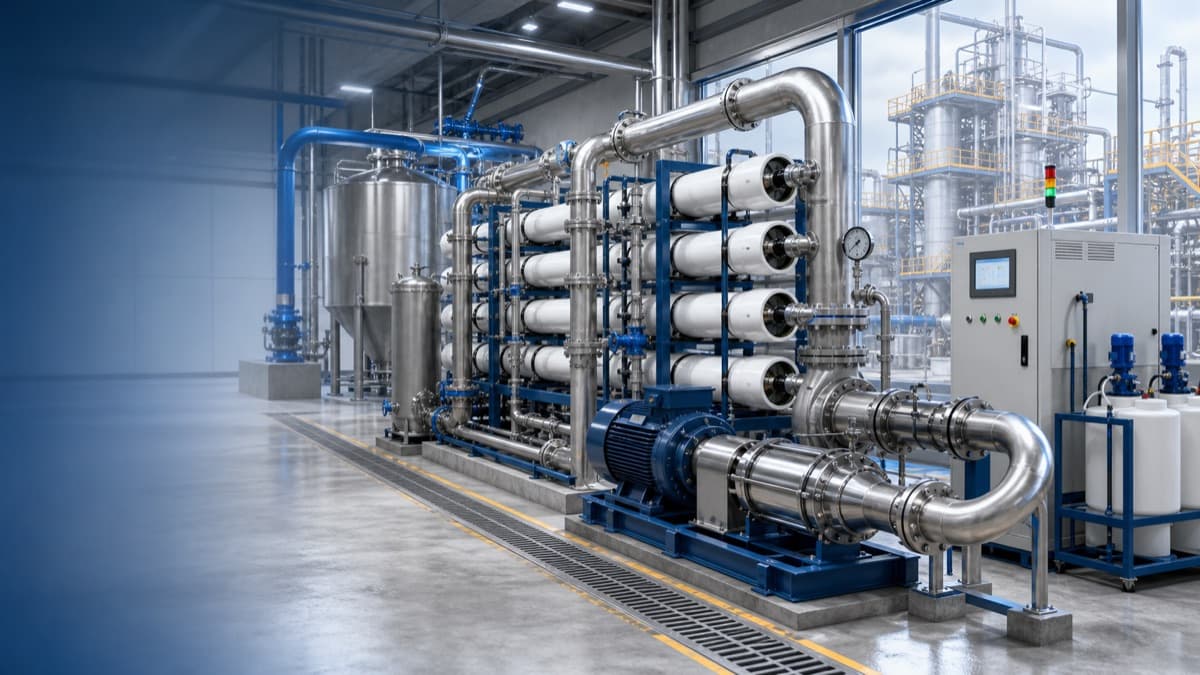
Ultra-High Pressure RO (UHPRO): pushing past ~120 bar to redefine ZLD brine concentration limits
The global industrial landscape, particularly within the semiconductor fabrication and specialty chemical sectors, faces an escalating imperative for Zero Liquid Discharge (ZLD) and advanced water reuse. As regulations tighten and freshwater scarcity intensifies, the cost and logistical burden of managing high-salinity brine streams become a critical operational constraint. Traditional reverse osmosis (RO) systems, typically operating below 80-90 bar, encounter an inherent thermodynamic barrier when processing brines nearing 100,000 mg/L TDS, as the osmotic pressure () of the concentrate stream approaches or exceeds the system's practical applied pressure ().
For CTOs and chief engineers strategizing 2026 CAPEX cycles and EPC bids, this limitation directly impacts recovery rates, specific energy consumption, and the footprint of downstream thermal ZLD evaporators or crystallizers. Ultra-High Pressure RO (UHPRO), by systematically pushing operating pressures beyond the conventional ~120 bar envelope—and in specialized cases approaching 160-180 bar—offers a paradigm shift. This technology does not merely extend performance; it redefines the boundary conditions for what is economically and ecologically feasible in brine concentration, allowing for significantly higher volumetric reduction before resorting to more energy-intensive thermal methods. The ability to concentrate brines further with membrane technology translates directly to reduced operational expenditure (OpEx) for ZLD systems and enhanced water security for industrial operations.
Governing Principles of High-Pressure Membrane Separation
The fundamental driving force for solvent transport across a semi-permeable membrane in reverse osmosis is the net trans-membrane pressure (). This is expressed as the difference between the applied hydraulic pressure and the osmotic pressure differential across the membrane:
Here, is the hydrostatic pressure exerted on the feed side, and represents the difference in osmotic pressure between the feed concentrate and the permeate stream. For a given membrane, the permeate flux () is directly proportional to this net driving pressure, typically described by:
where is the membrane's pure water permeability coefficient. The osmotic pressure itself, primarily driven by the concentration of dissolved solutes, can be estimated by the van 't Hoff equation for ideal solutions:
where is the van 't Hoff factor (number of ions/particles per mole of solute), is the molar concentration of the solute, is the ideal gas constant, and is the absolute temperature.
As industrial brines are concentrated, the molar concentration of solutes increases, leading to a substantial rise in . In traditional RO systems, as reaches its practical limit (e.g., 80-90 bar), any further increase in feed concentration causes to approach , leading to a sharp decline in and thus permeate flux. This necessitates either accepting lower recovery rates, increasing membrane surface area, or transitioning to thermal processes.
UHPRO directly addresses this thermodynamic bottleneck by significantly elevating . By operating at 120-180 bar, UHPRO systems maintain a substantial even with brine feed concentrations that would render conventional RO uneconomical or infeasible. This higher driving force allows for greater water recovery, often pushing total system recovery to 90-95% and beyond for complex industrial effluents, effectively reducing the volume of concentrate requiring thermal treatment by 50% or more. This shift profoundly impacts the OpEx of ZLD facilities by minimizing energy-intensive evaporation stages and associated chemical consumption.
Illustrative pilot / lab comparison
| Parameter | Traditional process | engineering evaluation path innovative |
|---|---|---|
| Max Brine TDS handled | ~75,000 mg/L | ~140,000 mg/L |
| Overall Water Recovery (post-RO) | 80-85% | 90-96% |
| Specific Energy Consumption (w/ ERS) | 2.5 – 4.0 kWh/m³ permeate | 1.8 – 3.2 kWh/m³ permeate |
| Downstream Thermal ZLD Volume Reduction | Up to 15% of initial feed | 5-8% of initial feed |
| CIP Interval (typical for high TDS) | 30-45 days | 45-75 days |
Note: The numeric values presented in this table are illustrative and represent typical performance ranges observed in pilot-scale deployments and laboratory simulations. Actual field performance will vary based on specific feed water chemistry, pre-treatment efficacy, and operational parameters.
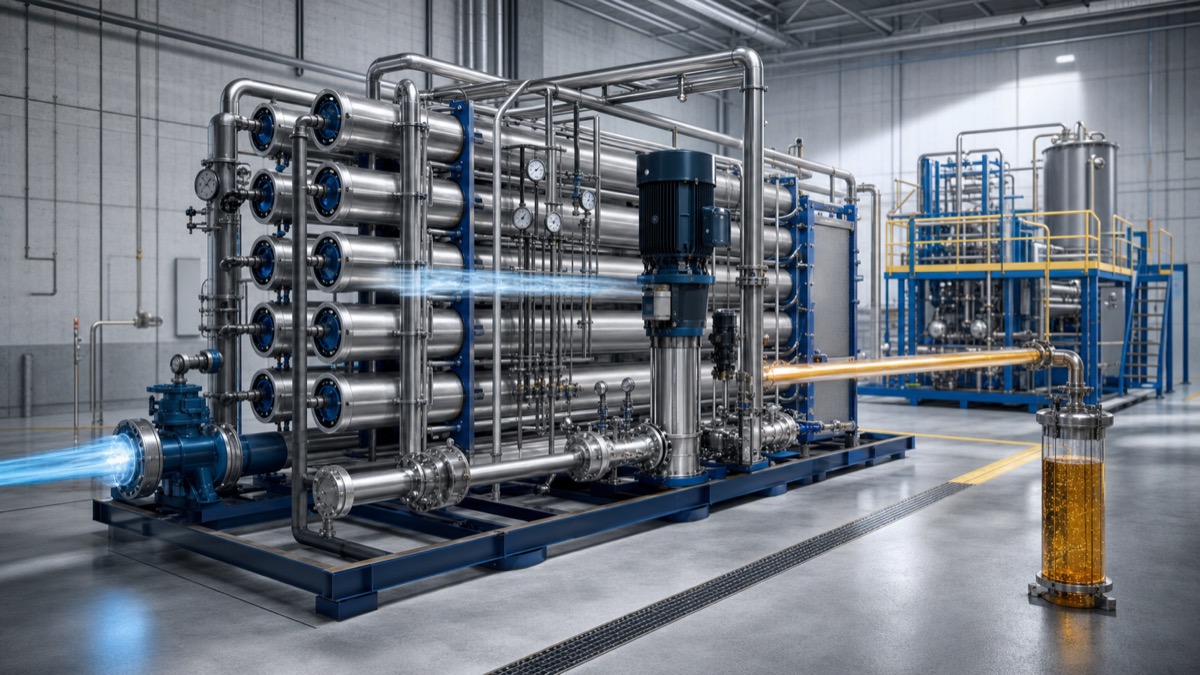
The illustration shows UHPRO as an industrial high-pressure membrane block rather than a generic RO cartridge: multiple pressure vessels, a heavy pumping section, energy-aware pipework, and a concentrated brine stream feeding the thermal ZLD boundary. That is the practical engineering point of this article: UHPRO is valuable only when the membrane block, energy recovery, antiscalant envelope, and downstream evaporator are sized around the same defensible brine chemistry.
Design and Operational Considerations for UHPRO
Implementing UHPRO systems requires meticulous engineering beyond simply selecting higher-pressure pumps and membrane elements. Key considerations include:
1. Membrane Materials and Element Design: UHPRO demands robust membrane materials capable of withstanding sustained high pressures without compaction or significant decline in salt rejection. Polyamide composite membranes have been optimized for these conditions, exhibiting excellent mechanical strength and chemical stability. Element design must minimize pressure drop and maximize active membrane area while maintaining structural integrity.
2. High-Pressure Pumping Systems: Specialized positive displacement or multi-stage centrifugal pumps are required, often designed with exotic alloys to resist corrosion and erosion from high-salinity brines. Energy Recovery Systems (ERS), such as isobaric or turbocharger devices, are indispensable for economic viability, recovering a significant portion of the energy from the high-pressure concentrate stream. Without ERS, the specific energy consumption would render UHPRO uneconomical compared to thermal options.
3. Advanced Pre-treatment: The importance of robust pre-treatment is significantly amplified in UHPRO. Even minor excursions in feed water quality—e.g., elevated suspended solids, colloidal silica, or organic foulants—can rapidly lead to irreversible membrane fouling or scaling due to the higher concentration factors achieved. Advanced physical separation (e.g., ultrafiltration, microfiltration) and chemical conditioning (e.g., precise antiscalant dosing, pH adjustment) become non-negotiable upstream components.
4. Material Selection for Balance of Plant: All components in contact with the high-pressure, high-salinity brine, including piping, valves, and instrumentation, must be rated for the extreme conditions. Duplex stainless steels (e.g., SAF 2205, SAF 2507) or even super-duplex alloys are often specified to prevent catastrophic failures due to corrosion or fatigue.
5. Process Control and Automation: Precise control of pressure, flow rates, and chemical dosing is paramount. Automated Clean-In-Place (CIP) sequences, often involving multiple chemical steps, are critical for maintaining membrane performance and extending operational cycles. Advanced monitoring of feed and permeate quality provides real-time insights into system health and allows for predictive maintenance.
Limits and honest boundaries
While UHPRO offers transformative potential, its performance is highly contingent on diligent system design and operation. Neglecting critical aspects can lead to rapid performance degradation and increased OpEx:
- Inadequate Pre-treatment: Failure to remove suspended solids, colloidal matter, and potential scaling agents (e.g., silica, sulfates, calcium phosphates) will result in severe membrane fouling and scaling. At UHPRO's high concentration factors, scaling will occur faster and be harder to reverse than in conventional RO, leading to increased CIP frequency, chemical consumption, and premature membrane replacement.
- Imprecise Chemical Dosing: Incorrect antiscalant dosage (either under- or over-dosing) or pH adjustment can either fail to inhibit scale formation or, conversely, lead to antiscalant fouling or membrane damage. The margin for error is significantly reduced at high ionic strengths and pressures.
- Lack of Redundancy or Robust Instrumentation: High-pressure operations inherently carry higher risks of mechanical failure. Insufficient redundancy in critical pumps or ERS, or poorly maintained pressure and flow sensors, can lead to system downtime, process instability, and potentially hazardous conditions.
- Material Compatibility Oversights: Using components not rated for the extreme pressures, temperatures, or chemical aggression of the concentrated brine will inevitably lead to material degradation, leaks, or catastrophic failures.
- Operator Training: UHPRO systems are not "set-and-forget." Operators must be highly trained in understanding the nuances of high-pressure operation, membrane chemistry, troubleshooting, and safety protocols.
FAQ
Q1: What are the practical upper limits for UHPRO pressure, and what are the main factors constraining it? A1: While laboratory studies have explored pressures up to 200 bar, the practical upper limit for current commercial UHPRO systems is typically in the 160-180 bar range. Constraints include the mechanical limits of membrane elements (e.g., telescoping, compaction), the strength and corrosion resistance of high-pressure pump components and piping, and the energy efficiency of ERS at extremely high pressures. Material science and ongoing R&D efforts are continuously pushing these boundaries.
Q2: How does UHPRO specifically impact membrane lifespan compared to conventional RO systems? A2: UHPRO systems expose membranes to higher sustained stress and more aggressive feed conditions (higher concentration, potentially higher temperature due to compression). While modern UHPRO membranes are designed for this, their lifespan can be reduced if pre-treatment is not exceptionally robust, leading to accelerated fouling or scaling. However, with optimal design and operation, including effective cross-flow dynamics and precise chemical conditioning, lifespans comparable to conventional high-pressure RO (3-5 years) are achievable.
Q3: Is UHPRO always more energy-efficient than thermal ZLD (e.g., evaporators/crystallizers) for brine concentration? A3: Generally, yes, for the concentration phase. UHPRO, especially when coupled with advanced Energy Recovery Systems (ERS), typically has a specific energy consumption of 1.8-3.5 kWh/m³ of permeate, significantly lower than the 20-100+ kWh/m³ required for thermal evaporation/crystallization. UHPRO's primary role is to reduce the volume fed to the thermal ZLD stage, making the overall ZLD solution more energy-efficient. However, for achieving dry solids from the final concentrated brine, thermal processes remain essential.
Related equipment & product lines
These categories typically support the approach above—open any line to compare brands and models.
- RO MembranesReverse osmosis membrane elements for municipal and industrial desalination.View category →
- Pumps & PumpingHigh-pressure and process pump solutions for water treatment skids and plants.View category →
- Pilot Units TestingPilot rigs and trial modules for process validation and feasibility studies.View category →
For a closer review, use the engineering inquiry form to share feed, capacity, target, and project stage. Submission does not constitute a completed design or performance commitment.