Solutions · Sustainability & ESG
Low-Temperature Membrane Distillation: brine concentration using industrial waste heat
When MD complements RO/ZLD: thermal driving force, fouling reality, and pairing with low-grade heat from stacks or compressors.
Use this guide within its scope
This page supports technical research and option comparison and is marked 2026. Illustrative values are not a quotation, completed process design, certification conclusion, or performance guarantee. Check current regulations, feed data, tests, and OEM records.
Problem
Electrical RO hits osmotic ceilings; low-grade heat often has nowhere productive to go.
Technology
Hybrid thermal–membrane staging with honest flux and cleaning discipline.
Results
Better water balance toward crystallization with lower marginal electricity than pushing RO alone.
Engineering decision card
Use when
Electrical RO hits osmotic ceilings; low-grade heat often has nowhere productive to go.
Evaluate first
Hybrid thermal–membrane staging with honest flux and cleaning discipline.
Inputs still required
Feed source and variability, capacity, target quality, operating hours, discharge or reuse boundary, available space, and utilities.
Comparison output
Better water balance toward crystallization with lower marginal electricity than pushing RO alone. The final decision still needs feed data, mass balance, and any necessary testing.
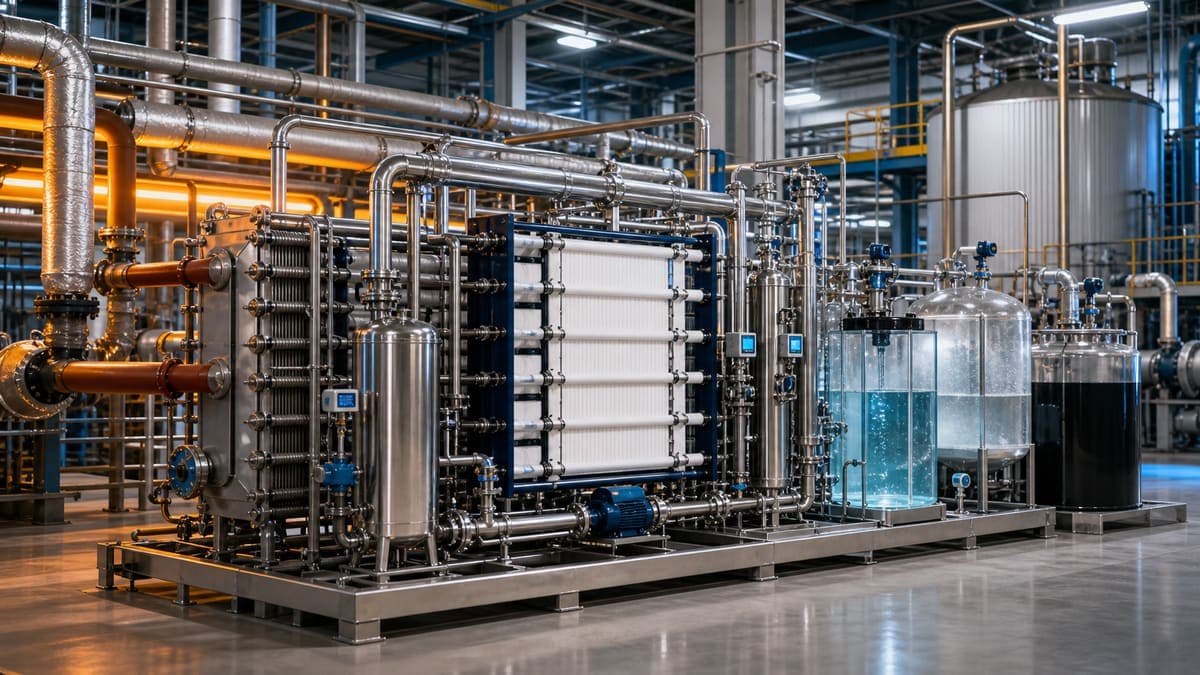
Low-Temperature Membrane Distillation: brine concentration using industrial waste heat
Industrial processes across sectors – from food & beverage to chemicals, mining, and power generation – are often faced with significant volumes of saline wastewater or process brine that require treatment. Discharging these streams is increasingly restricted and costly, posing a substantial water risk for operations and supply chains. While traditional thermal technologies can concentrate these brines, they are notoriously energy-intensive, contributing significantly to operational carbon footprints. As global supply chains, particularly within the UK and EU, impose stricter ESG gates on their partners, companies must seek innovative solutions that reduce both water consumption and greenhouse gas emissions.
Low-Temperature Membrane Distillation (LTMED) offers a compelling pathway to address this dual challenge. By efficiently harnessing abundant, low-grade industrial waste heat – energy typically vented to atmosphere – LTMED systems can concentrate brines, recover clean water, and reduce overall environmental impact, thereby enabling industries to meet evolving sustainability mandates and strengthen their position in export markets.
The Challenge of Brine
Brine management is a critical bottleneck in achieving zero liquid discharge (ZLD) or minimum liquid discharge (MLD) goals. Traditional methods, including reverse osmosis (RO), reach their osmotic pressure limits, leaving behind concentrated brine. Subsequent thermal evaporation, often using multi-effect evaporators (MEE) or crystallizers, demands substantial amounts of high-grade steam or electricity, escalating both operational costs and Scope 1/2 carbon emissions. This economic and environmental burden can make sustainable water management prohibitively expensive, especially for challenging industrial effluents.
How Low-Temperature Membrane Distillation Works
LTMED leverages a hydrophobic microporous membrane that acts as a physical barrier and an air-gap insulator. The process operates on the principle of vapor pressure difference across the membrane. Heated brine (feed side) causes water to evaporate at the membrane surface. The water vapor then passes through the membrane's pores and condenses on a cooler surface (permeate side), typically cooled by the incoming feed or another waste heat stream. Crucially, because the membrane prevents the passage of liquid water and dissolved salts, LTMED can effectively concentrate brines beyond the osmotic pressure limits of conventional RO, achieving very high recovery rates and producing exceptionally pure distillate. Its "low-temperature" aspect means it can operate efficiently with waste heat sources as low as 60-80°C, making it ideal for processes that generate significant low-grade thermal energy.
Worked energy / carbon sketch
Let's illustrate the potential savings for a facility concentrating 10 m³/h of brine, 8,000 hours per year.
An illustrative comparison between a traditional thermal evaporator (e.g., multi-effect evaporator) and an LTMED system leveraging waste heat:
-
Traditional Thermal Evaporator: Requires an average of 60 kWh/m³ of high-grade thermal energy (e.g., steam from natural gas) for brine concentration. Assuming a natural gas boiler efficiency of 85% and a typical natural gas emission factor of 0.2 kg CO₂e/kWh (thermal energy input), this equates to approximately 0.2 / 0.85 * 60 = 14.1 kg CO₂e/m³ of brine treated.
-
LTMED System (this approach): Operates primarily on low-grade industrial waste heat (e.g., 70°C effluent), effectively valorizing energy that would otherwise be discarded. For this sketch, we assume the electrical parasitic load for pumps is 2 kWh/m³ of treated brine. With an illustrative EU grid emission factor of 0.25 kg CO₂e/kWh (Scope 2), this results in 0.5 kg CO₂e/m³.
Annual Carbon Emissions:
- Traditional: 10 m³/h × 8,000 h/year × 14.1 kg CO₂e/m³ = 1,128,000 kg CO₂e/year = 1,128 tonnes CO₂e/year
- this approach LTMED: 10 m³/h × 8,000 h/year × 0.5 kg CO₂e/m³ = 40,000 kg CO₂e/year = 40 tonnes CO₂e/year
Illustrative Annual Carbon Reduction: 1,128 - 40 = 1,088 tonnes CO₂e/year. This significant reduction in Scope 1/2 emissions demonstrates LTMED's potential to dramatically improve a facility's carbon intensity, moving operations closer to ambitious net-zero targets and reducing exposure to carbon pricing mechanisms.
Traditional vs engineering evaluation path
| Aspect | MEE / high-T crystallizer path | LTMED + low-grade heat (engineering evaluation path) |
|---|---|---|
| Primary energy | High-grade steam / fuel-fired thermal; large Scope 1–2. | Low-grade waste heat as driver; modest electrical auxiliaries. |
| OPEX / fouling | Aggressive scaling temperature; heavy CIP and downtime risk. | Lower temperature flux regime; often gentler on mineral fouling (still needs honest pre-treatment). |
| ESG story | Hard to separate water from carbon in disclosures. | Clear “waste heat → water” mass/energy narrative for questionnaires. |
Beyond Operational Savings: ESG Reporting and Water Stewardship
Implementing LTMED with waste heat recovery is not merely an operational efficiency upgrade; it's a strategic move that significantly enhances a company's environmental, social, and governance (ESG) profile. Robust metering and documented mass/energy balance are critical for translating these operational improvements into verifiable data for sustainability reporting. By accurately tracking the volume of water recovered, the energy saved (and thus GHG emissions avoided), and the reduction in brine discharge, companies can credibly respond to increasingly detailed ESG questionnaires from frameworks like CDP (formerly Carbon Disclosure Project) and AWS (Alliance for Water Stewardship). This verifiable data provides a transparent narrative of resource efficiency, circular economy principles, and climate resilience, which is increasingly demanded by investors, regulators, and key buyers in export markets. Avoiding over-claiming and ensuring data integrity through rigorous measurement is paramount.
FAQ
Q1: What types of industrial waste heat can LTMED systems utilise? A: LTMED is particularly well-suited for low-grade waste heat streams, typically in the range of 60-90°C. This includes hot industrial effluent, cooling water from engines or compressors, condenser discharge, flue gas heat, and geothermal sources. The flexibility to use these commonly discarded energy streams is a key advantage.
Q2: How does LTMED compare to conventional reverse osmosis (RO) for brine concentration? A: While RO is excellent for primary desalination, its efficiency declines rapidly with increasing salinity due to osmotic pressure limits. LTMED, being a thermal process, is not limited by osmotic pressure and can concentrate brines to much higher levels, often pushing towards the saturation point, where RO can no longer operate economically or effectively. It also performs better with complex wastewater containing scaling compounds or oils.
Carbon savings calculator (illustrative)
Estimate annual electricity savings and avoided CO₂e when specific energy improves (e.g. after ERD, VFD tuning, or train optimization). Replace defaults with your meter data and your grid emission factor from your utility or ESG methodology.
ΔkWh/year ≈ Q(m³/h) × hours/year × (kWh/m³before − kWh/m³after) · tCO₂e ≈ ΔkWh × factor / 1000
Δ specific energy: 1.00 kWh/m³
Estimated electricity savings: 800,000 kWh/year
Indicative avoided emissions: 336 tCO₂e/year
Related equipment & product lines
These categories typically support the approach above—open any line to compare brands and models.
- Heat ExchangersThermal exchange equipment for process integration and temperature management.View category →
- RO MembranesReverse osmosis membrane elements for municipal and industrial desalination.View category →
- Pilot Units TestingPilot rigs and trial modules for process validation and feasibility studies.View category →
For a closer review, use the engineering inquiry form to share feed, capacity, target, and project stage. Submission does not constitute a completed design or performance commitment.