EDI modules and systems for ultrapure water production.
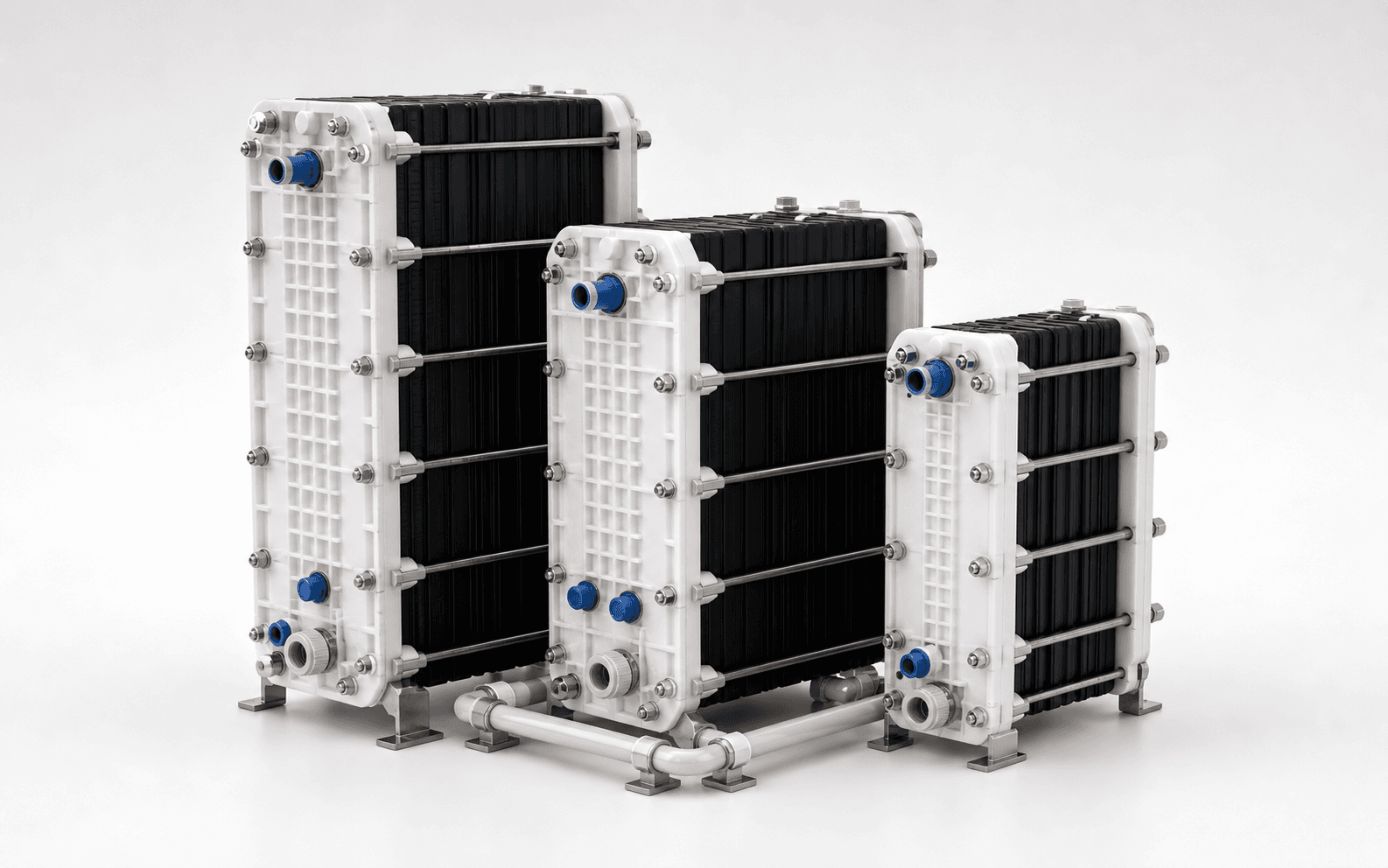
Electrodeionization (EDI) Typical product form
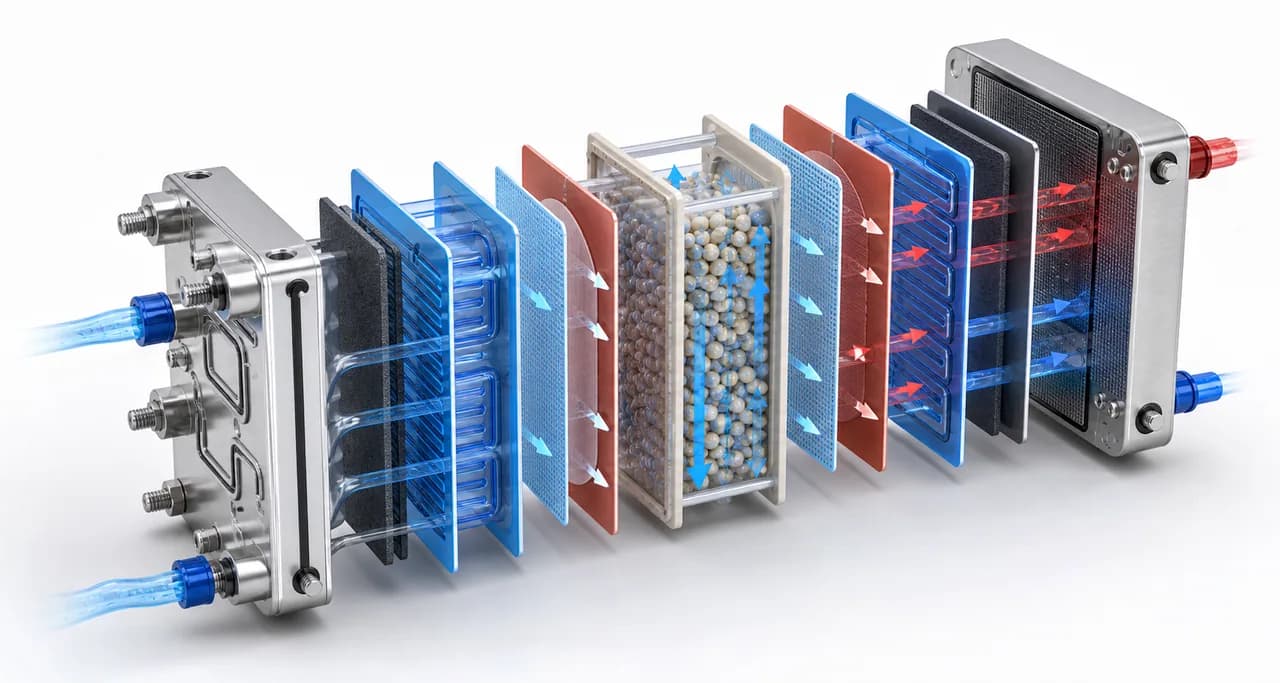
Electrodeionization (EDI) Working principle / structure
Electrodeionization (EDI) Selection path
1
Confirm RO permeate conductivity, CO2, silica, hardness, and temperature
2
Select modules by flow, resistivity target, and acceptable recovery
3
Verify concentrate path, power supply, pressure drop, hygiene, and controls
Electrodeionization (EDI) Application matrix
Electronics UPW
Primary objective
Continuous high-resistivity water
Check first
CO2, silica, TOC, downstream polishing
Pharmaceutical purified water
Primary objective
Reduce chemical regeneration
Check first
Sanitary design, hot/chemical sanitization
Power-plant makeup
Primary objective
Stable demineralization and low silica
Check first
Feed limits, redundancy, availability
Application
Primary objective
Check first
Electronics UPW
Continuous high-resistivity water
CO2, silica, TOC, downstream polishing
Pharmaceutical purified water
Reduce chemical regeneration
Sanitary design, hot/chemical sanitization
Power-plant makeup
Stable demineralization and low silica
Feed limits, redundancy, availability
Electrodeionization (EDI) Product information checklist
Key parameters
Flow, recovery, and target resistivity
Allowable feed conductivity, CO2, silica, and hardness
Operating voltage, current, and pressure drop
System interfaces
RO permeate buffer and degassing
Dilute, concentrate, electrode-water, and drain connections
Rectifier, PLC, interlocks, and grounding
O&M and documents
Resistivity, current, pressure-drop, and flow trends
Scaling, organic fouling, and sanitization limits
Feed specification, performance guarantee, and commissioning record
Indexed coverage:China-based brands 0 · International brands 7 · Total 7
China-based brands
No China-based brand profile is available in this category yet.
International brands
International brands: 7
Each brand card links to a brand profile with model profiles and datasheet entries.
Evoqua / Ionpure, EDI modules
International
Brand profile
Evoqua is now part of Xylem, following the 2023 combination of the two water-technology companies. In ultrapure water and EDI-adjacent applications, Evoqua records should be read as Xylem high-purity platforms that combine laboratory water, semiconductor and pharmaceutical UPW, deionization, service exchange, and packaged purification systems. Evoqua / Ionpure, EDI modules's position in electrodeionization (EDI) is defined by product families such as VNX series, LX series, MX series and NEXED modules. The portfolio is best understood inside ultrapure water, pharmaceutical water, power generation makeup, electronics rinsing, and final polishing after RO, where engineers compare the technology route, family boundaries, and duty fit before narrowing to individual models. Representative series on this page include IP-VNX28-2, IP-VNX50-3 and IP-VXN55EP-2. Selection should focus on feed conductivity, CO2 and silica load, module capacity, recovery, and power integration. These cues help users understand the brand's strongest fit before moving into the model index and product cards for finer comparison.
SnowPure Water Technologies supplies Electropure EDI modules and related high-purity water components including ion-exchange membranes, ED, NF, UF, gas-transfer membranes, power supplies, flow switches, and instrumentation. It is relevant where compact continuous deionization, chemical-free polishing, module integration, and OEM support matter. SnowPure EDI's position in electrodeionization (EDI) is defined by product families such as EXL modules, XL / lab modules and Power supplies. The portfolio is best understood inside ultrapure water, pharmaceutical water, power generation makeup, electronics rinsing, and final polishing after RO, where engineers compare the technology route, family boundaries, and duty fit before narrowing to individual models. Representative series on this page include EXL-650, EXL-750 and EXL-850. Selection should focus on feed conductivity, CO2 and silica load, module capacity, recovery, and power integration. These cues help users understand the brand's strongest fit before moving into the model index and product cards for finer comparison.
DuPont Water Solutions is a global water purification and separation portfolio built around recognized technologies such as FilmTec membranes, AmberLite resins, inge ultrafiltration, and related industrial separation materials. Its influence comes from breadth: the same corporate water platform is used in drinking water, desalination, industrial reuse, pharmaceutical and food processing, electronics ultrapure water, and selective purification. DOW, EDI modules's position in electrodeionization (EDI) is defined by product families such as DOW EDI modules. The portfolio is best understood inside ultrapure water, pharmaceutical water, power generation makeup, electronics rinsing, and final polishing after RO, where engineers compare the technology route, family boundaries, and duty fit before narrowing to individual models. Representative series on this page include EDI-210 and EDI-310. Selection should focus on feed conductivity, CO2 and silica load, module capacity, recovery, and power integration. These cues help users understand the brand's strongest fit before moving into the model index and product cards for finer comparison.
MEGA is an electroseparation and membrane-technology company whose EDI modules use RALEX ion exchange membranes and MPure module know-how for continuous high-purity water production. The brand is relevant where RO permeate polishing, high resistivity, low silica, recovery, chemical-free regeneration, and replacement of mixed beds are the main engineering questions. MEGA EDI modules's position in electrodeionization (EDI) is defined by product families such as EDI stacks, modules, power supplies, and high-purity water polishing systems. The portfolio is best understood inside ultrapure water, pharmaceutical water, power generation makeup, electronics rinsing, and final polishing after RO, where engineers compare the technology route, family boundaries, and duty fit before narrowing to individual models. Representative series on this page include Mpure 36, Power Supply MP36.4800 and HPWU Mpure Systems. Selection should focus on feed conductivity, CO2 and silica load, module capacity, recovery, and power integration. These cues help users understand the brand's strongest fit before moving into the model index and product cards for finer comparison.
Veolia Water Technologies & Solutions combines equipment, chemicals, analytics, engineering, and water-management services that were shaped by the former SUEZ Water Technologies platform. For product selection, Veolia/SUEZ records should be read as plant-scale water-technology lines where component performance, controls, serviceability, and lifecycle support must be assessed together. SUEZ E-Cell Electrodeionization EDI / EDR modules's position in electrodeionization (EDI) is defined by product families such as EDI stacks and E-Cell modules. The portfolio is best understood inside ultrapure water, pharmaceutical water, power generation makeup, electronics rinsing, and final polishing after RO, where engineers compare the technology route, family boundaries, and duty fit before narrowing to individual models. Representative series on this page include SUEZ MK3-1 EU, ECell 3X-2 and 2020-2L-2S. Selection should focus on feed conductivity, CO2 and silica load, module capacity, recovery, and power integration. These cues help users understand the brand's strongest fit before moving into the model index and product cards for finer comparison.
Evoqua is now part of Xylem, following the 2023 combination of the two water-technology companies. In ultrapure water and EDI-adjacent applications, Evoqua records should be read as Xylem high-purity platforms that combine laboratory water, semiconductor and pharmaceutical UPW, deionization, service exchange, and packaged purification systems. Evoqua Ultrapure Water Systems's position in electrodeionization (EDI) is defined by product families such as Ultra Clear systems, Labostar systems and Protegra systems. The portfolio is best understood inside ultrapure water, pharmaceutical water, power generation makeup, electronics rinsing, and final polishing after RO, where engineers compare the technology route, family boundaries, and duty fit before narrowing to individual models. Representative series on this page include Ultra Clear RO, Ultra Clear RO DI and Ultra Clear RO EDI. Selection should focus on feed conductivity, CO2 and silica load, module capacity, recovery, and power integration. These cues help users understand the brand's strongest fit before moving into the model index and product cards for finer comparison.
Veolia Water Technologies & Solutions combines equipment, chemicals, analytics, engineering, and water-management services that were shaped by the former SUEZ Water Technologies platform. For product selection, Veolia/SUEZ records should be read as plant-scale water-technology lines where component performance, controls, serviceability, and lifecycle support must be assessed together. Veolia E-Cell-EDI / EDR's position in electrodeionization (EDI) is defined by product families such as E-Cell modules, EDI stacks and EDR systems / stacks. The portfolio is best understood inside ultrapure water, pharmaceutical water, power generation makeup, electronics rinsing, and final polishing after RO, where engineers compare the technology route, family boundaries, and duty fit before narrowing to individual models. Representative series on this page include EDI Pro E-Cell EU Series, EDI AM Pro E-Cell EU Series and EDI E-Cell Stack MK-7. Selection should focus on feed conductivity, CO2 and silica load, module capacity, recovery, and power integration. These cues help users understand the brand's strongest fit before moving into the model index and product cards for finer comparison.
Electrodeionization (EDI), frequently referred to as Continuous Electrodeionization (CEDI), represents the most advanced technology for ion-exchange in industrial water treatment. This chemically-free process continuously produces high-quality, deionized water, achieving ultrapure standards necessary for critical applications. EDI systems are typically employed as a post-treatment stage for Reverse Osmosis (RO) permeate.
How EDI Technology Works
An EDI module utilizes a sophisticated combination of ion exchange resins, ion-selective membranes, and a direct current (DC) electrical field to continuously purify water:
Feedwater Entry: RO-permeate feedwater flows through compartments packed with mixed-bed ion exchange resins.
Ion Transport: Under the influence of the applied DC electrical field, dissolved ions in the water are driven through adjacent ion-selective membranes. Cations migrate towards the cathode, passing through cation-exchange membranes. Anions migrate towards the anode, passing through anion-exchange membranes.
Resin Regeneration: The electrical field also continuously regenerates the ion exchange resins by splitting water molecules into H+ and OH- ions. These ions then displace the captured impurity ions from the resin beads, effectively eliminating the need for chemical regeneration.
Concentrate Stream: The removed ions accumulate in separate concentrate (reject) compartments. This concentrated waste stream is continuously flushed, ensuring the product water remains ultrapure and the overall process is sustained without interruption for chemical cleaning.
Key Applications
The consistent production of ultrapure water makes EDI/CEDI an essential technology across various high-end industrial sectors:
Power Generation: Critical for boiler feedwater, turbine steam, and cooling systems where even trace impurities can cause significant damage and efficiency loss.
Pharmaceutical Industry: Essential for Water for Injection (WFI) and other process water needs requiring stringent purity levels, free from chemical contaminants.
Process Industry: For applications demanding consistently high-purity water, protecting sensitive equipment and ensuring product quality.
System Integration and Performance
EDI systems are engineered for seamless integration downstream of a Reverse Osmosis (RO) unit. The quality of the RO permeate directly influences the efficiency and lifespan of the EDI module. Optimal performance is achieved with pre-treated feedwater that meets specific quality parameters.
For specific performance data, including detailed module specifications, flow rates, pressure requirements, and product water resistivity, please refer to the certified technical datasheets provided by the module manufacturers. AquaChain facilitates access to comprehensive documentation to support your system design and procurement.
AquaChain's EDI Solutions
AquaChain offers a comprehensive range of Electrodeionization solutions tailored to meet diverse industrial requirements. From individual EDI modules to complete, skid-built turn-key EDI plants, we provide access to high-performance systems for your ultrapure water needs.