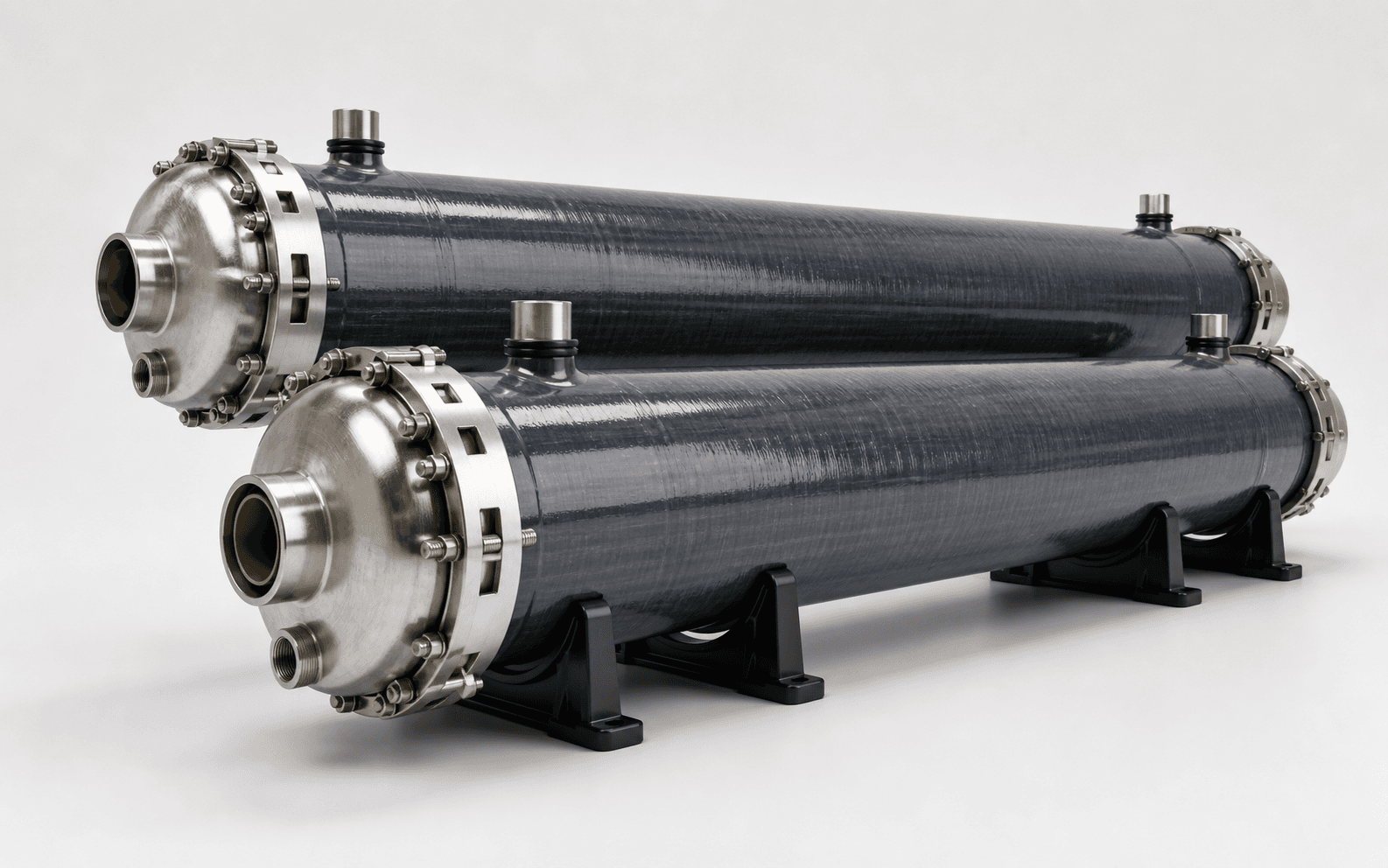
RO membrane pressure vessels and housings for industrial desalination and high-pressure treatment skids.
Pressure Vessels Typical product form
Pressure Vessels Working principle / structure
Pressure Vessels Selection path
1
Set design pressure, temperature, element size, and elements per vessel
2
Choose end/side porting, connection size, materials, and certification
3
Verify support spacing, thrust direction, closure service, and spares
Pressure Vessels Application matrix
Industrial BWRO
Primary objective
House standard medium/high-pressure arrays
Check first
Design pressure, element count, ports
High-pressure SWRO
Primary objective
Contain seawater desalination pressure
Check first
Pressure rating, fatigue, certification
Compact skids and replacement
Primary objective
Fit existing racks and piping
Check first
Envelope, ports, supports, spares
Application
Primary objective
Check first
Industrial BWRO
House standard medium/high-pressure arrays
Design pressure, element count, ports
High-pressure SWRO
Contain seawater desalination pressure
Pressure rating, fatigue, certification
Compact skids and replacement
Fit existing racks and piping
Envelope, ports, supports, spares
Pressure Vessels Product information checklist
Key parameters
Maximum operating pressure and design temperature
Element format and vessel capacity
Port type, size, and orientation
System interfaces
Rack supports, straps, and axial thrust
Elements, adapters, and interstage connections
High-pressure piping and concentrate/permeate interfaces
O&M and documents
Closure removal and locking inspection
O-rings, thrust ring, and adapter spares
Pressure test, material certificates, and installation manual
Indexed coverage:China-based brands 1 · International brands 9 · Total 10
China-based brands
ROPV
China-based
Brand profile
ROPV is a performance-engineered FRP pressure-vessel brand for water treatment, desalination, and industrial processing. It is a leading Asia-Pacific manufacturer with more than 1.5 million units installed, making it important in RO/NF system design where pressure rating, port layout, element count, code expectations, and safety margins define fit. ROPV Pressure Vessels's position in water treatment products is defined by product families such as multiple water-treatment product families. The portfolio is best understood inside industrial, municipal, and commercial water-treatment applications, where engineers compare the technology route, family boundaries, and duty fit before narrowing to individual models. First compare pressure rating, membrane count, port layout, closure design, certification, and skid space. These cues help users understand the brand's strongest fit before moving into the model index and product cards for finer comparison.
Each brand card links to a brand profile with model profiles and datasheet entries.
Bel Pressure Vessels
International
Brand profile
BEL Composite Iberica / BEL Pressure Vessels is a composite pressure-vessel manufacturer for RO membrane housings, with BEL Group roots going back to 1966 and its composite pressure-vessel focus in desalination since 1999. It is relevant where FRP vessel code compliance, diameter, port style, pressure rating, and global desalination references matter. Bel Pressure Vessels's position in RO/NF membranes and related equipment is defined by product families such as 4" End Port Pressure Vessels, 4" Side Port Pressure Vessels, 8" End Port Pressure Vessels and 8" Side Port Pressure Vessels. The portfolio is best understood inside brackish water, seawater desalination, ultrapure water, process separation, reuse, degassing, and membrane system packaging, where engineers compare the technology route, family boundaries, and duty fit before narrowing to individual models. Representative series on this page include 4-E-300-1M-&-2M, 4-E-300-3M-to-6M and 4-E-450-1M-&-2M. Engineers should compare element size, salt rejection, permeate flow, pressure rating, fouling resistance, connection type, and vessel fit. These cues help users understand the brand's strongest fit before moving into the model index and product cards for finer comparison.
Pentair is a broad water equipment group whose water-treatment brands include control valves, softening components, filter housings and cartridges, pumps, membrane housings, and X-Flow membrane modules. Its influence comes from installed-base breadth: many residential, commercial, industrial, and packaged water systems are designed around Pentair components, so selection often depends on service parts, controls, and compatibility as much as on the individual product rating. Codeline Pressure Vessels's position in RO/NF membranes and related equipment is defined by product families such as 4" CodeLine Membrane Housings, 8" CodeLine Membrane Housings, Ecoline series and Accessories. The portfolio is best understood inside brackish water, seawater desalination, ultrapure water, process separation, reuse, degassing, and membrane system packaging, where engineers compare the technology route, family boundaries, and duty fit before narrowing to individual models. Representative series on this page include CodeLine 40 E, CodeLine 40 S and 40E30. Engineers should compare element size, salt rejection, permeate flow, pressure rating, fouling resistance, connection type, and vessel fit. These cues help users understand the brand's strongest fit before moving into the model index and product cards for finer comparison.
Knappe Composites manufactures compact FRP membrane housings, RO pressure vessels, Xtype skids, and stainless components for RO and NF systems. Its The brand emphasizes more than 40 years of expertise, in-house manufacturing, and EU PED / ASME Section X design, making it relevant where vessel compactness and code expectations shape skid design. Knappe Pressure Vessels's position in RO/NF membranes and related equipment is defined by product families such as 4" Front Port Pressure Vessels, 8" Side Port Pressure Vessels, 8" Front Port Pressure Vessels and Extra information. The portfolio is best understood inside brackish water, seawater desalination, ultrapure water, process separation, reuse, degassing, and membrane system packaging, where engineers compare the technology route, family boundaries, and duty fit before narrowing to individual models. Representative series on this page include Serie 4" V4i 21, Permeat assembly and Feed assembly. Engineers should compare element size, salt rejection, permeate flow, pressure rating, fouling resistance, connection type, and vessel fit. These cues help users understand the brand's strongest fit before moving into the model index and product cards for finer comparison.
Phoenix Vessel Technology is a UK manufacturer of GRP pressure vessels used as housings for reverse-osmosis membrane elements. Its profile is relevant where ASME Section X accreditation, PED practice, pressure range, element count, end fittings, and vessel testing need to be checked for RO plant design. Phoenix Pressure Vessels's position in RO/NF membranes and related equipment is defined by product families such as Technical manuals, 2,5" Pressure Vessels, 4" End Port Pressure Vessels and 8" End Port Pressure Vessels. The portfolio is best understood inside brackish water, seawater desalination, ultrapure water, process separation, reuse, degassing, and membrane system packaging, where engineers compare the technology route, family boundaries, and duty fit before narrowing to individual models. Representative series on this page include 2,5" Installation Manual, 2,5" End Port Pressure Vessel 69 bar and 4,625" End Port Pressure Vessel 17,2 bar. Engineers should compare element size, salt rejection, permeate flow, pressure rating, fouling resistance, connection type, and vessel fit. These cues help users understand the brand's strongest fit before moving into the model index and product cards for finer comparison.
Protec Arisawa is an Arisawa Group FRP pressure-vessel specialist for membrane filtration systems. It has three production sites on three continents and more than 50 years of filament-winding experience, making the brand relevant for RO, NF, UF, and desalination systems where vessel safety, pressure range, custom sizes, corrosion resistance, and replacement-part support are key selection issues. Protec Bekaert Pressure Vessels's position in RO/NF membranes and related equipment is defined by product families such as Spares / manuals, Other documents, 600 psi Pressure Vessels and 1000 psi Pressure Vessels. The portfolio is best understood inside brackish water, seawater desalination, ultrapure water, process separation, reuse, degassing, and membrane system packaging, where engineers compare the technology route, family boundaries, and duty fit before narrowing to individual models. Representative series on this page include Bekaert Progressive Composites-brochure, Protec User Manual Pressure vessels and Protec Arisawa FRP-Collectors. Engineers should compare element size, salt rejection, permeate flow, pressure rating, fouling resistance, connection type, and vessel fit. These cues help users understand the brand's strongest fit before moving into the model index and product cards for finer comparison.
Wave Cyber is a Shanghai-based manufacturer of composite pressure tanks, membrane pressure vessels, and related water-treatment components. In membrane-system design it is relevant where FRP vessel construction, pressure class, port configuration, certification expectations, and component availability affect skid layout and maintenance. Membranes / Vessels (Wave Cyber)'s position in RO/NF membranes and related equipment is defined by product families such as 150 psi series, 300 psi series, 450 psi series and 600 psi series. The portfolio is best understood inside brackish water, seawater desalination, ultrapure water, process separation, reuse, degassing, and membrane system packaging, where engineers compare the technology route, family boundaries, and duty fit before narrowing to individual models. Representative series on this page include MPV 150 8" side port, MPV 150 8" side port Norit and MPV 150 8" side port sanitairy. Engineers should compare element size, salt rejection, permeate flow, pressure rating, fouling resistance, connection type, and vessel fit. These cues help users understand the brand's strongest fit before moving into the model index and product cards for finer comparison.
PWG membrane housings are represented here as RO pressure-vessel products for 2.5 inch, 4 inch, and 8 inch membranes, with published material describing pressure ranges from 150 to 1200 PSI. Selection should focus on pressure class, port layout, membrane size, UV-resistant finish, stock availability, and long-term housing reliability. PWG Membrane Housings's position in RO/NF membranes and related equipment is defined by product families such as RO, NF, UF-adjacent membrane elements, membrane contactors, pressure vessels, housings, and related separation products. The portfolio is best understood inside brackish water, seawater desalination, ultrapure water, process separation, reuse, degassing, and membrane system packaging, where engineers compare the technology route, family boundaries, and duty fit before narrowing to individual models. Representative series on this page include General. Engineers should compare element size, salt rejection, permeate flow, pressure rating, fouling resistance, connection type, and vessel fit. These cues help users understand the brand's strongest fit before moving into the model index and product cards for finer comparison.
3M Liqui-Cel and Liqui-Flux records should be read as 3M membrane contactor and membrane-filtration technologies. Liqui-Cel is used for dissolved gas control such as degassing and carbonation management, while Liqui-Flux UF modules support filtration duties where compact membrane modules and established 3M component supply are useful. 3M-Liqui-Cel® Membrane Contactors's position in RO/NF membranes and related equipment is defined by product families such as Debubbling, Gas transfer, Degassing (low surface tension fluids) and Application / guidance. The portfolio is best understood inside brackish water, seawater desalination, ultrapure water, process separation, reuse, degassing, and membrane system packaging, where engineers compare the technology route, family boundaries, and duty fit before narrowing to individual models. Representative series on this page include MM Series 0.5 x 1, MM Series 0.75 x 1 and MM Series 1.7 x 5.5. Engineers should compare element size, salt rejection, permeate flow, pressure rating, fouling resistance, connection type, and vessel fit. These cues help users understand the brand's strongest fit before moving into the model index and product cards for finer comparison.
Wila is a Danish hygienic process-equipment manufacturer focused on stainless tubular heat exchangers, membrane housings, tanks, and complete units for food, beverage, dairy, and process industries. Its products are relevant where heat transfer, hygienic design, cleanability, pressure rating, and custom stainless fabrication need to be assessed together. Wila Membrane Housings's position in RO/NF membranes and related equipment is defined by product families such as MH series, MHCA series, MHC series and MHA series. The portfolio is best understood inside brackish water, seawater desalination, ultrapure water, process separation, reuse, degassing, and membrane system packaging, where engineers compare the technology route, family boundaries, and duty fit before narrowing to individual models. Representative series on this page include MH-4-40, MH-6-16 and MH-8-12. Engineers should compare element size, salt rejection, permeate flow, pressure rating, fouling resistance, connection type, and vessel fit. These cues help users understand the brand's strongest fit before moving into the model index and product cards for finer comparison.
Pressure vessels are the structural housings that hold spiral-wound RO membrane elements under operating pressure. They directly influence mechanical reliability, sealing integrity, and long-term maintainability in desalination and high-recovery water treatment trains.
Typical Configuration Scope
Pressure-vessel product lines usually vary by vessel diameter, element count, end-port or side-port layout, and pressure rating. Selection should be aligned with membrane element format, plant hydraulics, and site maintenance standards.
Where They Are Used
Pressure vessels are common in brackish-water RO, seawater desalination, industrial reuse, and ultrapure-water pretreatment lines. In each case, vessel pressure class and connection standard should match design pressure, transients, and corrosion environment.
Practical Selection Notes
When comparing brands and models, verify shell construction, pressure rating, port standard, and allowable operating envelope from the OEM datasheet. For project procurement, also confirm compatibility with membrane element length, adapter type, and skid piping standard before final selection.