Solutions · Application Scenarios
Brackish water desalination: inland high-TDS groundwater to spec
BWRO trains sized on real geochemistry, pretreatment for SDI/iron/manganese, and concentrate routing. Compliance-grade permeate with a signed-off reject…
Use this guide within its scope
This page supports technical research and option comparison and is marked 2026. Illustrative values are not a quotation, completed process design, certification conclusion, or performance guarantee. Check current regulations, feed data, tests, and OEM records.
Problem
Inland wells exceed product or discharge limits for TDS and specific ions.
Technology
BWRO trains sized on real geochemistry, pretreatment for SDI/iron/manganese, and concentrate routing.
Results
Compliance-grade permeate with a signed-off reject management story.
Engineering decision card
Use when
Inland wells exceed product or discharge limits for TDS and specific ions.
Evaluate first
BWRO trains sized on real geochemistry, pretreatment for SDI/iron/manganese, and concentrate routing.
Inputs still required
Feed source and variability, capacity, target quality, operating hours, discharge or reuse boundary, available space, and utilities.
Comparison output
Compliance-grade permeate with a signed-off reject management story. The final decision still needs feed data, mass balance, and any necessary testing.
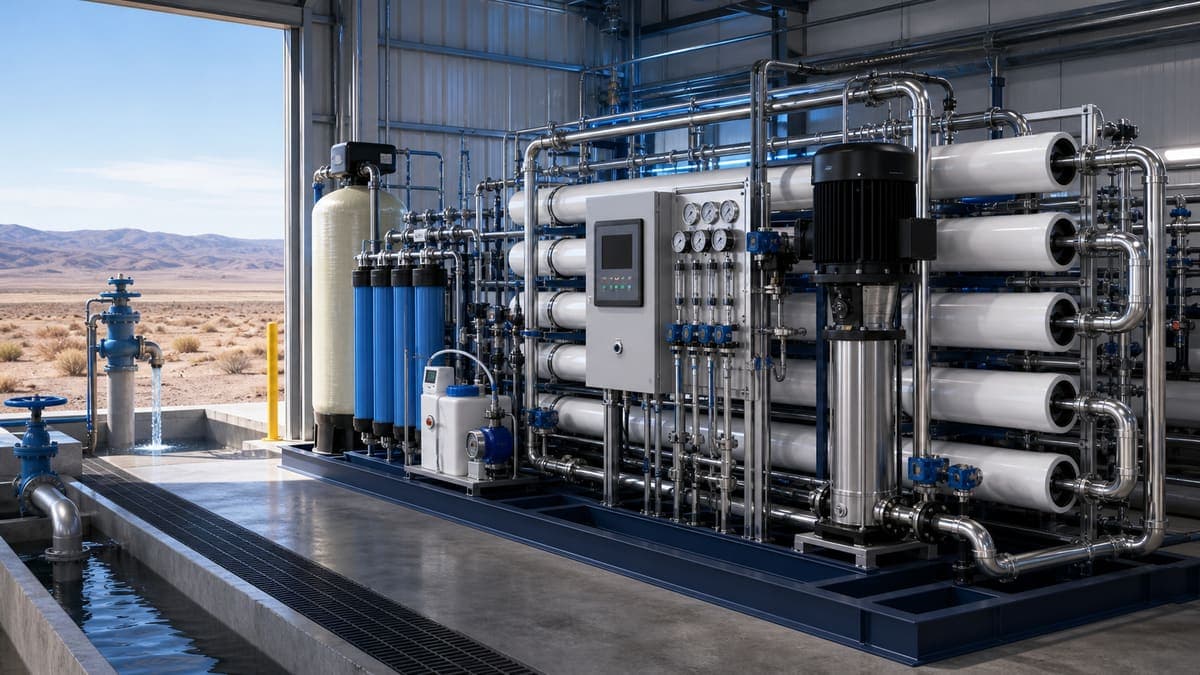
1. Process context & when this scenario is the right entry point
Brackish water desalination addresses the critical need for reliable water sources in regions with limited access to fresh surface water, particularly inland areas. This scenario typically involves treating groundwater or highly impacted surface water with total dissolved solids (TDS) ranging from 1,000 mg/L to 15,000 mg/L. The primary objective is to produce high-quality process water for industrial applications, potable water, or to augment existing water supplies, thereby reducing reliance on increasingly strained freshwater resources.
This process is the right entry point when:
- Existing water sources are insufficient or of declining quality.
- Regulatory drivers mandate reduced freshwater abstraction or improved effluent quality.
- Industrial processes require specific water quality parameters (e.g., low hardness, low conductivity) that cannot be met by conventional treatment.
- The economic cost of alternative water sources (e.g., long-distance pipelines, trucked-in water) outweighs the capital and operational expenditures of an onsite desalination plant.
- An integrated water management strategy is pursued, aiming for water circularity or reduced environmental discharge.
2. Feed characteristics & key risks
Brackish water sources exhibit significant variability. Common feed characteristics include:
- TDS: 1,000 – 15,000 mg/L, often dominated by calcium, magnesium, sodium, chloride, sulfate, and bicarbonate ions.
- Hardness: High concentrations of Ca²⁺ and Mg²⁺, posing scaling risks.
- Silica: Dissolved amorphous silica, which can scale at concentrations exceeding 120-200 mg/L, especially at higher temperatures and pH.
- Organic Matter: Natural organic matter (NOM) or synthetic organics, leading to membrane fouling.
- Suspended Solids & Colloids: Measured by turbidity and Silt Density Index (SDI), these cause particulate fouling.
- Iron & Manganese: Divalent metal ions that can precipitate as hydroxides or oxides, contributing to scaling and fouling.
- Biological Contaminants: Bacteria, algae, and other microorganisms that can form biofilms on membrane surfaces.
Key risks associated with brackish water reverse osmosis (BWRO) include:
- Fouling: Reduction in permeate flux and increased differential pressure due to accumulation of particulates, organics, or biological growth on the membrane surface.
- Scaling: Precipitation of sparingly soluble salts (e.g., CaCO₃, CaSO₄, BaSO₄, SrSO₄, SiO₂) when their saturation limits are exceeded in the concentrated reject stream. Langelier Saturation Index (LSI) is a key indicator for calcium carbonate scaling.
- Osmotic Pressure: Higher feed TDS translates to higher osmotic pressure, requiring greater applied pressure for permeate production and limiting economic recovery rates.
- Membrane Degradation: Oxidation by chlorine or other strong oxidants, hydrolysis from extreme pH, or physical damage from inadequate pretreatment.
- Concentrate Management: The reject stream, containing all concentrated impurities, presents a significant disposal or valorization challenge.
3. Concentrate / reject routing
A fundamental principle of water treatment is mass balance; matter is not destroyed, merely transformed or concentrated. For brackish water desalination, the concentrate stream, typically 15-50% of the feed flow and containing 3-5 times the feed TDS, represents the primary disposition challenge. Thoughtful and sustainable concentrate management is non-negotiable.
Common strategies for concentrate disposition include:
- Discharge to Wastewater Treatment Plant (WWTP): If the local WWTP has capacity and the concentrate quality (TDS, specific contaminants) is within discharge limits, this can be an option. Regulatory compliance for discharge to surface waters or sewer systems is paramount.
- Direct Discharge to Surface Waters: Requires extensive permitting and often further treatment (e.g., pH adjustment, dilution) to meet stringent environmental discharge standards. Only viable if the receiving body has sufficient assimilative capacity.
- Evaporation Ponds: For sites with ample land, suitable climate (high evaporation rates), and appropriate geological conditions. Requires liners to prevent groundwater contamination.
- Deep Well Injection: Geologically dependent, requiring specific subsurface formations for safe, long-term storage of concentrated brine. Subject to stringent environmental regulations and permitting.
- Further Concentration for ZLD (Zero Liquid Discharge):
- High-Recovery RO/NF: Deploying specialized RO/NF systems (e.g., industrial RO configurations) designed to operate at higher osmotic pressures or tolerate higher fouling/scaling risks. This can reduce the volume of the final concentrate by 50-80%.
- Brine Concentrators / Evaporators: Mechanical Vapor Recompression (MVR) evaporators or multi-effect distillation (MED) can significantly reduce brine volume, often achieving 90-95% water recovery from the RO concentrate.
- Crystallizers: The final step in many ZLD systems, converting concentrated brine into a solid, often recyclable, salt cake (e.g., NaCl, Na₂SO₄). This eliminates liquid discharge entirely.
- Blending with Raw Feed: In some industrial scenarios, a portion of the RO concentrate can be recycled and blended with the raw feed, provided it doesn't violate product water specifications or exacerbate scaling/fouling upstream. This reduces the net concentrate volume but requires careful monitoring of saturation indices.
- Haul-off: For smaller facilities or temporary operations, concentrate can be trucked away for off-site treatment or disposal. This is typically the most expensive option per unit volume.
The selected concentrate management strategy must be engineered at the project's outset, considering regulatory limits, economic viability, and environmental impact.
4. Reference process train options
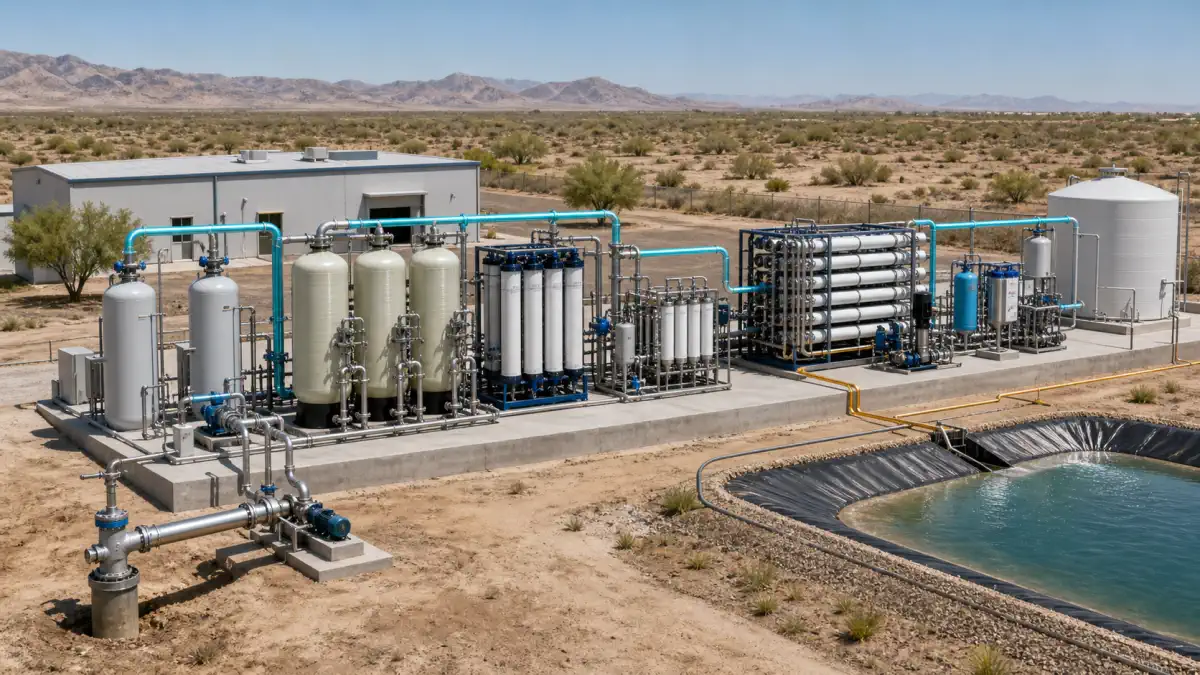
The choice of process train depends heavily on feed water quality, desired permeate quality, and concentrate management strategy.
5. Operating parameters
Precise control and monitoring of operating parameters are essential for sustainable membrane performance and longevity.
- SDI₁₅ Targets: The Silt Density Index (SDI₁₅) measures the fouling potential of suspended solids. For spiral wound RO membranes, a sustained SDI₁₅ <5, and ideally <3, is critical to minimize particulate fouling. Exceeding these targets leads to rapid flux decline and frequent cleanings.
- LSI / Scaling Posture: The Langelier Saturation Index (LSI) is used to predict calcium carbonate scaling. Antiscalant dosing and/or pH adjustment are designed to maintain an LSI <0 at the concentrate-side pH or ensure that all relevant scaling indices (calcium sulfate, silica, barium sulfate, strontium sulfate) remain below saturation limits in the most concentrated stream within the RO elements. Silica concentration in the concentrate should typically be maintained below 120-200 mg/L, depending on pH and temperature.
- Design Flux (LMH): Permeate flux (liters per square meter per hour, LMH) is a critical design and operating parameter. Typical design flux for brackish water RO ranges from 10 to 25 LMH, depending on feed water quality, temperature, and target recovery. More challenging feeds (higher fouling/scaling potential) or systems aiming for very high recovery require lower design fluxes to mitigate fouling rates and prolong membrane life between cleanings. Higher flux can lead to accelerated fouling and compaction.
- Differential Pressure (ΔP): The pressure drop across an RO membrane stage or vessel (stage ΔP) is a primary indicator of fouling. A significant and sustained increase in ΔP (e.g., >10-15% over baseline) typically signifies membrane fouling (particulate, organic, biological) and triggers a clean-in-place (CIP) cycle. Monitoring ΔP across individual pressure vessels or elements provides critical diagnostic information for troubleshooting.
6. Digital twin & instrumentation
Instrumentation & Sensors:
- Flow Meters: Electromagnetic or ultrasonic flow meters for feed, permeate, and concentrate streams (including individual arrays/stages).
- Pressure Transducers: High-accuracy sensors for feed pressure, inter-stage pressures, permeate pressure, and concentrate pressure.
- Conductivity Meters: Continuous measurement of feed, permeate, and concentrate conductivity for real-time monitoring of salt rejection and membrane integrity.
- Temperature Sensors: Feed water temperature is critical as it affects flux and viscosity.
- pH Meters: For feed, antiscalant dosing point, and permeate streams.
- ORP (Oxidation-Reduction Potential) Sensors: To monitor oxidant levels, particularly after dechlorination.
- Turbidity Sensors: On filtered feed to assess pretreatment effectiveness.
- Online SDI Analyzer: For continuous monitoring of the Silt Density Index, providing immediate alerts to pretreatment excursions.
7. Pilot-Scale vs Industrial RO
For brackish water desalination, the choice between pilot-scale RO and industrial RO depends primarily on scale, operational complexity, and long-term strategic objectives. The pilot-scale RO is ideal for pilot projects, temporary water supply needs, or smaller industrial demands, typically below 200 m³/day. Its compact, modular, and often containerized design allows for rapid deployment, ease of relocation, and focused testing of feed water characteristics and specific membrane chemistries. It features robust but simplified controls and remote monitoring capabilities suitable for standalone operations. In contrast, the industrial RO is engineered for large-scale, continuous production demands, ranging from several hundreds to thousands of cubic meters per day. These multi-stage systems incorporate advanced energy recovery devices, comprehensive automation via full SCADA integration with plant Distributed Control Systems (DCS), and ZLD-class design considerations for complex concentrate management. industrial RO is built for maximum uptime, lowest total cost of ownership, and seamless integration into existing industrial infrastructure.
8. Common engineering mistakes & pilot KPIs
Common Engineering Mistakes:
- Underestimating Feed Water Variability: Failing to account for seasonal or long-term changes in feed water quality (e.g., organics, silica, turbidity) leading to inadequate pretreatment design.
- Inadequate Pretreatment Design: A primary cause of premature membrane fouling, necessitating frequent cleanings, high chemical usage, and reduced membrane lifespan. Insufficient removal of suspended solids (high SDI), colloids, and oxidants.
- Overly Optimistic Recovery Targets: Designing for maximum recovery without a robust and economically viable concentrate management plan, leading to an intractable disposal problem or severe scaling issues.
- Ignoring Membrane Fouling/Scaling Indicators: Not properly monitoring or reacting to increases in differential pressure, changes in permeate quality, or deviations in normalized flux.
- Improper Chemical Dosing: Incorrect antiscalant type or dosage, or inadequate pH control, leading to rapid scaling.
- Lack of Pilot Testing: For complex or highly variable brackish water sources, skipping pilot studies can lead to significant design flaws and operational challenges post-commissioning.
Pilot Key Performance Indicators (KPIs):
- Sustainable Recovery Rate: The highest achievable permeate recovery rate that can be maintained without excessive fouling or scaling.
- Permeate Quality & Consistency: Meeting target conductivity, hardness, and other specific ion limits.
- Membrane Fouling Rate: Quantified by the rate of increase in normalized differential pressure (ΔP) and decline in normalized permeate flux.
- Cleaning Frequency & Effectiveness: How often CIP is required and its ability to fully restore performance.
- Antiscalant Efficacy: Verification that the selected antiscalant prevents scaling at design recovery.
- Specific Energy Consumption: kWh per m³ of permeate produced, crucial for operating cost projections.
- Concentrate Characteristics: Confirming the quality and volume of the concentrate for downstream disposal or further treatment.
9. FAQ
Q: How does feed water temperature affect BWRO performance and design? A: Lower feed water temperatures increase water viscosity, which reduces permeate flux and increases the hydraulic pressure required to maintain a given flow. Conversely, higher temperatures increase flux but can also increase the solubility of some scalants (e.g., silica) while decreasing others (e.g., calcium carbonate). Design must account for temperature variations to ensure consistent performance; often, higher design pressures or larger membrane areas are specified for colder feed waters.
Q: What is the primary advantage of using NF as a pre-treatment for BWRO? A: The main advantage of NF pre-treatment is its ability to selectively remove multivalent ions like calcium, magnesium, and sulfates at lower operating pressures than RO. This significantly reduces the scaling potential (especially for CaCO₃ and CaSO₄) in the downstream BWRO stage, allowing the RO system to operate at higher recoveries, lower operating pressures, and with potentially less antiscalant, thus lowering overall OPEX and extending membrane life.
Q: Can BWRO concentrate be economically treated for higher recovery or ZLD? A: Yes, BWRO concentrate can be further treated for higher recovery or ZLD, but the economics are highly site-specific. This typically involves a combination of specialized high-recovery RO/NF systems, brine concentrators (evaporators), and crystallizers. While capital and operating costs are significantly higher than basic RO, ZLD becomes economically viable when discharge regulations are extremely stringent, disposal costs are prohibitive, or water scarcity necessitates maximum water reuse.
Q: What are the key considerations for selecting an antiscalant for BWRO? A: Antiscalant selection depends on the specific ionic composition of the feed water, anticipated scaling potential (especially LSI, silica, and sulfate saturation indices), operating pH, and temperature. The antiscalant must effectively inhibit precipitation of all potential scalants at the highest concentration factor in the system. Compatibility with membrane materials, environmental discharge regulations, and cost-effectiveness are also critical factors.
Related equipment & product lines
These categories typically support the approach above—open any line to compare brands and models.
For a closer review, use the engineering inquiry form to share feed, capacity, target, and project stage. Submission does not constitute a completed design or performance commitment.