Solutions · Application Scenarios
Fluoride and arsenic removal: drinking-water and industrial discharge barriers
Speciation-aware treatment with media/IX/RO and explicit waste residual streams. Contract-defensible effluent with documented handling of spent media and…
Use this guide within its scope
This page supports technical research and option comparison and is marked 2026. Illustrative values are not a quotation, completed process design, certification conclusion, or performance guarantee. Check current regulations, feed data, tests, and OEM records.
Problem
Toxic anions need a validated second barrier beyond generic filtration.
Technology
Speciation-aware treatment with media/IX/RO and explicit waste residual streams.
Results
Contract-defensible effluent with documented handling of spent media and concentrates.
Engineering decision card
Use when
Toxic anions need a validated second barrier beyond generic filtration.
Evaluate first
Speciation-aware treatment with media/IX/RO and explicit waste residual streams.
Inputs still required
Feed source and variability, capacity, target quality, operating hours, discharge or reuse boundary, available space, and utilities.
Comparison output
Contract-defensible effluent with documented handling of spent media and concentrates. The final decision still needs feed data, mass balance, and any necessary testing.
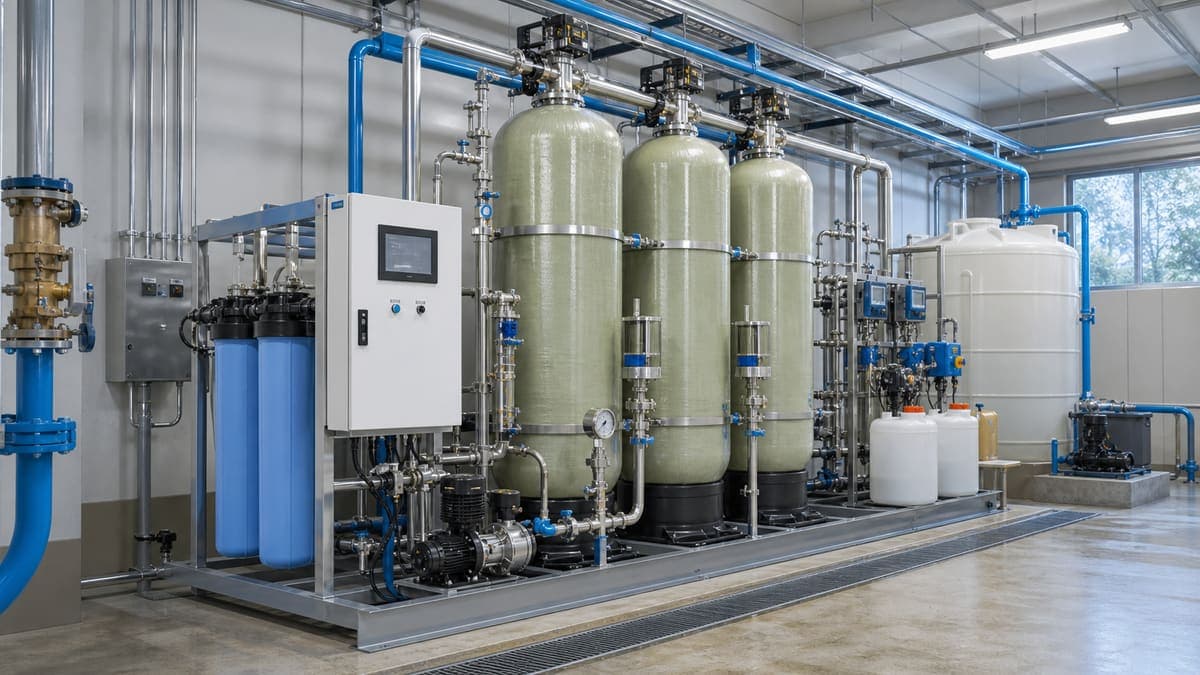
1. Process context & when this scenario is the right entry point
Fluoride (F⁻) and arsenic (As) are regulated contaminants in both drinking water and industrial wastewater discharges globally due to their significant health risks. Fluoride, while beneficial in low concentrations, causes dental and skeletal fluorosis at elevated levels. Arsenic is a known carcinogen, and its presence in water, even at microgram per liter levels, poses serious long-term health hazards. This scenario applies when source water or industrial effluent contains F⁻ and/or As above regulatory limits (e.g., WHO guideline for As is 10 µg/L, US EPA MCL for As is 10 µg/L, for F⁻ is 4 mg/L).
Typical applications include municipal drinking water treatment where natural geological formations release these contaminants, and industrial sectors such as mining, semiconductor manufacturing, glass production, and power generation, where F⁻ and As can be process byproducts or leached from raw materials. Targeted removal strategies are necessary because these contaminants are often present alongside other dissolved solids and can interact complexly with treatment chemicals and media.
2. Feed characteristics & key risks
The efficacy of F⁻ and As removal processes is highly dependent on feed water characteristics. Fluoride typically exists as the F⁻ ion, but its removal efficiency can be affected by pH and other competing anions. Arsenic speciation is crucial: arsenate (As(V)) is anionic (H₂AsO₄⁻, HAsO₄²⁻) and generally easier to remove by adsorption or ion exchange, while arsenite (As(III)) is uncharged (H₃AsO₃) at neutral pH, making its removal more challenging without prior oxidation. Common co-contaminants include iron, manganese, hardness (calcium, magnesium), sulfates, chlorides, and total organic carbon (TOC), which can interfere with treatment.
Key risks for downstream membrane processes include:
- Fouling: Particulate fouling (silt, colloids) and organic fouling (TOC) can lead to reduced flux and increased cleaning frequency. Biofouling is also a concern.
- Scaling: High concentrations of sparingly soluble salts like calcium fluoride (CaF₂), calcium carbonate (CaCO₃), silica, and metal hydroxides (if iron/manganese are present and not removed) can precipitate on membrane surfaces, necessitating frequent chemical cleaning or pre-treatment. For CaF₂, the Langelier Saturation Index (LSI) or other dedicated scaling indices for specific compounds must be carefully managed.
- Osmotic Pressure Limits: High total dissolved solids (TDS) feeds result in high osmotic pressure, requiring higher operating pressures for reverse osmosis (RO) and increasing energy consumption and potentially limiting recovery.
Regulatory drivers often mandate stringent discharge limits, pushing for high removal efficiencies and creating significant challenges for concentrate management.
3. Concentrate / reject routing
A core principle of water treatment is mass balance; contaminants are not destroyed but transferred to another phase or concentrated. For fluoride and arsenic removal, accountability for the concentrate or spent media is paramount.
- Adsorption Systems (e.g., Activated Alumina, Iron-based media): Once the media is exhausted and can no longer effectively remove F⁻ or As, it must be regenerated or disposed of. Regeneration produces a concentrated brine containing the desorbed contaminants, which itself requires further treatment or disposal. Non-regenerable spent media, particularly for arsenic, is often classified as hazardous waste due to the toxicity of the adsorbed arsenic and must be disposed of in a permitted hazardous waste landfill.
- Co-precipitation (e.g., with lime, ferric chloride): The F⁻ or As precipitates out as a solid sludge, often alongside other suspended solids and metal hydroxides. This sludge must be dewatered, typically using a filter press or centrifuge, producing a filter cake. This filter cake, containing high concentrations of F⁻ and As, must then be tested and disposed of according to local regulations, often requiring hazardous waste landfilling.
- Ion Exchange (IX): Regeneration of IX resins with brine produces a highly concentrated regenerate waste stream rich in F⁻, As, and other ions exchanged from the feed water. This regenerant brine requires further treatment, such as chemical precipitation (e.g., lime for F⁻, ferric for As), evaporation to minimize volume, or in some cases, deep well injection if permitted and geologically suitable.
- Reverse Osmosis (RO) / Nanofiltration (NF): These membrane processes generate a concentrated reject stream (brine) that contains the rejected F⁻, As, and other dissolved salts. The disposition of this brine is critical:
- Further Concentration: The concentrate can be fed to additional RO stages in a high-recovery system to maximize permeate yield and minimize concentrate volume.
- Evaporation/Crystallization: For Zero Liquid Discharge (ZLD) applications, the concentrate can be sent to evaporators and crystallizers to recover salts and produce a solid waste for disposal.
- Chemical Precipitation: Specific chemical additions can precipitate F⁻ or As from the concentrate, forming a sludge that then requires dewatering and hazardous disposal.
- Deep Well Injection: Where permitted and geologically viable, the concentrate can be injected into deep geological formations.
- Haul-off: For smaller volumes, concentrate can be hauled off-site for disposal at permitted facilities.
In all cases, the concentrate or solid waste stream is carefully characterized for F⁻, As, and other regulated constituents to ensure compliant and safe disposal, adhering strictly to mass balance principles.
4. Reference process train options
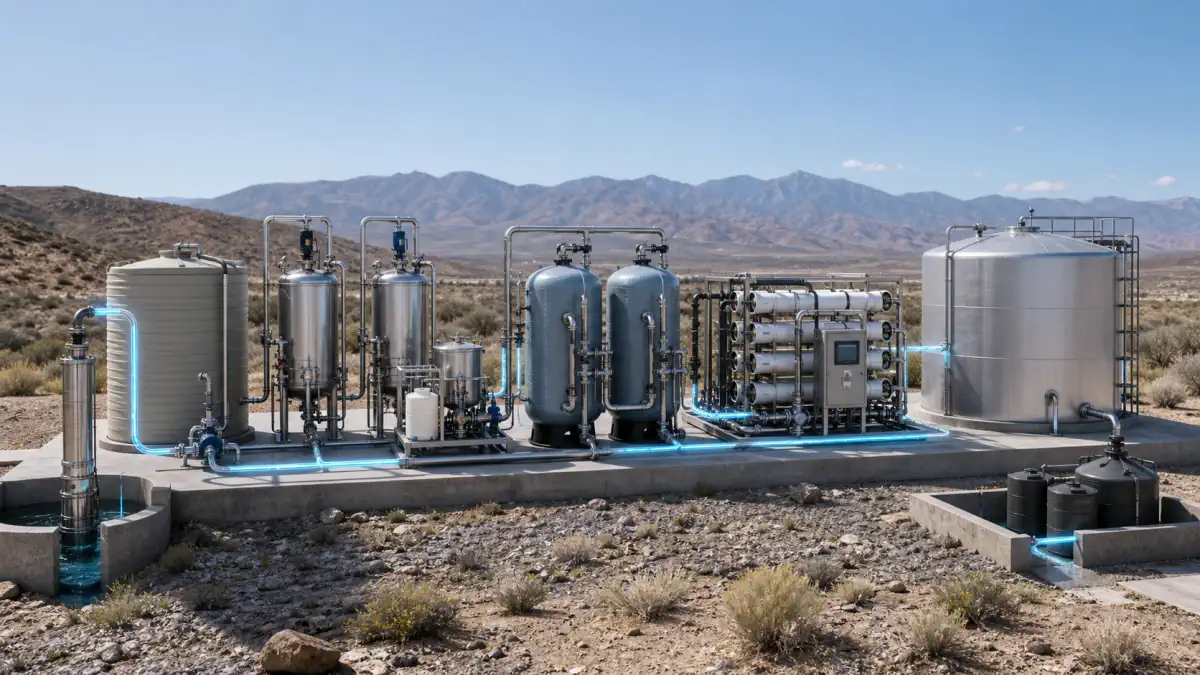
Effective F⁻ and As removal often requires a multi-stage process train, tailored to the specific feed water and regulatory requirements.
Pre-treatment: Essential for protecting downstream membrane and adsorption processes.
- Oxidation: For arsenic, particularly if As(III) is present. Oxidants like chlorine, permanganate, or hydrogen peroxide convert As(III) to the more easily removed As(V).
- pH Adjustment: Critical for optimizing coagulation, adsorption, and membrane performance. For fluoride, lower pH often improves adsorption onto activated alumina. For arsenic, a pH range of 6-7 is often optimal for iron coagulation.
- Coagulation/Flocculation & Clarification: Addition of coagulants (e.g., ferric chloride, alum) to precipitate suspended solids and some dissolved contaminants, followed by sedimentation or dissolved air flotation (DAF).
- Filtration: Multimedia filters, ultrafiltration (UF), or microfiltration (MF) are used to reduce turbidity and suspended solids. This is crucial for achieving an SDI₁₅ target typically less than 3, ideally <2, for downstream RO/NF.
Primary F/As Removal:
- Adsorption:
- Activated Alumina (AA): Highly effective for fluoride removal, especially at lower pH. Can also remove As(V).
- Iron-based Adsorbents: Granular ferric hydroxide (GFH) or other iron oxide-coated media are very effective for both As(III) (if oxidized) and As(V) removal. These systems are typically operated in pressure vessels (e.g., FRP tanks).
- Co-precipitation:
- Lime Softening: Primarily for hardness removal, but can co-precipitate fluoride as CaF₂ and arsenic if iron is also present.
- Enhanced Coagulation: Using ferric chloride or alum with careful pH control to achieve high removal of As(V) and other contaminants.
- Ion Exchange (IX): Strong base anion (SBA) resins are effective for As(V) and F⁻, particularly where sulfate and chloride concentrations are not excessively high (as they compete for exchange sites).
Polishing / Membrane Separation:
- Nanofiltration (NF): Can offer good rejection of F⁻ and As(V) while operating at lower pressures than RO, if the target removal allows. Retains some hardness.
- Reverse Osmosis (RO): Provides the highest rejection of F⁻ and As(V), typically 95-99+%, essential for meeting stringent drinking water or industrial discharge limits. RO requires substantial pre-treatment to protect the membranes.
- Electrodeionization (EDI): While not a primary F/As removal technology, EDI can be used post-RO to polish the permeate for ultra-pure water applications, handling any residual ions if required.
The specific combination of technologies depends on raw water quality, desired treated water quality, and economic considerations.
5. Operating parameters
Precise control and monitoring of operating parameters are vital for efficient and sustainable F/As removal:
- SDI₁₅ (Silt Density Index): For systems employing RO or NF, maintaining an SDI₁₅ below 3, and ideally consistently below 2, is critical to minimize colloidal and particulate fouling. High SDI signifies inadequate pre-treatment and will lead to rapid flux decline and increased differential pressure across membrane elements.
- LSI (Langelier Saturation Index) / Scaling Posture: For membrane systems, the LSI must be carefully managed to prevent calcium carbonate scaling, typically by maintaining a negative LSI or through effective antiscalant dosing. For fluoride, monitoring the saturation index for CaF₂ is equally important. High F⁻ concentrations combined with high Ca²⁺ can lead to CaF₂ scaling, which is difficult to remove. Pre-treatment with lime softening can remove bulk Ca²⁺ before RO to mitigate this.
- Flux (LMH): The design permeate flux (L/(m²·h)) for RO/NF membranes is typically in the range of 10-25 LMH, depending on feed water temperature, TDS, and the fouling propensity of the water. Operating at conservative fluxes extends membrane life and reduces fouling rates. Actual flux is continuously monitored; normalized permeate flux decline indicates fouling.
- DP (Differential Pressure): Monitoring the differential pressure (ΔP) across individual membrane vessels and between stages in an RO array is crucial. A gradual increase in ΔP (e.g., >10-15 psi or 0.7-1 bar per stage from baseline) signals fouling or scaling. A sudden, significant drop in ΔP could indicate a breach in a membrane element or sealing component, requiring immediate investigation. For adsorption columns, increased ΔP indicates media clogging or compaction.
6. Digital twin & instrumentation
Key instrumentation includes:
- Flow meters: Monitoring feed, permeate, and concentrate flows for mass balance and recovery calculations.
- Pressure transducers: Measuring inlet, outlet, and inter-stage pressures across membrane trains, adsorption columns, and filters to track ΔP.
- Conductivity probes: Monitoring feed, permeate, and concentrate conductivity for salt rejection performance and system recovery.
- Temperature sensors: Essential for flux normalization and chemical dosing adjustments.
- pH and ORP (Oxidation-Reduction Potential) sensors: For precise chemical dosing control (e.g., pH for coagulation/adsorption, ORP for arsenic oxidation).
- Turbidity sensors: Monitoring pre-treatment effectiveness (e.g., post-filtration).
- Online F⁻ and As analyzers: Providing real-time insights into removal efficiency (though often laboratory analysis provides the definitive compliance data).
This data feeds into a sophisticated digital twin model that performs several critical functions:
- Mass balance reconciliation: Continuously verifies F⁻, As, and TDS mass balance across each unit operation, flagging deviations that may indicate sensor drift or process issues.
- Fouling and scaling risk forecasting: Algorithms analyze trends in SDI, LSI, normalized flux decay, and ΔP increases to predict fouling and scaling events before they become severe, recommending proactive chemical cleaning or antiscalant adjustments.
- Performance optimization: The model suggests optimal operating parameters, chemical dosages, and cleaning schedules based on current conditions and historical data, minimizing chemical use and energy consumption.
- Operator decision support: Provides actionable insights and alerts, empowering operators to respond proactively to potential problems and maintain consistent compliance.
7. Pilot-Scale vs Industrial RO
For fluoride and arsenic removal applications, the choice between pilot-scale RO and industrial RO depends primarily on scale, complexity, and desired integration level.
pilot-scale RO systems are ideal for pilot studies to determine optimal treatment trains and operational parameters for a specific water source, for temporary emergency water supplies, small municipal drinking water points-of-use/points-of-entry, or for low-flow industrial batch treatment where permeate demands are less than 100 m³/day. These compact, often skid-mounted or mobile units allow for rapid deployment and flexibility in testing different media or membrane types without significant capital investment.
industrial RO systems are designed for large-scale, continuous municipal drinking water treatment plants, complex industrial ZLD applications requiring stringent discharge compliance, or high-recovery multi-stage RO systems exceeding 100 m³/day. These plants feature robust engineering, advanced automation, full SCADA integration, and are built for long-term reliability and deep integration with plant-wide control systems, often including thermal components for concentrate management.
8. Common engineering mistakes & pilot KPIs
Several recurring pitfalls can compromise the effectiveness and cost-efficiency of F/As removal systems:
- Underestimating As(III) Oxidation Needs: Failing to ensure complete oxidation of arsenite to arsenate before adsorption or ion exchange is a common mistake that severely limits removal efficiency.
- Inadequate Pre-treatment for Membranes: Skipping or undersizing pre-treatment steps (e.g., filtration, pH adjustment, antiscalant dosing) leads to rapid membrane fouling and scaling, increasing operational costs and reducing membrane life.
- Neglecting Concentrate Management: Focusing solely on permeate quality without a robust, compliant, and cost-effective plan for concentrate/sludge disposition leads to operational bottlenecks and potential regulatory non-compliance.
- Ignoring Synergistic Contaminant Effects: The presence of other ions (e.g., sulfate competing with As(V) on IX resins, high TOC causing fouling) can significantly impact removal efficiency and membrane performance.
- Lack of Pilot Testing: Directly scaling up without pilot data specific to the actual feed water characteristics is a high-risk strategy, often leading to underperforming or over-designed systems.
Key Performance Indicators (KPIs) for pilot studies and full-scale operations:
- F⁻/As Removal Efficiency: Percentage reduction from feed to permeate (primary KPI).
- Media Exhaustion Rate: For adsorption/IX, measured as bed volumes (BV) to breakthrough, dictating regeneration/replacement frequency.
- Normalized Permeate Flux: For membranes, stability over time, indicating fouling rates.
- Cleaning Frequency & Efficacy: Number of chemical cleanings per time period, and restoration of flux after cleaning.
- Chemical Consumption: Quantifying coagulants, oxidants, antiscalants, and pH adjusters per unit volume of treated water.
- Concentrate Volume & Characteristics: Volume of concentrate/sludge generated per volume of permeate, and its composition for disposal planning.
9. FAQ
Q1: Why is arsenite (As(III)) harder to remove than arsenate (As(V))? Arsenite, at typical neutral pH, exists predominantly as uncharged arsenious acid (H₃AsO₃). This neutral charge means it is not effectively removed by ion exchange resins or many common adsorbents that target anionic species. Arsenate, however, exists as negatively charged ions (H₂AsO₄⁻, HAsO₄²⁻) which are readily removed by anionic ion exchange and many metal oxide adsorbents. Therefore, oxidation of As(III) to As(V) is a critical pre-treatment step for most arsenic removal processes.
Q2: Can RO completely remove all fluoride and arsenic to non-detect levels? Reverse osmosis offers very high rejection rates (typically 95-99%+) for dissolved ions like fluoride and arsenate. While it can reduce concentrations to very low levels, achieving "non-detect" or extremely stringent limits may require multiple RO stages or a combination with other technologies, depending on the initial feed concentration. No membrane achieves 100% rejection, so a trace amount will always pass through.
Q3: What's the main challenge associated with concentrate from fluoride and arsenic removal? The primary challenge is managing the concentrated volume of hazardous waste. Both F⁻ and As, when concentrated, can be classified as hazardous due to their toxicity. The sheer volume of this concentrate, often combined with other dissolved solids, necessitates expensive and complex disposal methods such as off-site hauling to hazardous waste landfills, deep well injection, or energy-intensive ZLD technologies like evaporation and crystallization, each with significant capital and operational costs.
Related equipment & product lines
These categories typically support the approach above—open any line to compare brands and models.
- Filtration MediaGranular and specialty media for depth filtration and polishing stages.View category →
- Ion Exchange ResinsCation/anion and mixed bed resin solutions for demineralization and polishing.View category →
- RO MembranesReverse osmosis membrane elements for municipal and industrial desalination.View category →
For a closer review, use the engineering inquiry form to share feed, capacity, target, and project stage. Submission does not constitute a completed design or performance commitment.