Solutions · Application Scenarios
Heavy metal precipitation and capture: Ni, Cr, Cu, Pb to discharge limits
Engineered precipitation, clarification, and optional membrane polish with sludge accountability. Stable effluent and documented solids management—not “metal…
Use this guide within its scope
This page supports technical research and option comparison and is marked 2026. Illustrative values are not a quotation, completed process design, certification conclusion, or performance guarantee. Check current regulations, feed data, tests, and OEM records.
Problem
Trace metals fail spot samples when chemistry and solids handling are under-specified.
Technology
Engineered precipitation, clarification, and optional membrane polish with sludge accountability.
Results
Stable effluent and documented solids management—not “metal disappearance.”
Engineering decision card
Use when
Trace metals fail spot samples when chemistry and solids handling are under-specified.
Evaluate first
Engineered precipitation, clarification, and optional membrane polish with sludge accountability.
Inputs still required
Feed source and variability, capacity, target quality, operating hours, discharge or reuse boundary, available space, and utilities.
Comparison output
Stable effluent and documented solids management—not “metal disappearance.” The final decision still needs feed data, mass balance, and any necessary testing.
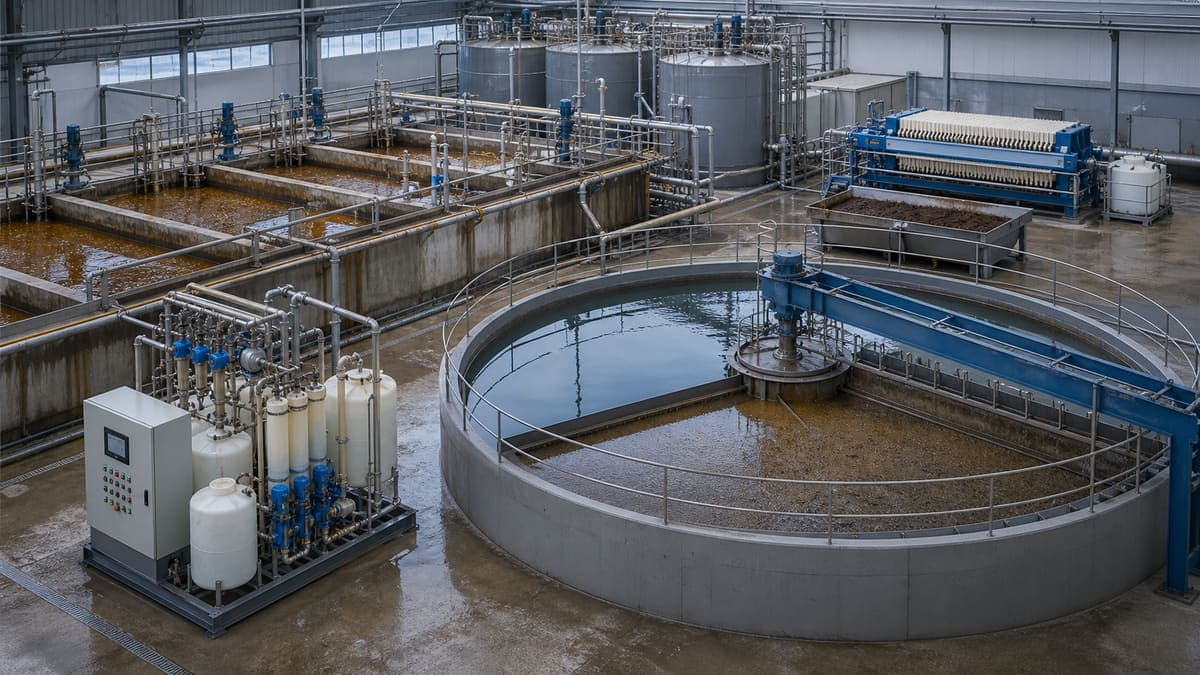
1. Process context & when this scenario is the right entry point
This application scenario addresses the removal of dissolved heavy metals such as Nickel (Ni), Chromium (Cr), Copper (Cu), and Lead (Pb) from industrial wastewater streams. These contaminants, often originating from electroplating, metal finishing, mining, battery manufacturing, and electronics industries, pose significant environmental and health risks, necessitating their reduction to meet stringent discharge regulations (e.g., typically below 0.1 mg/L for individual metals, or aggregate limits for total heavy metals).
This scenario is the primary entry point when dissolved heavy metals are the predominant pollutants requiring removal. It is typically implemented as a primary or secondary treatment step, often preceding further general wastewater polishing or direct discharge, or as a critical stage in internal water reuse loops. Effective heavy metal precipitation and capture ensures compliance while safeguarding downstream processes, such as membrane filtration, from metal fouling or complexation issues.
2. Feed characteristics & key risks
Industrial wastewater containing heavy metals is highly variable. Feed characteristics typically include a wide range of metal concentrations (from single-digit mg/L to hundreds of mg/L), fluctuating pH, high total dissolved solids (TDS), and often the presence of organic complexing agents (e.g., EDTA, NTA) or other inorganic contaminants.
Key risks in this scenario include:
- Solids Handling: The precipitation process inherently generates significant volumes of metal hydroxide or sulfide sludge. Inadequate design or operation of solids-liquid separation (e.g., clarifiers, DAF, filters) can lead to carryover of fine particulates, fouling downstream equipment, and compromising permeate quality.
- Scaling (LSI): pH adjustment for metal precipitation (especially with hydroxide) can drive the co-precipitation of less desirable scales like calcium carbonate (CaCO₃), magnesium hydroxide (Mg(OH)₂), or amorphous silica. If membranes are used downstream, the Langelier Saturation Index (LSI) for CaCO₃ in the membrane feed should ideally be maintained below +1.5, with even lower targets for high-recovery or challenging systems, to prevent scale formation. Silica saturation must also be carefully monitored and typically kept below 90-95% in the membrane concentrate.
- Fouling (SDI): Colloidal matter, fine precipitates, and unremoved suspended solids are primary foulants for subsequent membrane stages. The Silt Density Index (SDI₁₅) of membrane feed water must be rigorously controlled, with targets typically < 3 for reverse osmosis (RO) and nanofiltration (NF) systems, to minimize irreversible fouling and maintain stable operation.
- Chelating Agents: The presence of strong chelating agents can complex heavy metals, preventing their precipitation by conventional methods. This necessitates more aggressive chemical additions (e.g., concentrated sulfide, proprietary organic precipitants) or pre-treatment steps to break these complexes.
- Osmotic Limits: While precipitation removes metals, high background TDS can impose high osmotic pressure on subsequent membrane systems, impacting flux and recovery.
- Regulatory Drivers: Stringent discharge limits dictate the required treatment efficiency, often necessitating multi-barrier approaches and robust monitoring.
3. Concentrate / reject routing
The management of concentrate and reject streams is central to responsible heavy metal treatment.
The primary reject stream from the precipitation process is heavy metal sludge. This sludge, primarily metal hydroxides or sulfides, is typically thickened (e.g., gravity thickener) and dewatered (e.g., filter press, centrifuge) to reduce its volume. The resulting dewatered cake, classified as a hazardous waste, is then transported to a licensed hazardous waste landfill, often after stabilization/solidification to immobilize the metals. In cases where metal concentrations are exceptionally high, options for metal recovery or reclamation might be explored.
If membrane filtration (e.g., UF, NF, RO) is employed post-precipitation, additional reject streams are generated:
- UF/MF backwash/reject: Contains concentrated suspended solids and fine precipitates. This stream is typically recycled back to the head of the precipitation process (e.g., clarifier influent) or directed to the sludge handling system.
- NF/RO concentrate (brine): This stream contains concentrated dissolved salts, residual non-precipitated metals, and any unremoved organic constituents. Its disposition is critical for overall mass balance:
- Recycle: Can be returned to the precipitation stage for further treatment if it contains recoverable or further precipitable metals, or to the system feed for increased water recovery.
- Evaporation/Crystallization: For Zero Liquid Discharge (ZLD) objectives, the brine can be sent to thermal evaporators or crystallizers to recover more water and produce a solid waste (mixed salts, potentially including concentrated metals).
- Off-site Disposal: Haul-off to a licensed industrial waste disposal facility is an option for manageable volumes.
- Deep-Well Injection: Where geology and regulations permit, this can be an option for certain brine compositions.
The filtrate from the sludge dewatering process is usually recycled back to the head of the precipitation process or to a polishing step. This closed-loop approach maximizes water recovery and ensures no uncaptured fine particulates or dissolved components are inadvertently discharged.
4. Reference process train options
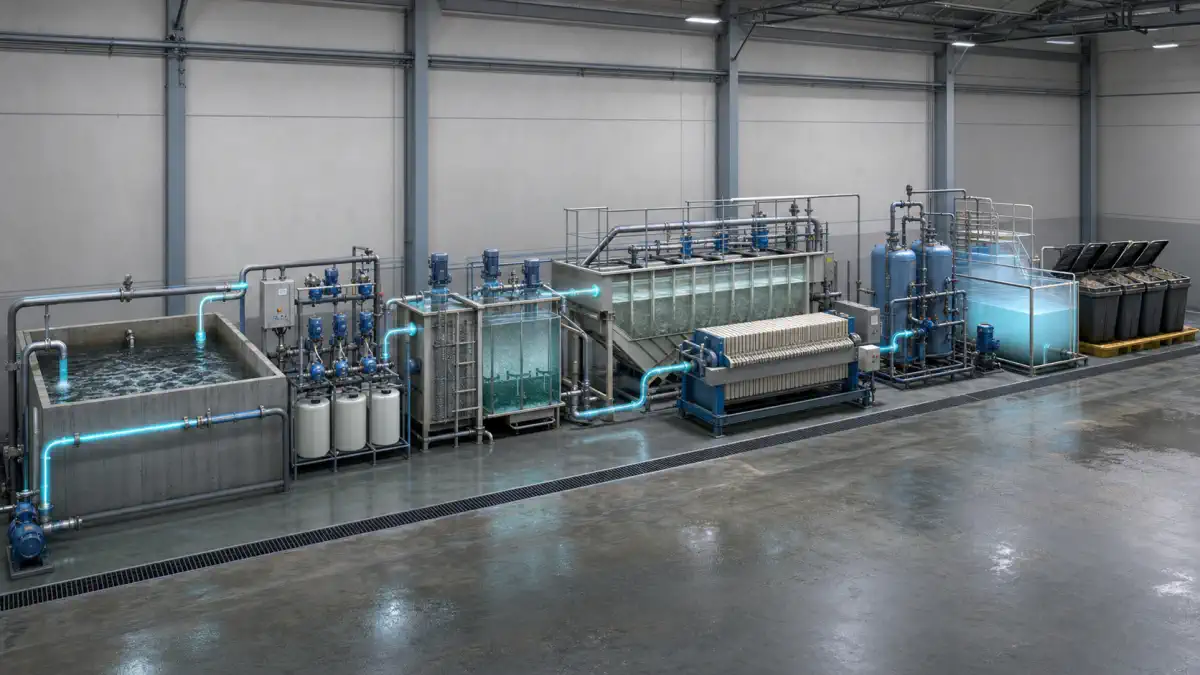
Effective heavy metal removal often employs a combination of chemical precipitation and physical separation, potentially followed by membrane polishing.
Option 1: Chemical Precipitation with Granular Media Filtration
- Process: Feed Water → pH Adjustment (Alkali for Hydroxide Precipitation or Sulfide Addition) → Coagulation/Flocculation → Clarification (e.g., lamella clarifier) or Dissolved Air Flotation (DAF) → Multi-Media Filtration (e.g., sand, anthracite) → Polishing (e.g., Ion Exchange, Activated Carbon for trace removal) → Discharge.
- Chemicals: Sodium hydroxide (NaOH), lime (Ca(OH)₂), sodium sulfide (Na₂S), sodium hydrosulfide (NaHS), ferric chloride (FeCl₃), aluminum sulfate (Al₂(SO₄)₃), polymeric flocculants.
- Sludge: From clarifier/DAF underflow and filter backwash, sent to thickener and filter press for dewatering.
Option 2: Chemical Precipitation with Membrane Filtration Polishing
- Process: Feed Water → pH Adjustment/Sulfide Addition → Coagulation/Flocculation → Clarification/DAF → Microfiltration (MF) or Ultrafiltration (UF) for robust suspended solids removal → pH Adjustment (post-UF/MF, if required for membrane compatibility or further treatment) → Nanofiltration (NF) or Reverse Osmosis (RO) → Discharge/Reuse.
- Chemical Choices:
- Hydroxide Precipitation: Common for Ni, Cu, Pb, Cr(III). Target pH typically 8.5-10.
- Sulfide Precipitation: Highly effective for Cu, Pb, Cd, Hg, and often achieves lower solubilities than hydroxides, especially in the presence of some chelating agents. Requires careful H₂S management.
- Proprietary Chelating Agents (e.g., Dithiocarbamates - DTCs): Can be used as a final polishing step or for metals refractory to hydroxide/sulfide precipitation.
- Coagulants/Flocculants: Metal salts (ferric chloride, aluminum sulfate) and synthetic polymers are crucial to enhance floc formation and settling/separation.
- Membrane Coupling: UF/MF provides a highly stable and consistent feed for RO/NF, protecting the downstream membranes from particulate fouling. NF can selectively remove divalent metal ions and larger organic molecules while passing monovalent salts, potentially reducing the load on RO or enabling specific separations. RO provides the highest level of rejection for most dissolved species, crucial for high-purity water reuse or meeting the most stringent discharge limits.
5. Operating parameters
Precise control of operating parameters is paramount for both heavy metal removal efficiency and the protection of downstream equipment.
- SDI₁₅ (Silt Density Index): This parameter is critical for membrane longevity. After the primary solids separation and any pre-filtration (e.g., multi-media, MF/UF), the SDI₁₅ of the feed water to NF/RO must be consistently < 3, with values often targeted at < 2 for optimal membrane performance and reduced cleaning frequency. High SDI values, typically in the range of 10-15 for untreated feed, necessitate robust pre-treatment.
- LSI (Langelier Saturation Index) / Scaling Posture: During pH adjustment for precipitation, or subsequent concentration by membranes, the risk of scaling by calcium carbonate, magnesium hydroxide, or silica increases. For RO, the LSI of the concentrate stream is typically designed to remain < +2.5 for calcium carbonate, although specific antiscalants can allow for higher values. Silica saturation should be maintained below 90-95% in the concentrate. Regular saturation index calculations using process chemistry are required for all potential scaling species.
- Design Flux (L/(m²·h) / LMH): This refers to the rate of permeate flow per unit membrane area.
- MF/UF: Typically operates at 40-100 L/(m²·h), influenced by feed turbidity, temperature, and membrane type.
- NF/RO: Design flux generally ranges from 10-25 L/(m²·h) for industrial wastewater applications, potentially lower for high-fouling feeds or high-recovery systems, to balance permeate production with minimizing membrane fouling and scaling.
- DP (Differential Pressure / Stage Pressure Drop): Monitoring pressure differentials across filters and membrane elements is a key indicator of fouling and impending maintenance.
- Pre-filters (e.g., cartridge filters): An initial ΔP of < 0.1 bar is typical, with replacement triggered at 1.0-1.5 bar.
- Membrane Elements: A ΔP of 0.2-0.8 bar across an individual membrane element within a pressure vessel is common. A significant increase (e.g., > 15-20% above baseline in a short period) across an element or a multi-element pressure vessel (where total ΔP can exceed 3 bar) is a strong indication of fouling, signaling the need for cleaning (CIP).
6. Digital twin & instrumentation
- Instrumentation & Sensors:
- Flow meters: Electromagnetic or ultrasonic flow meters on feed, permeate, and concentrate lines to accurately measure volumetric flows for mass balance calculations and recovery rate monitoring.
- Pressure transducers: Installed at key points such as pump inlets/outlets, pre-filters, and across each membrane vessel and stage, providing continuous differential pressure (ΔP) data to detect fouling.
- pH sensors: Critical for monitoring and controlling pH during precipitation, chemical dosing (acid/caustic), and ensuring membrane feed compatibility.
- Conductivity meters: On feed, permeate, and concentrate streams to assess overall salt rejection, system performance, and detect membrane integrity issues.
- ORP sensors: For redox control, particularly when reducing Cr(VI) to Cr(III) or for sulfide dosing.
- Turbidity meters: Pre- and post-clarification/filtration to monitor solids removal efficiency and predict SDI.
- Temperature sensors: System temperature affects chemical reaction kinetics and membrane flux.
- Level transmitters: For chemical dosing tanks, feed tanks, and product tanks to manage inventory and automate operations.
- On-line metal analyzers (optional): For continuous monitoring of target metal concentrations at critical points, providing immediate feedback on treatment effectiveness.
8. Common engineering mistakes & pilot KPIs
Common Engineering Mistakes:
- Inadequate Pre-treatment: Underestimating the impact of colloidal solids, fine precipitates, or residual chelants on downstream membrane systems, leading to rapid and irreversible fouling, increased cleaning frequency, and high operational costs.
- Poor pH Control: Inaccurate or widely fluctuating pH during precipitation can result in incomplete metal removal, co-precipitation of unwanted species (e.g., CaCO₃, Mg(OH)₂), larger sludge volumes, and compromised permeate quality.
- Neglecting Filtrate Recycle Impact: Failing to account for the impact of recycling dewatering filtrate (containing fine solids, dissolved salts, or even unprecipitated metals) on the overall mass balance and influent characteristics of the precipitation step.
- Underestimating Sludge Management Costs: The volume, dewaterability, and disposal costs of hazardous heavy metal sludge are often underestimated, significantly impacting the total operating expenditure (OPEX) of the system.
- Ignoring Complexing Agents: The presence of organic complexing agents can render conventional precipitation methods ineffective. Failing to identify and address these requires specialized chemical approaches or advanced oxidation.
- Lack of Scalability Planning: Designing a pilot system without a clear roadmap for how validated parameters (e.g., mixing energy, settling rates, chemical dosing) will translate to full-scale operations can lead to significant design gaps.
Pilot Key Performance Indicators (KPIs):
- Metal Removal Efficiency: Percent reduction for each target metal (Ni, Cr, Cu, Pb) across the entire system and for individual unit operations.
- Sludge Volume Index (SVI): Critical for assessing the settlability and dewaterability of the precipitated sludge, directly impacting clarifier design and sludge handling.
- Chemical Consumption: Quantifying the mass of each chemical (pH adjusters, coagulants, flocculants, antiscalants) consumed per cubic meter of wastewater treated, for accurate OPEX estimation.
- Membrane Flux & Recovery: Achieving stable, sustainable design flux (LMH) and water recovery (%) while meeting permeate quality targets.
- SDI₁₅ of Membrane Feed: Consistent demonstration of the target SDI to validate pre-treatment efficacy.
- Membrane Cleaning Frequency: Quantifying the time between Clean-In-Place (CIP) cycles to project maintenance costs and staffing needs.
- Permeate Quality: Confirming that all regulated discharge limits (e.g., individual metals < 0.1 mg/L, TDS, turbidity, pH) are reliably met.
- Concentrate Characteristics: Detailed analysis of the composition and volume of all reject streams (sludge cake, membrane concentrate) for accurate disposal planning and cost projection.
9. FAQ
Q: Can all heavy metals be effectively precipitated using hydroxide or sulfide? A: While common heavy metals like Ni, Cu, Pb, Cr(III), Cd, and Zn are generally well-removed by hydroxide or sulfide precipitation, some metals (e.g., mercury, silver) may require specific sulfide compounds or other advanced techniques for optimal removal. Notably, hexavalent chromium (Cr(VI)) must first be chemically reduced to Cr(III) before it can be precipitated as a hydroxide. The effectiveness of precipitation is also significantly hampered by the presence of strong complexing agents.
Q: How does the presence of chelating agents impact this process? A: Chelating agents such as EDTA, NTA, or citrates form stable, soluble complexes with heavy metals, preventing their precipitation by conventional pH adjustment or sulfide addition. This necessitates a more advanced approach, which might include breaking the chelating agent through advanced oxidation processes (e.g., UV/H₂O₂), employing highly selective proprietary precipitants, or utilizing downstream polishing steps such as ion exchange or specialized RO membranes designed to reject metal-chelate complexes.
Q: What are the main challenges associated with heavy metal sludge handling? A: Heavy metal sludge is typically categorized as hazardous waste due to its inherent toxicity. Key challenges include its often high water content, requiring extensive dewatering to minimize volume for disposal; often poor dewaterability characteristics which may necessitate polymer conditioning; and the stringent requirements for transportation and disposal at licensed hazardous waste landfills. Prior to landfilling, stabilization and solidification using reagents like cement or lime may be required to encapsulate and immobilize the metals, reducing their mobility and leachability.
Related equipment & product lines
These categories typically support the approach above—open any line to compare brands and models.
For a closer review, use the engineering inquiry form to share feed, capacity, target, and project stage. Submission does not constitute a completed design or performance commitment.