Solutions · Digital & Smart O&M
Cross-border Logistics for Heavy Equipment: moving large MBR and packaged trains without surprises
Crating, Incoterms, and port reality for oversized skids—how to plan lifts, inspections, and site receipt so installation day is boring (in a good way).
Use this guide within its scope
This page supports technical research and option comparison and is marked 2026. Illustrative values are not a quotation, completed process design, certification conclusion, or performance guarantee. Check current regulations, feed data, tests, and OEM records.
Problem
Oversized biological trains stall in ports or arrive with hidden damage because documentation and handling were treated as afterthoughts.
Technology
Engineering-led shipping packs: center of gravity, moisture control, and inspection gates matched to insurer expectations.
Results
Fewer demurrage days and a site team that receives equipment ready to bolt down—not ready to argue.
Engineering decision card
Use when
Oversized biological trains stall in ports or arrive with hidden damage because documentation and handling were treated as afterthoughts.
Evaluate first
Engineering-led shipping packs: center of gravity, moisture control, and inspection gates matched to insurer expectations.
Inputs still required
Feed source and variability, capacity, target quality, operating hours, discharge or reuse boundary, available space, and utilities.
Comparison output
Fewer demurrage days and a site team that receives equipment ready to bolt down—not ready to argue. The final decision still needs feed data, mass balance, and any necessary testing.
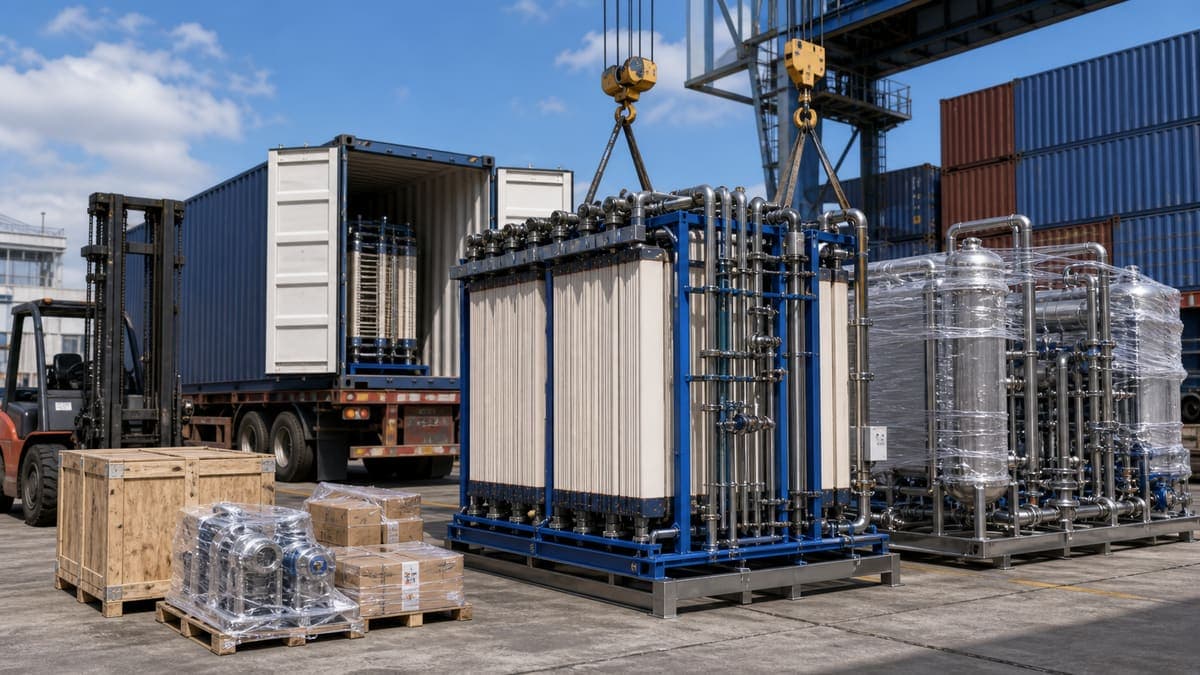
Traditional vs engineering evaluation path
Consider the scenario of delivering a multi-container MBR plant from Europe to Southeast Asia, involving several critical sub-assemblies (membrane racks, blowers, PLC cabinets, pumps, chemical dosing skids) that must arrive in a precise sequence for site assembly and commissioning.
| Traditional way | engineering evaluation path way |
|---|---|
| * Manual Coordination: Multiple emails, phone calls, and spreadsheets for each leg of the journey, with limited real-time updates from carriers and customs brokers. | * Unified Digital Platform: Single source of truth, real-time GPS tracking, and automated status updates across all carriers, customs, and last-mile logistics providers. |
| * Reactive Problem Solving: A critical membrane module container is delayed by 10 days at a transshipment port due to unexpected customs documentation issues, discovered only when it fails to appear for its onward journey. | * Proactive Risk Mitigation: AI-driven predictive analytics flag a high probability of customs delay for the membrane module 2 weeks in advance. Alternative documentation or expedited customs pre-clearance is initiated, reducing delay to 2 days. |
| * Cascading Delays & Costs: The 10-day delay in the membrane module causes a 2-week commissioning setback, leading to idle site crew, extended equipment rental, and potential penalty clauses, totaling an estimated $150,000 in direct and indirect costs. | * Optimized Scheduling & Cost Control: Minimal 2-day delay for the critical module allows for minor schedule adjustments, avoiding major commissioning impacts. Total cost deviation kept under $10,000, preserving project budget and timeline. |
| * Fragmented Data: Performance data from disparate systems (design, manufacturing, transport) is siloed, making it hard to link transport issues to potential long-term operational impacts or optimize future logistics. | * Integrated Data Analytics: End-to-end data correlation from manufacturing (e.g., component serial numbers) through transport conditions (e.g., tilt, shock, temperature) to site delivery, feeding into predictive maintenance models and future supply chain optimization. |
The Foundation of Truth: Instrumentation & Sensors
Digital supply chain solutions for heavy equipment like MBRs are only as reliable as the real-world data they leverage. Decisions about spare parts, maintenance schedules, or even expedited component deliveries are directly informed by the operational health of your assets. This "field truth" comes from real-time monitoring of critical parameters delivered by online instruments and sensors. Whether it's tracking flow rates through a membrane train, monitoring pressure across filtration stages, ensuring correct conductivity for water quality, or maintaining optimal ORP levels in a disinfection process, these instruments provide the actionable insights that drive an intelligent supply chain.
This continuous stream of data on key performance indicators (KPIs) and asset health allows this approach to anticipate needs, rather than react to failures.
engineering evaluation path Differentiation: Coordinated Intelligence
- Smart Spares Management: Leveraging real-time operational data from your plant's instruments, combined with supplier lead times and shipping routes, this approach predicts when critical spares will be needed. This allows for proactive ordering and optimized inventory levels, reducing emergency freight costs and ensuring parts arrive before they are critically required. For an MBR, this might mean having membrane modules, specific blower parts, or pump impellers ready for shipment based on actual performance degradation, not just calendar-based maintenance.
Related equipment & product lines
These categories typically support the approach above—open any line to compare brands and models.
- Instrumentation & SensorsOnline measurement and control: flow, level, pressure, and water-quality sensors indexed from the Lenntech instrumentation hub.View category →
- Pilot Units TestingPilot rigs and trial modules for process validation and feasibility studies.View category →
- Replacement Parts / SparesGeneral replacement parts for treatment systems and subassemblies.View category →
For a closer review, use the engineering inquiry form to share feed, capacity, target, and project stage. Submission does not constitute a completed design or performance commitment.