Solutions · Digital & Smart O&M
Digital Twin for Water Plants: 3D models to live operations and lifecycle decisions
Link P&ID and 3D asset context to live SCADA streams—simulate what-if loads, training, and retrofit planning without gambling on the real plant.
Use when
Operators and remote experts lack a shared visual ground truth when diagnosing upsets across distributed sites.
Process options
Geometry, asset tags and validated instrument data linked to models whose operating range is tested.
Assessment output
Measure diagnosis time, maintenance decisions and lifecycle costs against the current operation.
Inputs and conditions for an assessment
Collect feed variability, capacity, target quality, operating hours, discharge or reuse boundaries and installed equipment data. Compare examples on matched conditions and meter boundaries; assess a project using actual water data, equipment documentation and any necessary tests.
View the process illustration
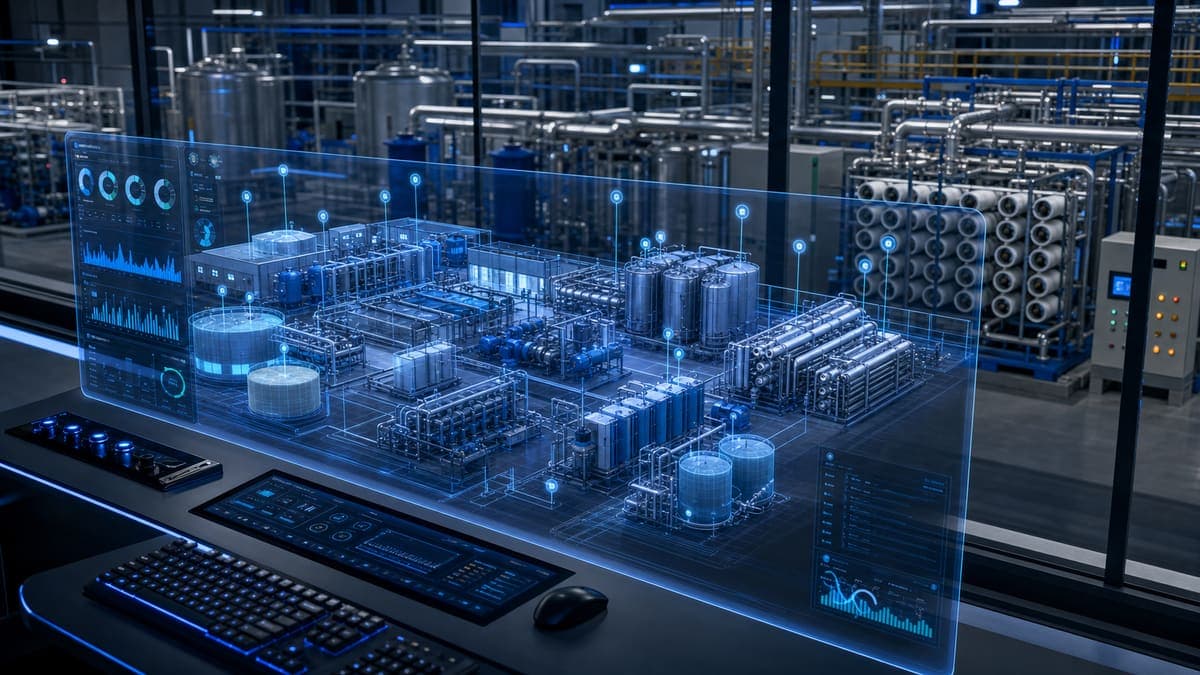
Digital Twin for Water Plants: 3D models to live operations and lifecycle decisions
A water-plant digital twin links an asset or process model to selected operational data. It can support shared views, scenario analysis and maintenance planning when the data mapping and model have been validated for the intended decisions. Start with the plant problem, required update rate and measurable acceptance criteria rather than assume every asset needs a real-time twin.
A useful twin may combine a 3D asset model, design specifications, operational data and maintenance history. Prediction and simulation depend on the chosen process models, input quality, calibration and validated operating range; a visual model alone does not provide them. Use uncertainty and plant checks when assessing design changes, performance optimization or maintenance across the asset lifecycle.
Beyond Static Schematics: Bridging Design and Reality
Traditionally, the detailed engineering models created during plant design often become static archives once construction is complete. A digital twin changes this paradigm entirely. It links these foundational 3D models and P&IDs directly to live sensor data, SCADA systems, and enterprise resource planning (ERP) systems. When integration is implemented, mapped pressure, flow, chemical dose and equipment status can be displayed with the asset context. Account for sensor uncertainty, missing or delayed values, tag errors and configuration changes. Alerts and model residuals support investigation; they do not identify every anomaly immediately or establish a root cause without corroboration.
Comparing current practice with a proposed digital twin
Consider the critical task of managing membrane performance and spare parts inventory in an Ultrafiltration (UF) plant.
| Current practice | Digital-twin functions to evaluate |
|---|---|
| Membrane Maintenance: Fixed schedule cleaning (e.g., every 3 months) or manual triggering based on operator observation of declining flux. | Membrane Maintenance: Compare normalized flux, transmembrane pressure (TMP), feed quality and validated fouling models. Check cleaning triggers, false alerts, chemical use and restored performance; demonstrate any life extension with operating history. |
| Spare Part Inventory (e.g., UF modules): Safety stock based on historical averages and lead times; often leads to either overstocking (high capital lockup) or understocking (risk of 2-week downtime for critical spares). | Spare Part Inventory: Combine condition indicators with confirmed supplier lead times and planned maintenance. Test reorder rules, safety stock and delivery contingencies; measure inventory cost and actual parts availability without assuming on-time arrival. |
| Troubleshooting: Reactive response to failures (e.g., pump cavitation). Manual data correlation across disparate systems (SCADA, logbooks, maintenance records). | Troubleshooting: Use pressure, vibration and motor-current trends to compare plausible causes. Validate any anomaly model, record false positives and confirm faults through inspection; measure investigation time against the baseline. |
| Training & Simulation: Classroom-based training or on-the-job learning. Limited ability to simulate high-risk scenarios or major operational changes without impacting production. | Training & Simulation: Evaluate simulations of procedures, emergencies and load changes without directly changing the operating plant. Validate scenarios and assess operator competency; simulation does not replace approved procedures or prove real-world safety. |
Data Security & Trust
- AES-256 encryption: Check the deployed storage and backup configuration, key management and recovery evidence rather than assume encryption from a platform name.
- TLS 1.2+ protocols: Check the actual endpoint, certificate and permitted protocol configuration against the current security requirements.
- Role-based access control (RBAC): Test permissions, account revocation, audit logs and separation of monitoring from control.
- Third-party security audits and penetration tests: Review dated evidence and remediation where performed; plan testing and operational safeguards for the proposed deployment.
The Foundation of Truth: Instrumentation & Sensors
Reliable instrument data are essential inputs, but model structure and validation also determine a twin’s usefulness. Check flow, pressure, conductivity, Oxidation-Reduction Potential (ORP), pH, turbidity and level instruments for calibration, sampling conditions, time synchronization and missing data. ORP is not a specific disinfectant concentration. Report the validated model range and uncertainty, and confirm decisions using the appropriate plant measurements and inspections.
References: NIST: digital-twin verification, validation and uncertainty; NIST IR 8356: security and trust considerations.
Related equipment & product lines
These categories typically support the approach above—open any line to compare brands and models.
- Instrumentation & SensorsInstruments and sensors for online monitoring of flow, level, pressure, temperature, and water quality.View category →
- InvertersVariable-frequency drives and inverter systems for variable-speed motor control.View category →
- Pilot Units TestingPilot rigs and trial modules for process validation and feasibility studies.View category →
For a closer review, use the engineering inquiry form to share feed, capacity, target, and project stage. Submission does not constitute a completed design or performance commitment.