Solutions · Industry Solutions
Brewing & distillery water: mineral balance and hardness control
Water profiles for mash and proofing: calcium, sulfate, chloride ratios, alkalinity, RO blending, and IX polishing for repeatable flavor.
Use this guide within its scope
This page supports technical research and option comparison and is marked 2026. Illustrative values are not a quotation, completed process design, certification conclusion, or performance guarantee. Check current regulations, feed data, tests, and OEM records.
Problem
Inconsistent city water chemistry shifts mash pH and enzyme behavior; blind RO strips everything and creates new problems.
Technology
Targeted RO, selective IX, remineralization blends, and documented seasonal adjustment playbooks.
Results
Repeatable flavor windows and predictable brewhouse chemistry across raw-water seasons.
Engineering decision card
Use when
Inconsistent city water chemistry shifts mash pH and enzyme behavior; blind RO strips everything and creates new problems.
Evaluate first
Targeted RO, selective IX, remineralization blends, and documented seasonal adjustment playbooks.
Inputs still required
Feed source and variability, capacity, target quality, operating hours, discharge or reuse boundary, available space, and utilities.
Comparison output
Repeatable flavor windows and predictable brewhouse chemistry across raw-water seasons. The final decision still needs feed data, mass balance, and any necessary testing.
Industry Context & Regulatory/Compliance Drivers
Brewing and distilling operations face a dual challenge: ensuring water meets stringent public health standards while simultaneously tailoring its mineral content for optimal product quality. While there isn't a single global "brewing water standard," the foundational requirement is that all source water must meet local and international potable water regulations, such as the WHO Guidelines for Drinking-water Quality or country-specific standards like the US EPA National Primary Drinking Water Regulations. Beyond this baseline, the specific ionic composition (calcium, magnesium, sulfate, chloride, alkalinity) is critical for achieving desired beer styles or spirit profiles.
Key challenges include:
- Seasonal variability: Surface water sources, common for many facilities, can exhibit significant seasonal shifts in turbidity, organic matter, and dissolved solids, impacting treatment efficacy and requiring adaptive solutions.
- Flavor impact: Undesirable ions (e.g., high iron, manganese, chloride/sulfate imbalance) can lead to off-flavors, haze, or contribute to corrosion.
- Process efficiency: Incorrect water chemistry, particularly alkalinity, can destabilize mash pH, leading to poor enzyme conversion, reduced fermentable sugars, and inefficient lautering. High hardness can also cause scaling in heat exchangers and boilers.
- Sustainability: Growing pressure to reduce water consumption and energy footprint drives the need for high-recovery systems and efficient operations.
Water Quality Targets
- Calcium (Ca²⁺): Typically 50-150 mg/L. Essential for enzyme activity, yeast flocculation, and pH stabilization.
- Magnesium (Mg²⁺): Typically 10-30 mg/L. Contributes to enzyme function and yeast nutrition.
- Sulfate (SO₄²⁻): Varies widely, 50-250 mg/L. Enhances hop bitterness perception (e.g., IPAs).
- Chloride (Cl⁻): Varies widely, 50-250 mg/L. Accentuates malt sweetness and body (e.g., Stouts). The sulfate-to-chloride ratio is crucial for balancing hop and malt character.
- Alkalinity (as CaCO₃): Highly style-dependent, 0-200 mg/L. Critical for mash pH control, directly impacting enzyme efficiency and fermentable sugar yield. High alkalinity raises mash pH, requiring acid additions.
- Sodium (Na⁺): Generally < 50 mg/L. Higher levels can contribute to salty off-flavors.
- Iron (Fe) & Manganese (Mn): Trace levels (< 0.05 mg/L) to avoid metallic off-flavors and haze.
- Turbidity: < 1 NTU for consistent pretreatment.
- Chlorine/Chloramines: Non-detectable, as they can cause phenolic off-flavors and damage membranes.
For proofing water in distilleries, the target is often exceptionally low TDS, approaching ultrapure water quality to prevent any flavor alteration or haze formation when blending spirits to their final proof.
1. Pretreatment: Protecting the Core System
The first line of defense protects downstream membrane systems and ensures consistent feedwater quality.
-
Raw Water Screening & Sedimentation: Removal of large particulates.
-
Multimedia Filtration (MMF): Essential for reducing turbidity and suspended solids. For challenging surface water sources or when the SDI₁₅ (Silt Density Index) consistently exceeds 5, Ultrafiltration (UF) is mandated. UF provides a superior barrier against suspended solids, bacteria, and viruses, ensuring a low and stable SDI for RO.
-
Activated Carbon Filtration (GAC): Critical for removing free chlorine, chloramines, organic compounds, and taste/odor precursors that can affect both product quality and RO membrane integrity.
-
Antiscalant Dosing: For RO systems operating at higher recovery rates, an antiscalant is dosed to inhibit the precipitation of sparingly soluble salts like calcium carbonate, calcium sulfate, and silica, thus preventing scaling on the membrane surface. this approach precisely calculates the LSI (Langelier Saturation Index) and other scaling indices to determine optimal antiscalant dosage and maximize system recovery without compromising membrane life.
2. Primary Treatment: Tailoring Mineral Profiles
-
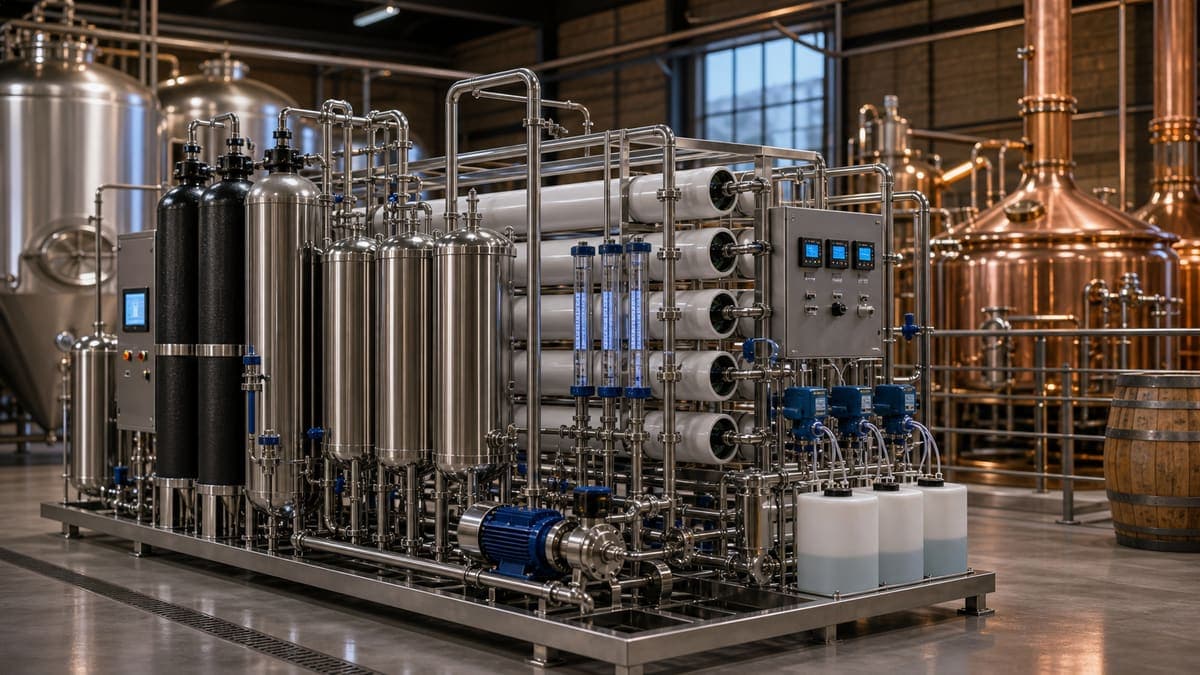
Reverse Osmosis (RO): The cornerstone for robust water treatment, RO membranes offer high salt rejection (typically 98-99.5% for monovalent ions) and are instrumental in producing a "blank canvas" water free of undesirable minerals and contaminants. this approach often deploys partial RO or a bypass strategy, blending RO permeate with raw (pretreated) water to achieve a specific mineral baseline, rather than fully demineralizing. Our
RO Pressure Vessel Trainis engineered for energy efficiency and long element life. -
Selective Ion Exchange (IX): For specific ion removal or preservation, this approach utilizes selective ion exchange resins. For instance, anion exchange can selectively reduce sulfates, or specific cation exchange can target hardness without removing all beneficial ions if a full RO system is not desired or justified. This allows for fine-tuning of the mineral profile.
3. Post-Treatment & Polishing: The Finishing Touches
- Continuous Electrodeionization (EDI): For distilleries requiring exceptionally low conductivity water for proofing, EDI provides continuous deionization without chemical regeneration. Unlike traditional mixed-bed ion exchange, EDI uses a DC electric field and ion-selective membranes to continuously remove ions from the water, concentrating them into a separate waste stream (concentrate) and removing them from the resin beds, which are contained within the stack. Ions migrate through the resin and across ion-selective membranes into electrode compartments, which are continuously flushed, eliminating the need for periodic chemical regeneration. This produces water with resistivity often exceeding 10 MΩ·cm.
Operations, Monitoring, and CIP Philosophy
Effective operation hinges on continuous monitoring and proactive maintenance. this approach systems feature advanced control architectures for optimal performance.
Related equipment & product lines
These categories typically support the approach above—open any line to compare brands and models.
- Ion Exchange ResinsCation/anion and mixed bed resin solutions for demineralization and polishing.View category →
- RO MembranesReverse osmosis membrane elements for municipal and industrial desalination.View category →
- Activated CarbonPowdered and granular activated carbon (PAC/GAC) for adsorption of organics, odor, and trace contaminants.View category →
- Instrumentation & SensorsOnline measurement and control: flow, level, pressure, and water-quality sensors indexed from the Lenntech instrumentation hub.View category →
For a closer review, use the engineering inquiry form to share feed, capacity, target, and project stage. Submission does not constitute a completed design or performance commitment.