Back to Industry Solutions

Solutions · Industry Solutions

Cooling tower blowdown recovery: cut makeup and chemical load

Treat CT blowdown for chloride, cycles of concentration, and scaling risk: RO, softening, and chemical programs that protect metallurgy while recovering water.

2026cooling towerblowdownROrecovery ratescalingchloride
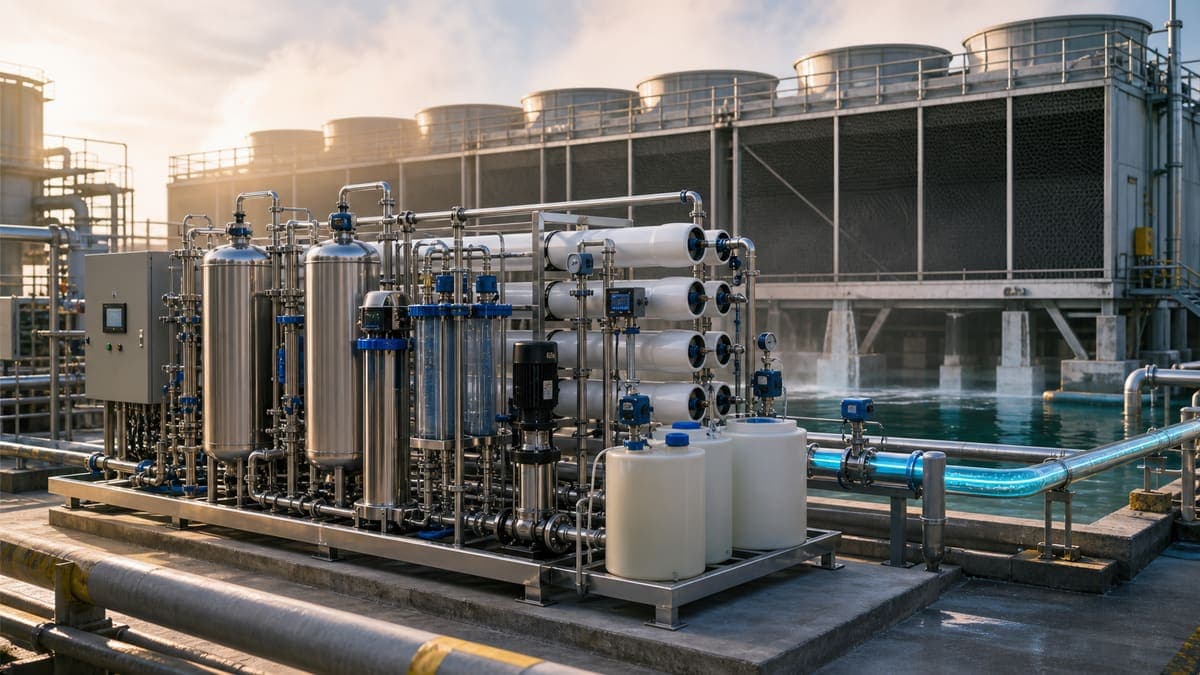
Cooling tower blowdown recovery: cut makeup and chemical load water treatment solution illustration

Problem

Rising cycles drive chloride and scaling stress on metallurgy; discharging blowdown wastes water and salts while tightening permits squeeze disposal options.

Technology

Side-stream softening or RO on blowdown, controlled cycles with real-time conductivity, and biocide strategies compatible with reuse trains.

Results

Lower fresh makeup, fewer corrosion events, and documented water balance for ESG and utility reporting.

Cooling Tower Blowdown Recovery: Cut Makeup and Chemical Load

Cooling towers are vital for heat rejection in countless industrial processes, from power generation and manufacturing to data centers. However, as water evaporates, non-volatile dissolved solids (TDS), chlorides, and scaling species concentrate within the circulating water. This necessitates a controlled discharge, known as blowdown, to prevent severe scaling, corrosion, and biological fouling within the tower and heat exchangers. Historically, this blowdown has been routed to drain, representing a significant loss of water and treated chemicals. AquaChain’s advanced solutions enable effective recovery of this blowdown, transforming a waste stream into a valuable resource.

Industry Challenges and Regulatory Drivers

The concentration of TDS, chloride, and particularly scaling species like calcium, magnesium, silica, and sulfates, is an inherent operational challenge for cooling towers. While essential, blowdown acts as the system's relief valve; insufficient blowdown inevitably leads to rapid scale formation and under-deposit corrosion, compromising heat transfer efficiency and equipment lifespan. Conversely, excessive blowdown wastes significant volumes of water and the associated treatment chemicals.

Industries face increasing pressure to reduce their environmental footprint and operational costs. Scarce water resources, escalating municipal water tariffs, and stringent local environmental discharge permits (which often impose limits on effluent TDS, chlorides, and specific pollutants) are driving the demand for cooling tower blowdown recovery. Projects focused on reusing blowdown must overcome several technical hurdles, including high scaling potential, biofouling risks from cooling water biocides, and metallurgical compatibility limits on elevated chloride levels in reused streams.

Water Quality Targets for Permeate Reuse

The target water quality for recovered cooling tower blowdown depends entirely on its intended reuse. Common reuse applications include:

  • Return to Cooling Tower (Makeup): The most common and direct reuse. Permeate quality must be low in TDS, hardness, and silica to prevent excessive concentration and scaling within the tower, thereby increasing cycles of concentration. Conductivity targets are typically below 100-200 µS/cm, with hardness below 1 mg/L as CaCO₃.
  • General Utility Water: For non-critical processes like washdowns or irrigation. Quality requirements are less stringent but still necessitate significant TDS rejection.
  • Boiler Feedwater Makeup (after further polishing): Requires very high purity, often demanding conductivity below 1 µS/cm, silica below 20 ppb, and hardness essentially zero. This usually necessitates post-RO ion exchange or EDI. (Refer to ASME/IAPWS standards for specific boiler feedwater quality guidelines).
  • Process Water: Quality is highly specific to the industrial process.

AquaChain rigorously characterizes both the makeup water and the cooling tower blowdown stream to define achievable maximum cycles of concentration for the tower and optimal permeate quality for reuse, always with metallurgist sign-off on chloride limits where applicable.

AquaChain's Advanced Process Train for Blowdown Recovery

AquaChain designs bespoke, robust treatment trains for cooling tower blowdown recovery, engineered for optimal performance and minimal lifecycle costs.

Pretreatment: The Foundation of Reliable Operation

Given the high concentration of suspended solids, scaling precursors, and potential biofouling agents in cooling tower blowdown, meticulous pretreatment is paramount to protect downstream membrane systems.

  1. Coagulation/Flocculation & Clarification: For blowdown streams with high turbidity and suspended solids, initial chemical treatment followed by clarification (e.g., dissolved air flotation or conventional clarifiers) is essential to reduce particulate load.
  2. Multimedia Filtration (MMF): Removes larger suspended solids. If the raw blowdown stream exhibits an SDI₁₅ (Silt Density Index at 15 minutes) above 5, MMF is a mandatory first step before advanced membrane filtration.
  3. Ultrafiltration (UF): Provides superior removal of suspended solids, colloids, bacteria, and viruses, typically achieving an SDI₁₅ below 3. AquaChain’s integrated UF skids offer consistent feed quality to RO, protecting against particulate fouling and significantly extending RO membrane lifespan.
  4. Softening or Ion Exchange (IX): For blowdown high in hardness (calcium, magnesium), a softening step (e.g., lime softening or ion exchange softening) ahead of RO dramatically reduces scaling potential. This is not solely for boiler plants; it’s a critical RO protection measure when hardness dominates the LSI.
  5. Chemical Dosing:
    • Antiscalant: A precisely selected antiscalant program, validated on composite blowdown samples, is critical for inhibiting scale formation on RO membranes, particularly at high recovery rates.
    • Biocide Dosing: A careful review of existing cooling tower oxidizing/non-oxidizing biocide choices is performed. Non-oxidizing biocides are generally preferred upstream of polyamide RO membranes, or strong oxidizers must be neutralized (e.g., with sodium bisulfite) before contacting the RO membranes to prevent irreversible damage.

Reverse Osmosis (RO): The Core Separation

Following robust pretreatment, Reverse Osmosis (RO) or Nanofiltration (NF) provides the primary separation of dissolved solids. AquaChain's industrial RO systems are engineered for industrial-scale blowdown recovery.

  • Membrane Selection: AquaChain employs spiral-wound polyamide membranes optimized for high salt rejection (typically 98-99.5%) and tailored for the specific blowdown chemistry. Nanofiltration might be considered if only divalent ions (hardness) and organic matter need removal, leaving monovalent ions (chloride, sodium) in the permeate.
  • Operating Parameters: Typical flux rates range from 15-25 L/(m²·h) to mitigate concentration polarization and fouling. Operating pressures can range from 10 to 40 bar, depending on the TDS of the feed and desired recovery rate. AquaChain designs ensure stable transmembrane pressure for consistent performance.
  • System Recovery: While aiming for high recovery rate (often 75-85% for blowdown), AquaChain's engineers balance this with the LSI (Langelier Saturation Index) and silica saturation limits in the concentrate stream to prevent aggressive scaling. Pushing recovery too high without adequate pretreatment and antiscalant risks rapid membrane fouling and costly CIP cycles. Our systems feature digitally modelled flow paths to optimize hydraulic performance and minimize dead zones.
  • Cross-Flow Filtration: RO operates in a cross-flow configuration, continuously sweeping the membrane surface to minimize solute accumulation and concentration polarization, allowing the permeate (purified water) to pass through while the concentrated salts are swept away as concentrate.

Post-Treatment (Optional)

  • Degasification: If RO permeate is returned directly to the tower, or used as boiler feed, it may require degasification to remove dissolved CO₂, which can lower pH and increase corrosivity.
  • Ion Exchange (IX) or Continuous Electrodeionization (CEDI): For applications requiring ultrapure water (e.g., boiler feed, process water), further polishing using mixed-bed ion exchange or CEDI will reduce conductivity to sub-µS/cm levels and remove residual trace ions. CEDI uses an electric field and ion-selective membranes to continuously regenerate ion-exchange resin, producing high-purity water without the need for chemical regenerants. It generates a small concentrate stream and a very dilute electrode rinse stream.
  • UV Sterilization: As a final safeguard for microbial control before reuse, a UV reactor can be installed.

Operations, Monitoring, and CIP Philosophy

AquaChain's solutions prioritize ease of operation and proactive maintenance. Our integrated stainless-steel skids are designed for robust industrial environments and minimize footprint.

  • Fouling Resistance: Our approach emphasizes honest and comprehensive pretreatment to achieve fouling resistance, rather than relying solely on aggressive chemical cleans.
  • Conductivity-Based Control: Precise, calibrated conductivity sensors are used throughout the system. For the cooling tower itself, trending both chloride and hardness alongside conductivity is crucial. Relying on conductivity alone can mask chloride creep until metallurgy issues arise. This ensures optimal blowdown control, preventing both under- and over-blowdown.
  • Normalized Permeate Flow: Continuous monitoring and trending of normalized permeate flow is a key indicator of membrane performance and fouling. A significant drop signals the need for investigation or a CIP cycle.
  • Cleaning-in-Place (CIP): AquaChain systems incorporate automated CIP skids, designed to effectively remove organic, inorganic, and biological fouling. Our digital O&M platform uses trend-based triggers (e.g., specific ΔP increase, normalized permeate flow drop, or feed pressure increase) to recommend or initiate CIP sequences, optimizing chemical usage and minimizing downtime.

Risks and Common Engineering Mistakes

  • Inadequate Pretreatment: The single most common cause of RO membrane failure and poor performance in blowdown recovery. Failure to address high SDI, hardness, and biofouling leads to rapid membrane scaling and biofouling.
  • Overly Aggressive Recovery Rates: Pushing RO recovery rate beyond the limits dictated by LSI and silica solubility in the concentrate stream will inevitably lead to severe scaling.
  • Incorrect Chemical Selection: Use of incompatible antiscalants, or biocides that damage polyamide membranes, can cause irreversible membrane damage.
  • Poor Water Balance Management: Failure to accurately characterize makeup and blowdown, or to properly manage blend points for permeate return, can lead to new operational challenges in the cooling tower.
  • Neglecting Material Compatibility: Reusing higher-chloride streams without considering the metallurgy of downstream equipment can lead to accelerated corrosion.

2026 Forward-Looking Context: Sustainable & Smart Water Management

AquaChain is committed to delivering solutions that meet current operational needs while anticipating future environmental and technological demands.

Energy & ESG

Minimizing energy consumption and maximizing water reuse are central to our Environmental, Social, and Governance (ESG) objectives. Our industrial RO systems are designed for high energy efficiency. We meticulously calculate the specific energy consumption (e.g., kWh/m³ permeate) for each design. For systems with high operating pressures and significant flow rates, AquaChain integrates advanced Energy Recovery Devices (ERD) on the high-pressure RO concentrate stream. These devices can recover up to 95-98% of the hydraulic energy from the concentrate, significantly reducing the overall specific energy consumption and minimizing the carbon footprint of the system.

Digital Operations & Maintenance (O&M)

AquaChain leverages a digital-first approach for monitoring and control. Our remote monitoring platforms provide real-time visibility into all critical process parameters: feed pressure, transmembrane pressure, individual stage ΔP (pressure drop), flow rates (feed, permeate, concentrate), conductivity, pH, and temperature. This data is used to calculate and trend normalized permeate flow, enabling proactive identification of fouling and performance degradation. Our systems are configured to trigger maintenance alarms and recommend CIP procedures based on these trended parameters, rather than fixed schedules. This predictive maintenance approach optimizes operational efficiency, reduces unscheduled downtime, and extends equipment lifespan.

Modular RO Systems

AquaChain’s modular RO membrane systems are the backbone of our industrial water treatment solutions. For cooling tower blowdown recovery, the industrial RO line is the ideal choice. These robust, production-scale units are designed for continuous, heavy-duty operation, featuring multi-stage configurations, full SCADA integration, and redundancy for critical applications. The pilot-scale RO series, while sharing the same core technology, is typically reserved for pilot studies, laboratory applications, or small-flow prototyping where flexibility and compact design are prioritized.

Frequently Asked Questions

Q: Can we return RO permeate directly to the tower?

A: Yes, often. RO permeate, being low in TDS and hardness, is ideal for makeup water. However, careful consideration is needed for its corrosivity. The low buffering capacity and potential for dissolved CO₂ (especially if the feed water was high in alkalinity) can lead to a slightly acidic permeate. Engineer the blend point carefully, possibly incorporating a degasification step or remineralization, to ensure the blended water meets the cooling tower's corrosion control targets and overall water chemistry.

Q: Is Zero Liquid Discharge (ZLD) on cooling water common?

A: Partial recovery is more typical and economically viable for cooling tower blowdown. True Zero Liquid Discharge (ZLD), which aims to recover 100% of the water and produce a solid waste, involves additional, energy-intensive steps like evaporators or crystallizers. While technically feasible, ZLD usually requires a strong economic driver (e.g., extremely high water costs, severe discharge restrictions, or valuable recovered salts) to justify its capital and operating expenditures. AquaChain can design ZLD systems where justified, but partial recovery for makeup is the more common and cost-effective solution.

Q: Do we need a separate biocide review for blowdown recovery?

A: Absolutely. Cooling tower biocides, particularly strong oxidizers like chlorine or bromine, can cause irreversible damage to polyamide RO membranes. If an oxidizing biocide is used in the tower and the blowdown is fed to RO, a neutralization step (e.g., with sodium bisulfite) must be implemented immediately before the RO system. Non-oxidizing biocides are generally safer for downstream membranes but still require careful selection to avoid biofouling within the RO system itself. AquaChain's engineers align biocide choices with downstream membrane integrity and reuse targets.

Q: How does the presence of organic matter in blowdown affect RO?

A: Organic matter, common in cooling tower blowdown from natural sources (e.g., humic acids in makeup) or process contamination, can lead to significant RO membrane fouling, particularly biofouling. It can also react with disinfectants to form problematic byproducts. Effective pretreatment, including UF and potentially activated carbon adsorption, is crucial to remove organics and protect RO membranes, ensuring stable normalized permeate flow and extending CIP intervals.

Call to action

AquaChain offers comprehensive engineering solutions for optimizing your industrial water cycles. Need a customized process diagram for your Industrial Water Management facility? Consult AquaChain's engineering team today.

These categories typically support the approach above—open any line to compare brands and models.

Looking for site-specific references or lab data? Contact us—we can share case material relevant to your feed and targets.