Solutions · Industry Solutions
Dairy & juice: membrane concentration and quality retention
UF/NF/RO in dairy and juice: flux control, cleaning protocols, sensory retention, and energy comparison to thermal evaporation.

Problem
Protein and pectin fouling drives flux loss; plants need predictable CIP and hygiene without cooking sensitive nutrients.
Technology
Ceramic or robust spiral UF, staged NF/RO for concentration, hygienic CIP chemistry, and temperature discipline.
Results
Stable solids profiles, lower thermal energy versus evaporators where membranes fit, and longer runs between deep cleans.
Dairy & juice: membrane concentration and quality retention
The dairy and juice industries are under increasing pressure to optimize processing, enhance product quality, and improve sustainability. Membrane technologies offer a compelling alternative or complement to traditional thermal processes for concentration, fractionation, and clarification. By leveraging membrane separation, processors can reduce energy consumption, preserve heat-sensitive nutrients and flavors, and significantly cut transportation costs.
Industry Context & Regulatory/Compliance Drivers
Dairy and juice producers face unique challenges related to product viscosity, high organic loads (proteins, fats, sugars, pectins, starches), and stringent hygiene requirements. The primary drivers for adopting membrane technology include:
- Concentration: Increasing Brix (for juices), total solids (for dairy products like milk protein concentrate or yogurt), or other desired components to reduce volume for transport, storage, or further processing (e.g., before evaporation or drying).
- Fractionation: Separating specific components like proteins from lactose in dairy, or clarifying juice by removing suspended solids and macromolecules.
- Quality Preservation: Minimizing thermal exposure helps retain natural flavors, colors, vitamins, and other heat-labile compounds, leading to a superior final product.
- Operational Efficiency: Reducing energy expenditure compared to thermal evaporators and potentially enabling continuous processing.
- Regulatory Compliance: Meeting strict food safety and hygiene standards, such as those outlined by FDA 21 CFR Part 117 (Current Good Manufacturing Practice, Hazard Analysis, and Risk-Based Preventive Controls for Human Food) in the U.S. or EU Regulation (EC) No 852/2004 on the hygiene of foodstuffs. This necessitates sanitizable equipment designs and robust cleaning validation protocols.
Water Quality Targets
Water quality targets vary depending on the application:
- Product Concentrate: The primary goal is to achieve specific Brix levels, protein concentrations, or other dissolved solids targets, while maintaining sensory attributes and microbial stability. For instance, concentrating apple juice from 12 Brix to 42 Brix, or milk from 13% total solids to 25%.
- Permeate (from product concentration): This water-rich stream can have varying levels of sugars, salts, and organic compounds. Depending on its quality, it may be discharged (requiring compliance with local wastewater codes) or potentially reused within the facility for non-product contact applications like cooling tower makeup or preliminary equipment rinses, following appropriate treatment.
- CIP Water: Water used for Cleaning-In-Place (CIP) and sanitation must meet potable water standards, typically aligned with WHO Guidelines for Drinking-water Quality or local municipal regulations. For effective CIP, water hardness should be managed, often requiring softening, to prevent scaling and optimize chemical efficacy.
AquaChain Technical Approach: Membrane Concentration Process Train
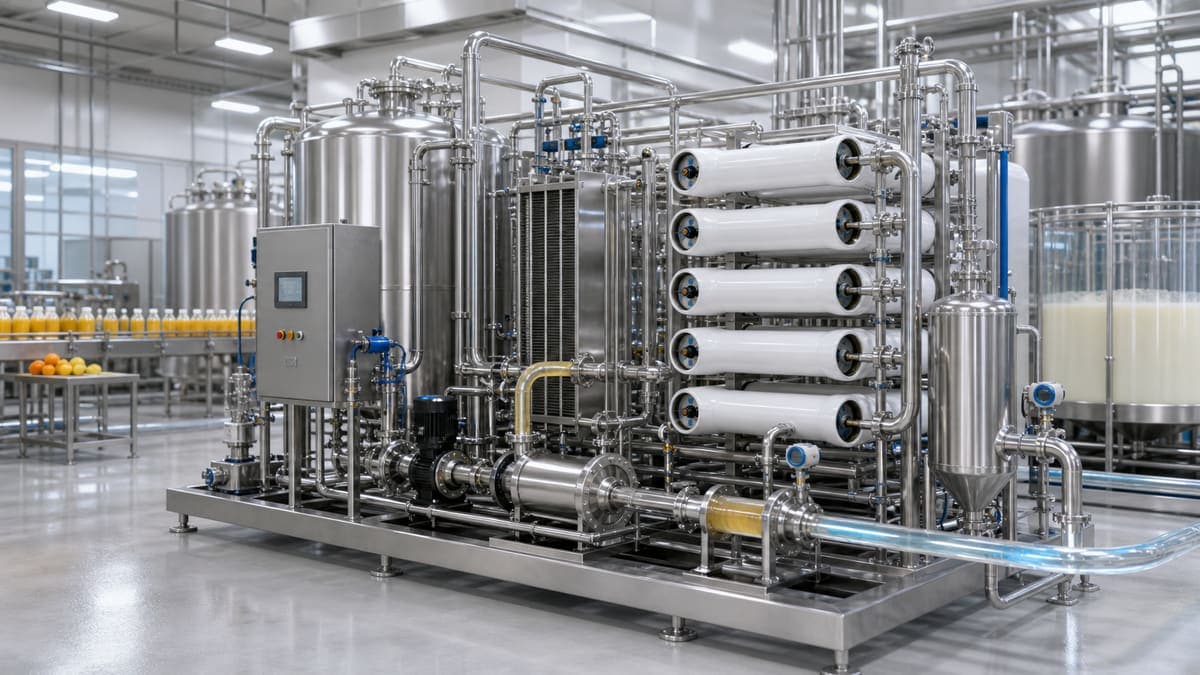
AquaChain designs bespoke membrane systems, featuring integrated stainless-steel skids and leveraging digitally modelled flow paths for optimal hydraulic performance and hygienic design.
1. Pre-treatment & Clarification (for product feed)
The product stream often requires initial treatment to remove gross solids before membrane filtration. This may involve:
- Centrifugation or decanting for heavy solids removal.
- Coarse filtration to protect downstream membranes.
2. Ultrafiltration (UF)
UF is a cornerstone for many dairy and juice applications, acting as a clarification step or initial concentration.
- Applications: Protein standardization (e.g., milk protein concentrates), clarification of fruit juices (removing pulp, pectins, and suspended solids), pre-concentration prior to NF/RO.
- Membrane Selection:
- Spiral-wound elements: Cost-effective for clarified feeds with lower solids and viscosity.
- Tubular membranes: More robust, tolerant of higher suspended solids and more viscous fluids, easier to clean mechanically if needed.
- Ceramic membranes: Offer extreme chemical and thermal resistance, ideal for very aggressive CIP cycles and highly fouling or abrasive feeds, but with higher capital cost.
- Operation: UF systems operate in cross-flow mode to sweep away retained particles from the membrane surface, mitigating concentration polarization and biofouling, and maintaining stable flux (typically 30–80 L/(m²·h) for juice clarification or dairy protein concentration).
3. Nanofiltration (NF) & Reverse Osmosis (RO)
Following UF, NF or RO membranes are employed for further concentration or demineralization.
- Nanofiltration (NF): Often referred to as "loosening RO," NF selectively rejects multivalent ions and larger molecules (like sugars) while allowing monovalent salts and water to pass. This is ideal for demineralization or partial concentration of juice while retaining organic acids and flavor compounds.
- Reverse Osmosis (RO): RO membranes achieve high rejection of nearly all dissolved solids (typically >98% for salts). They are used for achieving high concentration factors (e.g., high Brix juice concentrates, reduction of water content in milk).
- System Design: These systems are typically staged to achieve high recovery rates (e.g., 60-85% for juice concentration). Staging is critical to manage the increasing osmotic pressure and potential for scaling of mineral compounds, such as calcium phosphate in dairy or calcium oxalate in juices. AquaChain evaluates the LSI (Langelier Saturation Index) and other scaling indices at each stage to design appropriate antiscalant dosing programs. Operating pressures can range from 10 to 70 bar, depending on the desired concentration and membrane type.
4. Chemical Dosing & CIP Systems
Effective and routine CIP is paramount for maintaining membrane performance and ensuring hygienic operation in food processing.
- CIP Programs: AquaChain designs multi-step CIP sequences tailored to the specific product and membrane type. This typically involves:
- Pre-rinse (water) to remove gross soils.
- Alkaline wash (e.g., NaOH with detergents/enzymes) at elevated temperatures (e.g., 50-70°C) to remove proteins, fats, and organic residues.
- Intermediate rinse.
- Acid wash (e.g., HNO₃, citric acid) at elevated temperatures to remove mineral scales.
- Final rinse and sanitization (e.g., peracetic acid).
- Monitoring: CIP effectiveness is measured by the recovery of normalized permeate flow after each cycle and verified through chemical analysis of CIP solutions.
Operations, Monitoring, and CIP Philosophy
Maintaining optimal membrane performance requires continuous vigilance and proactive management of fouling and biofouling. AquaChain systems provide granular operational data.
- Key Monitoring Parameters:
- Transmembrane Pressure (TMP): The pressure difference driving permeate flow. An increasing TMP at constant flux indicates fouling.
- Normalized Permeate Flow: Corrected for temperature and pressure, this allows for trending the intrinsic membrane permeability and identifying fouling or damage.
- Differential Pressure (ΔP): Across individual membrane elements or stages, indicating fouling within the module.
- Feed flow, concentrate flow, permeate flow (m³/h).
- Feed, permeate, and concentrate conductivity, pH, and temperature.
- Viscosity of the concentrate, especially for high-solids applications.
- Fouling Management: Beyond optimized cross-flow velocities, AquaChain employs smart antiscalant dosing for mineral-rich feeds and designs systems for efficient and effective CIP. The goal is to maximize the interval between cleaning cycles while ensuring full flux recovery post-CIP.
Risks and Common Engineering Mistakes
- Undersized Systems: Operating at excessive flux rates to compensate for an undersized system leads to rapid concentration polarization and severe fouling, requiring frequent and aggressive CIP, shortening membrane life.
- Inadequate Pre-treatment: Failure to properly clarify feed streams (e.g., too many suspended solids, pulp) before UF or NF/RO can quickly overwhelm membranes, leading to irreversible fouling.
- Suboptimal CIP Design: Dead legs, insufficient flow rates, or incorrect chemical concentrations/temperatures during CIP result in ineffective cleaning, leading to progressive, irreversible fouling and microbial growth.
- Ignoring LSI/Scaling: For high-recovery NF/RO systems concentrating mineral-rich products, overlooking LSI and not implementing appropriate antiscalant dosing or pH adjustment will lead to severe mineral scaling.
- Inadequate Material Selection: Not specifying food-grade, sanitary materials and designs leads to hygiene risks and non-compliance. AquaChain prioritizes sanitary design, utilizing fully drainable systems and appropriate materials for contact surfaces.
2026 Forward-Looking Context
AquaChain is committed to integrating cutting-edge technology and sustainability into every solution.
Energy & ESG
Membrane systems offer significant energy savings compared to thermal evaporation. Our designs focus on minimizing specific energy consumption (e.g., kWh/m³ permeate produced). For high-pressure NF/RO applications (where operating pressure exceeds approximately 30 bar), AquaChain integrates energy recovery devices (ERD) on the concentrate stream. These devices can recapture up to 95% of the hydraulic energy from the high-pressure concentrate, significantly reducing the overall power demand of the high-pressure pump, contributing to a lower carbon footprint and enhanced ESG performance.
Digital O&M
AquaChain's modular RO systems are engineered for advanced digital operation and maintenance. Remote monitoring capabilities track critical parameters such as stage ΔP, normalized permeate flow, and system temperatures. Our algorithms analyze these trends to provide predictive insights, optimize CIP timing, and identify potential issues before they impact production. This data-driven approach enhances operational uptime, minimizes unscheduled maintenance, and extends membrane lifespan.
Modular RO Systems
AquaChain offers the modular RO system portfolio to meet diverse industrial needs. The pilot-scale RO series is specifically designed for pilot-scale trials, research and development, and small-volume prototyping, allowing for process optimization and new product development with minimal investment. For large-scale production requirements, the industrial RO series provides robust, multi-stage membrane filtration systems with full SCADA integration, accommodating high throughputs and demanding operational environments, ensuring continuous and reliable performance for your most critical concentration processes.
Frequently Asked Questions
Q: Ceramic vs polymer UF?
A: Ceramic membranes are exceptionally durable, tolerate aggressive CIP (high temperatures, strong chemicals), and handle high suspended solids/abrasive feeds. They have a longer lifespan but a higher initial capital expenditure per square meter of membrane area. Polymer (polymeric) membranes are generally more cost-effective upfront, offer good performance for less aggressive feeds, and are widely used for applications where fouling is manageable and CIP protocols are less extreme. The choice depends on feed characteristics, desired flux, and long-term operational costs.
Q: Can membranes replace evaporators entirely for dairy/juice concentration?
A: Membranes can significantly reduce the load on evaporators or, for moderate concentration ratios (e.g., up to 40-50 Brix for juice, or 30-35% total solids for dairy), can often replace them entirely. However, for achieving very high final solids concentrations (e.g., >65 Brix juice concentrate or highly concentrated milk powders), traditional thermal evaporation or drying is often still required as a finishing step due to the extreme osmotic pressure limits of membranes. The most energy-efficient approach often combines membrane concentration with a smaller, more efficient thermal finishing stage.
Q: How do we validate cleaning?
A: Cleaning validation is critical in food processing. AquaChain recommends a multi-faceted approach. This includes monitoring the recovery of normalized permeate flow after each CIP cycle, which serves as a key indicator of cleaning effectiveness. Beyond this, ATP (Adenosine Triphosphate) bioluminescence testing and microbial swabs (for total viable count, coliforms, yeast/mold) are used to confirm the absence of residual organic matter and microbial contamination on membrane and system surfaces. We help clients establish acceptance criteria based on their product and regulatory requirements.
Q: What is the typical lifespan of membranes in dairy and juice applications?
A: The lifespan of membranes (UF, NF, RO) varies significantly depending on the feed quality, operating conditions, effectiveness of the CIP program, and type of membrane. With proper pre-treatment, optimal operating parameters (e.g., conservative flux rates), and rigorous CIP, polymeric membranes typically last 3-5 years, while robust ceramic membranes can last 7-10 years or even longer. Neglecting proper maintenance, aggressive operating conditions, or inadequate CIP will drastically shorten membrane life.
Call to action
AquaChain empowers dairy and juice processors to achieve superior product quality, reduce operational costs, and meet stringent regulatory demands through advanced membrane technology. Our engineering expertise ensures a solution perfectly aligned with your production goals. Need a customized process diagram for your Dairy & Juice facility? Consult AquaChain's engineering team today.
Related equipment & product lines
These categories typically support the approach above—open any line to compare brands and models.
- UF ModulesUltrafiltration modules for suspended solids and colloid removal.View category →
- RO MembranesReverse osmosis membrane elements for municipal and industrial desalination.View category →
- ChemicalsAntiscalants, cleaners, and process chemicals for water treatment operations.View category →
- Pumps & PumpingHigh-pressure and process pump solutions for water treatment skids and plants.View category →
Looking for site-specific references or lab data? Contact us—we can share case material relevant to your feed and targets.