Solutions · Industry Solutions
Lithium-ion battery manufacturing: electrolyte and electrode process water
Water for cell manufacturing: strict metal-ion limits, low TOC, and RO/EDI polishing for mixing, washing, and cleanroom-adjacent loops.
Use this guide within its scope
This page supports technical research and option comparison and is marked 2026. Illustrative values are not a quotation, completed process design, certification conclusion, or performance guarantee. Check current regulations, feed data, tests, and OEM records.
Problem
Trace transition metals and organics in water can catalyze unwanted side reactions and affect slurry stability—limits are tight even when resistivity looks fine.
Technology
High-performance pretreatment, RO (often staged), EDI or mixed-bed polishing, and hygienic materials of construction for critical loops.
Results
Repeatable slurry and washing quality with monitoring aligned to the ions that actually affect cell chemistry.
Engineering decision card
Use when
Trace transition metals and organics in water can catalyze unwanted side reactions and affect slurry stability—limits are tight even when resistivity looks fine.
Evaluate first
High-performance pretreatment, RO (often staged), EDI or mixed-bed polishing, and hygienic materials of construction for critical loops.
Inputs still required
Feed source and variability, capacity, target quality, operating hours, discharge or reuse boundary, available space, and utilities.
Comparison output
Repeatable slurry and washing quality with monitoring aligned to the ions that actually affect cell chemistry. The final decision still needs feed data, mass balance, and any necessary testing.
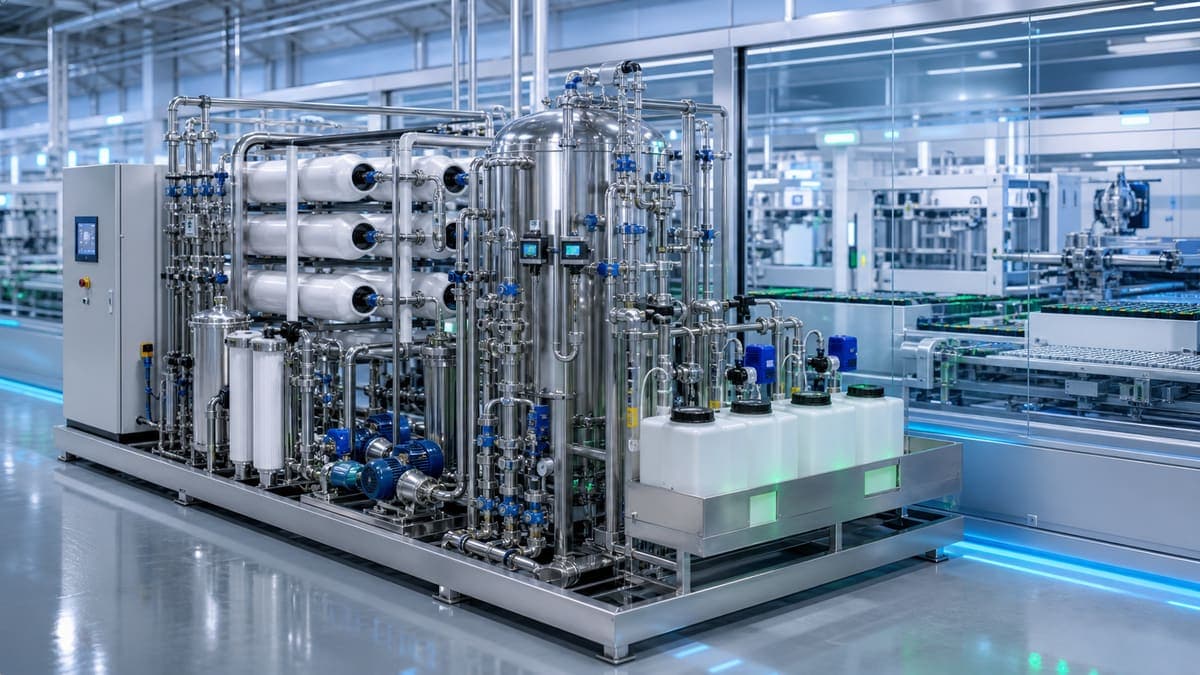
Lithium-ion battery manufacturing: electrolyte and electrode process water
Lithium-ion battery gigafactories are at the forefront of the global energy transition, but their demanding production processes – encompassing cathode and anode slurry preparation, precise coating, washing, and sensitive electrolyte handling – require water of exceptional purity. This goes far beyond generic deionized (DI) water. Trace contaminants such as transition metals (e.g., Fe, Cu, Zn), calcium, magnesium, and total organic carbon (TOC) can critically interfere with slurry dispersion, film formation uniformity, and ultimately compromise battery performance, cycle life, and safety. Furthermore, the cleanroom and dry-room environments demand stringent control over particles and microbial contamination at every water transfer point.
Industry Challenges and Regulatory Drivers
The global race to scale lithium-ion battery production brings intense scrutiny on quality, cost, and environmental footprint. Water purity is not merely an operational concern but a critical factor for product quality and regulatory compliance. While specific water quality standards for battery manufacturing are still evolving rapidly, the underlying principles often draw from ASTM D5127-13 Standard Guide for Ultrapure Water Used in the Electronics and Semiconductor Industries, particularly for Type E-1.2 or similar grades, which emphasizes extremely low levels of ionic and organic contaminants, as well as particles. For wastewater discharge, compliance with local environmental protection agency (EPA) or equivalent municipal discharge codes is paramount.
Water Quality Targets for Battery Manufacturing
Typical water quality targets are highly application-specific, but generally include:
- Resistivity: >10 MΩ·cm, often targeting >18.2 MΩ·cm at 25 °C for critical electrolyte or washing steps (ASTM D5127-13 Type E-1.2).
- TOC (Total Organic Carbon): <50 µg/L, often targeting <10 µg/L for critical applications.
- Particles: <1 particle/mL at >0.2 µm.
- Trace Metals (e.g., Fe, Cu, Zn, Ca, Mg): <1 ppb each.
- Silica: <5 ppb.
- Microbial Count: <1 CFU/100 mL.
engineering evaluation path Process Train: From Raw Water to Ultrapure Precision
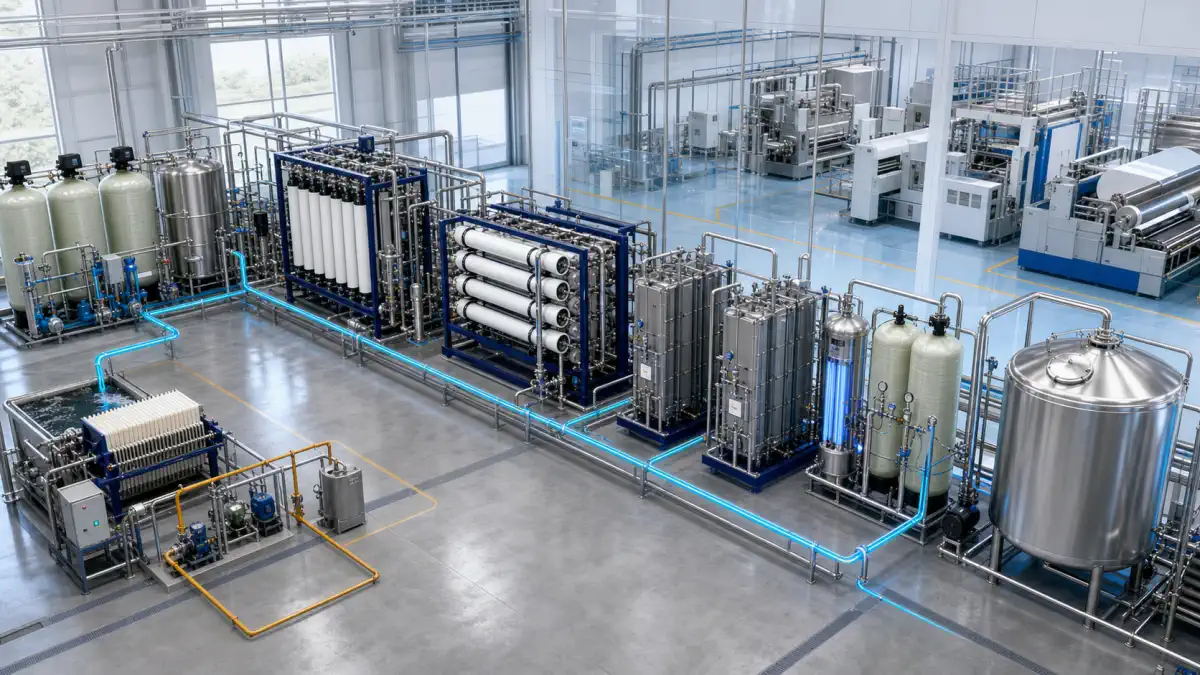
- Raw Water Pretreatment:
- Multimedia Filtration (MMF): Initial removal of larger suspended solids and turbidity. If the raw water SDI₁₅ (Silt Density Index over 15 minutes) is consistently above 5, an MMF system is essential.
- Ultrafiltration (UF): For challenging surface water sources or where biofouling potential is high, a robust UF system is implemented. UF membranes provide a physical barrier, effectively removing suspended solids, colloids, bacteria, and viruses, thereby reducing the SDI to <3 for optimal RO performance. This significantly extends the cleaning frequency and lifespan of downstream RO membranes.
-
Antiscalant Dosing: Prevents scaling on RO membranes due to sparingly soluble salts.
-
Dechlorination: Sodium bisulfite or activated carbon filtration removes free chlorine to protect polyamide RO membranes from oxidation.
- Cartridge Filtration: A final safety filter (e.g., 5-micron) before RO to capture any residual particulates.
-
Reverse Osmosis (RO):
- A critical step for high salt rejection and reduction of dissolved solids, organics, and microbial load. this approach typically employs high-rejection, low-pressure RO elements in a cross-flow configuration. The recovery rate of the RO system is carefully optimized to balance permeate production with the risk of concentration polarization and scaling, particularly for silica and hardness (LSI consideration). For very demanding applications or high boron removal, a double-pass RO system might be deployed to achieve permeate conductivity values typically below 5 µS/cm.
-
EDI Polishing (Continuous Electrodeionization):
- For ultrapure water requirements, RO permeate is fed to a continuous electrodeionization (EDI) system. EDI continuously regenerates its ion-exchange resin using a DC electric field and ion-selective membranes, eliminating the need for periodic chemical regeneration and its associated waste. Ions migrating through the resin are driven across ion-selective membranes into a concentrate compartment, which is continuously flushed, and an electrode compartment that receives a small electrode rinse flow. This produces high-purity water, typically with resistivity >16 MΩ·cm.
-
UV Sterilization and Polishing:
- UV Oxidation (185 nm): For TOC reduction, especially in critical loops, 185 nm UV reactors generate hydroxyl radicals that oxidize organic molecules into CO₂ and water.
- UV Disinfection (254 nm): Ensures microbial control within the distribution loop.
- Polishing Mixed-Bed Ion Exchange (Optional): For achieving 18.2 MΩ·cm resistivity and ultra-low ionic impurity, a non-regenerable mixed-bed ion exchange polisher or dedicated resin columns may follow EDI, often placed just before the point of use.
Operations, Monitoring, and CIP Philosophy
Effective operation of an ultrapure water system for battery manufacturing relies on continuous monitoring and proactive maintenance. this approach's systems are equipped with advanced instrumentation for real-time data acquisition:
- Transmembrane Pressure (TMP): Monitored across UF and RO membranes to detect fouling trends.
- Normalized Permeate Flow (NPF): Critical for RO performance trending, compensating for temperature and pressure variations to accurately track membrane degradation or fouling.
- Conductivity and Resistivity: Monitored at every critical stage (post-RO, post-EDI, point of use) to ensure ionic purity.
- TOC Analyzers: Online TOC meters provide continuous assurance for organic purity in critical loops.
- Differential Pressure (ΔP): Across all filtration stages to indicate filter loading.
Our Cleaning-in-Place (CIP) philosophy is based on predictive analytics rather than reactive measures. CIP timing is triggered by trend-based algorithms evaluating changes in NPF, TMP, and ΔP, ensuring membranes are cleaned before irreversible fouling occurs. CIP systems are designed for chemical compatibility and efficient regeneration of membrane performance.
Risks and Common Engineering Mistakes
- Underestimating Raw Water Variability: Failing to conduct comprehensive long-term raw water analysis is a common pitfall, leading to undersized pretreatment or inadequate chemical dosing.
- Overlooking Trace Contaminants: Focusing solely on conductivity and TOC can mask critical trace metal contamination unique to battery chemistry. A detailed Uniform Requirements Specification (URS) developed in conjunction with electrode and electrolyte suppliers is crucial.
- Improper Materials Selection: Using non-specified materials (e.g., brass fittings, inappropriate plastics) introduces leachables that can poison sensitive battery chemistries.
- Insufficient Recovery Rate Planning: Pushing RO recovery rates too high without proper antiscalant selection and LSI calculation can lead to rapid scaling, high transmembrane pressure, and premature membrane failure.
- Ignoring Biofouling: Inadequate UV, regular sanitization, or poorly designed loops can lead to microbial growth, impacting both water quality and membrane performance.
engineering evaluation path Engineering Tip
Ask electrode and electrolyte suppliers for a written maximum allowable list for metals and TOC per loop, not a single plant-wide “DI water” specification. This granularity is crucial for optimizing system design and cost.
Frequently Asked Questions
Q: Do we need double-pass RO everywhere? A: Rarely. Double-pass RO is typically employed where specific contaminant removal, such as high boron rejection, or exceptionally low ionic leakage is critical and economically justified. For many applications, a well-designed single-pass RO followed by EDI is sufficient.
Q: How important is TOC? A: TOC is often very important for binder and dispersion chemistry in slurry preparation, as well as electrolyte stability. High TOC can interfere with critical electrochemical processes. It is vital to specify where TOC is measured (e.g., post-UV, point of use) and how often (e.g., online continuous monitoring) to ensure consistent compliance.
Q: Can we share water with cooling towers? A: Never without clear physical and control separation. The risk of cross-contamination from cooling tower water, which is often chemically treated and prone to microbial growth, is far too high and could have catastrophic consequences for battery production quality. The saved pump head or pipe run is not worth the immense risk.
Q: What is the significance of LSI in RO design? A: The Langelier Saturation Index (LSI) indicates the scaling potential of water, primarily for calcium carbonate. In high-recovery RO systems, the concentration of dissolved solids increases significantly in the concentrate stream. Monitoring LSI is critical to predict and prevent calcium carbonate scaling on the membrane surface, which would lead to reduced permeate flow and increased transmembrane pressure. Proper antiscalant dosing and controlled recovery rates are used to maintain LSI within acceptable limits.
Related equipment & product lines
These categories typically support the approach above—open any line to compare brands and models.
- RO MembranesReverse osmosis membrane elements for municipal and industrial desalination.View category →
- Electrodeionization (EDI)EDI modules and systems for ultrapure water production.View category →
- Ion Exchange ResinsCation/anion and mixed bed resin solutions for demineralization and polishing.View category →
- UF ModulesUltrafiltration modules for suspended solids and colloid removal.View category →
For a closer review, use the engineering inquiry form to share feed, capacity, target, and project stage. Submission does not constitute a completed design or performance commitment.