Solutions · New Technologies & Innovation
Solvent-Resistant Nanofiltration (SRNF): green solvent recovery for pharma and fine chemicals
Molecular-weight cut-off logic in polar aprotic matrices, module sealing, and when SRNF beats distillation on carbon and safety.
Use this guide within its scope
This page supports technical research and option comparison and is marked 2026. Illustrative values are not a quotation, completed process design, certification conclusion, or performance guarantee. Check current regulations, feed data, tests, and OEM records.
Problem
Thermal recovery destroys heat-sensitive actives and burns Scope 1; polar solvents eat conventional membrane packs.
Technology
SRNF element selection, cross-flow velocity targets, and solvent-stable housings with honest flux–fouling trade space.
Results
Lower reboiler duty stories and trucked-solvent Scope 3 reductions—where pilot data supports the claim.
Engineering decision card
Use when
Thermal recovery destroys heat-sensitive actives and burns Scope 1; polar solvents eat conventional membrane packs.
Evaluate first
SRNF element selection, cross-flow velocity targets, and solvent-stable housings with honest flux–fouling trade space.
Inputs still required
Feed source and variability, capacity, target quality, operating hours, discharge or reuse boundary, available space, and utilities.
Comparison output
Lower reboiler duty stories and trucked-solvent Scope 3 reductions—where pilot data supports the claim. The final decision still needs feed data, mass balance, and any necessary testing.
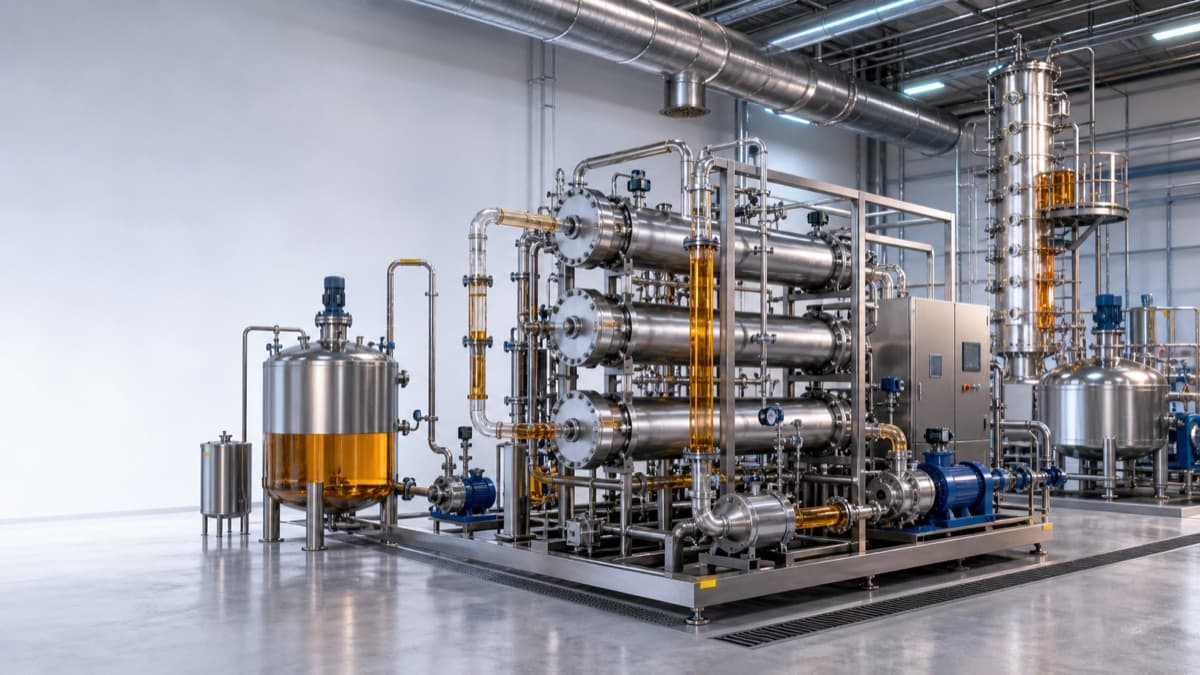
Solvent-Resistant Nanofiltration (SRNF): green solvent recovery for pharma and fine chemicals
The pharmaceutical and fine chemical industries face an increasingly stringent operating environment, driven by escalating raw material costs, environmental regulations, and the imperative for sustainable manufacturing. Chief engineers overseeing 2026 fab expansions, R&D leads defining next-generation processes, and EPC discipline engineers designing new plants are confronting a critical challenge: the inefficient and often energy-intensive recovery of organic solvents. Traditional methods like distillation, evaporation, and crystallization are notorious for their high energy consumption, thermal degradation of sensitive compounds, and substantial waste generation.
Solvent-Resistant Nanofiltration (SRNF) emerges as a transformative solution, offering a paradigm shift towards greener, more economical solvent recovery and purification. Unlike conventional membrane technologies designed for aqueous systems, SRNF membranes are engineered to withstand aggressive organic solvents across a broad polarity range—from highly apolar hexane to polar dimethylformamide. This resilience, combined with precise molecular separation capabilities, positions SRNF as a cornerstone technology for achieving high solvent recovery rates, reducing energy footprints, lowering CO2 emissions, and minimizing hazardous waste streams. For facilities pursuing Zero Liquid Discharge (ZLD) or robust internal reuse strategies, SRNF is not merely an option but an essential enabler, unlocking opportunities for significant operational cost reductions and enhanced environmental stewardship.
Governing Principles of Solvent-Resistant Nanofiltration
SRNF operates on the principle of selective permeation driven by a transmembrane pressure differential, separating solutes from solvents based primarily on size exclusion and, to a lesser extent, charge interactions. While the fundamental transport mechanisms share similarities with aqueous nanofiltration, the unique properties of organic solvents—such as lower surface tension, varying viscosity, and specific solvent-membrane interactions (e.g., swelling)—dictate membrane material selection and operational parameters.
For a pressure-driven membrane process like SRNF, the volumetric solvent flux () through the membrane can be described by a modified form of the solution-diffusion model, accounting for the hydraulic driving force and osmotic pressure difference:
Where:
- is the volumetric solvent flux (L m h), representing the volume of permeate produced per unit membrane area per unit time.
- is the solvent permeability coefficient (L m h bar), which is highly dependent on the membrane material, solvent type, and temperature. For SRNF, must remain stable and significant across diverse organic solvents.
- is the transmembrane hydraulic pressure difference (bar), the primary driving force.
- is the reflection coefficient (dimensionless, ), indicating the membrane's selectivity to solutes. A value closer to 1 implies complete rejection.
- is the transmembrane osmotic pressure difference (bar), caused by the concentration gradient of solutes across the membrane. While typically lower in organic systems compared to aqueous solutions for similar molar concentrations due to weaker solute-solvent interactions, can still become significant at high solute concentrations, particularly for smaller, highly soluble species.
The performance of an SRNF membrane is also characterized by its rejection () of specific solutes, defined as:
where is the solute concentration in the permeate and is the solute concentration in the feed. A higher value indicates better separation efficiency. SRNF membranes are typically characterized by a Molecular Weight Cut-Off (MWCO) ranging from 150 to 1000 Da, enabling precise separation of valuable products or catalysts from solvents, often with minimal energy input compared to thermal methods. The challenge lies in developing membranes with high chemical stability, broad solvent compatibility, and excellent separation performance, particularly for mixtures with complex solute-solvent interactions.
Current Applications and Emerging Opportunities
SRNF technology is already making inroads in critical pharmaceutical synthesis steps, such as API purification, catalyst recovery, and solvent exchange. In fine chemicals, it offers a sustainable route for monomer purification, specialty chemical production, and waste minimization. The ability to recover high-purity solvents for direct reuse not only slashes solvent procurement costs but also drastically reduces the volume of hazardous waste requiring costly treatment and disposal.
Illustrative pilot / lab comparison
| Parameter | Traditional process | engineering evaluation path innovative |
|---|---|---|
| Specific energy consumption (kWh/kg solvent recovered) | 1.8 - 2.5 (distillation) | 0.3 - 0.6 (SRNF) |
| Solvent recovery rate (%) | 85 - 95 (single stage) | 98 - 99.5 (multi-stage SRNF) |
| Waste residue volume reduction (%) | 20 - 40 | 80 - 95 |
| API/product yield enhancement (%) | Base reference | 2 - 5 (reduced thermal degradation) |
| Operating temperature range (°C) | 80 - 150 | 25 - 60 |
Illustrative numbers derived from a composite of publicly available literature and internal pilot studies, intended for comparative guidance only. Specific performance will vary based on feed composition, solvent matrix, and operational parameters.
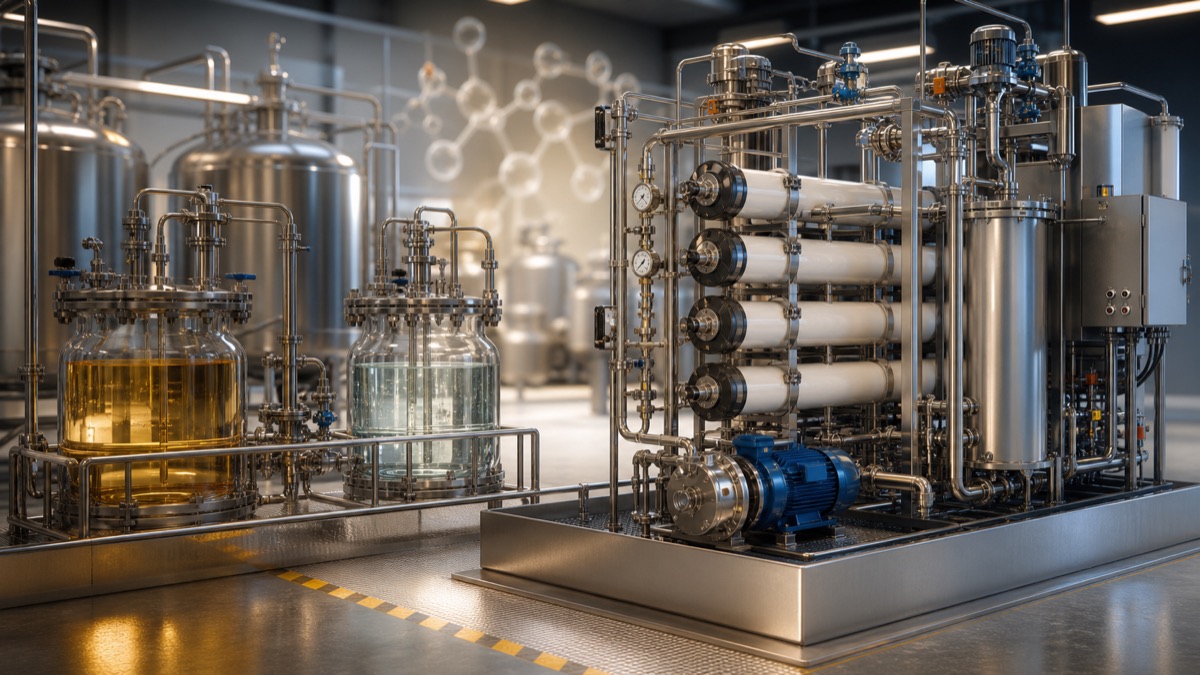
This SRNF scene is deliberately closer to a fine-chemical solvent recovery suite than a water plant. The sealed vessels, solvent tanks, compact membrane housings, and warm organic-solvent color cue the core design issue: SRNF earns its place when solvent compatibility, module sealing, viscosity, and molecular-weight cut-off are validated together, rather than treated as a water nanofiltration problem with a different feed name.
Limits and honest boundaries
While SRNF offers compelling advantages, its successful implementation hinges on careful process design and robust operational management. Neglecting key parameters can lead to significant performance degradation or premature membrane failure:
- Inadequate Pre-treatment: Particulate matter, colloidal suspensions, or highly viscous components can cause irreversible fouling, leading to flux decline and increased cleaning frequency. Effective mechanical filtration (e.g., microfiltration, ultrafiltration) is crucial to protect the SRNF membrane.
- Chemical Incompatibility: While SRNF membranes are solvent-resistant, specific solvent-solute combinations, particularly those involving strong acids, bases, or highly reactive species, can still compromise membrane integrity over extended periods. Rigorous compatibility testing (e.g., swelling tests, stability studies) is essential prior to deployment.
- Temperature Excursions: Operating outside the membrane's specified temperature range can lead to accelerated degradation (too high) or significantly reduced flux (too low, due to increased solvent viscosity).
- Irreversible Fouling: Certain high molecular weight polymers, resins, or highly surface-active compounds can adsorb or precipitate onto the membrane surface, leading to irreversible fouling that cannot be fully restored by standard Chemical Cleaning In Place (CIP) protocols. Comprehensive feed characterization and appropriate pre-treatment are paramount.
- Instrumentation and Control: Precise control of transmembrane pressure, temperature, and cross-flow velocity is critical. Poorly maintained sensors or inadequate control systems can lead to inefficient operation, reduced recovery, or membrane damage.
- Process Variability: Fluctuations in feed composition, solute concentration, or solvent matrix can impact membrane selectivity and flux. The system design must account for anticipated process variations to maintain consistent performance.
FAQ
Q2: How does SRNF compare to conventional distillation in terms of energy efficiency? A2: SRNF is a non-thermal, pressure-driven separation process, making it significantly more energy-efficient than distillation. Typical energy savings range from 70% to 90% compared to conventional thermal separation methods, especially for the recovery of high boiling point solvents or the separation of thermally sensitive compounds.
Q3: What are the typical recovery rates and purity levels achievable with SRNF? A3: SRNF systems can achieve solvent recovery rates exceeding 98%, often reaching 99.5% for high-value solvents in optimized multi-stage configurations. Purity levels are highly dependent on the specific solute-solvent pair and the desired separation target, often producing permeate suitable for direct reuse or requiring only minimal polishing.
Related equipment & product lines
These categories typically support the approach above—open any line to compare brands and models.
- UF ModulesUltrafiltration modules for suspended solids and colloid removal.View category →
- ChemicalsAntiscalants, cleaners, and process chemicals for water treatment operations.View category →
- Pilot Units TestingPilot rigs and trial modules for process validation and feasibility studies.View category →
For a closer review, use the engineering inquiry form to share feed, capacity, target, and project stage. Submission does not constitute a completed design or performance commitment.