Solutions · Sustainability & ESG
Lithium Recovery from Brine: resource chemistry from concentrated wastewater streams
Selective extraction, pretreatment, and purity paths—what is engineering-feasible versus headline hype.
Use this guide within its scope
This page supports technical research and option comparison and is marked 2026. Illustrative values are not a quotation, completed process design, certification conclusion, or performance guarantee. Check current regulations, feed data, tests, and OEM records.
Problem
Battery demand makes dissolved lithium in reject brines a stranded asset.
Technology
Pretreatment, selective sorbents/resins, and polishing aligned to battery-grade specs.
Results
Mass balance and reagent intensity you can put in front of investors.
Engineering decision card
Use when
Battery demand makes dissolved lithium in reject brines a stranded asset.
Evaluate first
Pretreatment, selective sorbents/resins, and polishing aligned to battery-grade specs.
Inputs still required
Feed source and variability, capacity, target quality, operating hours, discharge or reuse boundary, available space, and utilities.
Comparison output
Mass balance and reagent intensity you can put in front of investors. The final decision still needs feed data, mass balance, and any necessary testing.
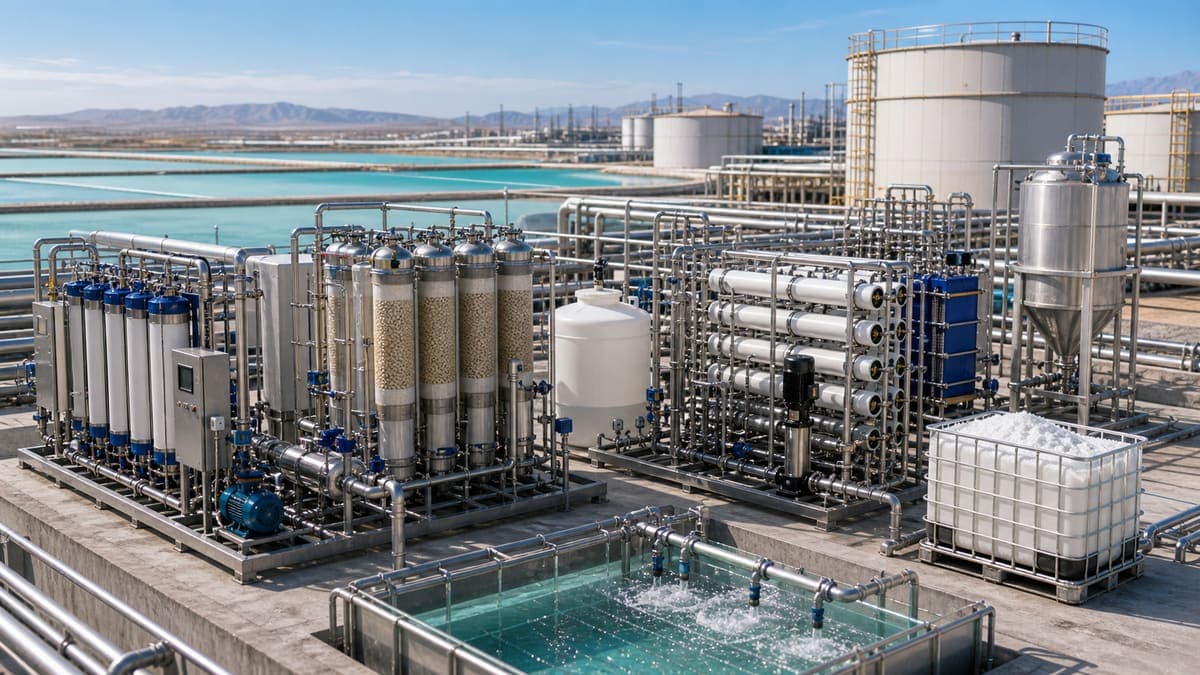
Lithium Recovery from Brine: resource chemistry from concentrated wastewater streams
The global push towards decarbonisation and the electrification of transport is placing unprecedented demand on critical raw materials, none more so than lithium – often dubbed "white petroleum." As the bedrock of electric vehicle batteries and grid-scale energy storage, lithium demand is projected to surge by up to 500% by 2050. This escalating need presents both a challenge and a profound opportunity. Traditional lithium extraction methods, typically from hard rock mining or vast evaporation ponds, are resource-intensive, consuming significant land and water, and carrying substantial environmental footprints that expose supply chains to escalating water risk and carbon emissions.
For UK and EU industries, securing a stable, ethically sourced, and low-carbon lithium supply is rapidly becoming a strategic imperative and a critical ESG gate for market access and investment. Buyers, EPCs, and sustainability officers are increasingly scrutinising the entire lifecycle of components, making sustainable resource recovery not just an environmental choice but an economic necessity. Concentrated industrial brine streams and process wastewaters, often considered liabilities, are now emerging as untapped reservoirs of this vital element. this approach specialises in turning these liabilities into assets, enabling industries to contribute to a circular economy for critical materials while drastically improving their environmental performance and reducing supply chain vulnerabilities.
The Strategic Imperative of Circular Lithium
The inherent water intensity of traditional lithium extraction, particularly from South American salars, creates substantial environmental and social risks. These "water wars" for lithium directly impact local communities and ecosystems, translating into supply chain instability and reputational damage for downstream industries. Furthermore, the carbon footprint associated with energy-intensive mining, processing, and long-distance transport of primary lithium contributes significantly to Scope 3 emissions for manufacturers. By recovering lithium from concentrated industrial wastewater streams, industries can mitigate these risks, reduce their overall carbon and water footprint, and strengthen their resilience against market volatility and stringent regulatory pressures. This approach aligns perfectly with the EU's Critical Raw Materials Act and the UK's Net Zero targets, positioning companies as leaders in the green transition.
Worked energy / carbon sketch
Consider an industrial facility generating a concentrated brine stream from a membrane separation process, containing recoverable lithium. Instead of costly disposal or conventional, energy-intensive primary processing, this approach's Direct Lithium Extraction (DLE) solution is implemented.
- Illustrative flow rate: 50 m³/day of concentrated brine.
- Illustrative lithium concentration: 300 mg/L (0.3 kg Li/m³).
- Annual lithium recovery potential: 50 m³/day * 0.3 kg Li/m³ * 330 operating days/year = 4,950 kg Li/year.
Energy comparison for purification/concentration to a sellable lithium product:
Annual Energy Savings: (18 kWh/kg Li - 4 kWh/kg Li) * 4,950 kg Li/year = 14 kWh/kg Li * 4,950 kg Li/year = 69,300 kWh/year.
Annual Carbon Savings: Using a stated illustrative UK grid emission factor of 0.233 kg CO₂e/kWh (based on UK Government GHG Conversion Factors for Company Reporting 2023): 69,300 kWh/year * 0.233 kg CO₂e/kWh = 16,140.9 kg CO₂e/year ≈ 16.1 tonnes CO₂e/year.
This calculation highlights the substantial carbon footprint reduction achievable by recovering lithium from concentrated wastewater streams using energy-efficient DLE technologies, primarily by reducing the energy required for purification and concentration steps compared to conventional methods.
Traditional vs engineering evaluation path
| Lens | Salars / hard-rock supply chain | Brine & DLE at the fence line (engineering evaluation path) |
|---|---|---|
| Water & land | Ponds and mining disturb large basins and groundwater narratives. | Works on existing concentrated streams; smaller footprint at site. |
| Carbon intensity | Drill–haul–calcine stack dominates Scope 1–3 story. | Electricity + reagents bounded by plant meters; easier to show year-on-year Δ. |
| Buyer proof | Long asset timelines; disclosure is project-led. | Pilot-to-scale data: mass balance on Li, impurities, and energy per kg. |
Carbon savings calculator (illustrative)
Estimate annual electricity savings and avoided CO₂e when specific energy improves (e.g. after ERD, VFD tuning, or train optimization). Replace defaults with your meter data and your grid emission factor from your utility or ESG methodology.
ΔkWh/year ≈ Q(m³/h) × hours/year × (kWh/m³before − kWh/m³after) · tCO₂e ≈ ΔkWh × factor / 1000
Δ specific energy: 1.00 kWh/m³
Estimated electricity savings: 800,000 kWh/year
Indicative avoided emissions: 336 tCO₂e/year
Related equipment & product lines
These categories typically support the approach above—open any line to compare brands and models.
- Ion Exchange ResinsCation/anion and mixed bed resin solutions for demineralization and polishing.View category →
- ChemicalsAntiscalants, cleaners, and process chemicals for water treatment operations.View category →
- RO MembranesReverse osmosis membrane elements for municipal and industrial desalination.View category →
For a closer review, use the engineering inquiry form to share feed, capacity, target, and project stage. Submission does not constitute a completed design or performance commitment.