Solutions · Sustainability & ESG
Selective Heavy Metal Harvesting: copper, nickel, zinc recovery from industrial streams
IX, chelation, and membrane hybrids for metal-bearing effluents—concentrate for smelter or refiner offtake.
Use this guide within its scope
This page supports technical research and option comparison and is marked 2026. Illustrative values are not a quotation, completed process design, certification conclusion, or performance guarantee. Check current regulations, feed data, tests, and OEM records.
Problem
Discharge limits tighten while dissolved metals have commodity value.
Technology
Selective media, pH/ORP staging, and mass-balance reporting for compliance.
Results
Lower sludge fees and revenue or credit from concentrate quality.
Engineering decision card
Use when
Discharge limits tighten while dissolved metals have commodity value.
Evaluate first
Selective media, pH/ORP staging, and mass-balance reporting for compliance.
Inputs still required
Feed source and variability, capacity, target quality, operating hours, discharge or reuse boundary, available space, and utilities.
Comparison output
Lower sludge fees and revenue or credit from concentrate quality. The final decision still needs feed data, mass balance, and any necessary testing.
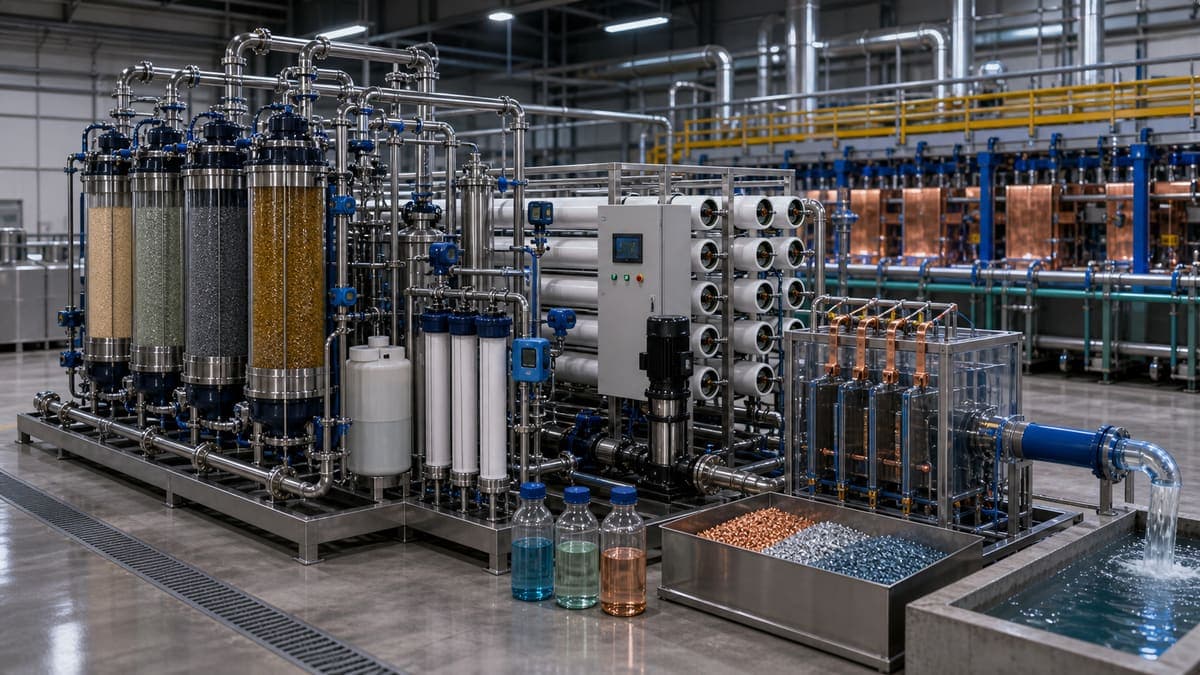
Selective Heavy Metal Harvesting: Copper, Nickel, Zinc Recovery from Industrial Streams
In an era defined by intensifying water risks, escalating raw material costs, and stringent supply-chain ESG (Environmental, Social, and Governance) demands, industrial operators in sectors from electroplating to mining face unprecedented pressure. For businesses supplying into the UK and EU, navigating forthcoming regulations like the Critical Raw Materials Act and evolving Extended Producer Responsibility schemes will not merely be about compliance, but about securing market access and fostering resilience. The linear "take-make-dispose" model is no longer tenable. Instead, the imperative for 2026 and beyond is a circular approach, where critical resources like copper, nickel, and zinc are not merely treated as waste, but harvested as valuable assets. This is where selective heavy metal harvesting becomes a cornerstone of sustainable operations, simultaneously mitigating environmental impact, reducing carbon footprints, and creating new revenue streams.
The Rising Value of Resource Recovery
Historically, heavy metals in industrial wastewaters were primarily seen as pollutants requiring costly removal and disposal. Traditional methods, often involving chemical precipitation, generate significant volumes of hazardous sludge and consume substantial energy and chemicals, with no economic return from the metals themselves. However, the paradigm is shifting. As global demand for critical metals outstrips supply, and their extraction from virgin sources incurs immense environmental and social costs, recovering them from industrial streams offers a compelling alternative.
Selective heavy metal harvesting technologies, predominantly leveraging advanced ion exchange or selective adsorption, enable the targeted capture and concentration of specific valuable metals. This not only cleanses the wastewater to meet discharge limits but also produces a concentrated, high-ppurity metal stream suitable for reintroduction into the production cycle or sale. This approach directly addresses water scarcity by enabling water reuse, contributes to decarbonisation by avoiding energy-intensive virgin extraction, and enhances supply chain security by localising critical material sources.
Worked energy / carbon sketch
Let's illustrate the potential energy and carbon savings from implementing selective heavy metal harvesting for copper recovery in an industrial facility.
Calculation:
- Annual Energy Savings: Q × H × ΔkWh/m³ = 15 m³/h × 7,500 h/year × 0.2 kWh/m³ = 22,500 kWh/year
- Annual Carbon Emissions Reduction: Annual Energy Savings × Grid Decarbonisation Factor = 22,500 kWh/year × 0.2 kg CO₂e/kWh = 4,500 kg CO₂e/year This translates to 4.5 tonnes CO₂e/year.
This illustrative calculation demonstrates that beyond the direct value of recovered metal, significant energy savings and associated carbon reductions can be achieved by transitioning from waste treatment to resource recovery. The avoided emissions are primarily from reduced chemical manufacturing, sludge dewatering, and the transportation of hazardous waste.
Traditional vs engineering evaluation path
| Aspect | Hydroxide precipitation | Selective IX / membrane hybrids (engineering evaluation path) |
|---|---|---|
| Residue | Mixed-metal sludge; high haulage Scope 3. | Concentrated eluate for refiner offtake; less mass to landfill. |
| Reagents | Broad-spectrum chemicals; messy mass balance. | Targeted regeneration chemistry; easier to meter. |
| Water + ESG | Effluent often needs extra polishing steps. | Clearer path to reuse + documented metal tonnes recovered. |
Elevating Water Stewardship and ESG Disclosure
Implementing advanced solutions for selective heavy metal harvesting is not just an operational upgrade; it's a strategic move to bolster your organisation's environmental credentials and streamline ESG reporting. By meticulously metering the quantity of recovered metals, the energy consumed by the recovery process, and the reduction in chemical inputs, businesses can generate verifiable data. This data, presented as mass and energy balances, forms the backbone of robust responses to ESG questionnaires from frameworks like CDP Water Security, the Alliance for Water Stewardship (AWS) Standard, or emerging EU Green Taxonomy requirements. Documenting reduced hazardous waste generation, lower carbon emissions associated with treatment, and tangible resource recovery clearly articulates progress towards circular economy goals and strengthens resilience in the face of supply chain scrutiny from UK and EU buyers. This transparency positions you as a responsible and sustainable partner in an increasingly demanding global marketplace.
FAQ
Q1: What heavy metals can typically be recovered using selective harvesting technologies? A1: Selective heavy metal harvesting is highly effective for recovering valuable metals like copper (Cu), nickel (Ni), and zinc (Zn). Advanced systems can also target and recover other strategic metals such as chromium, cobalt, precious metals (gold, silver, palladium), and rare earth elements, depending on the specific industrial stream and technology employed.
Q2: Which industries benefit most from selective heavy metal recovery? A2: Industries with high concentrations of target metals in their wastewater streams are prime candidates. This includes electroplating and surface finishing, electronics manufacturing, battery production and recycling, mining and metallurgical operations, chemical manufacturing, and aerospace. Any sector facing stringent discharge limits or high costs for virgin metal acquisition stands to benefit significantly.
Q3: How pure is the recovered metal, and what are its potential uses? A3: Selective harvesting technologies, particularly advanced ion exchange, can yield highly concentrated and pure metal solutions or solids. The purity is often sufficient for direct reintroduction into the original manufacturing process, reducing raw material procurement. Alternatively, these concentrates can be sold as high-value secondary raw materials to refiners, creating a new revenue stream and reducing reliance on volatile commodity markets.
Carbon savings calculator (illustrative)
Estimate annual electricity savings and avoided CO₂e when specific energy improves (e.g. after ERD, VFD tuning, or train optimization). Replace defaults with your meter data and your grid emission factor from your utility or ESG methodology.
ΔkWh/year ≈ Q(m³/h) × hours/year × (kWh/m³before − kWh/m³after) · tCO₂e ≈ ΔkWh × factor / 1000
Δ specific energy: 1.00 kWh/m³
Estimated electricity savings: 800,000 kWh/year
Indicative avoided emissions: 336 tCO₂e/year
Related equipment & product lines
These categories typically support the approach above—open any line to compare brands and models.
- Ion Exchange ResinsCation/anion and mixed bed resin solutions for demineralization and polishing.View category →
- ChemicalsAntiscalants, cleaners, and process chemicals for water treatment operations.View category →
- UF ModulesUltrafiltration modules for suspended solids and colloid removal.View category →
For a closer review, use the engineering inquiry form to share feed, capacity, target, and project stage. Submission does not constitute a completed design or performance commitment.