Solutions · Sustainability & ESG
VFD-Optimized Pumping Stations: matching flow demand and eliminating parasitic head
Affinity laws in practice: turndown, staging, and feedback so pumps do not fight valves—measurable kWh/m³ impact.
Use this guide within its scope
This page supports technical research and option comparison and is marked 2026. Illustrative values are not a quotation, completed process design, certification conclusion, or performance guarantee. Check current regulations, feed data, tests, and OEM records.
Problem
Throttling valves on fixed-speed pumps waste kWh and wear equipment.
Technology
VFD curves with minimum-flow guards, harmonics-aware drives, and instrumented verification.
Results
Lower kWh and demand charges tied to real duty cycles—not nameplate optimism.
Engineering decision card
Use when
Throttling valves on fixed-speed pumps waste kWh and wear equipment.
Evaluate first
VFD curves with minimum-flow guards, harmonics-aware drives, and instrumented verification.
Inputs still required
Feed source and variability, capacity, target quality, operating hours, discharge or reuse boundary, available space, and utilities.
Comparison output
Lower kWh and demand charges tied to real duty cycles—not nameplate optimism. The final decision still needs feed data, mass balance, and any necessary testing.
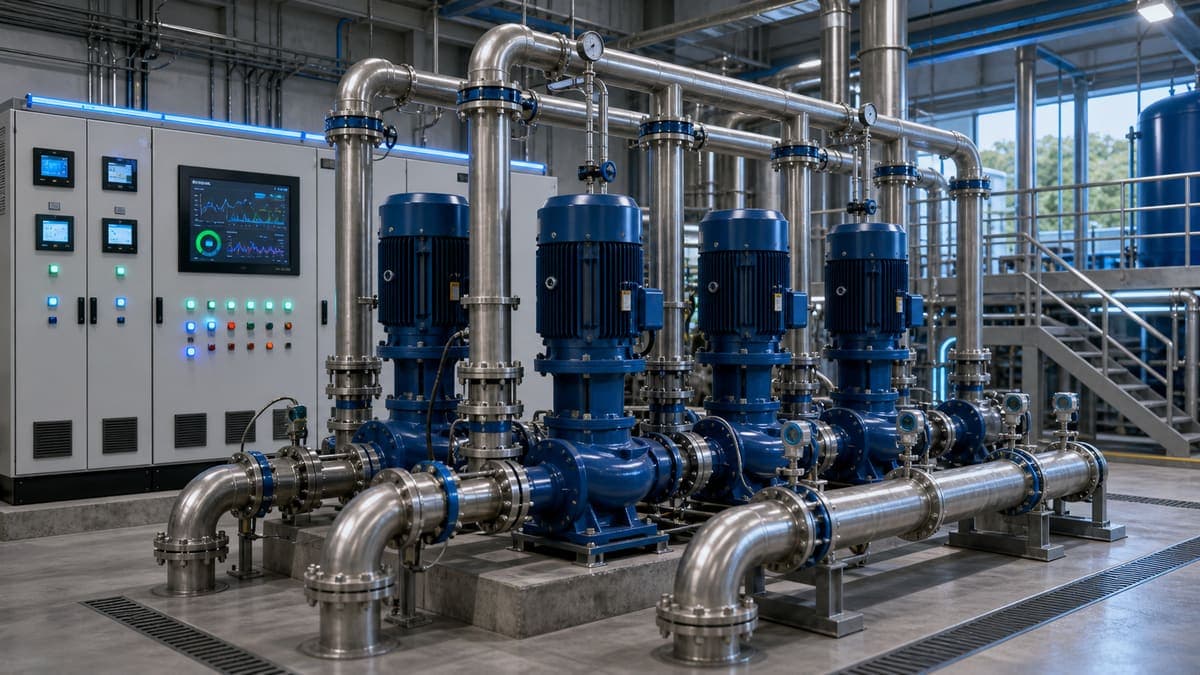
VFD-Optimized Pumping Stations: matching flow demand and eliminating parasitic head
In the drive towards a sustainable industrial future, operational efficiency is paramount. Pumping systems, often the largest consumers of electricity in industrial facilities, represent a significant opportunity for both carbon emissions reduction and enhanced water risk management. Variable Frequency Drives (VFDs) are a foundational technology in this transition, enabling pumping stations to precisely match dynamic flow demands, thereby eliminating the "parasitic head" that wastes enormous amounts of energy. For international industrial buyers, especially those supplying to the stringent UK and EU markets, optimising pump energy consumption is no longer just a cost-saving measure; it is a critical component of supply chain decarbonisation and meeting increasingly rigorous ESG (Environmental, Social, and Governance) disclosure requirements. Embracing VFD technology directly translates into a reduced carbon footprint, lower operational costs, and demonstrably improved resource efficiency, which are non-negotiable for competitive advantage in export-oriented contexts.
Pumping systems are ubiquitous in industry, moving everything from raw water intake and process fluids to wastewater and cooling water. Traditionally, these systems often operate at a fixed speed, designed for peak demand. When demand is lower, flow is often controlled by throttling valves, which creates artificial resistance or "parasitic head." This method forces the pump to work harder than necessary, consuming excessive energy without contributing to useful work. Imagine driving a car with your foot on the accelerator while simultaneously pressing the brake—this is analogous to a throttled, constant-speed pump.
VFDs revolutionise this by allowing the pump motor's speed to be adjusted continuously and precisely according to the actual system demand. Instead of creating resistance, a VFD reduces the motor's revolutions per minute (RPM). The power consumed by a centrifugal pump is proportional to the cube of its speed (the Affinity Laws). This means even a small reduction in speed leads to a significant reduction in power consumption. For instance, reducing a pump's speed by just 20% can decrease its power consumption by nearly 50%. This inherent efficiency gain directly addresses the parasitic head issue, allowing the pump to operate at its most efficient point for any given flow rate.
Beyond energy savings, VFDs offer a multitude of operational advantages:
- Extended Equipment Lifespan: Smoother operation, reduced motor and pump wear, and elimination of high-stress starts and stops contribute to longer service intervals and reduced maintenance costs.
- Improved Process Control: Precise flow and pressure regulation lead to more stable and consistent industrial processes, enhancing product quality and reducing waste.
- Reduced Noise and Vibration: Operating pumps at optimal speeds minimises mechanical stress and turbulence, leading to quieter facilities.
- Enhanced Reliability: Intelligent control systems can monitor pump health, predict maintenance needs, and integrate seamlessly with plant-wide automation.
Worked energy / carbon sketch
To illustrate the tangible benefits, consider an industrial facility operating a medium-sized process water pump without VFDs.
Illustrative Assumptions:
- Average Flow Rate (Q): 350 m³/hour
- Operating Hours (H): 7,000 hours/year (typical for continuous industrial operations)
- Specific Energy Consumption (before VFD): 0.28 kWh/m³ (conservative estimate for a constant-speed, partially throttled pump)
- Specific Energy Consumption (after VFD): 0.16 kWh/m³ (achievable with VFD optimization, reflecting ~40% energy reduction per m³)
- Grid Emission Factor: 0.23 kg CO₂e/kWh (representative of the UK national grid average in recent years, for illustrative purposes; specific factors vary by region and year).
Calculation:
-
Annual Water Volume Pumped: 350 m³/hour × 7,000 hours/year = 2,450,000 m³/year
-
Annual Energy Consumption (Before VFD): 2,450,000 m³/year × 0.28 kWh/m³ = 686,000 kWh/year
-
Annual Energy Consumption (After VFD): 2,450,000 m³/year × 0.16 kWh/m³ = 392,000 kWh/year
-
Annual Energy Savings (ΔkWh): 686,000 kWh/year - 392,000 kWh/year = 294,000 kWh/year
-
Annual Carbon Emissions Reduction (tonnes CO₂e): 294,000 kWh/year × 0.23 kg CO₂e/kWh = 67,620 kg CO₂e/year 67,620 kg CO₂e/year ÷ 1,000 kg/tonne = 67.62 tonnes CO₂e/year
This illustrative example demonstrates that a single VFD-optimized pumping station can eliminate nearly 70 tonnes of CO₂e annually, while simultaneously yielding significant operational cost savings. Such tangible reductions are precisely what UK and EU buyers are looking for in their supply chain sustainability reports.
Traditional vs engineering evaluation path
| Topic | Fixed-speed / throttled pumping | VFD-optimized pumping (engineering evaluation path) |
|---|---|---|
| Energy | Parasitic head on valves; motor often sized for peak; high kWh/m³. | Speed tracks demand; affinity-law savings; lower kWh/m³ and demand charges. |
| Reliability | Frequent starts, valve wear, higher vibration. | Soft ramps, gentler hydraulics, richer signals for condition monitoring. |
| ESG data | Weak link from meter to disclosure. | Flow, pressure, and kWh aligned for CDP/AWS-style intensity metrics. |
For industrial facilities supplying into the European and UK markets, robust water stewardship and transparent ESG disclosure are no longer optional. The data generated by VFD-optimized pumping stations—specific energy consumption (kWh/m³), actual flow rates, and operating hours—forms the bedrock of credible reporting. By meticulously metering and documenting these parameters, companies can accurately track their mass and energy balance, quantify efficiency gains, and verify carbon reductions. This granular, verifiable data is precisely what is required for comprehensive ESG questionnaires from frameworks like CDP Water Security, CDP Climate Change, and the Alliance for Water Stewardship (AWS), providing concrete evidence of environmental performance rather than aspirational statements. It enables you to demonstrate tangible progress towards sustainability goals, build trust with stakeholders, and mitigate reputation risks.
FAQ
Q1: What types of pumps or applications benefit most from VFD optimization? A1: VFDs deliver the greatest energy savings in applications where flow or pressure demands vary significantly over time. This includes cooling water loops, wastewater treatment (aeration, sludge transfer), process fluid transfer, boiler feedwater, irrigation, and HVAC systems. Any centrifugal pump operating for extended periods with fluctuating load is a prime candidate.
Q2: What is the typical Return on Investment (ROI) for installing VFDs on existing pumping systems? A2: While specific ROI varies based on pump size, operating hours, electricity costs, and the existing system's inefficiency, energy savings alone often result in an ROI of 1-3 years. Additional benefits such as reduced maintenance and extended equipment lifespan further enhance the overall economic justification.
Q3: Are there any specific regulatory considerations for VFD installations in the UK/EU? A3: VFDs themselves are energy-saving devices, aligning with EU ecodesign directives for motors and pumps. However, installations must comply with local electrical codes, electromagnetic compatibility (EMC) standards, and machinery safety directives. It's always advisable to consult with qualified electrical engineers and local regulatory bodies to ensure full compliance for permits and safe operation.
Carbon savings calculator (illustrative)
Estimate annual electricity savings and avoided CO₂e when specific energy improves (e.g. after ERD, VFD tuning, or train optimization). Replace defaults with your meter data and your grid emission factor from your utility or ESG methodology.
ΔkWh/year ≈ Q(m³/h) × hours/year × (kWh/m³before − kWh/m³after) · tCO₂e ≈ ΔkWh × factor / 1000
Δ specific energy: 1.00 kWh/m³
Estimated electricity savings: 800,000 kWh/year
Indicative avoided emissions: 336 tCO₂e/year
Related equipment & product lines
These categories typically support the approach above—open any line to compare brands and models.
- Pumps & PumpingHigh-pressure and process pump solutions for water treatment skids and plants.View category →
- InvertersVariable-frequency drives and inverter systems for variable-speed motor control.View category →
- Instrumentation & SensorsOnline measurement and control: flow, level, pressure, and water-quality sensors indexed from the Lenntech instrumentation hub.View category →
For a closer review, use the engineering inquiry form to share feed, capacity, target, and project stage. Submission does not constitute a completed design or performance commitment.