Pollutant removal
Ammonia Nitrogen: A Comprehensive Engineering Guide
Ammonia nitrogen (NH3-N) refers to the sum of unionized ammonia (NH3) and the ammonium ion (NH4+) dissolved in water. The equilibrium between these two forms is highly dependent on pH and temperature. At lower pH and temperature, the ammonium ion (NH4+) predominates, while at higher pH and temperature, the more toxic unionized ammonia (NH3) becomes prevalent.
Overview & Sources
Ammonia nitrogen (NH3-N) refers to the sum of unionized ammonia (NH3) and the ammonium ion (NH4+) dissolved in water. The equilibrium between these two forms is highly dependent on pH and temperature. At lower pH and temperature, the ammonium ion (NH4+) predominates, while at higher pH and temperature, the more toxic unionized ammonia (NH3) becomes prevalent.
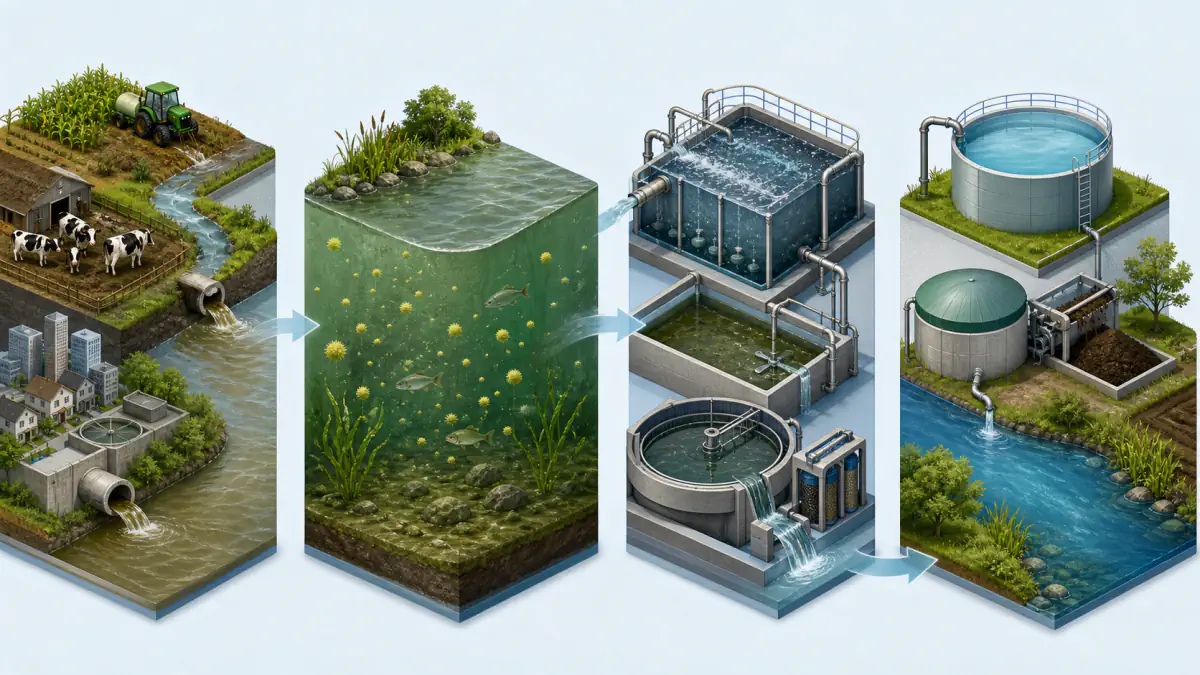
Ammonia nitrogen is a common pollutant in various water bodies and wastewater streams. Its primary sources include:
- Domestic Wastewater: A significant component of municipal sewage, resulting from the decomposition of urea and other nitrogenous organic compounds.
- Industrial Effluents: Industries such as fertilizer production, chemical manufacturing, petrochemicals, pharmaceuticals, food processing, and textile dyeing can discharge high concentrations of ammonia nitrogen.
- Agricultural Runoff: Animal waste and the overuse of nitrogen-based fertilizers contribute to ammonia runoff into surface and groundwater.
- Landfill Leachate: Decomposition of organic waste in landfills produces leachate rich in ammonia nitrogen.
- Natural Decomposition: Decomposition of organic matter in natural aquatic environments also releases ammonia.
Understanding the speciation of ammonia nitrogen is crucial for selecting appropriate treatment technologies, as different forms react differently to chemical and biological processes.
Environmental & Health Impact
The presence of ammonia nitrogen in water can lead to several severe environmental and health consequences:
- Eutrophication: As a primary nutrient, excessive ammonia nitrogen, especially in its oxidized forms (nitrates), can stimulate prolific growth of algae and aquatic plants in surface waters. This process, known as eutrophication, can lead to harmful algal blooms (HABs), reduced water clarity, and disruption of aquatic ecosystems.
- Aquatic Toxicity: Unionized ammonia (NH3) is highly toxic to aquatic life, particularly fish and invertebrates. It can damage gills, impair physiological functions, and lead to mortality even at low concentrations. The toxicity is exacerbated by higher pH and temperature, which shift the equilibrium towards NH3.
- Oxygen Depletion: The biological oxidation of ammonium (nitrification) consumes significant amounts of dissolved oxygen (DO) from the water column. This process, NH4+ + 2O2 → NO3- + 2H+ + H2O, can lead to hypoxic or anoxic conditions, severely impacting aquatic organisms that require oxygen.
- Disinfection Byproduct Formation: In drinking water treatment, ammonia nitrogen can react with chlorine disinfectants to form chloramines, which are less effective disinfectants than free chlorine and can persist longer in distribution systems. While chloramines are generally less harmful than some other disinfection byproducts, their formation is a concern for taste, odor, and overall disinfection efficiency.
- Indicator of Contamination: Elevated levels of ammonia nitrogen in drinking water sources often indicate recent contamination by domestic sewage or agricultural runoff, signaling potential presence of pathogens and other pollutants. Direct human toxicity from typical environmental ammonia levels is generally low, but its presence signals broader water quality issues.
Regulatory Standards
Regulatory limits for ammonia nitrogen vary significantly based on the water body type (e.g., discharge effluent, drinking water, surface water) and jurisdiction. These standards are typically set to protect aquatic life, prevent eutrophication, and ensure drinking water safety.
| Standard Body | Application / Water Type | Limit | Unit | Notes |
|---|---|---|---|---|
| WHO | Drinking Water Guideline | No direct guideline for health | - | No specific health-based guideline value, but taste and odor issues can occur above 1.5 mg/L. Indicates potential fecal contamination. |
| US EPA | Freshwater Aquatic Life (Acute) | Varies significantly by pH & Temp | mg/L as N | Highly dependent on pH and temperature. For example, at pH 7, 20°C, acute limit for fish can be around 5.3 mg/L NH3-N. Requires complex calculation. |
| US EPA | Freshwater Aquatic Life (Chronic) | Varies significantly by pH & Temp | mg/L as N | Chronic limits are lower than acute. For example, at pH 7, 20°C, chronic limit for fish can be around 0.61 mg/L NH3-N. Requires complex calculation. |
| US EPA | Drinking Water MCL | No federal MCL | - | Not a primary contaminant, but a secondary standard for taste/odor considerations (SMCL of 0.5 mg/L). |
| China GB | Discharge Std (GB 8978-1996) | Varies by Discharge Level | mg/L as N | Grade I Discharge: TBD; Grade II Discharge: TBD; Grade III Discharge: TBD. Requires source confirmation. |
| China GB | Environmental Quality Std for Surface Water (GB 3838-2002) | Varies by Water Quality Class | mg/L as N | Class I: TBD; Class II: TBD; Class III: TBD; Class IV: TBD; Class V: TBD. Requires source confirmation. |
Removal Technologies
The selection of an appropriate ammonia nitrogen removal technology depends on factors such as the initial concentration, desired effluent quality, wastewater characteristics (pH, temperature, presence of other pollutants), flow rate, capital costs (CapEx), operating costs (OpEx), and available footprint.
Membrane Solutions
Membrane technologies offer advanced separation capabilities for ammonia nitrogen, particularly for high-purity applications or where traditional biological methods are challenged.
- Reverse Osmosis (RO): Highly effective in rejecting dissolved salts and ions, including ammonium (NH4+). Rejection rates can exceed 95-99%. However, RO membranes are typically less effective at removing unionized ammonia (NH3), which can pass through the membrane more readily due to its smaller molecular size and non-ionic nature. Therefore, pH adjustment (to convert NH3 to NH4+) before RO can enhance removal.
- Engineering Considerations: Requires significant pretreatment (e.g., ultrafiltration, media filtration) to prevent fouling by suspended solids, organic matter, and scaling from mineral precipitation. High energy consumption due to operating pressure. Concentrate disposal is a major challenge.
- Nanofiltration (NF): Offers lower rejection rates than RO for monovalent ions like ammonium but can be effective for larger organic molecules and some multivalent ions. Ammonia rejection is typically lower than RO and more pH-dependent.
- Engineering Considerations: Lower operating pressure and energy consumption than RO. Still requires pretreatment.
- Membrane Contactor (MC) / Gas Permeation: These systems use hydrophobic gas-permeable membranes to separate dissolved gases. By adjusting the wastewater pH to be alkaline (e.g., pH > 10-11) to convert NH4+ to NH3, the ammonia gas can then selectively pass through the membrane into a stripping solution (e.g., acid) on the other side, or into a gas stream.
- Engineering Considerations: Offers selective removal. Requires careful pH control and subsequent treatment of the stripping solution (e.g., acid recovery or ammonium sulfate production). Membrane fouling can still occur.
Adsorption Solutions
Adsorption involves the binding of ammonia or ammonium ions to the surface of a solid material.
- Ion Exchange Resins / Zeolites: Natural (e.g., clinoptilolite) or synthetic zeolites are highly effective in selectively exchanging ammonium ions (NH4+) with other cations (e.g., Na+, K+, Ca2+) present on their surface. This is a common and robust method for ammonium removal, especially when biological treatment is not feasible or for polishing effluent.
- Engineering Considerations: Requires regeneration of the adsorbent material, typically with a concentrated salt solution (e.g., NaCl), which generates a brine waste stream rich in ammonia that requires further treatment. Breakthrough curves dictate regeneration frequency. Pretreatment for suspended solids is crucial to prevent clogging.
- Activated Carbon: While activated carbon is highly effective for removing organic pollutants, it has limited direct adsorption capacity for ammonia nitrogen unless specifically impregnated or modified. It can, however, be used as a polishing step to remove other contaminants that might interfere with downstream ammonia removal processes or to address odors.
- Engineering Considerations: Primarily effective for organic removal. Regeneration by thermal reactivation or chemical methods.
Chemical/Biological
These are the most widely applied and often most cost-effective methods for ammonia nitrogen removal, especially for large volumes of wastewater.
- Biological Nitrification-Denitrification: This is the cornerstone of advanced biological nitrogen removal.
- Nitrification (Aerobic): Ammonia (NH3) and ammonium (NH4+) are oxidized by nitrifying bacteria (e.g., Nitrosomonas and Nitrobacter) under aerobic conditions to nitrite (NO2-) and then to nitrate (NO3-).
- NH4+ + 1.5 O2 → NO2- + 2H+ + H2O (Nitrosomonas)
- NO2- + 0.5 O2 → NO3- (Nitrobacter)
- Engineering Considerations: Highly sensitive to temperature (optimal 25-35°C), pH (optimal 7.0-8.5), dissolved oxygen (DO > 2.0 mg/L), and presence of inhibitory compounds. Consumes alkalinity (approximately 7.14 mg CaCO3 per mg NH4+-N oxidized) and requires sufficient oxygen supply, increasing energy costs.
- Denitrification (Anoxic): Nitrate (NO3-) is then reduced to nitrogen gas (N2) by denitrifying bacteria under anoxic conditions, using an external or internal carbon source (e.g., methanol, acetic acid, or endogenous carbon).
- NO3- + organic carbon → N2 + H2O + CO2
- Engineering Considerations: Requires an anoxic environment (DO < 0.5 mg/L) and a readily available carbon source (C:N ratio). Can produce alkalinity, offsetting some nitrification alkalinity consumption.
- Integrated Systems: Often implemented in various configurations like Activated Sludge Processes (ASP), Sequencing Batch Reactors (SBR), Membrane Bioreactors (MBR), or specialized systems like ANAMMOX (Anaerobic Ammonium Oxidation), which combines partial nitrification with anammox bacteria to convert ammonium and nitrite directly to N2 gas, significantly reducing aeration and carbon source requirements.
- Nitrification (Aerobic): Ammonia (NH3) and ammonium (NH4+) are oxidized by nitrifying bacteria (e.g., Nitrosomonas and Nitrobacter) under aerobic conditions to nitrite (NO2-) and then to nitrate (NO3-).
- Breakpoint Chlorination: Ammonia can be oxidized to nitrogen gas (N2) by adding sufficient chlorine (hypochlorous acid/hypochlorite) until a "breakpoint" is reached. At this point, all ammonia and intermediate chloramines are destroyed.
- Engineering Considerations: Requires a high chlorine dose (approx. 7.6 mg Cl2 per mg NH3-N). Produces N2 gas, but can also form undesirable disinfection byproducts (DBPs) like trihalomethanes (THMs) and haloacetic acids (HAAs) if organic matter is present. High chemical costs and potential for residual chlorine issues. Generally not used as a primary treatment for large volumes.
- Air Stripping: This process involves increasing the pH of the wastewater (typically to >10-11) to convert ammonium (NH4+) to gaseous ammonia (NH3), then passing the wastewater through a stripping tower where it is contacted with air. The air strips the NH3 gas from the water.
- Engineering Considerations: Very effective at high pH. Sensitive to temperature (higher temp increases efficiency). The stripped ammonia in the off-gas often requires treatment (e.g., acid scrubbing) to prevent air pollution. Scaling of carbonates can occur at high pH. Cold weather significantly reduces efficiency.
- Chemical Precipitation: While not a primary method for ammonia removal, certain conditions can lead to co-precipitation. For example, in magnesium ammonium phosphate (MAP) precipitation (Struvite formation), ammonia, magnesium, and phosphate ions precipitate as a solid. This is primarily used for phosphorus recovery, with incidental ammonia removal.
- Engineering Considerations: Requires specific stoichiometric ratios of Mg, NH4+, and PO43-. pH control is crucial. Can be a useful side-stream treatment in some industrial wastewaters or digestates.
Technical Comparison Table
| Technology | Efficiency (NH3-N Removal) | CapEx (Relative) | OpEx (Relative) | Footprint (Relative) | Complexity (Operation) | Sludge/Waste Byproduct | Pretreatment Needs | Key Challenges |
|---|---|---|---|---|---|---|---|---|
| Biological Nitrification-Denitrification | High (>90%) | Medium | Medium-High | Large | Medium | Biological sludge | Screening, Grit removal, Primary clarification | Temperature/pH sensitivity, C:N ratio, Alkalinity consumption |
| Membrane Contactor (MC) | High (>90%) | High | Medium-High | Medium | Medium | Concentrated ammonia brine/acid stream | Removal of SS, pH adjustment | Membrane fouling, pH adjustment costs, Off-gas treatment |
| Reverse Osmosis (RO) | High (>95% for NH4+) | High | High | Medium-Small | High | Concentrated brine (high TDS, some NH4+) | Extensive (UF/MF, media filters, antiscalants) | Fouling, scaling, high energy, concentrate disposal |
| Ion Exchange (Zeolites) | High (>90%) | Medium | Medium-High | Small | Medium | Ammonia-rich regeneration brine | Removal of SS, heavy metals, oil/grease | Regeneration brine treatment, breakthrough management |
| Air Stripping | Medium-High (pH dependent) | Medium | Medium-High | Large | Medium | Stripped NH3 gas (requires scrubbing), high pH sludge | Removal of SS, pH adjustment | Off-gas treatment, temperature sensitivity, scaling |
| Breakpoint Chlorination | High (>95%) | Low-Medium | High | Small | Medium | Residual chlorine, potential DBPs | Removal of SS, organics (to reduce DBP formation) | High chemical cost, DBP formation, precise dosing |
AquaChain Engineering Tip
When designing or optimizing an ammonia nitrogen removal system, it is paramount to conduct a thorough wastewater characterization, including not only ammonia and TKN, but also pH, temperature, alkalinity, dissolved oxygen, COD/BOD, and inhibitory substances. This comprehensive data allows for the accurate sizing of biological reactors, precise calculation of chemical dosages for pH adjustment or carbon supplementation, and selection of appropriate pretreatment steps to mitigate fouling or process upsets, ultimately leading to a robust, efficient, and cost-effective solution. Always consider the long-term operational costs associated with chemical consumption, energy demand, and sludge/byproduct management.
FAQ
Q: Why is pH control critical for ammonia nitrogen removal? A: pH directly influences the speciation of ammonia nitrogen between the non-toxic ammonium ion (NH4+) and the toxic unionized ammonia gas (NH3). This affects toxicity to aquatic life, membrane permeability, efficiency of air stripping (favors NH3 at high pH), and biological nitrification rates (optimal for nitrifying bacteria).
Q: What are the main challenges in implementing biological nitrification-denitrification for industrial wastewater? A: Key challenges include maintaining stable environmental conditions (pH, temperature, DO), ensuring a sufficient carbon source for denitrification, managing potential inhibitory compounds present in industrial effluents, and dealing with varying ammonia concentrations and flow rates that can upset microbial activity.
Q: Can Reverse Osmosis (RO) be a standalone solution for ammonia nitrogen removal in all cases? A: While RO can achieve high rejection of the ammonium ion (NH4+), it is less effective for unionized ammonia (NH3), which can pass through the membrane. Therefore, for effective ammonia removal, RO often requires pH adjustment of the feed water to convert NH3 to NH4+. Additionally, high energy consumption, extensive pretreatment requirements, and concentrate disposal are significant considerations, making it rarely a standalone solution for primary ammonia removal without complementary processes.