Pollutant removal
Arsenic Pollutant Encyclopedia Entry
Arsenic (As) is a naturally occurring metalloid widely distributed in the Earth's crust. It exists in various oxidation states, primarily as arsenite (As(III)) and arsenate (As(V)) in aquatic environments. The inorganic forms are generally considered more toxic than organic arsenic species.
Overview & Sources
Arsenic (As) is a naturally occurring metalloid widely distributed in the Earth's crust. It exists in various oxidation states, primarily as arsenite (As(III)) and arsenate (As(V)) in aquatic environments. The inorganic forms are generally considered more toxic than organic arsenic species.
Natural Sources:
- Geological Formations: Dissolution from arsenic-rich rocks, minerals (e.g., arsenopyrite), and volcanic ash. Groundwater in regions with specific geological features (e.g., Ganges-Brahmaputra Delta, parts of South America, and the Southwestern US) is particularly susceptible to high arsenic concentrations due to natural weathering and geochemical processes.
- Geothermal Activity: Release from geothermal fluids and hot springs.
Anthropogenic Sources:
- Mining & Smelting: Operations involving gold, copper, lead, and zinc can release arsenic into water and soil.
- Industrial Applications: Historically used in pesticides, herbicides, wood preservatives, and glass manufacturing. Modern uses include semiconductors, alloys, and certain pharmaceuticals.
- Fossil Fuel Combustion: Burning coal and other fossil fuels can release airborne arsenic, which then deposits into water bodies.
- Agricultural Runoff: Residues from past pesticide use can leach into water sources.
Understanding the specific speciation (As(III) vs. As(V)) and the presence of co-contaminants (e.g., iron, manganese, sulfide) is crucial for designing effective treatment strategies.
Environmental & Health Impact
Arsenic poses significant risks to both the environment and human health due to its high toxicity and persistence.
Environmental Impact:
- Water & Soil Contamination: Elevated arsenic levels in water can contaminate agricultural soils through irrigation, leading to bioaccumulation in crops.
- Bioaccumulation: Arsenic can accumulate in aquatic organisms, potentially moving up the food chain, though biomagnification is generally limited compared to other heavy metals.
- Ecosystem Disruption: High concentrations can be toxic to aquatic flora and fauna.
Health Impact: Chronic exposure to inorganic arsenic, primarily through contaminated drinking water, is a major public health concern. The effects are systemic and can manifest over many years.
- Carcinogenic: Classified as a Group 1 human carcinogen by the International Agency for Research on Cancer (IARC). It is strongly linked to skin, bladder, lung, liver, and kidney cancers.
- Dermatological Effects: Skin lesions, hyperkeratosis (thickening of the skin), and melanosis (pigmentation changes) are classic signs of chronic arsenic poisoning ("blackfoot disease").
- Cardiovascular Effects: Increased risk of cardiovascular disease, hypertension, and peripheral vascular disease.
- Neurological Effects: Peripheral neuropathy, cognitive impairment.
- Gastrointestinal Effects: Nausea, vomiting, diarrhea, abdominal pain (acute exposure).
- Developmental & Reproductive Effects: Associated with adverse birth outcomes, developmental delays, and reproductive issues.
- Endocrine Disruption: Potential links to diabetes and other endocrine disorders.
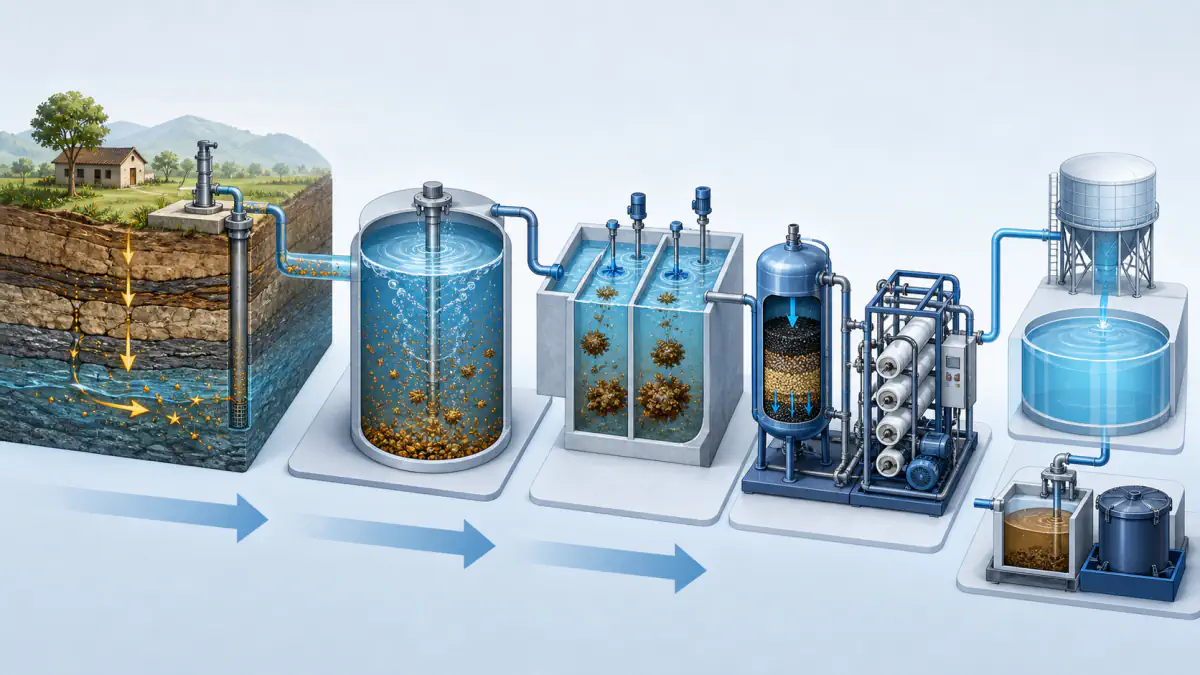
As(III) must be oxidized to As(V) using Cl2 or KMnO4 for effective removal. This oxidation step is critical because As(V) is typically anionic and thus more amenable to removal by adsorption, ion exchange, or precipitation technologies compared to the generally uncharged As(III) species in typical circumneutral pH ranges.
Regulatory Standards
Regulatory bodies worldwide have established stringent limits for arsenic in drinking water due to its severe health risks.
| Organism/Jurisdiction | Limit (mg/L) | Notes |
|---|---|---|
| WHO | 0.01 | Guideline value for drinking water |
| US EPA (MCL) | 0.01 | Maximum Contaminant Level for drinking water |
| China GB 5749-2006 | 0.01 | Standard for Drinking Water Quality |
Removal Technologies
The selection of an arsenic removal technology depends on various factors including initial arsenic concentration, speciation (As(III) vs. As(V)), presence of co-contaminants (e.g., iron, manganese, sulfide, silica), water chemistry (pH, alkalinity), desired treated water quality, waste management considerations, and economic feasibility. Pre-oxidation of As(III) to As(V) is a common and often essential first step for many removal processes.
Membrane Solutions
Membrane processes are highly effective for arsenic removal, particularly for As(V).
- Reverse Osmosis (RO): Achieves very high rejection rates (95-99%) for both As(III) (less effective) and As(V) by size exclusion and charge repulsion. RO is suitable for high-purity water requirements but comes with significant energy demands and concentrate management challenges.
- Nanofiltration (NF): Offers good rejection (70-90%) for As(V) and moderate rejection for As(III), depending on the specific membrane and feed water conditions. NF operates at lower pressures than RO but also produces a concentrate stream.
- Pretreatment: Critical for membrane longevity. Iron and manganese must be removed to prevent fouling. pH adjustment, anti-scalants, and filtration are often required to prevent scaling (e.g., silica, calcium carbonate) and particulate fouling.
- Concentrate Management: The concentrated arsenic-laden brine requires proper disposal or further treatment.
Adsorption Solutions
Adsorption is a widely used and robust technology for arsenic removal, particularly suitable for groundwater applications.
- Activated Alumina (AA): Effective for As(V) removal, especially at lower pH (optimum pH 5.5-6.0). Less effective for As(III). Requires regeneration with caustic soda, producing a hazardous waste stream.
- Iron-Based Adsorbents: Granular Ferric Hydroxide (GFH), hydrated ferric oxide (HFO), and iron-coated media are highly effective for both As(V) and As(III) after oxidation. They exhibit high adsorption capacities over a wide pH range (6-8). These are often considered "throw-away" media due to difficulties in regeneration, but offer high efficiency and robust performance.
- Other Adsorbents: Titanium dioxide, manganese oxide-coated media, and various proprietary adsorbents also exist.
- Mechanism: Arsenic species adsorb onto the surface of the media, forming strong surface complexes.
- Maintenance: Requires periodic backwashing to remove particulates and replacement of spent media. Iron-based adsorption or Oxidation + Membrane are often considered best available technologies for robust arsenic removal.
Chemical/Biological
These methods involve chemical reactions to change the arsenic speciation or physical state, or biological activity to transform it.
- Coagulation-Precipitation/Flocculation: Widely used, particularly for As(V). Ferric salts (ferric chloride, ferric sulfate) or aluminum salts (alum) are added to water, forming insoluble precipitates (e.g., ferric arsenate) that can be removed by sedimentation and filtration. Effective over a pH range of 5.5-8.5 for iron-based coagulants. As(III) requires pre-oxidation to As(V) for efficient removal by this method.
- Lime Softening: Primarily targets hardness but can achieve some arsenic co-precipitation, especially for As(V), though generally less effective than iron/aluminum coagulation alone.
- Oxidation: Essential for converting As(III) to As(V) prior to many treatment processes. Common oxidants include chlorine (Cl2, hypochlorite), potassium permanganate (KMnO4), and ozone (O3). The choice depends on water chemistry, oxidant demand, and contact time.
- Biological Methods: Less common for drinking water due to operational complexities, but involve microorganisms that can reduce As(V) to As(III) (mobilization) or oxidize As(III) to As(V) (immobilization) or even precipitate arsenic sulfides. Primarily explored for bioremediation or specific industrial wastewater applications.
Technical Comparison Table
| Technology | Removal Mechanism | Effectiveness (As(V)) | Pretreatment Needs | Waste Stream | Cost (Qualitative) |
|---|---|---|---|---|---|
| Membrane (RO/NF) | Size exclusion, charge repulsion | High | High (particulate, scaling, Fe/Mn, pH adjustment, oxidation) | Concentrated brine | High (CAPEX/OPEX) |
| Adsorption | Surface complexation, chemical binding | High | Moderate (particulate, Fe/Mn, oxidation for As(III)) | Spent adsorbent media (hazardous) | Medium |
| Chemical/Biological | Precipitation, co-precipitation, oxidation | Medium to High | Moderate (pH adjustment, oxidant control, solids removal) | Arsenic-laden sludge/solids | Low to Medium |
AquaChain Engineering Tip
Co-precipitation with Ferric Chloride is highly cost-effective for large-scale municipal plants. This method leverages readily available chemicals and existing infrastructure (flocculation, sedimentation, filtration) making it an economical choice for treating large volumes of water, provided that sludge management is adequately addressed.
FAQ
Q: Why is As(III) more difficult to remove than As(V)? A: As(III) (arsenite) exists predominantly as an uncharged species (H3AsO3) in typical pH ranges (6-9), making it less amenable to removal by electrostatic adsorption, ion exchange, or coagulation/precipitation compared to the negatively charged As(V) (arsenate) species (H2AsO4-, HAsO4^2-). Oxidation to As(V) is therefore a critical pretreatment step.
Q: What are the primary concerns for membrane fouling during arsenic removal? A: The main concerns are fouling by iron and manganese, especially if these are present in the source water. These metals can oxidize and precipitate on membrane surfaces, leading to severe flux decline and increased operating pressure. Other foulants include silica scaling, organic matter, and biological growth, all necessitating robust pretreatment.
Q: Can arsenic be removed effectively by conventional activated carbon? A: No, conventional activated carbon is generally ineffective for the removal of inorganic arsenic species (As(III) and As(V)) in water. Its adsorption capacity for arsenic is very low. Specialized iron-impregnated activated carbons or other functionalized carbons can enhance removal, but these are distinct from standard activated carbon.
Recommended AquaChain Guide solution
Oxidation + Adsorption/Membrane Filtration