Pollutant removal
Chromium (VI) - Engineering Pollutant Profile
Chromium (VI), also known as hexavalent chromium, is a highly toxic and mobile form of chromium. Unlike its trivalent counterpart, Chromium (III) [Cr(III)], which is relatively insoluble and can be an essential nutrient at trace levels, Cr(VI) exists primarily as soluble oxyanions (e.g., chromate (CrO4^2-) and dichromate (Cr2O7^2-)) in aquatic environments, making it highly bioavailable and environmentally pervasive. Its high solubility and mobility facilitate its transport through water systems, posing significant risks.
Overview & Sources
Chromium (VI), also known as hexavalent chromium, is a highly toxic and mobile form of chromium. Unlike its trivalent counterpart, Chromium (III) [Cr(III)], which is relatively insoluble and can be an essential nutrient at trace levels, Cr(VI) exists primarily as soluble oxyanions (e.g., chromate (CrO4^2-) and dichromate (Cr2O7^2-)) in aquatic environments, making it highly bioavailable and environmentally pervasive. Its high solubility and mobility facilitate its transport through water systems, posing significant risks.
Common industrial sources of Chromium (VI) include:
- Electroplating and Metal Finishing: Widely used in chrome plating, anodizing, and passivation processes for corrosion resistance and aesthetic finishes.
- Leather Tanning: Chromate compounds are used in the tanning process to stabilize collagen fibers.
- Textile Dyeing: Employed as a mordant in some dyeing operations.
- Wood Preservation: Chromated copper arsenate (CCA) was historically used as a wood preservative.
- Pigment and Dye Manufacturing: Chromium (VI) compounds are constituents in certain yellow, orange, and red pigments.
- Mining and Ore Refining: Naturally occurring chromium ores can release Cr(VI) during mining and processing, especially under oxidizing conditions.
- Cooling Tower Water: Used as a corrosion inhibitor in some industrial cooling systems, though its use is declining due to environmental regulations.
- Steel Manufacturing: Present in some steel production effluents.
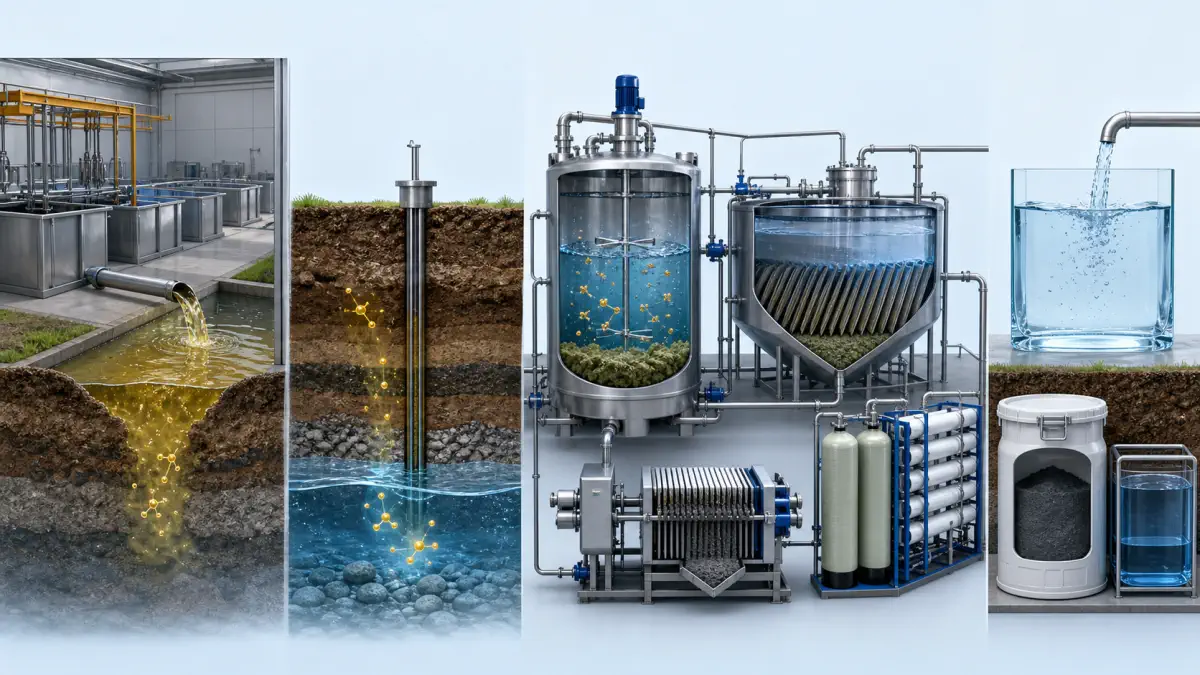
Environmental & Health Impact
The environmental and health impacts of Chromium (VI) are severe due to its high toxicity and mobility.
Environmental Impact: Chromium (VI) is highly soluble and mobile in aquatic systems, leading to extensive contamination of groundwater and surface water bodies. It does not readily degrade and can persist for long periods. Cr(VI) is acutely toxic to aquatic organisms, including fish and invertebrates, affecting their growth, reproduction, and survival. It can also be phytotoxic, inhibiting plant growth and accumulating in plant tissues. While Cr(VI) can be reduced to less toxic Cr(III) in reducing environments (e.g., anaerobic sediments), it can re-oxidize to Cr(VI) under aerobic conditions, posing a continuous threat.
Health Impact: Chromium (VI) is classified as a human carcinogen by inhalation. Exposure routes include inhalation, ingestion, and dermal contact, each leading to distinct health concerns:
- Inhalation: Primarily associated with lung cancer, as well as respiratory irritation, nasal ulcers, asthma, and perforation of the nasal septum.
- Ingestion: Can cause severe gastrointestinal distress, abdominal pain, nausea, vomiting, diarrhea, and internal bleeding. Chronic ingestion may lead to kidney and liver damage, and potentially an increased risk of gastrointestinal cancers.
- Dermal Contact: Known to cause allergic dermatitis ("chrome eczema"), skin ulcers ("chrome sores"), and irritation.
Cr(VI) is also recognized as a potent mutagen, capable of causing DNA damage. Due to these significant hazards, strict regulatory limits are in place globally for its presence in drinking water and industrial effluents.
Regulatory Standards
Regulatory standards for chromium vary by region and application (e.g., drinking water, industrial discharge). Typically, total chromium limits are set, with specific mention or stricter limits for Chromium (VI) due to its heightened toxicity.
| Parameter | WHO (Drinking Water) | US EPA (Drinking Water) | China GB (Drinking Water GB 5749-2006) | China GB (Industrial Discharge, e.g., GB 21900-2008 for Electroplating) |
|---|---|---|---|---|
| Chromium (Total) | 0.05 mg/L | 0.1 mg/L | 0.05 mg/L | 0.2 mg/L (Max daily average) or 0.5 mg/L (Discharge limit for new/old sources) |
| Chromium (VI) | No specific guideline (included in Total Cr) | Regulated under Total Cr MCL. Some states have specific Cr(VI) limits (e.g., California 0.01 mg/L). | No specific guideline (included in Total Cr) | 0.05 mg/L (Max daily average) or 0.1 mg/L (Discharge limit for new/old sources) |
| Notes | Health-based guideline | MCL for Total Cr. Cr(VI) is the primary health concern. | Standard specifies total chromium. Cr(VI) limits are often more stringent for specific applications. | Specific industry discharge standards apply. Values shown are examples for electroplating. |
Removal Technologies
Effective Chromium (VI) removal typically involves a multi-stage approach due to its chemical properties and the stringent effluent limits.
Membrane Solutions
Membrane processes offer high-efficiency separation for dissolved contaminants, including Chromium (VI). They act as a physical barrier to pollutant passage.
- Reverse Osmosis (RO): Highly effective in rejecting Cr(VI) oxyanions, achieving >95% removal. It is typically used as a polishing step for very low effluent concentrations. Requires extensive pretreatment (e.g., removal of suspended solids, hardness, organic matter, and often pre-reduction of Cr(VI) to Cr(III) to prevent membrane oxidation) to prevent fouling and scaling. Operating pressures are high, leading to significant energy consumption.
- Nanofiltration (NF): Offers good rejection of Cr(VI) (90-99%) with lower operating pressures and higher fluxes than RO. NF membranes are generally more resistant to fouling than RO but still require careful pretreatment. The separation mechanism is a combination of size exclusion and charge repulsion.
- Ultrafiltration (UF) / Microfiltration (MF): These membranes are primarily used for suspended solids removal and serve as essential pretreatment steps for RO and NF. They are not effective for the direct removal of dissolved Cr(VI).
Engineering considerations for membrane systems include careful pH management, removal of potential oxidants, hardness control (for scaling), and managing the concentrate stream, which contains high concentrations of rejected pollutants.
Adsorption Solutions
Adsorption processes leverage the affinity of Cr(VI) ions for specific surfaces or exchange sites.
- Ion Exchange (IX): This is a highly effective method for Cr(VI) removal, particularly using strong base anion (SBA) exchange resins. Cr(VI) oxyanions are selectively adsorbed onto the resin, displacing less strongly held anions. IX can achieve very low effluent concentrations (often <0.01 mg/L). The resin eventually becomes saturated and requires regeneration with a brine solution (e.g., NaCl). The spent regenerant is a concentrated hazardous waste that requires further treatment or disposal.
- Activated Carbon (GAC/PAC): While activated carbon is effective for removing many organic contaminants, its efficiency for Cr(VI) removal is generally lower than IX resins unless the carbon is specifically functionalized. Some reduction of Cr(VI) to Cr(III) can occur on the carbon surface, followed by adsorption of Cr(III). pH significantly influences the removal efficiency.
- Other Adsorbents: Various other adsorbents, including treated zeolites, modified clays, and biosorbents (e.g., derived from agricultural waste), are being researched for their Cr(VI) removal capabilities, often demonstrating pH-dependent performance.
Critical engineering aspects include optimizing pH for adsorption, designing appropriate contact time and column configurations, and managing regeneration and disposal of spent media.
Chemical/Biological
These methods involve altering the chemical state of Chromium (VI) or utilizing biological processes for its removal.
- Chemical Reduction: This is the most common and often primary treatment method for Cr(VI). It involves reducing highly soluble Cr(VI) to less soluble Cr(III) using reducing agents. Common reductants include:
- Ferrous Sulfate (FeSO4): Reacts rapidly, forming Fe(OH)3 precipitate which also aids in Cr(III) removal. Stoichiometry: 3 moles of Fe(II) per 1 mole of Cr(VI).
- Sodium Metabisulfite (Na2S2O5) or Sodium Sulfite (Na2SO3): Effective and relatively inexpensive. Stoichiometry: ~1.5 moles of sulfite per 1 mole of Cr(VI).
- Sodium Dithionite (Na2S2O4): Stronger reductant, used for higher concentrations or faster kinetics. The reduction reaction is highly pH-dependent, typically requiring acidic conditions (pH 2-3) for optimal kinetics.
- Coagulation/Flocculation/Precipitation: Following chemical reduction, the resulting Cr(III) is insoluble at neutral to alkaline pH (pH 8-10) and precipitates as Cr(OH)3. This precipitate is then removed from the water stream via coagulation, flocculation, sedimentation (clarification), and often followed by filtration. This process generates a hazardous sludge that requires dewatering and appropriate disposal.
- Biological Reduction: Certain microorganisms (e.g., Pseudomonas, Bacillus) can reduce Cr(VI) to Cr(III) under anaerobic or anoxic conditions. While an environmentally friendly approach, biological methods are typically slower, require careful control of environmental parameters (nutrients, pH, redox potential), and are more complex to implement for high-flow, high-concentration industrial wastewaters compared to chemical reduction. They are often considered for polishing or in specific bioremediation contexts.
Engineering design must consider precise chemical dosage control, accurate pH monitoring and adjustment, reaction tank design for sufficient contact time, efficient clarification and filtration, and robust sludge handling facilities.
Technical Comparison Table
| Feature | Membrane (RO/NF) | Adsorption (Ion Exchange) | Chemical Reduction + Precipitation |
|---|---|---|---|
| Primary Mechanism | Size/Charge Exclusion | Ion Exchange / Surface Binding | Redox Reaction, Precipitation |
| Target Cr Species | Cr(VI) primarily (as anion) | Cr(VI) primarily (anionic resins) | Cr(VI) reduced to Cr(III) |
| Typical Efficiency | >95% (RO), 90-99% (NF) | >99% | >95-99% |
| Capital Cost | High | Moderate to High | Moderate |
| Operating Cost | High (energy, membrane replacement, pretreatment chemicals) | Moderate (regenerants, disposal) | Moderate (chemicals, sludge disposal) |
| Pretreatment Req. | High (TSS, hardness, organics, oxidants) | Moderate (TSS, competing ions) | Low to Moderate (pH adjustment) |
| Sludge Generation | Moderate (concentrate, pretreatment sludge) | High (spent regenerant, spent resin) | High (Cr(III) hydroxide sludge) |
| Selectivity for Cr(VI) | Moderate (depends on other anions) | High (strong base anion resins) | Very High (specific reduction) |
| Applicability (Inlet) | Low to Moderate Cr(VI) (post-reduction often) | Low to Moderate Cr(VI) | High Cr(VI) |
| Footprint | Moderate | Moderate | Large (clarifier, sludge dewatering) |
| Maintenance | High | Moderate | Moderate |
| Key Challenges | Fouling, scaling, concentrate disposal | Regeneration chemical management, competing ions | Sludge dewatering & disposal, pH control |
AquaChain Engineering Tip
Always prioritize real-time pH monitoring and chemical dosing control for Chromium (VI) reduction-precipitation systems to ensure optimal reaction stoichiometry and minimize reagent overuse while maximizing Cr(III) insolubility.
FAQ
Q: Why is Cr(VI) removal more challenging than Cr(III)? A: Cr(VI) exists as highly soluble oxyanions (e.g., CrO4^2-, HCrO4^-), making it difficult to precipitate directly. Cr(III), however, forms insoluble hydroxides (Cr(OH)3) at neutral to alkaline pH, allowing for easier removal via precipitation and sedimentation.
Q: What is the most critical parameter to control in chemical reduction of Cr(VI)? A: pH is paramount. The reduction reaction typically requires acidic conditions (pH 2-3) for optimal kinetics, followed by an increase to neutral/alkaline pH (pH 8-10) to precipitate the resulting Cr(III) as Cr(OH)3.
Q: Can standard RO membranes effectively remove Cr(VI) directly from raw industrial wastewater? A: While RO membranes exhibit high rejection for dissolved species, direct treatment of raw industrial wastewater containing high Cr(VI) is challenging. Extensive pretreatment is required to prevent fouling from suspended solids, organics, and scaling. Often, Cr(VI) is first reduced to Cr(III) and precipitated, with RO/NF used as a polishing step.
Recommended AquaChain Guide solution
Reduction-Coagulation-Flocculation followed by advanced filtration or ion exchange, depending on concentration and desired effluent quality.