Pollutant removal
Fluoride
Fluoride (F⁻) is a naturally occurring anion found widely in the Earth's crust, primarily in mineral forms such as fluorite (CaF₂), cryolite (Na₃AlF₆), and fluorapatite (Ca₅(PO₄)₃F). While beneficial at low concentrations (e.g., for dental health), elevated levels in water sources pose significant health and environmental risks.
Overview & Sources
Fluoride (F⁻) is a naturally occurring anion found widely in the Earth's crust, primarily in mineral forms such as fluorite (CaF₂), cryolite (Na₃AlF₆), and fluorapatite (Ca₅(PO₄)₃F). While beneficial at low concentrations (e.g., for dental health), elevated levels in water sources pose significant health and environmental risks.
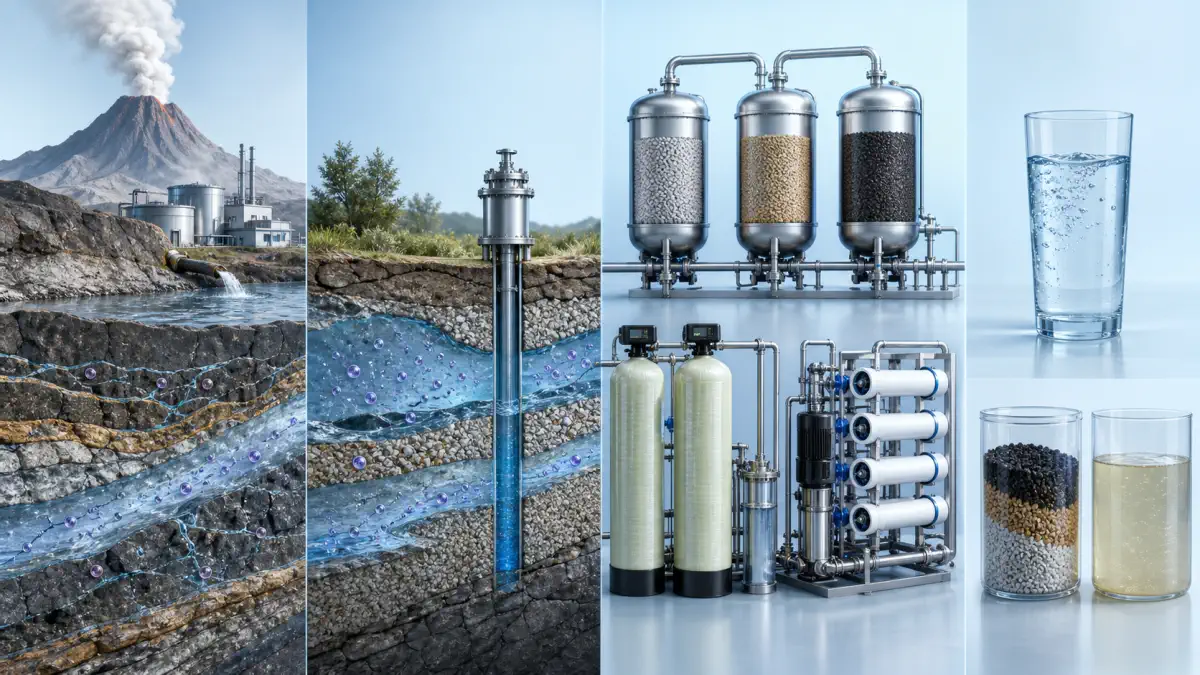
Sources of fluoride in water can be broadly categorized into:
- Natural/Geogenic:
- Weathering and dissolution of fluoride-rich minerals and rocks (e.g., granites, gneisses, shales) in aquifers.
- Geothermal activity, where fluoride is released from deep crustal rocks.
- Anthropogenic/Industrial:
- Aluminum Smelting: A major source, as cryolite is used as a solvent for aluminum oxide.
- Fertilizer Production: Phosphate rocks, used to produce phosphoric acid and fertilizers, often contain significant fluoride impurities.
- Glass and Ceramics Manufacturing: Fluoride compounds are used as fluxes.
- Electronics Industry: Etching processes in semiconductor manufacturing.
- Pesticide Manufacturing: Some pesticides contain fluoride.
- Water Fluoridation: Intentional addition to public water supplies for dental health, which can lead to localized elevated levels if not properly managed.
The solubility and mobility of fluoride in water are influenced by pH, temperature, and the presence of other ions like calcium and aluminum.
Environmental & Health Impact
Fluoride's impact varies significantly with concentration and exposure duration.
-
Human Health Impacts:
- Dental Fluorosis: Mild to severe discoloration and pitting of tooth enamel, typically occurring with chronic exposure to fluoride levels above 1.5-2.0 mg/L during tooth development.
- Skeletal Fluorosis: A debilitating bone disease resulting from chronic ingestion of high fluoride levels (>10 mg/L) over many years. It leads to bone hardening, joint stiffness, and impaired mobility.
- Non-Skeletal Effects: Studies suggest potential impacts on neurological development, thyroid function, and kidney health at very high concentrations, though these are subjects of ongoing research.
- insight: AA adsorption is highly pH-sensitive, optimal at 5.5 - 6.5.
-
Environmental Impacts:
- Phytotoxicity: High fluoride concentrations in irrigation water or soil can be toxic to plants, inhibiting growth, causing chlorosis, and reducing crop yield.
- Aquatic Ecosystems: While generally less toxic to aquatic life than some other pollutants, elevated fluoride can affect sensitive species, particularly fish and amphibians, leading to impaired growth and reproductive issues.
- Bioaccumulation: Fluoride can accumulate in soil and plant tissues, potentially entering the food chain.
Regulatory Standards
Regulatory limits for fluoride in drinking water are established to balance its dental health benefits with the risks of fluorosis. These limits often reflect the average daily intake from all sources.
| Organization | Limit (mg/L) | Notes |
|---|---|---|
| WHO | 1.5 | Guideline value for drinking water |
| US EPA | 4.0 | Maximum Contaminant Level (MCL) |
| US EPA | 2.0 | Secondary Maximum Contaminant Level (SMCL) |
| China GB | 1.0 | GB 5749-2006 (Drinking Water Standard) |
| China GB | 10.0 | GB 8978-1996 (Wastewater Discharge, Class 1) |
Note: Specific discharge limits for industrial wastewater can vary significantly based on industry type, local regulations, and receiving water body classification.
Removal Technologies
Fluoride removal from water presents engineering challenges due to its high solubility, small ionic size, and the need for high removal efficiency to meet stringent regulatory limits.
best_tech: Activated Alumina (AA) or RO/NF
Membrane Solutions
- Reverse Osmosis (RO): Highly effective in removing fluoride due to its small pore size, typically achieving >95% rejection.
- Mechanism: Pressure-driven separation through a semi-permeable membrane that rejects ions while allowing water molecules to pass.
- Advantages: High removal efficiency for fluoride and other dissolved solids, producing high-quality permeate.
- Disadvantages: High capital and operating costs (energy), significant concentrate (brine) disposal challenges, susceptibility to fouling and scaling (especially from calcium fluoride or silica), requiring robust pre-treatment.
- Pre-treatment: Essential to prevent membrane fouling and scaling. Includes clarification, filtration (e.g., multimedia, ultrafiltration), and antiscalant dosing.
- Nanofiltration (NF): Offers a compromise between RO and ultrafiltration. Can reject fluoride effectively, especially divalent ions, but is less complete than RO for monovalent ions like F⁻.
- Mechanism: Similar to RO, but with larger pores, allowing some monovalent ions to pass. Operates at lower pressures than RO.
- Advantages: Lower energy consumption than RO, good rejection of many dissolved solids and hardness.
- Disadvantages: Lower fluoride rejection than RO, still requires concentrate management and pre-treatment for fouling/scaling.
Adsorption Solutions
- Activated Alumina (AA): One of the most common and effective adsorbents for fluoride.
- Mechanism: Fluoride ions exchange with hydroxyl groups on the surface of the activated alumina, forming a chemical bond. Adsorption is highly pH-dependent, with optimal removal typically occurring in the pH range of 5.0 to 6.5.
- Advantages: High fluoride selectivity, relatively simple operation, regenerable.
- Disadvantages: Significant pH adjustment required (which adds operational cost and complexity), limited capacity (requiring frequent regeneration or media replacement), regeneration generates concentrated fluoride waste.
- Regeneration: Typically achieved using a caustic solution (NaOH) followed by an acid wash (H₂SO₄) to restore adsorption capacity.
- Ion Exchange Resins: Strong base anion exchange (SBA) resins can effectively remove fluoride.
- Mechanism: Fluoride ions exchange with counter-ions (e.g., chloride) on the resin matrix.
- Advantages: High removal efficiency, regenerable.
- Disadvantages: Can be non-selective, leading to competition with other common anions (sulfate, nitrate), which reduces fluoride removal capacity. Regeneration produces a concentrated brine waste.
- Bone Char (Tricalcium Phosphate): A traditional defluoridation method, particularly effective in developing regions.
- Mechanism: Surface precipitation and ion exchange of fluoride with hydroxyl and phosphate groups.
- Advantages: Effective, low-cost material, especially for smaller-scale applications.
- Disadvantages: Limited capacity, potential for microbial growth, and often requires pre-treatment for turbidity.
Chemical/Biological
- Precipitation (Calcium Precipitation): Uses calcium salts (e.g., lime, calcium chloride) to precipitate fluoride as insoluble calcium fluoride (CaF₂).
- Mechanism: Addition of Ca²⁺ ions reacts with F⁻ ions to form CaF₂(s), which has a low solubility product (Ksp ≈ 3.9 x 10⁻¹¹ at 25°C).
- Advantages: Relatively low cost for reagents, effective for high fluoride concentrations (often used as pre-treatment).
- Disadvantages: Residual fluoride concentration is limited by CaF₂ solubility (typically ~8 mg/L at pH 7, higher in acidic conditions), significant sludge generation, requires pH adjustment, and solid-liquid separation. Not suitable for achieving very low fluoride levels independently.
- Coagulation/Flocculation: Uses metal salts (e.g., aluminum sulfate (alum), ferric chloride) to adsorb or co-precipitate fluoride.
- Mechanism: Fluoride ions are adsorbed onto the surface of metal hydroxide flocs formed by the coagulant. Optimal pH range for removal varies by coagulant.
- Advantages: Can also remove turbidity and other contaminants.
- Disadvantages: Lower removal efficiency compared to other methods, high reagent dosage often required, significant sludge generation, and residual aluminum or iron in treated water can be an issue.
- Biological Methods: While some microbial strains can transform or immobilize fluoride, large-scale biological fluoride removal from water is not yet a widely established or commercially viable technology. Research is ongoing but currently, physical and chemical methods dominate.
Technical Comparison Table
| Technology | Removal Efficiency (F⁻) | Selectivity for F⁻ | Capital Cost | Operating Cost | Sludge/Waste Generated | Pre-treatment Needs | Sensitivity |
|---|---|---|---|---|---|---|---|
| Membrane (RO) | Very High (>95%) | Low (non-selective) | High | High | High (concentrate) | High (particulates, hardness, oxidants) | Fouling, Scaling, pH |
| Membrane (NF) | High (60-90%) | Low (non-selective) | Medium | Medium | Medium (concentrate) | Medium (particulates, hardness) | Fouling, Scaling, pH |
| Adsorption (AA) | High (80-99%) | High | Medium | Medium | Medium (spent media, regenerant) | pH adjustment, suspended solids | pH, Capacity, other anions |
| Adsorption (IX) | High (80-95%) | Medium | Medium | Medium | Medium (regenerant brine) | Suspended solids, competing anions | pH, Competing anions |
| Chemical Precip. (Ca) | Low-Medium (to ~8 mg/L) | Medium | Low | Medium | High (CaF₂ sludge) | Mixing, pH adjustment | pH, Initial F⁻ conc. |
| Coagulation (Al/Fe) | Low-Medium (20-70%) | Low | Low | Medium | High (metal hydroxide sludge) | Mixing, pH adjustment | pH, Initial F⁻ conc. |
Note: Costs and efficiencies are relative and can vary based on specific influent water quality, system design, and operational parameters.
AquaChain Engineering Tip
For high concentrations (>50mg/L), use Calcium precipitation as a pre-treatment.
FAQ
Q: Why is fluoride often considered a challenging pollutant to remove from water? A: Fluoride is challenging due to its small ionic size, high solubility in water, and the need to achieve very low residual concentrations to meet stringent regulatory limits, which often necessitates multi-stage or advanced treatment processes.
Q: What are the primary concerns for membrane fouling during fluoride removal using RO or NF? A: The primary concerns are scaling from sparingly soluble salts like calcium fluoride (CaF₂) and silica, as well as organic and particulate fouling. Proper pre-treatment, including filtration, antiscalant dosing, and pH adjustment, is crucial.
Q: How does pH significantly influence the effectiveness of activated alumina for fluoride removal? A: Activated alumina exhibits optimal fluoride adsorption in an acidic pH range, typically between 5.0 and 6.5. At higher pH, the alumina surface becomes negatively charged, repelling the fluoride anion, while at very low pH, competitive adsorption from other anions and potential dissolution of the alumina itself can occur.
Recommended AquaChain Guide solution
Activated Alumina, Reverse Osmosis, Nanofiltration, Calcium Precipitation, Ion Exchange.