Pollutant removal
Hardness (Water)
Water hardness refers to the concentration of dissolved multivalent metallic cations, primarily calcium (Ca²⁺) and magnesium (Mg²⁺) ions, in water. While other ions like iron (Fe²⁺) and manganese (Mn²⁺) can contribute, their concentrations are typically much lower. Hardness is commonly expressed in units of milligrams per liter (mg/L) as calcium carbonate (CaCO₃) equivalents, but other units like German degrees of hardness (dH) or grains per gallon (gpg) are also used.
Overview & Sources
Water hardness refers to the concentration of dissolved multivalent metallic cations, primarily calcium (Ca²⁺) and magnesium (Mg²⁺) ions, in water. While other ions like iron (Fe²⁺) and manganese (Mn²⁺) can contribute, their concentrations are typically much lower. Hardness is commonly expressed in units of milligrams per liter (mg/L) as calcium carbonate (CaCO₃) equivalents, but other units like German degrees of hardness (dH) or grains per gallon (gpg) are also used.
Hardness can be classified into two main types:
- Temporary Hardness: Caused by the presence of bicarbonate ions (HCO₃⁻) alongside calcium and magnesium. It can be largely removed by boiling, which precipitates calcium carbonate (CaCO₃) and magnesium hydroxide (Mg(OH)₂).
- Permanent Hardness: Caused by non-carbonate salts such as calcium sulfate (CaSO₄), magnesium sulfate (MgSO₄), calcium chloride (CaCl₂), and magnesium chloride (MgCl₂). This type of hardness cannot be removed by boiling and requires chemical or physical treatment.
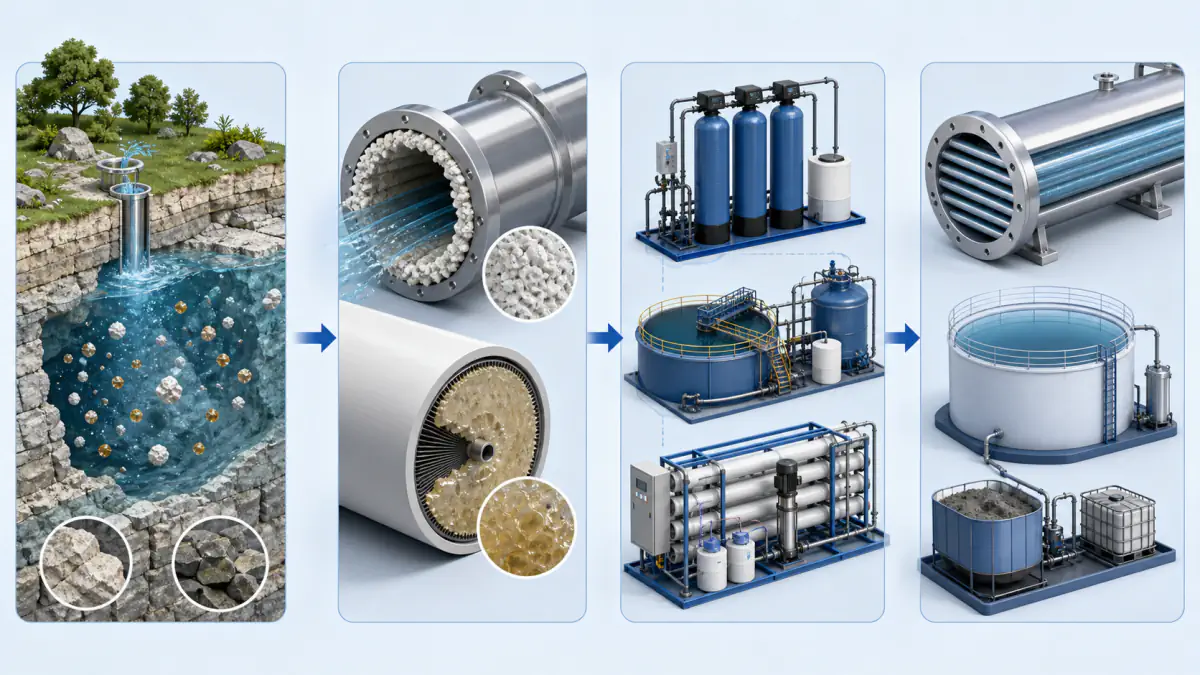
The primary sources of water hardness are geological formations. As water percolates through soil and rock, it dissolves minerals containing calcium and magnesium. Common mineral sources include:
- Limestone: Primarily calcium carbonate (CaCO₃)
- Dolomite: A mixture of calcium carbonate and magnesium carbonate (CaMg(CO₃)₂)
- Gypsum: Calcium sulfate (CaSO₄·2H₂O)
- Magnesite: Magnesium carbonate (MgCO₃)
The concentration of these minerals in groundwater and surface water varies significantly depending on the local geology, influencing the overall hardness of the water supply.
Environmental & Health Impact
While not typically considered a direct health hazard, hardness in water presents significant operational and economic challenges for both industrial and domestic users.
Industrial and Commercial Impacts:
- Scale Formation: The most prevalent issue is the precipitation of calcium carbonate (CaCO₃) and magnesium hydroxide (Mg(OH)₂) as scale on heat exchange surfaces (boilers, cooling towers, heat exchangers), pipes, and industrial equipment. This scale acts as an insulating layer, drastically reducing heat transfer efficiency and increasing energy consumption.
- Reduced Efficiency: Scaling can restrict water flow in pipes, increase pumping costs, and lead to premature failure of equipment due to overheating or blockage.
- Increased Chemical Consumption: In processes requiring specific water quality, hardness interferes with many chemical reactions and necessitates higher dosages of detergents, soaps, and other treatment chemicals. For example, soap consumption can increase significantly as soap reacts with hardness ions to form insoluble soap scum.
- Corrosion Potential: While often seen as protective, excessive scaling can sometimes lead to under-deposit corrosion or interfere with corrosion inhibitor performance.
- Product Quality Issues: In industries like textile manufacturing, pharmaceuticals, or food and beverage, hardness can negatively impact product quality, appearance, or shelf life.
Domestic Impacts:
- Soap and Detergent Waste: Hardness ions react with soap to form insoluble soap scum, reducing lathering and requiring more soap for effective cleaning.
- Aesthetic Issues: Scale buildup on plumbing fixtures, glassware, and dishes leaves unsightly spots and residues.
- Appliance Longevity: Accumulation of scale in water heaters, dishwashers, and washing machines reduces their efficiency and lifespan.
- Skin and Hair: Some individuals report skin dryness or hair dullness when washing with hard water.
Health Aspects: From a direct human health perspective, hard water is generally not considered harmful; in fact, it contributes essential minerals like calcium and magnesium to the diet. The World Health Organization (WHO) states that "there is no convincing evidence that water hardness causes adverse health effects in humans." However, some epidemiological studies have explored a potential inverse relationship between water hardness and cardiovascular disease mortality, though the mechanisms are complex and not fully understood. For engineering applications, the focus remains primarily on operational and economic impacts.
Regulatory Standards
Water hardness is typically classified based on concentration rather than strict regulatory limits due to its primary impact being aesthetic and operational, rather than a direct health hazard. However, some countries and organizations provide guidance or secondary standards.
| Parameter | WHO Guidelines (Potable) | US EPA (Potable) | China GB 5749-2006 (Potable) |
|---|---|---|---|
| Total Hardness | Varies | No MCL | Limit: TBD |
| (as CaCO₃ mg/L) | (Guidance for acceptability) | (Secondary Drinking Water Contaminant) | Notes: Requires source confirmation. |
| Notes | - Taste/Aesthetics. | - Aesthetic/operational issues. | - Limit applies to drinking water quality. |
| - <100 mg/L: Soft | - <60 mg/L: Soft | ||
| - 100-200 mg/L: Moderately Hard | - 60-120 mg/L: Moderately Hard | ||
| - 200-300 mg/L: Hard | - 120-180 mg/L: Hard | ||
| - >300 mg/L: Very Hard | - >180 mg/L: Very Hard |
Note: For the China GB 5749-2006 standard, specific numeric limits require direct consultation of the latest official document.
Removal Technologies
The selection of hardness removal technology depends on the raw water quality, desired treated water quality, economic considerations, and waste disposal regulations.
Membrane Solutions
Membrane processes utilize semi-permeable barriers to separate dissolved solids from water based on size exclusion and charge repulsion.
- Reverse Osmosis (RO): A pressure-driven process that forces water molecules through a dense membrane, leaving almost all dissolved ions, including Ca²⁺ and Mg²⁺, behind. RO offers very high rejection rates (typically >98%) for hardness ions, producing high-purity water.
- Advantages: Excellent removal of all dissolved solids, reliable performance, consistent water quality.
- Disadvantages: High energy consumption, significant capital cost, requires extensive pretreatment to prevent membrane fouling (scaling, organic, particulate), concentrate disposal challenges, sensitive to chlorine.
- Nanofiltration (NF): Often referred to as "softening membranes," NF membranes have larger pores than RO but smaller than ultrafiltration. They are highly effective at removing divalent ions like Ca²⁺ and Mg²⁺ (typically 80-98% rejection) while allowing monovalent ions (e.g., Na⁺, Cl⁻) to pass through to some extent.
- Advantages: Lower operating pressure and energy consumption than RO, high hardness rejection, partial removal of other dissolved solids.
- Disadvantages: Requires pretreatment, concentrate disposal, membrane fouling potential, may not achieve the same purity as RO.
Adsorption Solutions
These methods typically involve ion exchange resins that exchange hardness ions for less problematic ions.
- Ion Exchange (IX) Softening: The most common method for industrial and domestic hardness removal. Water passes through a bed of strong acid cation (SAC) resin, typically in the sodium form (R-SO₃⁻Na⁺). Hardness ions (Ca²⁺, Mg²⁺) are adsorbed by the resin, releasing sodium ions (Na⁺) into the water.
- Mechanism: 2R-SO₃⁻Na⁺ + Ca²⁺ → (R-SO₃⁻)₂Ca²⁺ + 2Na⁺
- Regeneration: When the resin is exhausted (all sodium sites replaced by hardness ions), it is regenerated by passing a concentrated brine (NaCl solution) through the bed, reversing the reaction and flushing out the accumulated hardness ions as a concentrated waste stream.
- Advantages: Highly effective, relatively simple operation, produces soft water suitable for many applications.
- Disadvantages: Requires regeneration with salt (leading to a brine waste stream), contributes sodium to the treated water, sensitive to suspended solids, iron, and chlorine (which can foul or damage the resin). Requires backwash.
Chemical/Biological
- Chemical Precipitation (Lime/Soda Ash Softening): This process involves adding chemicals, typically lime (calcium hydroxide, Ca(OH)₂) and/or soda ash (sodium carbonate, Na₂CO₃), to increase the pH of the water. At higher pH, calcium carbonate and magnesium hydroxide become insoluble and precipitate out of solution, which can then be removed by sedimentation and filtration.
- Mechanism:
- Ca(HCO₃)₂ + Ca(OH)₂ → 2CaCO₃(s) + 2H₂O (Removes temporary Ca hardness)
- Mg(HCO₃)₂ + Ca(OH)₂ → CaCO₃(s) + MgCO₃ + 2H₂O
- MgCO₃ + Ca(OH)₂ → Mg(OH)₂(s) + CaCO₃(s) (Removes temporary Mg hardness)
- CaSO₄ + Na₂CO₃ → CaCO₃(s) + Na₂SO₄ (Removes permanent Ca hardness)
- MgSO₄ + Ca(OH)₂ + Na₂CO₃ → Mg(OH)₂(s) + CaCO₃(s) + Na₂SO₄ (Removes permanent Mg hardness)
- Advantages: Cost-effective for large-scale operations with very high hardness, reduces alkalinity, can remove other contaminants (e.g., iron, manganese, silica).
- Disadvantages: Generates large volumes of sludge (CaCO₃, Mg(OH)₂) that require disposal, requires precise chemical dosing and pH control, treated water may require further pH adjustment and filtration, does not achieve very low hardness levels compared to IX or membranes.
- Mechanism:
- Biological Processes: While some biological processes can indirectly influence mineral solubility or complexation, direct biological removal of hardness as a primary treatment mechanism is not commonly employed in engineered water treatment. The primary methods remain physical (membranes), chemical (precipitation), or adsorptive (ion exchange).
Technical Comparison Table
| Feature | Ion Exchange (IX) | Reverse Osmosis (RO) | Nanofiltration (NF) | Chemical Softening (Lime/Soda) |
|---|---|---|---|---|
| Removal Efficiency (Ca/Mg) | High (>95%) | Very High (>98%) | High (80-98%) | High (85-95%) |
| Capital Cost | Medium | High | Medium-High | Medium-High |
| Operating Cost | Medium (salt, regeneration) | High (energy, membrane replacement, pretreatment chemicals) | Medium (energy, membrane replacement, pretreatment chemicals) | Medium (chemicals, sludge disposal, energy) |
| Pretreatment Needs | Essential (TSS, Fe, Cl₂) | Critical (SDI, scale inhibitors, Cl₂ removal) | Critical (SDI, scale inhibitors, Cl₂ removal) | Moderate (TSS, alkalinity adjustment) |
| Waste Products | Brine (regenerant waste) | Concentrate (high TDS) | Concentrate (moderate TDS) | Sludge (CaCO₃, Mg(OH)₂) |
| Operational Complexity | Moderate | High | High | Moderate-High |
| Applicability | Potable, Industrial, Boiler feed, Cooling water | Potable, Ultrapure, Desalination, Wastewater reclamation | Potable, Industrial, Specialty applications | Large-scale potable, industrial, wastewater |
| Selectivity (Monovalent vs Divalent) | Highly selective for divalent ions | Non-selective (rejects most ions) | High selectivity for divalent over monovalent | Non-selective precipitation based on solubility |
| Post-Treatment Needs | Minimal, pH adjustment if needed | pH adjustment, remineralization | pH adjustment, remineralization | pH adjustment, clarification, filtration |
AquaChain Engineering Tip
When designing a hardness removal system, always perform a comprehensive water analysis, including seasonal variations, and project the long-term operational costs beyond just chemical consumption. Consider an integrated approach that leverages the strengths of different technologies, such as coagulation/filtration for turbidity and iron removal followed by ion exchange or membrane filtration for final hardness reduction. This holistic view minimizes fouling, extends equipment lifespan, and optimizes total cost of ownership (TCO) for robust and efficient operation.
FAQ
Q: Why is understanding temporary vs. permanent hardness important for system design? A: Understanding this distinction helps engineers select the most appropriate treatment. Temporary hardness can be partially reduced by simple heating, influencing decisions for boiler feed or hot water systems. Permanent hardness requires more intensive chemical or physical methods, guiding the choice between ion exchange, membranes, or chemical softening.
Q: Can hard water cause corrosion in pipes? A: While a moderate level of hardness can form a protective scale (calcium carbonate layer) that inhibits general corrosion, excessive hardness can lead to issues like under-deposit corrosion or galvanic corrosion if scale forms unevenly, creating localized anodic and cathodic areas. Additionally, very hard water can exacerbate specific types of corrosion depending on other water chemistry parameters like alkalinity and pH.
Q: What are the key considerations for managing the waste stream from hardness removal technologies? A: For ion exchange, the primary waste is a concentrated brine solution (high in NaCl, Ca²⁺, Mg²⁺) which can have significant environmental impact if not properly managed, requiring discharge to municipal sewers (if permitted), evaporation ponds, or further treatment. For membrane systems (RO/NF), the concentrate stream is high in dissolved solids and often requires similar disposal considerations. Chemical softening produces a substantial volume of sludge, which needs dewatering and landfill disposal or beneficial reuse where possible. Waste management is a critical factor in the overall economic and environmental viability of any hardness removal project.
Recommended AquaChain Guide solution
Ion exchange softening, reverse osmosis (RO), nanofiltration (NF), chemical precipitation (lime/soda ash softening).