Pollutant removal
Microplastics: An Engineering Perspective on Treatment
Microplastics are broadly defined as plastic particles smaller than 5 millimeters in their largest dimension. This category encompasses a vast array of polymeric materials, shapes, and sizes, making their characterization and removal a complex engineering challenge.
Overview & Sources
Microplastics are broadly defined as plastic particles smaller than 5 millimeters in their largest dimension. This category encompasses a vast array of polymeric materials, shapes, and sizes, making their characterization and removal a complex engineering challenge.
Key Characteristics:
- Size: Ranging from 5 mm down to nanometers (nanoplastics).
- Shape: Fragments (irregular shapes from larger plastic degradation), fibers (from textiles), spheres (microbeads from personal care products, industrial pellets), films (from packaging).
- Polymer Type: Common polymers include Polyethylene (PE), Polypropylene (PP), Polystyrene (PS), Polyvinyl Chloride (PVC), Polyethylene Terephthalate (PET), Polyamide (PA, e.g., Nylon), and others. Each polymer has distinct physical and chemical properties influencing its fate and treatability.
- Density: Varies significantly, influencing buoyancy (e.g., PE, PP often float; PET, PVC often sink).
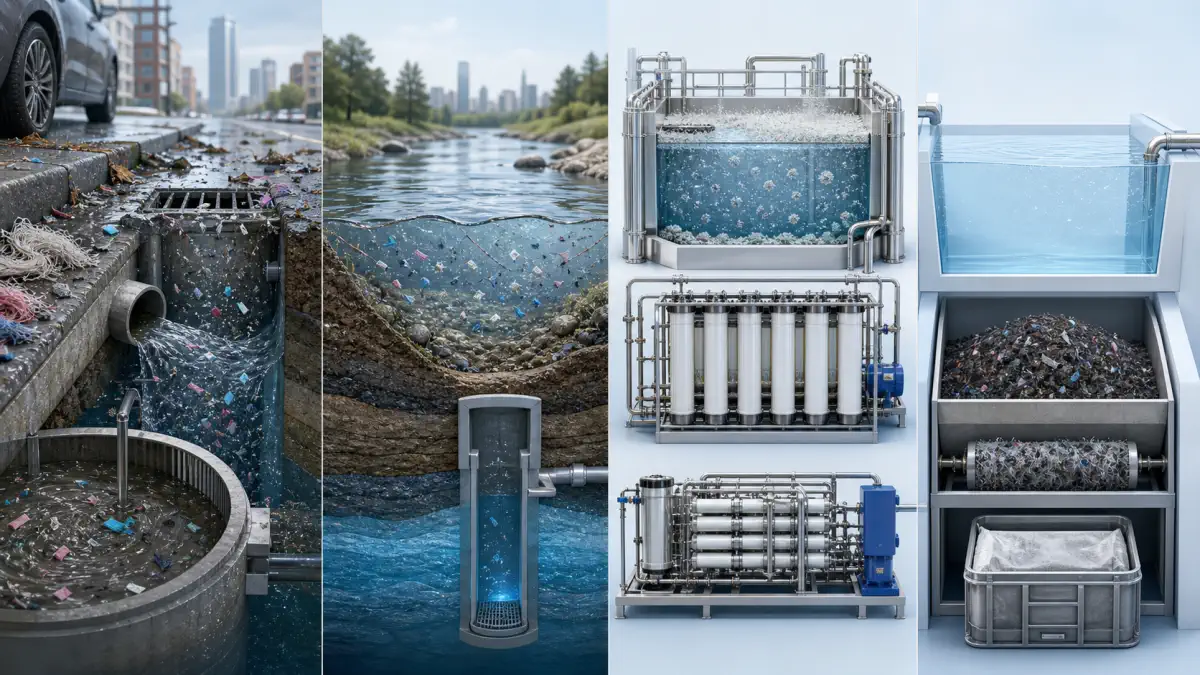
Primary Sources: Microplastics enter the aquatic environment from diverse pathways:
- Wastewater Treatment Plant (WWTP) Effluents: A significant pathway, as microfibers from laundry, microbeads from cosmetics, and fragmented plastics from urban runoff pass through or are inadequately removed by conventional treatment processes.
- Stormwater Runoff: Carries plastic debris, tire wear particles, and litter fragments from urban and agricultural areas into water bodies.
- Industrial Discharges: Effluents from plastic manufacturing, textile industries, and recycling facilities.
- Agricultural Runoff: Degradation of plastic mulches and films used in agriculture.
- Atmospheric Deposition: Microplastics can be transported long distances through the air and deposited onto land and water surfaces.
- Degradation of Macroplastics: Larger plastic items in the environment break down into smaller fragments due to UV radiation, mechanical abrasion, and biological processes.
Environmental & Health Impact
The widespread presence of microplastics in aquatic and terrestrial ecosystems, as well as drinking water, has raised significant environmental and human health concerns.
Environmental Impact:
- Ubiquitous Presence: Microplastics have been found in oceans, freshwater systems, soil, air, and even remote polar regions, indicating their global distribution.
- Ingestion by Organisms: Aquatic and terrestrial organisms, from zooplankton to fish and birds, can ingest microplastics. This can lead to physical damage, false satiation, reduced energy reserves, and altered feeding behaviors.
- Toxicity and Chemical Leaching: Microplastics can leach chemical additives (e.g., plasticizers, flame retardants, UV stabilizers) used during their manufacturing. They also act as vectors, adsorbing and concentrating persistent organic pollutants (POPs), heavy metals, and pathogens from the environment onto their surfaces, potentially transferring these contaminants to organisms upon ingestion.
- Ecosystem Disruption: Accumulation in sediments can alter benthic habitats, while floating microplastics can affect light penetration and primary productivity in surface waters.
Human Health Impact:
- Direct Ingestion: Humans are exposed to microplastics through contaminated food (seafood, salt), drinking water (tap and bottled), and inhaled air.
- Chemical Exposure: The potential for leaching of additives and adsorbed environmental contaminants from ingested microplastics into human tissues is a major concern. Some plastic additives are known endocrine disruptors or carcinogens.
- Physical Effects: While largely unproven at environmentally relevant concentrations, the physical presence of microparticles could potentially cause inflammation or other cellular responses in sensitive tissues.
- Research Gap: The long-term effects of microplastic exposure on human health are still largely unknown and are an area of active and critical research. More epidemiological and toxicological studies are needed to establish clear causal links and health risks.
Regulatory Standards
Regulatory frameworks specifically addressing microplastics in water are still in their nascent stages globally, reflecting the status of microplastics as an emerging contaminant. Most regulations are currently focused on monitoring, assessment, and source reduction rather than specific effluent or drinking water limits.
| Agency/Country | Limit | Notes |
|---|---|---|
| WHO | TBD | Currently, the WHO published a review in 2019 concluding no evidence of human health risk at current levels, but emphasized more research is needed. No specific guideline limits. |
| US EPA | TBD | No federal primary drinking water regulations or effluent limits for microplastics. Research and monitoring are ongoing. |
| China GB | TBD | China has actively researched microplastic pollution, but as of current major national standards (e.g., GB 5749-2022 for drinking water, GB 18918-2002 for WWTP discharge), no specific numerical limits for microplastics exist. Focus is on source control and research. |
Removal Technologies
Effective microplastic removal often requires a multi-barrier approach due to their diverse characteristics. Pretreatment is critical for the success and longevity of advanced treatment technologies.
Membrane Solutions
Membrane processes offer high-efficiency removal of microplastics, particularly smaller particles and nanoplastics. The choice of membrane depends on the target particle size and desired water quality. Pretreatment is paramount to prevent fouling.
- Microfiltration (MF): Effective for particles typically 0.1 to 10 µm. Can remove larger microplastic fragments and fibers. Often used as a robust pretreatment for finer membranes.
- Ultrafiltration (UF): Pores typically 0.01 to 0.1 µm. Highly effective at removing most microplastics, including many smaller fragments and suspended solids. UF membranes are commonly used for drinking water purification and advanced wastewater treatment.
- Nanofiltration (NF): Pores typically 0.001 to 0.01 µm. Can remove even finer microplastics and some dissolved organic compounds and multivalent ions. Offers a higher rejection rate than UF but with higher operating pressure.
- Reverse Osmosis (RO): Pores typically <0.001 µm. Provides the highest level of removal for virtually all microplastics, including nanoplastics, as well as dissolved salts and small organic molecules. Requires significant energy and extensive pretreatment to prevent scaling and fouling.
Engineering Considerations for Membranes:
- Fouling: Microplastics themselves, along with natural organic matter (NOM), colloids, and biological growth, can cause significant membrane fouling, leading to flux decline and increased cleaning frequency.
- Pretreatment: Essential to reduce the suspended solids, turbidity, and organic load entering the membrane system. Common pretreatment steps include coagulation/flocculation, sedimentation, dissolved air flotation (DAF), and granular media filtration.
- Energy Consumption: Increases with decreasing membrane pore size, with RO being the most energy-intensive.
Adsorption Solutions
Adsorption processes can remove microplastics and, crucially, the associated chemical contaminants they carry.
- Activated Carbon (Granular Activated Carbon - GAC / Powdered Activated Carbon - PAC):
- Mechanism: GAC beds or PAC dosing can effectively adsorb organic compounds associated with microplastics. While not primarily designed for physical microplastic removal, PAC can become entrapped in flocs during coagulation, aiding in their removal. GAC can physically filter out some microplastics larger than its pore structure and has an affinity for hydrophobic plastic surfaces, potentially adsorbing some particles.
- Efficiency: More effective for removing the chemical contaminants (e.g., PCBs, PAHs, phthalates) that sorb onto microplastics than for removing the microplastic particles themselves, especially smaller ones.
- Limitations: High operational cost, regeneration requirements for GAC, and potential for saturation.
- Biochar and Other Novel Adsorbents: Research is exploring various low-cost, sustainable adsorbents (e.g., biochar, modified clays, metal-organic frameworks) for microplastic removal and associated pollutant sequestration.
Chemical/Biological
These conventional treatment processes, while not specifically designed for microplastics, can play a significant role in their removal, especially as primary and secondary treatment steps.
- Coagulation/Flocculation: A critical pretreatment step. Coagulants (e.g., aluminum sulfate, ferric chloride) destabilize microplastic particles and suspended solids, allowing them to aggregate into larger flocs. Flocculation enhances the growth of these aggregates.
- Sedimentation/Dissolved Air Flotation (DAF): Following coagulation/flocculation, gravity sedimentation or DAF can effectively remove the aggregated microplastics. Sedimentation is suitable for denser particles, while DAF is effective for lighter flocs that tend to float.
- Conventional Activated Sludge (CAS): During biological treatment, some microplastics (especially fibers and smaller fragments) can become embedded within biological flocs (bioflocculation) and subsequently removed with the settled sludge. The efficiency is variable and dependent on sludge characteristics and operational parameters.
- Membrane Bioreactors (MBR): An advanced biological treatment that integrates activated sludge with membrane separation (typically UF or MF). MBRs offer significantly higher microplastic removal rates than conventional activated sludge due to the physical barrier of the membranes, retaining almost all microplastics larger than the membrane pore size.
- Advanced Oxidation Processes (AOPs): (e.g., Ozonation, UV/H2O2, Fenton processes). While not a primary removal technology for intact microplastics, AOPs generate highly reactive radicals that can degrade plastic polymers into smaller molecules or even mineralize them. However, AOPs are energy-intensive and can be costly for large volumes, and incomplete degradation might create new, potentially harmful, degradation products.
Technical Comparison Table
| Technology | Microplastic Removal Efficiency (Qualitative) | Cost (Relative) | Pretreatment Requirement | Fouling/Operational Complexity | Byproduct/Sludge |
|---|---|---|---|---|---|
| Membrane Filtration | High (UF/NF/RO), Medium (MF) | High | High (critical) | High (fouling) | Concentrated brine/retentate |
| Adsorption (Activated Carbon) | Medium (physical), High (chemical uptake) | Medium-High | Medium | Medium (saturation, regeneration) | Spent adsorbent |
| Coagulation/Flocculation + Sedimentation/DAF | Medium-High (depends on optimization) | Low-Medium | Low | Low-Medium | Sludge |
| Biological (CAS) | Low-Medium (variable) | Low-Medium | Low | Low-Medium | Sludge |
| Membrane Bioreactor (MBR) | High | Medium-High | Medium | Medium (membrane fouling) | Excess sludge, concentrated permeate |
| Advanced Oxidation Processes (AOPs) | Low (degradation, not removal) | High | Medium | Medium | Degradation byproducts |
AquaChain Engineering Tip
When designing a microplastic removal system, an integrated, multi-barrier approach is almost always superior. Prioritize robust pretreatment (coagulation/flocculation followed by sedimentation, DAF, or media filtration) to remove larger particles and aggregate smaller ones. This extends the lifespan and efficiency of subsequent advanced treatment steps, especially membrane systems, by minimizing fouling and reducing operational costs. Consider the specific microplastic characteristics (size distribution, polymer type, density) and the desired effluent quality to tailor the most effective and economically viable solution.
FAQ
Q: Why is microplastic removal so challenging from an engineering perspective? A: Microplastics present a challenge due to their immense diversity in size (nano to millimeter), shape, density, and chemical composition. This heterogeneity means no single 'silver bullet' technology is universally effective, requiring engineers to design multi-barrier systems tailored to specific pollutant profiles and desired effluent quality.
Q: What is the primary operational concern for membrane systems when treating microplastic-laden water? A: Fouling is the primary operational concern. Microplastics themselves, along with suspended solids, natural organic matter, and biological growth, can rapidly clog membrane pores, leading to decreased flux, increased energy consumption, and frequent chemical cleaning, all of which elevate operational costs and complexity.
Q: How does particle size of microplastics influence the selection of removal technologies? A: Particle size is a critical determinant. Larger microplastics (>10 µm) can often be effectively removed by conventional physical separation methods like filtration, coagulation/flocculation with sedimentation/DAF. For smaller microplastics (<10 µm) and nanoplastics, finer membrane processes (UF, NF, RO) or highly efficient adsorption technologies become necessary, often requiring more intensive pretreatment.