Pollutant removal
Nitrate: Sources, Impact, and Advanced Removal Strategies in Water Treatment
Nitrate (NO3-) is a polyatomic inorganic anion consisting of one nitrogen atom and three oxygen atoms. It is highly soluble in water and stable under aerobic conditions. While naturally occurring in the environment as part of the nitrogen cycle, elevated concentrations in water sources are primarily anthropogenically driven.
Overview & Sources
Nitrate (NO3-) is a polyatomic inorganic anion consisting of one nitrogen atom and three oxygen atoms. It is highly soluble in water and stable under aerobic conditions. While naturally occurring in the environment as part of the nitrogen cycle, elevated concentrations in water sources are primarily anthropogenically driven.
Key sources of nitrate contamination include:
- Agricultural Runoff: The most significant contributor, stemming from the excessive use of nitrogen-based fertilizers in farming, which leach into groundwater and surface waters.
- Wastewater Discharges: Inadequately treated municipal and industrial wastewaters, particularly from food processing, animal husbandry, and chemical industries, can contain high levels of nitrate.
- Septic Systems: Leaching from on-site wastewater treatment systems, especially in areas with high population density or unsuitable soil conditions.
- Natural Decomposition: The aerobic decomposition of organic matter in soils and water bodies naturally produces nitrate.
- Atmospheric Deposition: Nitrogen oxides (NOx) from vehicle emissions and industrial processes can be converted to nitrate and deposited via rain.
Nitrate is a mobile ion in aquatic environments, making it a persistent pollutant that readily migrates through soil strata into groundwater.
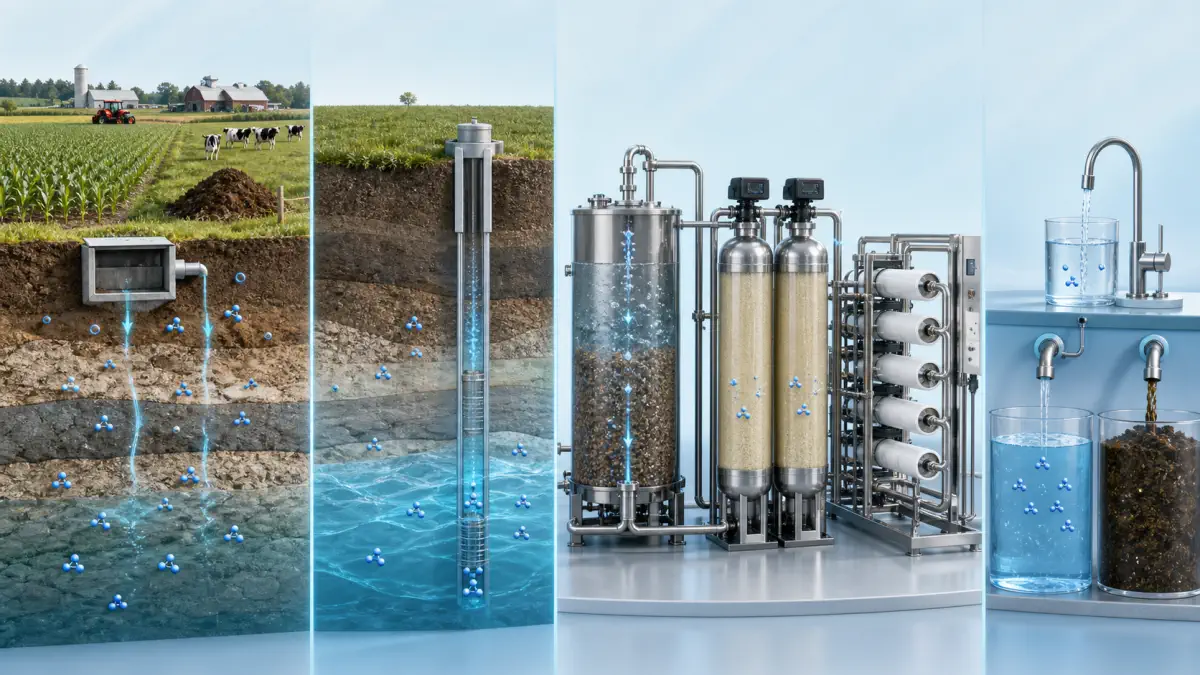
Environmental & Health Impact
Excessive nitrate concentrations pose significant environmental and public health risks.
Environmental Impact
- Eutrophication: High nitrate levels, along with phosphates, act as primary nutrients for algae and aquatic plants. This leads to excessive growth (algal blooms) in surface waters, which upon decomposition, consume dissolved oxygen (DO), resulting in anoxic or hypoxic conditions. This oxygen depletion severely harms aquatic life, leading to fish kills and biodiversity loss.
- Groundwater Contamination: Once groundwater is contaminated with nitrate, its removal is challenging and costly, impacting long-term water resource availability.
Health Impact
- Methemoglobinemia (Blue Baby Syndrome): This is the most serious acute health effect, primarily affecting infants under six months of age. In the infant's gastrointestinal tract, nitrate can be reduced to nitrite (NO2-), which then oxidizes hemoglobin to methemoglobin. Methemoglobin cannot carry oxygen, leading to a reduction in oxygen transport throughout the body, causing cyanosis (blue discoloration of the skin), and in severe cases, brain damage or death.
- Potential Carcinogen: Research suggests a potential link between high nitrate intake and increased risk of certain cancers, particularly gastric cancer. This is hypothesized to occur through the endogenous formation of N-nitrosamines, which are known carcinogens, from the reaction of nitrites (derived from nitrates) with amines in the human body. Nitrate can also react with organic compounds during water disinfection to form N-nitrosamines.
- Other Effects: Some studies have explored links to reproductive issues and thyroid dysfunction, though these are less definitively established than methemoglobinemia.
Regulatory Standards
Regulatory bodies worldwide establish limits for nitrate in drinking water to protect public health. These limits are typically expressed as nitrate (NO3-) or as nitrogen (N), where 1 mg/L NO3-N is equivalent to 4.43 mg/L NO3-.
| Standard Body | Parameter | Limit (mg/L) | Notes |
|---|---|---|---|
| WHO | Nitrate (as NO3-) | 50 | Guideline for drinking water quality. |
| Nitrate (as N) | 10 | Equivalent to 50 mg/L as NO3-. | |
| US EPA | Nitrate (as N) | 10 | Maximum Contaminant Level (MCL) for public water systems. |
| Nitrate (as NO3-) | 45 | Equivalent to 10 mg/L as N. | |
| China GB | Nitrate (as N) | 10 | GB 5749-2006 (Standards for Drinking Water Quality). |
| Nitrate (as NO3-) | 45 | Equivalent to 10 mg/L as N. |
Notes: These limits are for drinking water. Surface water and wastewater discharge limits vary significantly based on intended use and discharge location.
Removal Technologies
Effective nitrate removal from water streams often requires advanced treatment solutions due to its high solubility and stability.
Membrane Solutions
Membrane processes offer physical separation based on pore size or ionic charge exclusion.
- Reverse Osmosis (RO): Highly effective in removing nitrate, typically achieving >90-95% rejection. RO membranes are non-selective to specific ions but reject nearly all dissolved solids.
- Engineering Considerations: High energy consumption, significant concentrate (brine) volume requiring disposal, and stringent pretreatment requirements for suspended solids, hardness, and organic matter to prevent fouling and scaling of the membranes.
- Nanofiltration (NF): Offers good nitrate rejection (often 50-90%) with lower operating pressures than RO. NF membranes reject divalent ions more effectively than monovalent ones, and nitrate (monovalent) rejection can be less consistent than RO, especially in waters with high sulfate concentrations.
- Engineering Considerations: Similar to RO, pretreatment is crucial. Concentrate management is a significant factor.
- Electrodialysis (ED/EDR): Utilizes ion-selective membranes and an electrical potential to move ions out of the water stream. Can be effective for nitrate, as it's an anionic species. Electrodialysis Reversal (EDR) mitigates scaling and fouling by periodic polarity reversal.
- Engineering Considerations: Energy efficiency is generally better than RO for lower TDS waters. Selectivity can be tuned with specific membranes. Requires electrical power and produces a concentrated brine stream.
Adsorption Solutions
Adsorption, particularly ion exchange, is a common and effective method for nitrate removal.
- Ion Exchange (IX): Strong base anion exchange resins (SBA) are commonly used. These resins exchange chloride ions (or other anions) for nitrate ions. Nitrate has a higher affinity for these resins than many other common anions (e.g., bicarbonate, chloride), but sulfate often has a stronger affinity, leading to competitive adsorption.
- Engineering Considerations: Resin selection is critical; nitrate-selective resins are available to minimize sulfate interference. Regeneration with a salt solution (e.g., NaCl) produces a concentrated brine waste stream rich in nitrate and chloride, which requires proper disposal or further treatment. Pretreatment for suspended solids and organic matter is essential to prevent resin fouling.
Chemical/Biological
Biological processes are often favored for their ability to convert nitrate to inert nitrogen gas, eliminating the waste concentrate issue.
- Biological Denitrification: This process leverages facultative anaerobic bacteria to convert nitrate (NO3-) to nitrite (NO2-) and then ultimately to nitrogen gas (N2) under anoxic conditions. This requires an external organic carbon source (e.g., methanol, ethanol, acetic acid) to serve as an electron donor for the bacteria.
- Engineering Considerations: Careful control of the carbon-to-nitrogen (C:N) ratio, pH, temperature, and dissolved oxygen levels is critical. Insufficient carbon can lead to incomplete denitrification and nitrite accumulation (a more toxic compound). Excess carbon can lead to residual organic matter in the treated effluent. Systems can be configured as suspended growth (e.g., activated sludge) or fixed-film (e.g., fluidized bed reactors). Post-treatment for biomass removal (e.g., filtration, clarification) is usually necessary.
- Chemical Reduction: While less common for primary nitrate removal in drinking water due to complexity and potential for byproduct formation, some approaches involve strong reducing agents (e.g., zero-valent iron) to chemically convert nitrate.
- Engineering Considerations: Requires careful management of reaction conditions, pH, and the removal of spent reducing agents or reaction byproducts.
Technical Comparison Table
| Feature | Reverse Osmosis / Nanofiltration | Ion Exchange | Biological Denitrification |
|---|---|---|---|
| Removal Efficiency | High (>90-95%) | High (80-99%) | High (90-99%) |
| Selectivity for NO3- | Low (non-selective to ions) | Medium to High (resin type) | High (biological process) |
| Capital Cost | High | Medium | High |
| Operating Cost | High (energy, concentrate) | Medium (regenerant, brine) | Medium (carbon source, energy) |
| Waste Stream | Concentrated brine | Brine (regenerant waste) | Excess sludge, N2 gas |
| Pretreatment Needs | High (TSS, hardness, organics) | Medium (TSS, organics) | Medium (TSS, pH control) |
| Complexity of O&M | Medium to High | Medium | High |
| Applicability | Broad (high TDS, multiple ions) | Selective ion removal | Specific for nitrate/nitrite |
AquaChain Engineering Tip
When designing a biological denitrification system, meticulous control of the C:N ratio and redox potential is paramount to prevent nitrite accumulation and ensure complete conversion to inert nitrogen gas, thereby optimizing treatment efficiency and avoiding secondary pollutant formation.
FAQ
Q: What is the primary operational challenge for ion exchange systems used for nitrate removal? A: The primary challenge is the competitive adsorption of sulfate ions, which are often present in higher concentrations than nitrate. This necessitates either more frequent regeneration, use of nitrate-selective resins, or pretreatment to reduce sulfate load, all impacting operational cost and efficiency.
Q: How does water temperature affect biological denitrification? A: Biological denitrification rates are significantly affected by temperature. Lower temperatures reduce microbial activity, decreasing the denitrification rate and potentially requiring larger reactor volumes or longer hydraulic retention times to achieve desired nitrate removal efficiencies.
Q: What are the key considerations for concentrate management from membrane-based nitrate removal systems? A: Key considerations include the volume and composition of the concentrate, which is rich in removed nitrates and other dissolved solids. Options range from discharge to sewer (if regulations allow), further treatment for volume reduction (e.g., evaporation, crystallization), or zero liquid discharge (ZLD) strategies, all with significant cost and energy implications.