Pollutant removal
PFAS (PFOA/PFOS) - Per- and Polyfluoroalkyl Substances
Per- and polyfluoroalkyl substances (PFAS) constitute a vast group of synthetic organic compounds characterized by their exceptionally strong carbon-fluorine (C-F) bonds. This molecular structure imparts unique properties such as thermal stability, hydrophobicity, and oleophobicity, leading to their widespread use across numerous industrial and consumer applications since the 1940s. Among the thousands of PFAS compounds, Perfluorooctanoic Acid (PFOA) and Perfluorooctanesulfonic Acid (PFOS) are two of the most extensively studied and regulated due to their historical prevalence and known environmental persistence.
Overview & Sources
Per- and polyfluoroalkyl substances (PFAS) constitute a vast group of synthetic organic compounds characterized by their exceptionally strong carbon-fluorine (C-F) bonds. This molecular structure imparts unique properties such as thermal stability, hydrophobicity, and oleophobicity, leading to their widespread use across numerous industrial and consumer applications since the 1940s. Among the thousands of PFAS compounds, Perfluorooctanoic Acid (PFOA) and Perfluorooctanesulfonic Acid (PFOS) are two of the most extensively studied and regulated due to their historical prevalence and known environmental persistence.
Primary sources of PFAS contamination in water include:
- Aqueous Film-Forming Foams (AFFF): Used extensively in firefighting, particularly at military bases, airports, and industrial facilities, leading to significant groundwater and soil contamination.
- Industrial Processes: Manufacturing of fluoropolymers, electroplating, semiconductor fabrication, textile and paper production, and metal finishing.
- Consumer Products: Non-stick cookware (e.g., Teflon), water-repellent clothing, stain-resistant carpets and upholstery, food packaging, cosmetics, and certain cleaning products.
- Wastewater Treatment Plants: While not manufacturing PFAS, these facilities can become diffuse sources as they receive wastewater containing PFAS from various industrial and domestic inputs, potentially discharging them into receiving waters.
- Landfills: Leachate from municipal and industrial landfills often contains significant concentrations of PFAS.
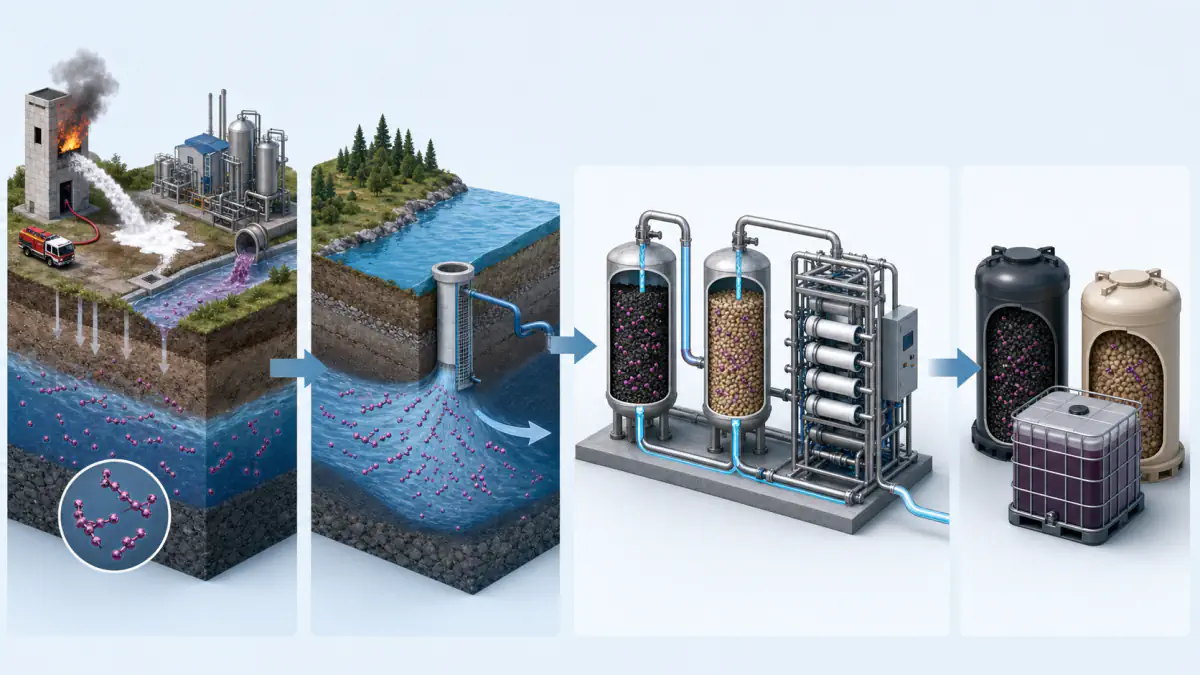
Environmental & Health Impact
PFAS are often referred to as "forever chemicals" due to the extreme strength of their C-F bonds, which renders them highly resistant to environmental degradation (photolysis, hydrolysis, microbial degradation). This persistence leads to their widespread presence in the environment, including soil, air, groundwater, surface water, and even rainwater. They exhibit high water solubility, allowing for significant mobility and transport in aquatic systems, leading to extensive contamination of drinking water sources.
These compounds are bioaccumulative, meaning they build up in living organisms over time, and biomagnify, increasing in concentration up the food chain. Human exposure occurs primarily through contaminated drinking water, food, and consumer products.
Health effects associated with PFAS exposure are diverse and concerning, including:
- Liver damage and altered liver enzyme levels
- Thyroid disease and endocrine disruption
- Increased cholesterol levels
- Reduced immune system response
- Reproductive and developmental effects (e.g., decreased birth weight, effects on puberty)
- Increased risk of certain cancers, particularly kidney and testicular cancer
Insight: Short-chain PFAS require IX as GAC is less effective. RO/NF acts as a final physical barrier.
Regulatory Standards
Regulatory standards for PFAS are evolving rapidly globally, with a strong focus on PFOA and PFOS due to their widespread detection and established health risks. Many regions are also beginning to regulate the sum of specific PFAS compounds.
| Regulator | Pollutant | Limit | Unit | Notes |
|---|---|---|---|---|
| WHO | PFOA | Limit: TBD | Requires source confirmation. WHO guidance is under development or has been recently issued, often providing health-based guideline values for individual PFAS. | |
| PFOS | Limit: TBD | Requires source confirmation. | ||
| US EPA (Proposed MCLs) | PFOA | 4 | ppt | Proposed Maximum Contaminant Level (MCL) for drinking water. Final rule expected 2024. |
| PFOS | 4 | ppt | Proposed Maximum Contaminant Level (MCL) for drinking water. Final rule expected 2024. | |
| PFOA (Total) | TBD | ppt | Proposed regulatory levels for groups of PFAS, including Hazard Index for mixtures, and MCLGs for 6 specific PFAS. Currently, a health advisory exists for a sum of PFOA and PFOS. A Hazard Index is proposed for mixtures of GenX, PFBS, PFNA, and PFHxS. | |
| China GB (Drinking Water) | PFOA/PFOS | Limit: TBD | Requires source confirmation. China is actively developing national standards for PFAS in various environmental matrices, including drinking water, aiming to address these emerging contaminants. |
Note: Regulatory limits are subject to change and should always be verified with the latest official publications from the respective regulatory bodies.
Removal Technologies
Effective PFAS removal from water typically requires advanced treatment technologies due to their recalcitrant nature. A multi-barrier approach is often recommended, combining different technologies for robust and comprehensive treatment.
Membrane Solutions
Reverse Osmosis (RO) and Nanofiltration (NF) are highly effective physical separation processes for PFAS removal.
- Mechanism: Membranes reject PFAS compounds primarily through size exclusion and, to a lesser extent, charge repulsion. The dense structure of RO membranes allows for the rejection of nearly all PFAS compounds (>99%), including both long- and short-chain variants. NF membranes are also highly effective (typically 90-99% rejection), with slightly lower rejection for very short-chain PFAS compounds compared to RO.
- Engineering Considerations:
- Pre-treatment: Essential to prevent membrane fouling (organic, colloidal, biological, scaling) which can significantly reduce flux, increase operating pressure, and decrease membrane lifespan. Common pre-treatment includes media filtration, ultrafiltration (UF), or microfiltration (MF).
- Concentrate Management: Membrane processes produce a concentrated PFAS-laden brine stream that requires proper disposal or further treatment. This is a significant operational and environmental challenge.
- Energy Consumption: RO is an energy-intensive process due to the high pressures required. NF operates at lower pressures, reducing energy costs.
Adsorption Solutions
Adsorption processes leverage the affinity of PFAS compounds for the surface of a porous material.
- Granular Activated Carbon (GAC):
- Mechanism: PFAS compounds adsorb onto the porous structure of GAC, primarily through hydrophobic interactions.
- Effectiveness: Highly effective for removing longer-chain PFAS. Its effectiveness decreases for shorter-chain PFAS and can be significantly impacted by the presence of natural organic matter (NOM), which competes for adsorption sites, leading to faster breakthrough.
- Engineering Considerations: Requires sufficient empty bed contact time (EBCT). GAC needs periodic regeneration (thermal reactivation) or disposal once saturated. Pre-treatment for suspended solids and NOM is often beneficial.
- Ion Exchange (IX) Resins:
- Mechanism: Anion exchange resins, particularly specialized strong base anion (SBA) resins, are highly effective. PFAS compounds, being anionic (especially carboxylates and sulfonates), are preferentially exchanged for ions on the resin.
- Effectiveness: Can be more selective and efficient than GAC, especially for challenging short-chain PFAS. They generally have higher capacities and faster kinetics compared to GAC.
- Engineering Considerations: Regeneration of IX resins produces a highly concentrated PFAS waste stream that requires specialized handling. Resins have finite lifespans and require replacement. Pre-treatment to remove particulates and some NOM can prevent fouling and extend resin life.
Best Technology: GAC (Granular Activated Carbon) or specialized IX (Ion Exchange) Resins.
Chemical/Biological
- Advanced Oxidation Processes (AOPs):
- Mechanism: AOPs (e.g., UV/H2O2, UV/persulfate, electrochemical oxidation, ozonation with catalysts) generate highly reactive radicals (e.g., hydroxyl radicals, sulfate radicals) that can break down organic contaminants. For PFAS, the goal is often defluorination (breaking the C-F bond).
- Effectiveness: Can achieve significant reduction of some PFAS, but complete mineralization (conversion to CO2, H2O, and fluoride ions) is often challenging due to the stability of the C-F bond and can require very high energy inputs. Intermediate products may also be recalcitrant or toxic.
- Engineering Considerations: High energy consumption, significant chemical dosing, potential for scavenger effects (other compounds consuming radicals), and the need to manage reaction byproducts. Often used as a polishing step or for concentrate treatment.
- Bioremediation:
- Mechanism: Involves microorganisms to break down contaminants.
- Effectiveness: Generally considered limited for most PFAS due to their extreme resistance to microbial degradation. The C-F bond is one of the strongest in organic chemistry, making it very difficult for enzymes to cleave.
- Engineering Considerations: While some specialized anaerobic and aerobic microbial consortia show promise in laboratory settings for very specific PFAS types or transformation pathways, widespread, robust full-scale biological treatment for comprehensive PFAS destruction is not yet established for water treatment.
Technical Comparison Table
| Technology | Removal Efficiency (PFAS) | CapEx | OpEx | Pre-treatment Needs | Waste Management | Key Challenges |
|---|---|---|---|---|---|---|
| Membrane (RO/NF) | High (90-99%+ for most PFAS) | High | Moderate-High (energy) | High (fouling prevention) | Concentrated brine disposal | Fouling, energy consumption, brine disposal |
| Adsorption (GAC) | Moderate-High (chain-dependent) | Moderate | Moderate-High (regeneration/replacement) | Moderate (NOM removal) | Spent carbon regeneration/disposal | Shorter chain effectiveness, NOM competition |
| Adsorption (IX) | High (specific resins, incl. short-chain) | Moderate-High | High (resin replacement/regeneration) | Moderate (particulate/NOM) | Concentrated brine/spent resin disposal | Regeneration complexity, resin selectivity |
| Chemical (AOPs) | Moderate-High (process-dependent) | High | High (energy/chemical costs) | Moderate (turbidity/scavengers) | Chemical sludge, incomplete defluorination | Energy intensity, incomplete mineralization |
| Biological | Low-TBD (very limited) | Low-Moderate | Low | Low | Biosolids | Limited applicability, C-F bond stability |
AquaChain Engineering Tip
Tip: Pre-treatment is vital to prevent organic fouling of expensive resins.
FAQ
Q: Why is pre-treatment so critical for PFAS removal systems like RO or IX? A: Pre-treatment, such as media filtration or ultrafiltration, prevents particulate fouling and removes natural organic matter (NOM) which can irreversibly foul membranes or compete for active sites on GAC/IX resins, significantly reducing their lifespan and effectiveness for PFAS removal.
Q: What's the main difference in effectiveness between GAC and IX for PFAS? A: While both are effective adsorbents, GAC generally performs better for longer-chain PFAS. Specialized anion exchange (IX) resins often demonstrate superior performance and selectivity for both long- and short-chain PFAS, particularly in the presence of competing background organic matter.
Q: Can biological treatment effectively remove or destroy PFAS in water? A: For the vast majority of PFAS, conventional biological treatment is ineffective due to the high stability of the C-F bond, making them highly resistant to biodegradation. Research is ongoing for specialized microbial consortia, but full-scale practical applications are currently very limited.
Recommended AquaChain Guide solution
Reverse Osmosis (RO), Nanofiltration (NF), Granular Activated Carbon (GAC), Ion Exchange (IX) Resins, Advanced Oxidation Processes (AOPs).