Pollutant removal
Silica: Pollutant Encyclopedia Entry
Silica exists in natural waters in three primary forms: 1. Reactive (Dissolved) Silica: Present as silicic acid, Si(OH)₄, or its ionized forms (silicates) at higher pH. It is non-colloidal and passes through a 0.45-micron filter. 2. Colloidal Silica: Amorphous, non-ionic, hydrated silica polymers ranging from 5 nm to 100 nm in size. It does not pass through a 0.45-micron filter and does not readily react with molybdate reagents. 3. Particulate Silica: Larger, suspended crystalline or amorphous silica particles, typically greater than 100 nm, which can be removed by conventional filtration.
Silica (Silicon Dioxide, SiO₂) is one of the most ubiquitous elements in the Earth's crust, commonly found in natural waters. While not typically a direct health concern at common concentrations, its presence, particularly in industrial water systems, can lead to severe operational issues and significant economic losses. Understanding its various forms and behaviors is paramount for effective water treatment.
Overview & Sources
Silica exists in natural waters in three primary forms:
- Reactive (Dissolved) Silica: Present as silicic acid, Si(OH)₄, or its ionized forms (silicates) at higher pH. It is non-colloidal and passes through a 0.45-micron filter.
- Colloidal Silica: Amorphous, non-ionic, hydrated silica polymers ranging from 5 nm to 100 nm in size. It does not pass through a 0.45-micron filter and does not readily react with molybdate reagents.
- Particulate Silica: Larger, suspended crystalline or amorphous silica particles, typically greater than 100 nm, which can be removed by conventional filtration.
Sources:
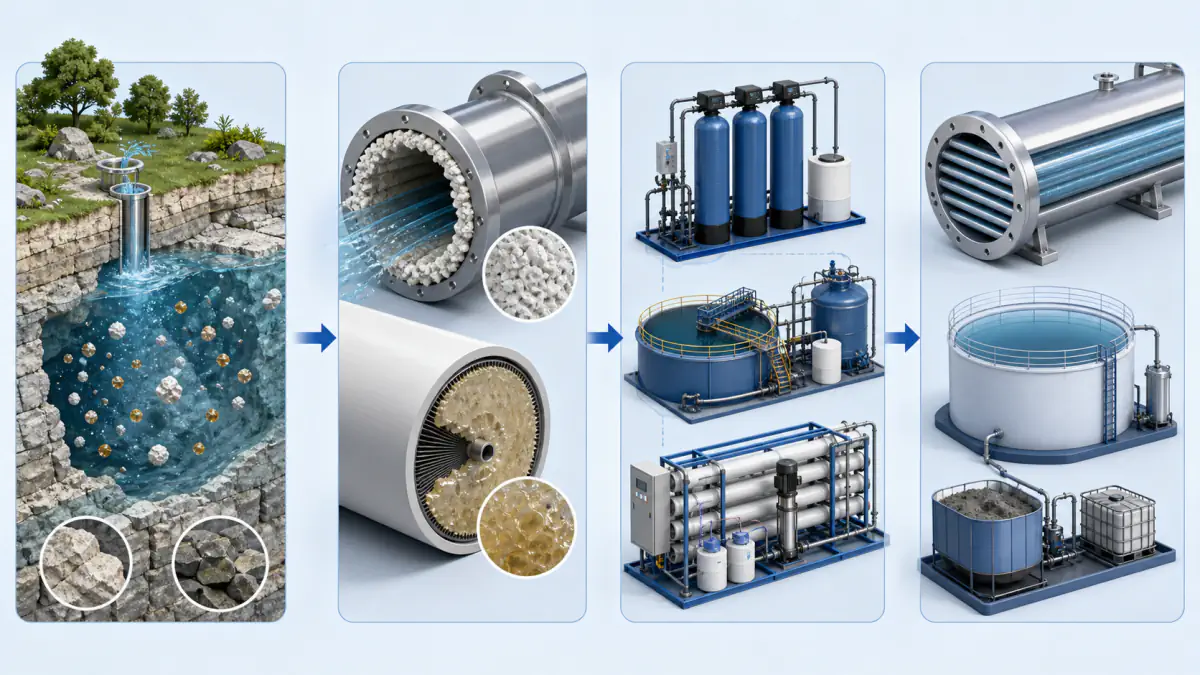
- Natural: Leaching from rocks, sands, and soils (e.g., quartz, feldspar). Groundwater often has higher dissolved silica concentrations than surface water due to prolonged contact with geological formations.
- Industrial: Effluents from industries such as mining, glass manufacturing, semiconductor production, and power generation (e.g., cooling tower blowdown, boiler feedwater).
Environmental & Health Impact
While silica is generally considered a benign substance for human health at typical environmental concentrations, its impact on industrial processes and infrastructure is profound:
- Scaling and Fouling: The primary concern in water treatment. Silica and silicates can precipitate out of solution, forming hard, tenacious scales on heat transfer surfaces (boilers, cooling towers) and membrane surfaces (RO, NF). This reduces heat transfer efficiency, increases energy consumption, and shortens equipment lifespan.
- Membrane Performance Degradation: Silica scaling is a major cause of flux decline and increased trans-membrane pressure in reverse osmosis (RO) and nanofiltration (NF) systems, leading to more frequent chemical cleanings and premature membrane replacement.
- Turbine Blade Damage: In high-pressure steam turbines, volatilized silica can deposit on turbine blades, causing imbalance and erosion.
- Process Interference: In some industrial processes, silica can interfere with product quality or catalyst performance.
Insight: Colloidal silica needs ultrafiltration or coagulation; dissolved silica is pH-dependent. This distinction is critical for selecting appropriate treatment strategies.
Regulatory Standards
Regulatory standards for silica are often driven by operational needs rather than direct health concerns for potable water. Industrial applications, particularly power generation and semiconductor manufacturing, have stringent limits to prevent scaling and equipment damage.
| Standard Body | Application | Limit | Notes |
|---|---|---|---|
| WHO | Drinking Water | TBD | Generally not considered a primary health concern; aesthetic/operational limits may apply. Requires source confirmation. |
| US EPA | Drinking Water | TBD | No primary drinking water standard; secondary standards or industrial guidance more relevant. Requires source confirmation. |
| China GB | Drinking Water (GB 5749-2006) | TBD | Relevant for industrial processes like boiler feedwater and ultrapure water. Requires source confirmation. |
| Typical Industrial Guidelines | Boiler Feedwater (High-Pressure) | < 0.02 mg/L | Essential to prevent turbine deposition and boiler scaling. |
| Typical Industrial Guidelines | RO Feedwater | < 50-120 mg/L | Limit depends on antiscalant use, pH, temperature, and recovery rate. |
| Typical Industrial Guidelines | Ultrapure Water (Semiconductor) | < 1 ppb | Critical for device manufacturing. |
Note: The specific limits for industrial applications are highly dependent on the process, operating conditions (e.g., temperature, pressure, pH), and desired water quality.
Removal Technologies
The selection of a silica removal technology depends heavily on the form of silica (dissolved, colloidal, particulate), the initial concentration, target water quality, and economic considerations.
Best Technology: RO with Antiscalants or Strong Base Anion Exchange
Membrane Solutions
- Ultrafiltration (UF) / Microfiltration (MF): Highly effective for removing colloidal and particulate silica. Often used as pretreatment for RO systems to reduce fouling.
- Reverse Osmosis (RO): Can effectively remove dissolved silica, typically achieving 95-99% rejection. However, silica scaling on RO membranes is a significant challenge, requiring careful pH control and the use of antiscalants.
- Nanofiltration (NF): Offers lower rejection rates for dissolved silica compared to RO but can be effective for partial removal, especially at lower pH.
Adsorption Solutions
- Ion Exchange (IX): Strong Base Anion (SBA) resins in hydroxide form are effective for removing dissolved silica. Silica is weakly dissociated and exchanges as a complex silicate anion. Regeneration requires significant amounts of caustic (NaOH) and often warm water to ensure complete elution. Mixed-bed demineralizers can polish water to very low silica levels.
- Specialty Adsorbents: Some proprietary media are designed for enhanced silica adsorption, often operating on a chelation or specific surface binding principle.
Chemical/Biological
- Coagulation/Flocculation: Effective for removing colloidal and particulate silica by destabilizing particles and forming larger flocs that can be settled or filtered. Alum or ferric salts are common coagulants, sometimes enhanced with polymers. Optimal pH is crucial.
- Lime Softening: Can remove some dissolved silica, especially when magnesium precipitation is encouraged. The silica often adsorbs onto the magnesium hydroxide flocs.
- Biological Methods: Generally not effective for direct silica removal.
Technical Comparison Table
| Technology | Removal Efficiency (Dissolved) | Removal Efficiency (Colloidal) | Pretreatment Requirement | Cost (CAPEX/OPEX) | Complexity | Fouling Risk | Waste Stream |
|---|---|---|---|---|---|---|---|
| Membrane (RO) | High (95-99%) | Medium (UF/NF needed) | High (SDI < 5, pH control, antiscalant) | High | High | High (scaling) | Concentrated brine |
| Membrane (UF/MF) | Low | High (>98%) | Low-Medium | Medium | Medium | Medium (particulate) | Backwash |
| Ion Exchange (SBA) | High (90-99%) | Low | Low (particulate, organics) | Medium-High | Medium | Low (resin fouling) | Regenerant waste |
| Coagulation/Floc. | Low | High (60-90%) | Low | Medium | Medium | Low | Sludge |
| Lime Softening | Low-Medium (30-60%) | Low-Medium | Low | Medium | Medium | Medium | Sludge |
Note: Removal efficiencies and costs are highly dependent on feed water characteristics, system design, and operating conditions.
AquaChain Engineering Tip
Tip: Maintain high pH (>9.0) to increase silica solubility if recovery is the priority. This helps prevent silica precipitation on membranes in high-recovery RO systems, though it may increase scaling potential for other sparingly soluble salts like calcium carbonate.
FAQ
Q: Why is silica particularly problematic for Reverse Osmosis (RO) systems? A: Silica is a major RO membrane foulant. As water is recovered, silica concentration increases. If its solubility limit is exceeded, it precipitates as amorphous silica, forming a hard, difficult-to-remove scale on the membrane surface, leading to flux decline, increased pressure, and reduced membrane lifespan.
Q: What is the key difference in treating dissolved versus colloidal silica? A: Dissolved silica, typically as silicic acid, is removed by ion exchange or reverse osmosis. Colloidal silica, being sub-micron particles, is primarily removed by physical separation methods like ultrafiltration, microfiltration, or coagulation-flocculation followed by sedimentation and filtration. Pretreatment targeting colloidal silica is crucial for downstream dissolved silica removal processes.
Q: How does pH influence silica solubility and removal? A: Dissolved silica solubility increases significantly with pH above 9.0, due to the formation of more soluble silicate ions. However, at pH values between 7.0 and 9.0, silica can polymerize into colloidal forms, becoming less reactive and harder to remove by ion exchange. For RO, operating at a pH that keeps silica dissolved (often higher pH with antiscalants) is preferred, but this can increase the scaling potential of other minerals.