Solutions · Digital & Smart O&M
Asset Life Extension Programs: digital retrofit paths for aging RO systems
Assess instrument upgrades, control modernization, and selective membrane replacement against condition, safety, product quality, reliability, and whole-life cost.
Use when
Binary 'replace everything' quotes ignore the margin left in hydraulics and civil if instrumentation and controls catch up.
Process options
Condition assessment + staged retrofit waves with KPI gates at each tranche.
Assessment output
Compare staged retrofit and replacement using measured reliability, quality, and whole-life cost.
Inputs and conditions for an assessment
Collect feed variability, capacity, target quality, operating hours, discharge or reuse boundaries and installed equipment data. Compare examples on matched conditions and meter boundaries; assess a project using actual water data, equipment documentation and any necessary tests.
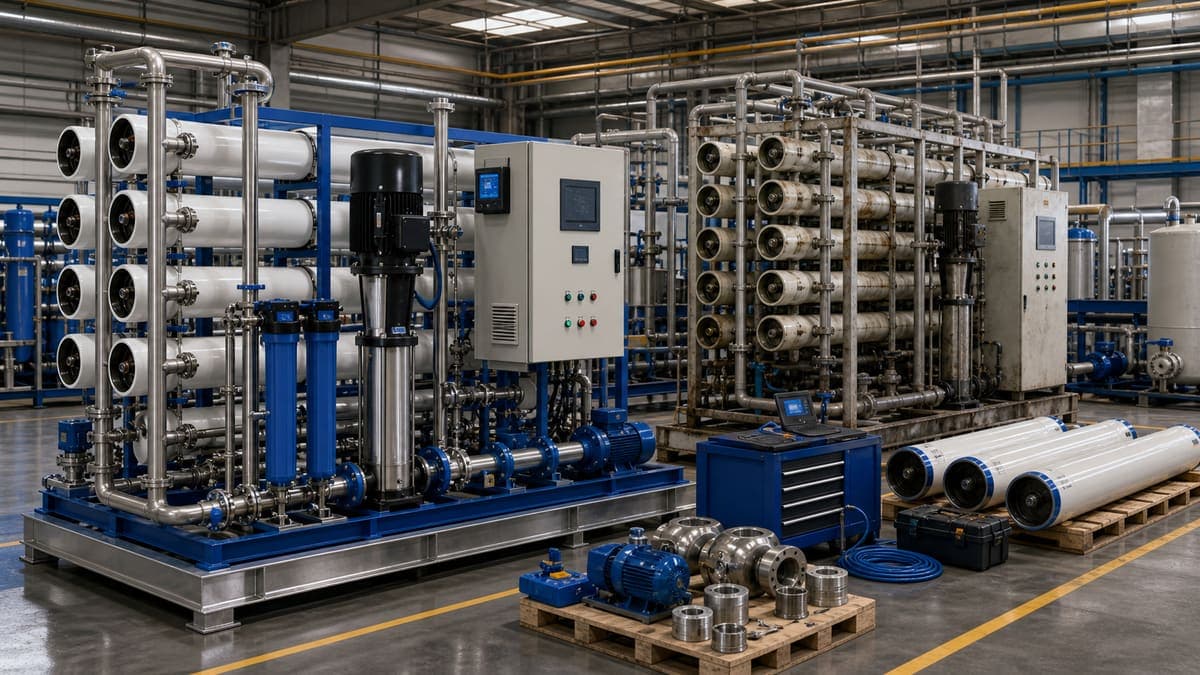
View the process illustration
The Imperative for Digital Transformation in RO
RO systems are the backbone of clean water production in countless industrial facilities, from power generation to pharmaceuticals. Yet, many of these critical assets operate with outdated monitoring, reactive maintenance, and fragmented supply chain processes. This leads to:
- Suboptimal Performance: Reduced permeate quality, lower recovery rates, and increased energy consumption due to membrane fouling or degradation that goes undetected or unaddressed promptly.
- Uncertainty and Risk: Higher incidence of unexpected breakdowns, leading to costly emergency repairs, production interruptions, and missed output targets.
- Inefficient Resource Use: Over-reliance on scheduled, rather than condition-based, maintenance for membrane cleaning or replacement, wasting chemicals and shortening asset lifespan.
- Supply Chain Vulnerability: Slow, manual spare parts procurement processes that fail to anticipate needs, resulting in long lead times and increased inventory holding costs or critical shortages.
Maintenance practice and retrofit options
Consider the critical task of managing membrane performance and ordering essential spares for an aging RO plant.
| Practice to review | Retrofit option to assess |
|---|---|
| Reactive Maintenance & Manual Data: Sparse pressure and conductivity records may miss changes between samples; establish the actual monitoring baseline and quality method. | Trend Monitoring: Record calibrated flow, pressure, conductivity, and temperature, then normalize performance. Validate any model alarms against independent events; trends do not uniquely identify scale or fouling or guarantee detection within a fixed time. |
| Scheduled Membrane Cleaning: Fixed calendar cleaning may be too early or late for actual conditions. Compare chemical use and normalized performance with manufacturer criteria. | Condition-Based Review: Assess normalized flow, salt passage, and pressure drop before operator-approved cleaning. Measure recovery, intervals, chemical use, and cost; optimum timing and a percentage life extension are not guaranteed. |
| Reactive Spare Parts Ordering: Ordering membranes or pump seals only after failure can leave the plant exposed to the actual supplier lead time and production consequence. | Spare Parts Planning: Verify stock, ownership, compatible specifications, shelf life, supplier lead time, and approved reorder rules. A model or interface does not guarantee just-in-time delivery, shorter manufacturing lead time, or zero production loss. |
| Expert Dependency & Ad-hoc Troubleshooting: Specialist travel and incomplete evidence can delay troubleshooting; assess actual response arrangements and site capability. | Remote Review: Where secure access and support are contracted, share relevant measurements and histories with specialists. Define approval, escalation, and required site inspection; do not assume a universal remote-resolution or time-saving rate. |
Q1: What kind of ROI can we expect from a digital retrofit for an aging RO system?
A1: Calculate ROI from actual retrofit capital, integration, licenses, training, maintenance, energy, chemicals, replacement, and production-loss assumptions. Compare measured baseline and trial outcomes with staged or full replacement, including equipment condition and remaining-life uncertainty. Instrument or software upgrades cannot restore chemically damaged membranes or prove pressure-vessel safety. Payback, uptime, energy savings, and life extension require project evidence; no universal percentage or payback interval is established.
References
Related equipment & product lines
These categories typically support the approach above—open any line to compare brands and models.
- Instrumentation & SensorsInstruments and sensors for online monitoring of flow, level, pressure, temperature, and water quality.View category →
- RO MembranesReverse osmosis membrane elements for municipal and industrial desalination.View category →
- InvertersVariable-frequency drives and inverter systems for variable-speed motor control.View category →
For a closer review, use the engineering inquiry form to share feed, capacity, target, and project stage. Submission does not constitute a completed design or performance commitment.