Back to Digital & Smart O&M

Solutions · Digital & Smart O&M

Carbon Footprint Tracking: defensible energy and chemical intensity for ESG reporting

Meter-grade energy attribution, chemical embodied signals where available, and audit trails—so sustainability claims survive scrutiny.

2026carbonESGenergyreportingsustainability
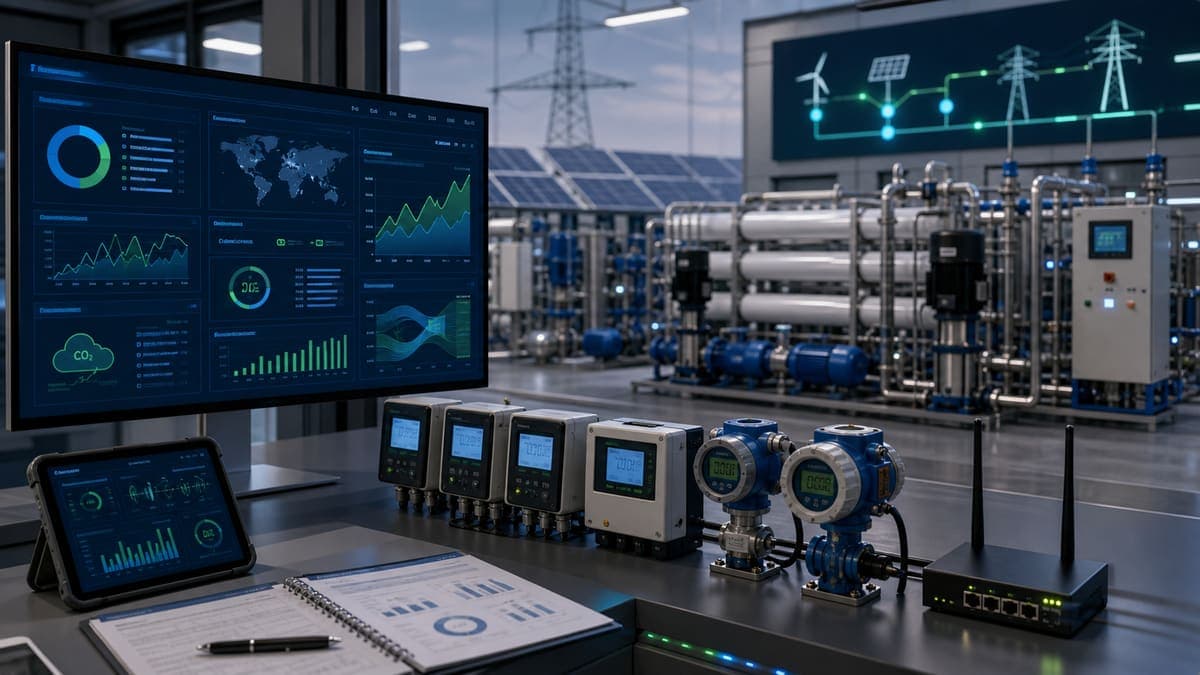
Carbon Footprint Tracking: defensible energy and chemical intensity for ESG reporting water treatment solution illustration

Problem

Spreadsheet carbon stories collapse under auditor questions about boundary conditions and meter provenance.

Technology

Time-stamped telemetry, allocation rules for shared loads, and export formats aligned to common disclosure frameworks.

Results

ESG narratives that link to the same SCADA historians operations already trust.

Carbon Footprint Tracking: Defensible Energy and Chemical Intensity for ESG Reporting

The push for sustainability is no longer optional; it's a core driver of business value, regulatory compliance, and investor confidence. For industrial water operators, understanding and reporting your carbon footprint with accuracy is paramount. AquaChain delivers the operational certainty and supply chain efficiency needed to provide transparent, defensible data on your energy and chemical intensity, directly supporting your Environmental, Social, and Governance (ESG) reporting requirements. This isn't just about compliance; it's about unlocking new levels of operational efficiency and identifying tangible pathways to green reduction.

Traditional vs AquaChain

The journey from raw operational data to auditable ESG reports is often fraught with manual effort, estimation, and delayed insights. AquaChain transforms this process, providing real-time, validated data streams.

Let's consider the scenario of a municipal wastewater treatment plant aiming to reduce its chemical and energy consumption per cubic meter of treated water.

Traditional wayAquaChain way
Manual Data AggregationAutomated, Real-time Data Capture
- Operators record chemical tank levels daily, pump runtimes weekly.- Online flow meters, chemical dosing pump strokes, and power meters stream data directly.
- Energy bills arrive monthly, averaged across the entire facility.- Granular energy consumption per process unit, calculated instantly.
- Chemical consumption estimated based on deliveries and inventory counts.- Actual chemical dose rates (e.g., kg/m³) calculated from flow and pump calibration.
- ESG reports compiled quarterly/annually from disparate spreadsheets.- Continuous calculation of energy and chemical intensity (e.g., kWh/m³, kg/m³).
Delayed Insights & Reactive AdjustmentsProactive Optimization & Predictive Reporting
- High chemical use identified weeks later, after tanks are low.- Alerts trigger immediately if intensity deviates from target thresholds.
- Inefficient aeration patterns only discovered after energy bills spike.- Predictive models flag equipment drift affecting energy use (e.g., failing blowers).
- Carbon reduction targets tracked retrospectively, no immediate impact.- Real-time dashboards provide auditable carbon equivalent (CO2e) metrics.
- Difficulty in substantiating claims for investors/regulators due to data gaps.- Data lineage ensures defensible, traceable metrics for all ESG stakeholders.

The Foundation of Trust: Data from the Field

Accurate carbon footprint tracking begins with accurate measurements at the source. AquaChain’s platform integrates seamlessly with your plant's existing infrastructure, pulling crucial operational data directly from online instruments and sensors. Decisions regarding your chemical usage, energy consumption, and overall process efficiency are only as reliable as the data feeding them. This means leveraging real-time inputs from flow meters, pressure transducers, conductivity probes, ORP sensors, and level transmitters to capture the true operational truth.

These instruments provide the granular data points needed to calculate precise chemical intensity (e.g., kilograms of coagulant per cubic meter of treated water) and energy intensity (e.g., kilowatt-hours per cubic meter). By integrating these diverse data streams, AquaChain provides a comprehensive and continuously updated picture of your plant’s resource consumption, which is then translated into verifiable carbon equivalent metrics.

Data Security & Trust

In 2026, the integrity and security of operational data are non-negotiable, especially when linked to critical ESG reporting and financial implications. AquaChain understands that the underlying SCADA historians and production KPIs of an industrial plant are highly sensitive. Our platform employs robust security measures, ensuring that your data remains protected throughout its lifecycle.

All data in motion between your plant and the AquaChain cloud is secured with end-to-end encryption, adhering to industry-leading cryptographic standards. For clients with heightened security protocols or specific regulatory requirements, AquaChain offers private cloud deployment options, allowing for a dedicated tenant or deployment within your existing Virtual Private Cloud (VPC) infrastructure. This ensures that your most sensitive operational intelligence resides within your controlled environment, offering maximum data sovereignty and peace of mind.

  • AES-256 encryption for all data at rest.
  • TLS 1.3 for secure data transmission.
  • Role-based access control ensuring data visibility is restricted to authorized personnel.
  • Compliance with major industrial cybersecurity standards to safeguard operational technology (OT) data.

AquaChain Differentiation: Coordinated Intelligence

AquaChain goes beyond simple data aggregation. We offer a unified platform that correlates operational data with your supply chain, maintenance schedules, and engineering specifications to provide a holistic view of your carbon footprint. This means connecting the dots between, for example, a subtle increase in pump energy consumption, an overdue maintenance schedule, and the subsequent impact on your reported energy intensity.

Our system tracks the lifespan and performance of critical assets, predicts optimal maintenance windows, and can even integrate with spare parts inventory management. When a piece of equipment begins to operate inefficiently, the platform not only alerts you to the performance degradation but also links this to its CO2e impact and suggests corrective actions, which may include ordering specific spares or scheduling a technician. This coordinated intelligence ensures that engineering teams receive direct feedback on how design choices translate to operational efficiency and carbon impact, while procurement teams can optimize inventory to support proactive maintenance, preventing costly and carbon-intensive emergency repairs. This is about delivering auditable data that drives genuine, measurable reductions in your plant's environmental impact.

FAQ

Q: How accurate can my carbon footprint tracking really be with AquaChain? A: Your accuracy directly correlates with the quality of your instrument data. By integrating real-time, calibrated data from your online sensors for flow, chemical dosing, and power consumption, AquaChain calculates energy and chemical intensities with a high degree of precision, minimizing estimations. This provides a defensible data trail for auditors.

Q: Is this system only for new, state-of-the-art facilities, or can I integrate it with my existing plant? A: AquaChain is designed for both greenfield and brownfield projects. Our platform is vendor-agnostic and can integrate with most existing SCADA systems, PLCs, and instrument networks. We specialize in retrofitting older facilities, helping them unlock latent data and bring them up to modern ESG reporting standards without requiring a full system overhaul.

Q: How does AquaChain's carbon footprint data integrate with my existing ESG reporting software or ERP systems? A: AquaChain provides flexible APIs and data export capabilities designed for seamless integration with leading ESG reporting platforms and Enterprise Resource Planning (ERP) systems. We aim to act as the single source of truth for your operational sustainability metrics, feeding validated data directly into your preferred reporting tools, streamlining your compliance and disclosure processes.

Call to action

Achieving verifiable, green reductions and producing defensible ESG reports starts with transparent, reliable data. Don't let scattered spreadsheets and manual processes undermine your sustainability goals. Talk to AquaChain engineering about how we can transform your operational data into a powerful tool for carbon footprint tracking and reduction. Tell us your duty, your instruments, and your risk tolerance—we will translate that into a delivery and data plan you can audit.

These categories typically support the approach above—open any line to compare brands and models.

Looking for site-specific references or lab data? Contact us—we can share case material relevant to your feed and targets.