Back to Industry Solutions

Solutions · Industry Solutions

Fine chemical plants: corrosion-safe, stable process water

Aggressive reagent environments: materials selection, RO/EDI stability, chemical injection, and instrumentation for batch and multi-product sites.

2026fine chemicalsROEDIcorrosionbatch productionconductivity
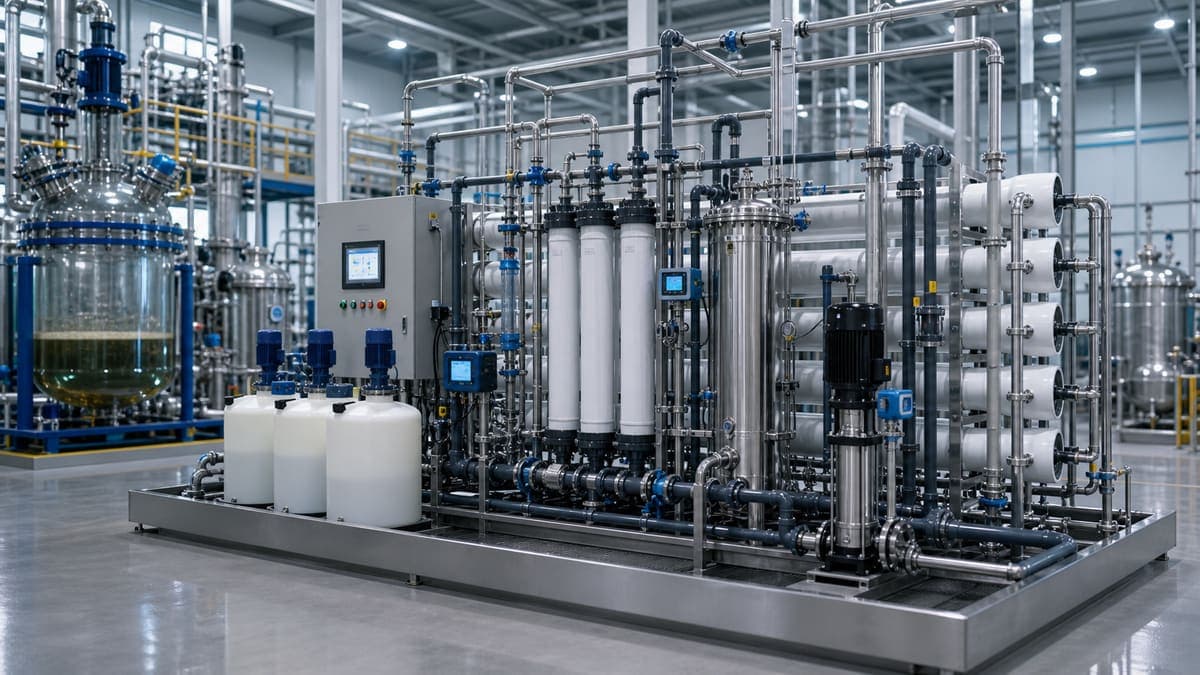
Fine chemical plants: corrosion-safe, stable process water water treatment solution illustration

Problem

Multi-product batches change water demand and quality tiers; incompatible materials and organics spikes cause unplanned shutdowns.

Technology

Segmented loops, RO/EDI or polishers sized per tier, compatible alloys and gaskets, and dosing skids with redundancy.

Results

Fewer batch scrubs from water excursions and faster changeovers between campaigns.

Fine chemical plants: corrosion-safe, stable process water

The fine chemical and specialty chemical manufacturing sectors are defined by their agility and precision, often running batch campaigns that demand highly specific and often divergent water quality specs. From general utility water for cleaning and cooling to highly purified water for sensitive reactions and product formulation, the range of requirements is vast. Process water for these applications must be not only consistently pure but also inherently stable, resilient to operational variability, and compatible with the frequently corrosive environments within the plant. AquaChain understands these intricacies, providing engineered solutions that ensure reliable, high-purity water supply while safeguarding capital equipment and product integrity.

Industry context & regulatory/compliance drivers

Fine chemical facilities face a unique set of challenges. Production often involves aggressive chemistries, which can lead to corrosive atmospheres impacting instrument housings and seals. The nature of batch processing means water demands fluctuate significantly, requiring systems capable of rapid ramp-up and turndown. Furthermore, accidental organic spills or volatile vent condensates can unpredictably stress water treatment pretreatment systems if not adequately designed for such events.

Regulatory drivers are multifaceted:

  • Internal Product Quality Standards: The most stringent requirements often originate from the product specifications themselves, dictating conductivity, TOC, particulate, and microbial limits. For sensitive synthesis steps, water quality might approach requirements akin to ASTM D5127-13 Type E-1.2 for ultrapure water, or even pharmaceutical grades like USP-NF Purified Water depending on the end-use and regulatory classification of the fine chemical product.
  • Environmental Discharge Permits: Local and national environmental agencies (e.g., US EPA, EU Environmental Directives) impose strict limits on the quality of discharged concentrate streams from RO systems and general wastewater, particularly regarding pH, TSS, COD, TOC, heavy metals, and specific organic compounds. AquaChain ensures compliance through careful process design and discharge monitoring.
  • Boiler Feedwater Guidelines: For steam generation, guidelines such as those from the ASME/IAPWS are critical to prevent scaling, corrosion, and carryover in boilers, requiring high-purity feed water.
  • Cooling Water Management: Standards are typically internal but focus on minimizing scaling, corrosion, and biofouling within cooling towers and heat exchangers.

Water quality targets

Water quality targets in fine chemical plants are highly segmented based on application. Examples include:

  • Cooling Water Makeup: Often requires removal of hardness and suspended solids to prevent scaling and biofouling, with conductivity typically <500 µS/cm.
  • Rinse Water: Varies widely; some non-critical rinses might tolerate conductivity <100 µS/cm, while critical intermediate product rinses might demand <1 µS/cm or even resistivity >1 MΩ·cm.
  • Reactor Feed/Synthesis Water: This is often the most critical, requiring very low conductivity (<0.1 µS/cm, or >10 MΩ·cm resistivity), extremely low TOC (<50 ppb), and absence of specific ions that could interfere with reactions.
  • Boiler Feedwater: Typically requires demineralized water with conductivity <5 µS/cm, low hardness, silica, and dissolved oxygen to protect boiler integrity.

AquaChain adopts a modular approach to achieve these varied targets, ensuring each use point receives the precise water quality it needs, without over-treating where unnecessary.

Process train description

AquaChain's robust process water solutions for fine chemical plants are designed with resilience and flexibility in mind. We emphasize digitally modelled flow paths and integrated stainless-steel skids for optimal footprint, corrosion resistance, and operational reliability.

  1. Pretreatment: Raw water quality can vary significantly. If the source is surface water or has an SDI₁₅ (Silt Density Index) consistently above 5, AquaChain mandates robust pretreatment.

    • Multimedia Filtration (MMF): Removes larger suspended solids and turbidity.

    • Ultrafiltration (UF): Provides superior removal of suspended solids, colloids, and microorganisms, significantly reducing the SDI to protect downstream RO membranes from fouling.

    • Activated Carbon Filtration: Essential for removing chlorine, chloramines, and a significant portion of dissolved organics, which can damage RO membranes or interfere with processes.

    • Chemical Dosing:

      • Antiscalant: Precisely dosed upstream of the RO to mitigate scaling potential (e.g., calcium carbonate, silica) on the membrane surface, especially at higher recovery rates. AquaChain systems incorporate redundant chemical dosing pumps with interlocks for critical additions.

      • pH Adjustment: To optimize RO performance and prevent scaling.

  2. Reverse Osmosis (RO): The core of the demineralization process. Our cross-flow RO systems are designed to achieve high salt rejection (typically 98-99.5%) while managing concentration polarization.

    • Multi-stage RO systems are often employed to maximize recovery rate while managing LSI / scaling risk in the concentrate stream. The permeate from the first pass RO typically achieves conductivity in the range of 5-20 µS/cm.
  3. Post-Treatment / Polishing: For applications requiring higher purity.

    • Second Pass RO: For even lower conductivity (e.g., <1 µS/cm) and reduced dissolved solids.

    • Ultraviolet (UV) Sterilization: Placed at strategic points (e.g., post-RO, before storage, before use point) to reduce microbial load.

    • Continuous Electrodeionization (EDI): For generating ultrapure water from RO permeate. EDI continuously deionizes water using ion-exchange resins, DC electric fields, and ion-selective membranes. Ions migrate through the resin to concentrate compartments under the influence of the electric field, where they are continuously flushed away in a concentrate stream. Water splitting at the electrode compartments provides the H+ and OH- ions necessary for continuous resin regeneration, eliminating the need for hazardous chemical regeneration. EDI typically achieves permeate resistivity >10 MΩ·cm.

    • Mixed-Bed Ion Exchange (MBDI): Used for achieving the highest resistivity (>18 MΩ·cm) and lowest TOC levels, often as a final polish after EDI or for critical points. This step typically uses external chemical regeneration.

Operations, monitoring, and CIP philosophy

AquaChain systems are built for ease of operation and maintenance. Our philosophy centers on proactive monitoring and scheduled maintenance.

  • Performance Monitoring: Continuous monitoring of key parameters such as permeate conductivity, flow rate (including normalized permeate flow), and differential pressure (ΔP) across membrane stages. This allows for early detection of fouling or other performance degradations.
  • Online Analytics: Critical parameters like ORP, pH, and conductivity are monitored at strategic branches and use points to ensure water quality consistency.
  • Clean-in-Place (CIP): Automated CIP sequences are standard. Our systems are designed with dedicated CIP skids to facilitate periodic cleaning of RO and UF membranes, essential for managing biofouling and inorganic scaling. CIP frequency is determined by trend analysis of normalized permeate flow and transmembrane pressure increases, not just fixed schedules.
  • Loop Segmentation: Implementation of multiple, smaller process loops, each with tailored water quality targets and dedicated monitoring, rather than a single large loop, provides greater control, reduces operational costs, and enhances system resilience.

Risks and common engineering mistakes

  • Inadequate Pretreatment: The most common mistake leading to premature membrane fouling, reduced life, and higher operational costs. Ignoring high SDI or intermittent organic loading can rapidly degrade RO membrane performance.
  • Poor Material Compatibility: Failing to account for aggressive chemicals or corrosive atmospheres can lead to equipment corrosion, leaks, and contamination of the product water. AquaChain's HAZOP-style reviews explicitly address materials compatibility for diverse solvent classes.
  • One-Size-Fits-All Design: Trying to meet all water demands with a single, ultra-high-purity system is inefficient and costly. Staged capacity and quality tiers are essential for fine chemical plants.
  • Ignoring LSI and Recovery Rate: Pushing RO recovery rate too high without proper antiscalant dosing and LSI calculations (Langlier Saturation Index) will invariably lead to severe scaling and membrane damage.
  • Lack of Redundancy: Critical water supplies require redundant pumps, filtration units, and even entire treatment trains to ensure uninterrupted operation during maintenance or unexpected failures.

2026 forward-looking context

AquaChain is committed to advancing water treatment technologies through innovation, focusing on sustainability and digital integration.

Energy & ESG

Our designs prioritize minimizing environmental impact and maximizing resource efficiency. For RO systems, we analyze the specific energy consumption (kWh/m³ permeate) and optimize operating pressures. Where higher salinity and significant pressure differentials justify it, AquaChain integrates energy recovery devices (ERD) on high-pressure RO concentrate streams. These devices recapture hydraulic energy, significantly reducing the overall power consumption of the high-pressure pumps and contributing to a lower carbon footprint. This commitment aligns with the growing ESG (Environmental, Social, and Governance) demands on the fine chemical industry.

Digital O&M

AquaChain systems incorporate advanced digital monitoring and control. Remote monitoring of critical parameters like stage ΔP (pressure drop) across membrane elements, normalized permeate flow, and system recovery allows for predictive maintenance. Our platforms provide trend-based triggers for maintenance activities such as membrane CIP cycles, filter cartridge replacement, and antiscalant recalibration, moving away from reactive repairs to proactive optimization. This digital twin approach enhances operational reliability and reduces unexpected downtime.

modular RO system portfolio

AquaChain's modular RO system portfolio offers scalable solutions tailored to the fine chemical industry. The pilot-scale RO series is ideal for laboratory-scale process development, pilot studies, or small-flow prototyping, offering compact, high-purity water generation for R&D departments or small-scale specialized production runs. For full-scale production facilities in fine chemical manufacturing, the industrial RO series provides multi-stage, high-capacity RO/EDI systems with full SCADA integration, designed for continuous, robust operation and easily expandable to meet evolving production demands.

Frequently asked questions

Q: One RO for whole site?

A: Rarely optimal. The diverse campaign requirements and varied quality tiers within fine chemical manufacturing usually favor staged capacity and dedicated treatment trains for specific high-purity applications, offering greater flexibility and cost efficiency.

Q: Is stainless always enough?

A: No. While stainless steel is generally robust, specific chloride concentrations, elevated temperature, and the presence of certain aggressive chemical species (e.g., strong acids or bases) dictate the precise alloy grade required. AquaChain meticulously documents worst-case corrosion potential index (CPI) exposures to ensure appropriate material selection, including specialized coatings or gasket elastomers.

Q: How to handle organics spikes?

A: For predictable or intermittent organic spikes from specific rinse composites or vent condensates, solutions often involve advanced oxidation processes (AOPs) like UV/H₂O₂ or specialized resin adsorption. For general, unpredictable organic loads, granular activated carbon (GAC) filtration or membrane bioreactors (MBR) in pretreatment are effective. AquaChain recommends pilot studies on worst-case water streams to determine the most effective and economical solution.

Q: What is the typical salt rejection of an RO membrane?

A: The typical salt rejection for industrial reverse osmosis membranes is between 98% and 99.5%, depending on the membrane type, operating pressure, feed water salinity, and temperature. It's important to distinguish this from recovery rate, which is the volumetric percentage of permeate produced relative to the total feed flow.

Call to action

Achieving precise water quality for critical processes in fine chemical manufacturing demands expert engineering and robust, reliable systems. Need a customized process diagram for your Fine Chemical facility? Consult AquaChain's engineering team today.

These categories typically support the approach above—open any line to compare brands and models.

Looking for site-specific references or lab data? Contact us—we can share case material relevant to your feed and targets.