Solutions · Industry Solutions
High-pressure boiler feed water: UF + RO + EDI demineralization
Power and process boilers: silica limits, conductivity, and iron control with membrane demineralization, degassing strategy, and chemical coordination.
Use this guide within its scope
This page supports technical research and option comparison and is marked 2026. Illustrative values are not a quotation, completed process design, certification conclusion, or performance guarantee. Check current regulations, feed data, tests, and OEM records.
Problem
High-pressure drums demand extremely low dissolved solids and silica; poor makeup design drives carryover, tube failures, and unplanned outages.
Technology
UF pretreatment, two-stage RO where needed, EDI or mixed-bed polishing, and coordinated internal boiler chemistry with consistent makeup quality.
Results
Stable steam purity, longer runs between chemical cleans, and predictable blowdown conductivity.
Engineering decision card
Use when
High-pressure drums demand extremely low dissolved solids and silica; poor makeup design drives carryover, tube failures, and unplanned outages.
Evaluate first
UF pretreatment, two-stage RO where needed, EDI or mixed-bed polishing, and coordinated internal boiler chemistry with consistent makeup quality.
Inputs still required
Feed source and variability, capacity, target quality, operating hours, discharge or reuse boundary, available space, and utilities.
Comparison output
Stable steam purity, longer runs between chemical cleans, and predictable blowdown conductivity. The final decision still needs feed data, mass balance, and any necessary testing.

High-Pressure Boiler Feed Water: UF + RO + EDI Demineralization
High-pressure boilers, integral to utility and large industrial steam plants, demand makeup water of exceptional purity. The presence of even trace contaminants—especially hardness, silica, and dissolved solids (TDS)—can lead to severe operational issues such as tube scaling, corrosion, carryover, and costly turbine damage. These phenomena not only reduce plant efficiency but also pose significant safety risks and necessitate expensive unscheduled maintenance. Traditional demineralization methods often struggle with variable raw water quality, particularly seasonal changes in turbidity and dissolved solids, pushing the limits of system recovery and silica rejection.
Industry Challenges & Regulatory Drivers
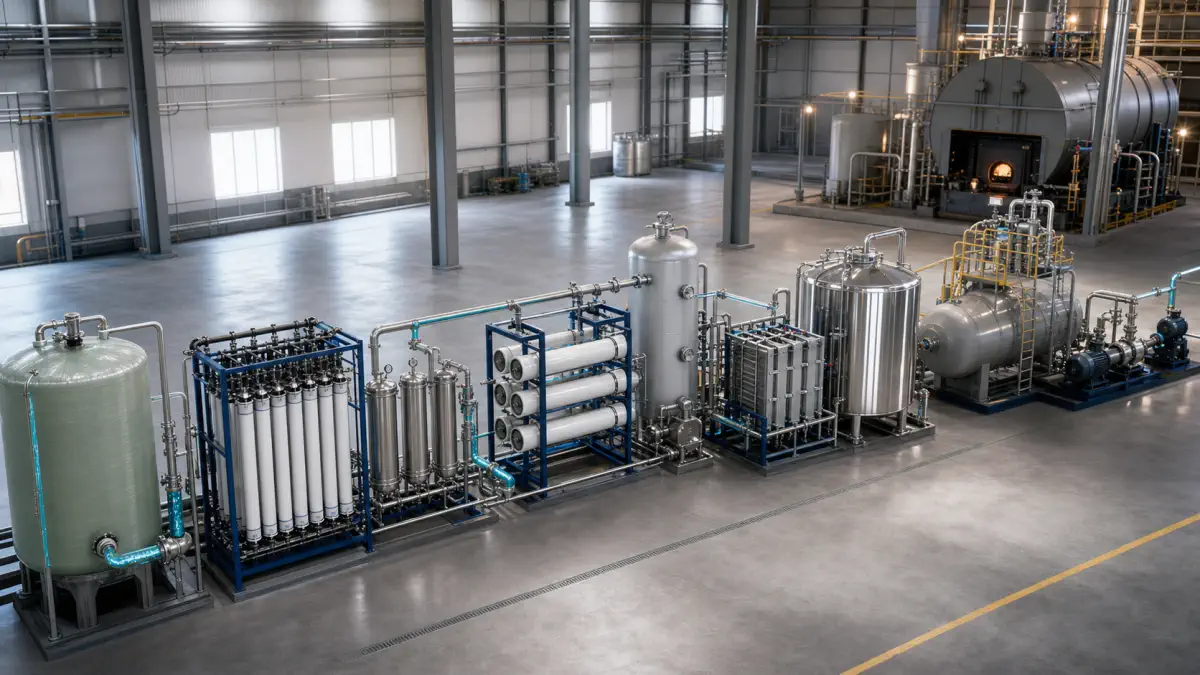
High-pressure boiler operations, especially those above 10 MPa (100 bar), are governed by stringent water quality specifications to ensure reliability and longevity. Key parameters include extremely low conductivity, silica, and sodium levels. For instance, the International Association for the Properties of Water and Steam (IAPWS) Technical Guidance Document on Instrumentation and Control for Water and Steam Cycle Chemistry for Fossil and Combined Cycle/Heat Recovery Steam Generator (HRSG) Plants (TP-03) provides detailed guidance for acceptable water and steam purity limits, often requiring makeup water conductivity below 0.1 µS/cm and silica below 10 µg/L (ppb). Local environmental regulations also dictate wastewater discharge limits, impacting concentrate management strategies.
1. Advanced Pretreatment for Membrane Protection
For raw water sources with elevated suspended solids, turbidity, or potential for biofouling (e.g., surface water, high SDI sources), effective pretreatment is paramount. If the raw water Silt Density Index (SDI₁₅) is consistently above 5, this approach mandates robust physical separation.
- Multimedia Filtration (MMF): Effectively removes larger suspended solids, reducing particulate load.
- Ultrafiltration (UF): Our UF systems act as a superior barrier, consistently producing an SDI₁₅ well below 3, critical for protecting downstream reverse osmosis membranes from particulate fouling. This significantly extends RO membrane life and reduces the frequency of Clean-In-Place (CIP) cycles.
3. Degasification for Optimized Post-RO Treatment
Post-RO, dissolved carbon dioxide (CO₂) can depress the permeate pH, increase conductivity, and exert a significant load on downstream ion exchange or EDI systems.
- Forced Draft Degasifier (FDD): Often employed after RO to remove dissolved CO₂, improving the efficiency of subsequent polishing steps and reducing the overall operating cost.
4. Continuous Electrodeionization (EDI) for Ultrapure Water
To achieve the ultra-low conductivity and trace ion levels required for high-pressure boilers (e.g., <0.1 µS/cm, <2 ppb Na, <10 ppb SiO₂), this approach employs Continuous Electrodeionization (EDI) as the final polishing step.
- Continuous Regeneration: Unlike traditional mixed-bed ion exchange, EDI continuously regenerates its internal ion-exchange resin using a DC electric field and ion-selective membranes, eliminating the need for hazardous acid and caustic regenerants.
- Multi-Compartment Design: Within the EDI stack, water flows through alternating dilute and concentrate compartments, separated by ion-exchange membranes. Ions migrate from the dilute (product water) compartments into the concentrate and electrode compartments under the influence of the electric field. This process yields very high-purity water, with the concentrate stream typically returned to the RO inlet or discharged.
Operations, Monitoring, and CIP Philosophy
Sustained high-purity water production depends on rigorous monitoring and a proactive maintenance strategy.
Risks and Common Engineering Mistakes
- Underestimating Raw Water Variability: Failing to account for seasonal or episodic changes in raw water quality (turbidity, TDS, organics) can lead to rapid fouling, reduced rejection, and system upsets. Comprehensive raw water analysis and flexible pretreatment design are crucial.
- Aggressive Recovery Rates: Pushing RO recovery rates too high without proper consideration of LSI and saturation limits for silica and other scaling compounds will inevitably lead to membrane scaling, poor rejection, and increased CIP frequency.
- Ignoring Dissolved Gases: Overlooking CO₂ post-RO can overload downstream polishing, increasing operational costs and potentially failing to meet strict conductivity targets.
- Inadequate Pretreatment: Insufficient particulate removal (high SDI) before spiral-wound RO membranes is a primary cause of fouling, leading to higher transmembrane pressure and shortened membrane lifespan.
Digital Operations & Maintenance (O&M)
this approach's digital-first approach transforms how water treatment plants are operated and maintained.
Modular RO Systems: Scalable Solutions
this approach's modular RO system portfolio offers unparalleled flexibility and performance across diverse application scales.
- pilot-scale RO: Ideal for pilot studies, laboratory applications, or small-flow prototyping, pilot-scale RO systems provide precise control and data acquisition for R&D and process optimization before full-scale deployment.
- industrial RO: For production-scale high-pressure boiler feed water applications, industrial RO solutions offer multi-stage configurations, robust construction, and full SCADA integration. These systems are designed for continuous, high-volume operation, ensuring reliable delivery of ultrapure water with minimal operator intervention.
Related equipment & product lines
These categories typically support the approach above—open any line to compare brands and models.
- RO MembranesReverse osmosis membrane elements for municipal and industrial desalination.View category →
- Electrodeionization (EDI)EDI modules and systems for ultrapure water production.View category →
- UF ModulesUltrafiltration modules for suspended solids and colloid removal.View category →
- ChemicalsAntiscalants, cleaners, and process chemicals for water treatment operations.View category →
For a closer review, use the engineering inquiry form to share feed, capacity, target, and project stage. Submission does not constitute a completed design or performance commitment.