Back to Industry Solutions

Solutions · Industry Solutions

Mining & mineral processing: acid drainage and metals load reduction

Acid mine drainage and flotation plant water: pH adjustment, metals precipitation, solids separation, and membrane steps for sulfate and TDS management.

2026miningAMDheavy metalssulfateROlime treatment
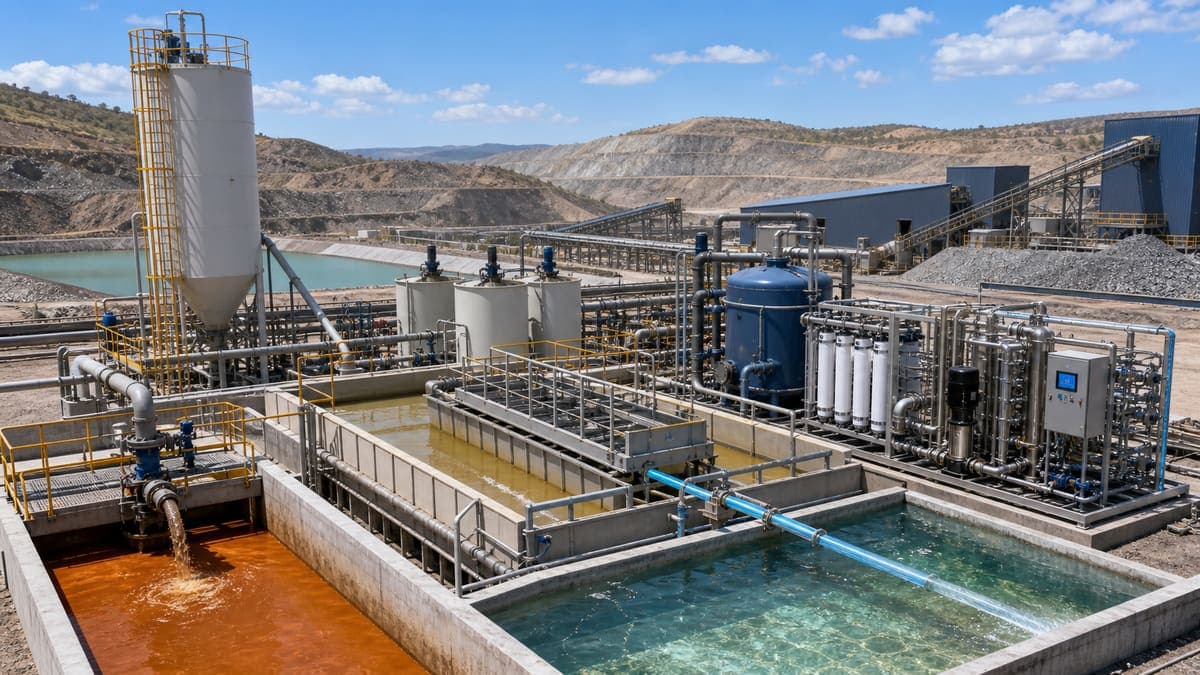
Mining & mineral processing: acid drainage and metals load reduction water treatment solution illustration

Problem

Low pH, metals, and sulfate stress conventional lime plants and create membrane scaling when recovery is pushed without ionic mapping.

Technology

Active and passive treatment options, high-density sludge practices, targeted metals recovery, and selective membrane/nanofiltration for sulfate where justified.

Results

Permit-stable effluent, lower sludge volumes per kg metal removed in optimized trains, and clearer solids handling paths.

Mining & Mineral Processing: Acid Drainage and Metals Load Reduction

The mining and mineral processing sectors are foundational to modern industry, yet they confront significant environmental stewardship challenges, particularly concerning water management. The generation of acid rock drainage (ARD), process wastewaters from flotation and beneficiation, and contact water from tailings storage facilities presents a complex cocktail of pollutants. These typically include high concentrations of dissolved metals (e.g., copper, zinc, nickel, lead, arsenic, cadmium), elevated sulfate levels, and varying degrees of total suspended solids (TSS). Operational complexities are further compounded by variable flow rates influenced by seasonal rainfall and snowmelt, demanding robust and adaptable treatment solutions.

Meeting stringent environmental discharge limits, driven by local and national environmental protection agencies (e.g., US EPA, EU Water Framework Directive, national environmental codes and permits), is paramount. These regulations typically specify maximum allowable concentrations for pH, TSS, heavy metals, and often sulfate or total dissolved solids (TDS). While conventional methods like lime or caustic neutralization effectively precipitate many metals, they often produce substantial sludge volumes and may not adequately address dissolved constituents like sulfate, ultimately failing to meet downstream TDS limits for discharge or process reuse. AquaChain specializes in developing integrated, sustainable water treatment pathways that transcend simple neutralization, focusing on both compliance and resource optimization.

Water Quality Targets

Water quality targets in mining are multifaceted, driven by:

  1. Discharge Compliance: Adherence to local environmental permits, which can dictate limits for pH (typically 6.0-9.0), TSS (<10-30 mg/L), and specific metals (e.g., Cu, Zn, Ni, As often <0.1 mg/L, sometimes much lower). Sulfate limits might range from 200-2,000 mg/L.
  2. Process Water Reuse: Treated water may be recycled back into grinding, flotation, or dust suppression. This demands careful consideration of scaling potential (e.g., calcium sulfate, silica), corrosion risks, and the impact of dissolved ions on process chemistry.
  3. Ultrapure Water (UPW) for Niche Applications: While less common for bulk mining processes, some specialized mining or processing steps, such as in semiconductor materials extraction, might require UPW. For such cases, water quality would need to conform to standards like ASTM D5127-13 Type E-1.2, requiring resistivity of >16 MΩ·cm and very low TOC.

AquaChain's Technical Approach: From Characterization to Compliance

Our approach begins with a comprehensive understanding of the wastewater matrix. Initial characterization involves detailed composite sampling across different weather conditions to analyze the full spectrum of pollutants: dissolved and particulate metals, sulfate, silica, fluoride, and organic compounds from flotation reagents or explosives. This critical first step informs the entire process design.

Process Train Description

AquaChain designs modular and scalable treatment trains, ensuring optimal performance from initial solids removal to advanced dissolved solids management.

  1. Primary Treatment: Chemical Precipitation & Solids Separation The first line of defense typically involves chemical precipitation to remove the bulk of heavy metals and suspended solids. High-density sludge (HDS) processes or integrated chemical precipitation strategies are favored due to their efficiency in metal removal and reduction in sludge volume compared to conventional lime treatment.

    • Neutralization: pH adjustment with lime or caustic precipitates multivalent metal hydroxides and often calcium sulfate.
    • Coagulation/Flocculation: Polymer addition aids in agglomerating fine particles and precipitates into larger flocs.
    • Sedimentation/Clarification: These larger flocs are then separated via gravity. High-rate clarifiers or settlers are often employed.
  2. Secondary Treatment: Advanced Solids & Colloids Removal Following primary treatment, water often requires further polishing, especially if membrane processes are downstream. The goal here is to reduce TSS and colloidal matter that could lead to fouling of subsequent membrane stages.

    • Multimedia Filtration (MMF): For water with residual TSS, MMF effectively reduces turbidity.
    • Ultrafiltration (UF): For challenging surface water sources or process waters with high colloidal content and an SDI₁₅ (Silt Density Index) consistently above 5, ultrafiltration is essential. UF membranes provide an absolute barrier, ensuring virtually complete removal of suspended solids, colloids, bacteria, and large organic molecules, protecting downstream reverse osmosis (RO) membranes from biofouling and particulate fouling.
  3. Tertiary Treatment: Dissolved Solids Removal (RO/NF) When sulfate or overall salinity drives discharge limits or dictates the suitability for reuse, membrane filtration becomes indispensable.

    • Reverse Osmosis (RO): Our industrial RO RO systems are engineered for high-pressure, robust operation in mining environments. These systems utilize semi-permeable membranes to achieve high salt rejection (typically 98-99.5% for monovalent ions) and effectively remove residual metals, sulfate, and other dissolved inorganic contaminants. Operating pressures can range from 10-70 bar, depending on the feed water TDS. High recovery rates (typically 70-85% for mining applications, depending on feed water quality) are achieved while carefully managing scaling risks, particularly for calcium sulfate, silica, and barium sulfate.
    • Nanofiltration (NF): In some cases, Nanofiltration might be employed where only multivalent ions (e.g., sulfate, hardness) need selective removal, allowing some monovalent ions to pass, potentially reducing operating pressure and energy consumption. Proper antiscalant dosing is crucial to prevent precipitation on membrane surfaces. AquaChain's engineers digitally model fluid dynamics and concentration polarization effects within the RO elements to optimize transmembrane pressure and minimize fouling. The entire RO system, including digitally modelled flow paths within pipework, is typically integrated into robust, integrated stainless-steel skids, designed for durability and ease of maintenance in harsh industrial environments.
  4. Specialized Polishing (e.g., for Selenium or Specific Metals) For contaminants like selenium, which are not effectively removed by chemical precipitation or RO alone, specialized processes may be required. These often include biological treatment (e.g., anoxic bioreactors) or adsorptive media. These are integrated as necessary based on initial water characterization.

Operations, Monitoring, and CIP Philosophy

Effective operation of complex water treatment systems in mining relies on continuous monitoring and proactive maintenance. AquaChain's operational philosophy emphasizes:

  • Continuous Monitoring: Real-time sensors track critical parameters such as pH, ORP, conductivity, turbidity, and flow rates across all stages.
  • Normalized Permeate Flow: Tracking normalized permeate flow for RO membranes is crucial for identifying fouling trends early, allowing for proactive intervention.
  • Transmembrane Pressure (TMP) & Differential Pressure (ΔP): Monitoring ΔP across filters and UF/RO stages provides insights into membrane fouling and the need for backwashing or CIP (Clean-in-Place).
  • Antiscalant Control: Precise dosing of antiscalant is vital, often adjusted based on feed water chemistry changes and LSI calculations to mitigate scaling.
  • CIP Protocols: Regular and effective CIP using chemical agents (acids for scale, alkalis for organics/biofouling) is fundamental to maintain membrane performance and extend membrane life. Our systems are designed for easy CIP integration.

Risks and Common Engineering Mistakes

  • Inadequate Characterization: Assuming uniform wastewater quality or failing to account for seasonal variations or changes in ore body can lead to undersized or ineffective treatment systems.
  • Underestimating Scaling Potential: High recovery rates without rigorous LSI and saturation index calculations, coupled with insufficient antiscalant dosing, invariably lead to rapid membrane scaling and performance decline.
  • Poor Pretreatment: Skimping on MMF or UF before RO is a false economy. High SDI values will quickly foul RO membranes, leading to increased cleaning frequency, higher operational costs, and shorter membrane lifespan.
  • Ignoring Sludge Management: Chemical precipitation generates sludge. Overlooking its volume, dewatering characteristics, and disposal costs can make an otherwise effective treatment process economically unviable.
  • Lack of Operational Robustness: Mining sites are often remote and subject to harsh conditions. Designs that are overly complex, difficult to maintain, or sensitive to minor operational upsets will struggle in the field. AquaChain emphasizes robust, user-friendly designs suitable for industrial applications.

2026 Forward-Looking Context: Sustainable & Smart Water Management

AquaChain is at the forefront of integrating advanced technologies for sustainable water management in mining, focusing on energy efficiency, environmental stewardship, and digital intelligence.

Energy & ESG

Energy consumption is a significant operational cost in water treatment, particularly for high-pressure RO systems. Our designs prioritize minimizing the specific energy consumption (kWh/m³ of permeate). For high-pressure RO systems treating highly saline mine water, energy recovery devices (ERD) are standard. These devices reclaim hydraulic energy from the high-pressure concentrate stream and transfer it to the incoming feed water, significantly reducing the overall power demand of the high-pressure pumps. This commitment to energy efficiency contributes directly to lower operational expenditure and improved Environmental, Social, and Governance (ESG) performance for our clients.

Digital O&M and Predictive Maintenance

AquaChain's industrial RO solutions incorporate advanced digital platforms for seamless operation and predictive maintenance. This includes:

  • Remote Monitoring: Real-time data acquisition from sensors across the entire treatment train (e.g., feed pressure, permeate flow, concentrate flow, pH, conductivity, ΔP across filters and membranes).
  • Trend-Based Triggers: Our systems analyze trends in key performance indicators (KPIs) like normalized permeate flow and transmembrane pressure. For example, a consistent 10-15% drop in normalized permeate flow or a significant increase in ΔP can automatically trigger alarms, recommend a CIP cycle, or alert operators to potential issues before they escalate, preventing costly downtime.
  • Optimized CIP Scheduling: By tracking fouling rates, the system can predict the optimal time for CIP, balancing membrane cleanliness with chemical and energy consumption. This moves away from fixed-schedule cleaning to condition-based maintenance.

Modular RO Systems

AquaChain's modular RO system portfolio offers scalable solutions tailored to specific needs. For the demanding volumes and variable conditions of mining and mineral processing, our industrial RO systems are the cornerstone. These are production-scale, multi-stage systems featuring robust construction, advanced instrumentation, and full SCADA integration for comprehensive control and monitoring. industrial RO systems are built to withstand harsh environments and deliver reliable performance for critical operations. For pilot testing of novel treatment chemistries, evaluating new ore body characteristics, or R&D applications, the pilot-scale RO offers a compact, modular platform, providing accurate data for scaling up to industrial operations.

Frequently Asked Questions

Q: Is membrane technology always appropriate for mine water treatment?

A: No, membrane technology is a powerful tool but not a universal solution. Initial steps focusing on gross metals removal via chemical precipitation and effective solids management are often paramount. Membranes, particularly RO/NF, become critical when stringent TDS, sulfate, or specific dissolved metal targets cannot be met by conventional physicochemical methods, or when high-purity water is required for reuse.

Q: Can treated mine water be reused in processing?

A: Absolutely, reuse of treated mine water is a key sustainability driver. However, it requires careful evaluation of the specific process requirements. For instance, high levels of dissolved solids or specific ions in reused water can impact reagent effectiveness in flotation, accelerate corrosion in pipelines, or cause scaling in heat exchangers. Detailed scaling and corrosion risk assessments on specific circuits are essential.

Q: What about challenging contaminants like selenium?

A: Selenium removal often requires specialized approaches beyond standard lime precipitation. These typically include biological treatment (e.g., anaerobic bioreactors with specific microbial communities), adsorptive media, or advanced ion exchange resins. Planning for such specific contaminant removal must occur early in the project development and permitting phases, as these technologies can have significant footprint and operational requirements.

Q: How do you address the variable flow rates common in mining, especially during storms?

A: AquaChain designs solutions with operational flexibility. This includes adequately sized equalization basins to buffer flow surges, allowing the treatment plant to operate at a more stable rate. Our modular industrial RO systems can also be configured with redundant units or variable capacity controls to adapt to fluctuating influent volumes, ensuring continuous compliance even during extreme weather events.

Call to Action

AquaChain combines deep engineering expertise with cutting-edge digital tools to tackle the most complex water challenges in mining and mineral processing. Need a customized process diagram for your Mining & Mineral Processing facility? Consult AquaChain's engineering team today.

These categories typically support the approach above—open any line to compare brands and models.

Looking for site-specific references or lab data? Contact us—we can share case material relevant to your feed and targets.