Solutions · Industry Solutions
Oil & gas produced water: deoiling, desalting, and reuse
High TDS, organics, and dispersed oil in produced water: CPI/DGF, media, UF, RO brine management, and discharge or beneficial reuse framing.
Use this guide within its scope
This page supports technical research and option comparison and is marked 2026. Illustrative values are not a quotation, completed process design, certification conclusion, or performance guarantee. Check current regulations, feed data, tests, and OEM records.
Problem
Variable oil-in-water, iron sulfides, and scaling ions destroy naive membrane designs; disposal and seismic injection constraints tighten the business case for reuse.
Technology
Staged separation—degassing, flotation, walnut-shell or media, UF guard, and RO/NF where economics support—each gate matched to lab characterization.
Results
Predictable membrane life, defensible effluent or reuse quality, and fewer emergency truck-outs.
Engineering decision card
Use when
Variable oil-in-water, iron sulfides, and scaling ions destroy naive membrane designs; disposal and seismic injection constraints tighten the business case for reuse.
Evaluate first
Staged separation—degassing, flotation, walnut-shell or media, UF guard, and RO/NF where economics support—each gate matched to lab characterization.
Inputs still required
Feed source and variability, capacity, target quality, operating hours, discharge or reuse boundary, available space, and utilities.
Comparison output
Predictable membrane life, defensible effluent or reuse quality, and fewer emergency truck-outs. The final decision still needs feed data, mass balance, and any necessary testing.
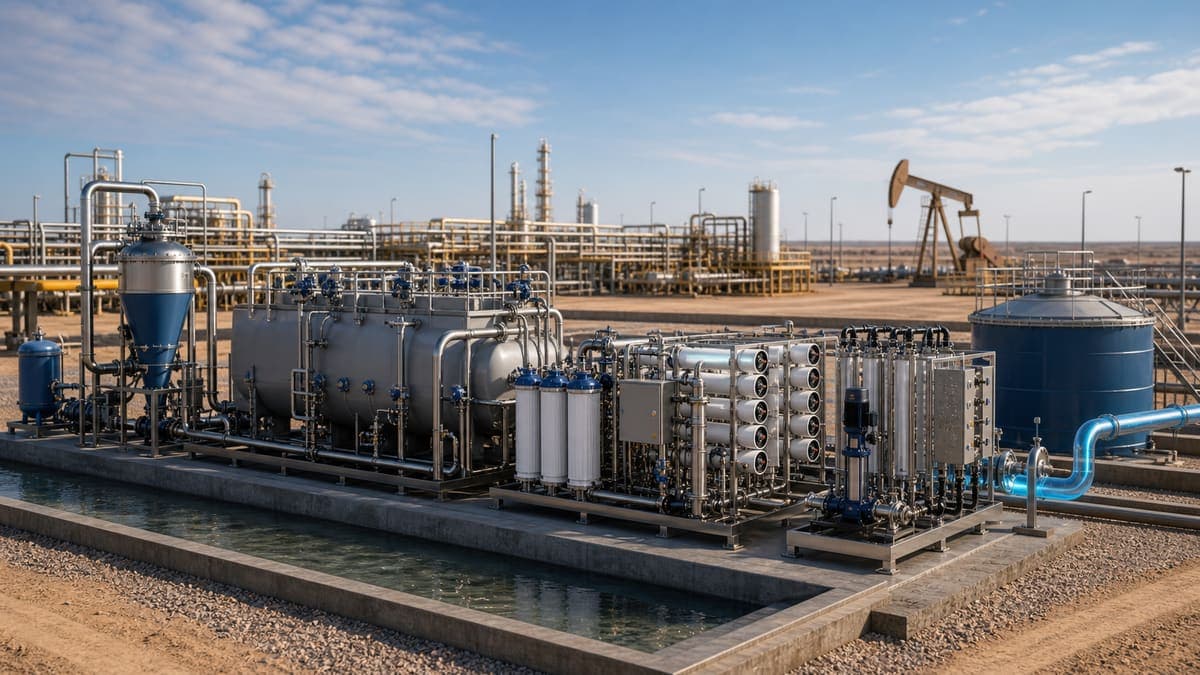
Industry Challenges & Regulatory/Compliance Drivers
Produced water treatment projects are inherently complex. The raw water often contains a volatile mix of dispersed oil, emulsified oil, various solids (sand, clays, iron sulfides), organics (BTEX, phenols, paraffin waxes, asphaltenes), and frequently very high TDS levels, sometimes exceeding 100,000 mg/L. A critical pitfall in project development is conducting pilot studies on cleaned-up samples that fail to represent the actual process conditions, omitting transient spikes in iron sulfides, surfactants, or polymer carryover from upstream separation processes. This can lead to under-designed systems prone to rapid biofouling and scaling.
Regulatory compliance is a primary driver, with paths differing significantly based on the intended fate of the treated water:
- Surface Discharge: Requires stringent removal of oil and grease (O&G), total suspended solids (TSS), and often specific organic compounds. Discharge limits are typically site-specific, dictated by local environmental permits (e.g., National Pollutant Discharge Elimination System (NPDES) in the US, or equivalent regional regulations), and may also include salinity limits.
- Deep Well Injection (Disposal Wells): Focuses on preventing formation plugging, primarily requiring removal of suspended solids and oil to meet injection well specifications (e.g., typically <2 mg/L TSS, <5 mg/L O&G, and particle size distribution limits to prevent formation damage).
- Reuse in Fracturing Operations: Presents an economic incentive, reducing demand for fresh water. Water quality requirements are less stringent for TDS but critical for suspended solids and oil to prevent wellbore damage and ensure compatibility with fracturing chemicals.
- Evaporation Ponds: While simple in concept, they are facing increasing scrutiny due to land use, environmental impact, and evolving regulatory landscape for air emissions and potential seepage.
Water Quality Targets
Water quality targets are highly dependent on the end-use. Typical ranges include:
- Oil & Grease (O&G): Target of <5 mg/L for discharge or reuse; <1 mg/L for RO feed.
- Total Suspended Solids (TSS): Target of <10 mg/L for discharge/reuse; <1 mg/L for UF/MF feed; <0.1 mg/L for RO feed.
- Turbidity: <1 NTU for UF/MF feed; <0.2 NTU for RO feed.
- Silt Density Index (SDI₁₅): Crucially, an SDI₁₅ < 5 (ideally < 3) is required for reliable spiral-wound reverse osmosis operation. If raw water SDI₁₅ is above 5, multimedia filtration (MMF) and/or ultrafiltration (UF) pretreatment is required before spiral-wound RO.
- TDS: Highly variable. For reuse in fracturing, it might be 10,000–50,000 mg/L. For specific industrial reuse or discharge, significant desalting may be required to achieve <1,000 mg/L or even lower depending on the specific application (e.g., agricultural, industrial boiler makeup).
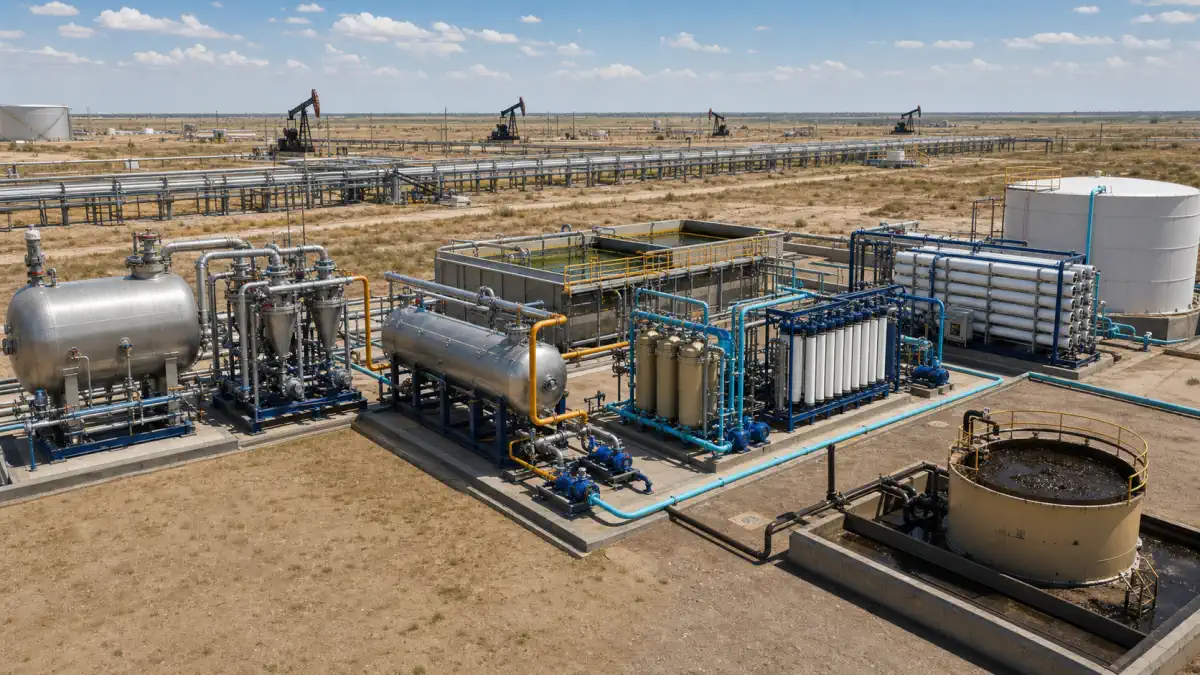
engineering evaluation path Technical Approach: A Multi-Barrier Process Train
-
Primary Oil & Solids Separation:
- Initial separation is critical and sized based on worst-case oil droplet histograms, not just median values.
- Technologies: Corrugated Plate Interceptors (CPI), Induced Gas Flotation (IGF), or Compact Flotation Units (CFU) are deployed to remove bulk free oil and larger suspended solids. These units are designed to handle significant oil slugs and high solids loading.
-
Fine Solids and Emulsified Oil Removal:
- Following primary separation, finer solids and emulsified oil require further treatment.
- Technologies: Nut-shell filters, multimedia filters (MMF), or cartridge filtration are employed. Chemical coagulation/flocculation is often applied upstream to enhance the removal efficiency of these particulate and colloidal contaminants.
- Chemical Dosing: An integrated chemical dosing skid precisely controls the addition of coagulants, flocculants, biocides, and scale inhibitors (antiscalants). This program is carefully selected for membrane compatibility and optimized to prevent scaling and biofouling throughout the system.
Risks and Common Engineering Mistakes
- Inadequate Pretreatment: The most common cause of membrane failure. Failing to properly remove oil, suspended solids, and colloids leads to rapid fouling and irreversible membrane damage. Underestimating the SDI of the feed is a frequent mistake.
- Underestimating Water Variability: Produced water composition can fluctuate significantly over time and across different wells. Designs must account for this variability and be robust enough to handle spikes in contaminants.
- Ignoring Scaling Potential: High TDS produced water inherently carries a high scaling risk. Improperly designed antiscalant programs or insufficient rejection of hardness ions can lead to rapid RO membrane scaling. Accurate LSI (Langelier Saturation Index) and Ryznar Stability Index calculations are critical.
- Poor Concentrate Management: The disposal or further treatment of the highly concentrated brine can be an economic and environmental bottleneck. A comprehensive concentrate management plan must be integrated into the initial design.
Related equipment & product lines
These categories typically support the approach above—open any line to compare brands and models.
- Filtration MediaGranular and specialty media for depth filtration and polishing stages.View category →
- UF ModulesUltrafiltration modules for suspended solids and colloid removal.View category →
- RO MembranesReverse osmosis membrane elements for municipal and industrial desalination.View category →
- ChemicalsAntiscalants, cleaners, and process chemicals for water treatment operations.View category →
For a closer review, use the engineering inquiry form to share feed, capacity, target, and project stage. Submission does not constitute a completed design or performance commitment.