Solutions · Industry Solutions
PCB & precision electroplating wastewater: metals recovery and reuse
Heavy metals, chelates, and high TDS from PCB and plating shops: pretreatment, selective recovery, membrane concentration, and discharge compliance.
Use this guide within its scope
This page supports technical research and option comparison and is marked 2026. Illustrative values are not a quotation, completed process design, certification conclusion, or performance guarantee. Check current regulations, feed data, tests, and OEM records.
Problem
Mixed rinses and drag-out create variable metal loads and chelated chemistry—standard hydroxide precipitation fails or produces unstable sludge.
Technology
Segregated streams, targeted IX or adsorption for high-value metals, membrane concentration for reuse or volume reduction, and polishing for permit limits.
Results
Lower fresh water and chemical use, metal recovery where economics support it, and effluent that survives spot sampling.
Engineering decision card
Use when
Mixed rinses and drag-out create variable metal loads and chelated chemistry—standard hydroxide precipitation fails or produces unstable sludge.
Evaluate first
Segregated streams, targeted IX or adsorption for high-value metals, membrane concentration for reuse or volume reduction, and polishing for permit limits.
Inputs still required
Feed source and variability, capacity, target quality, operating hours, discharge or reuse boundary, available space, and utilities.
Comparison output
Lower fresh water and chemical use, metal recovery where economics support it, and effluent that survives spot sampling. The final decision still needs feed data, mass balance, and any necessary testing.
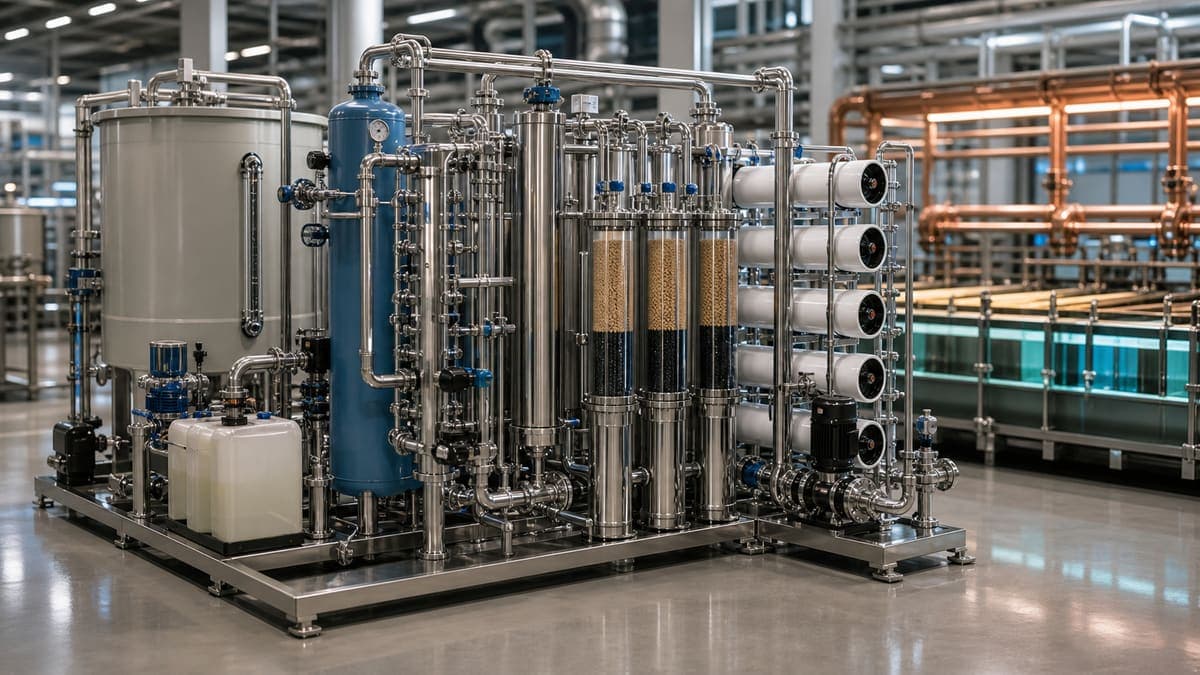
Industry Context & Regulatory/Compliance Drivers
Traditional wastewater treatment in PCB and electroplating often relies on chemical precipitation, which can be inefficient for chelated metals and generates large volumes of hazardous sludge for disposal. Mixing all streams into a single sump further complicates treatment, leading to increased chemical consumption and loss of valuable resources.
Regulatory frameworks, such as local environmental discharge codes (e.g., for municipal wastewater systems or direct discharge limits), are becoming increasingly stringent regarding heavy metal concentrations, total dissolved solids (TDS), and organic pollutants. Beyond compliance, corporate Environmental, Social, and Governance (ESG) initiatives are driving companies to pursue higher levels of resource recovery, water reuse, and achieve a positive metal mass balance, moving beyond mere end-of-pipe compliance. The economic incentives are also clear: recovering high-value metals reduces raw material costs, while water reuse minimizes fresh water intake and wastewater discharge fees.
Water Quality Targets for Recovery and Reuse
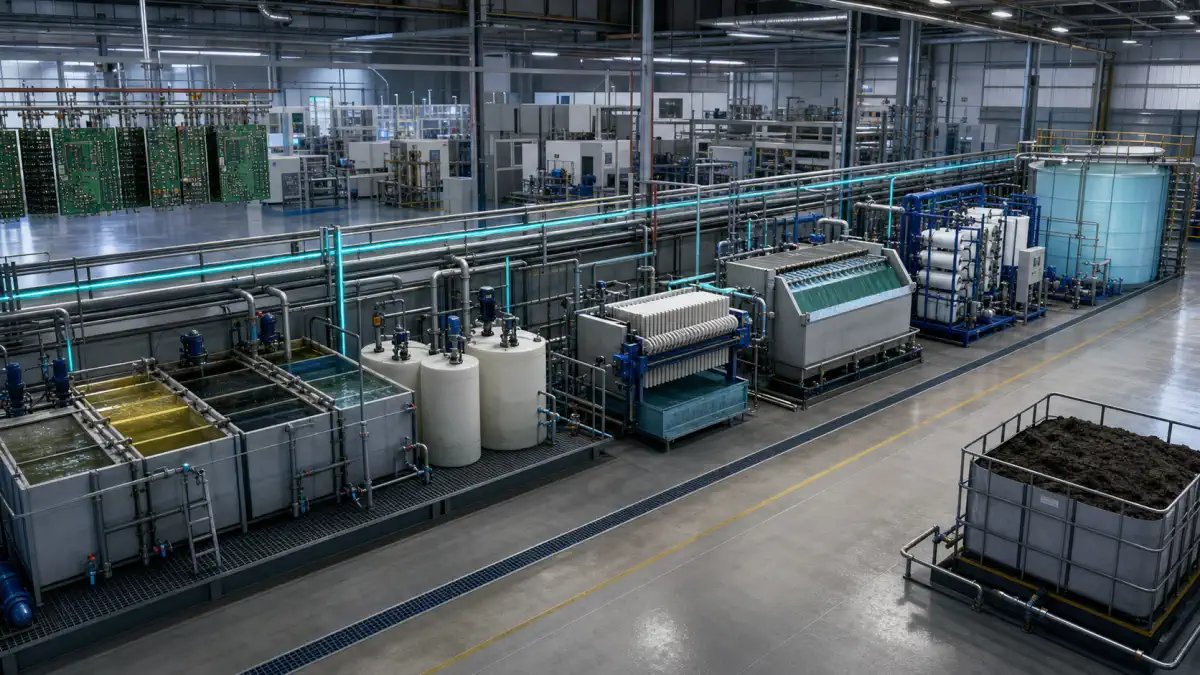
The quality requirements for recovered metals vary depending on their end use (e.g., direct reuse in plating baths, sale as purified metal salts, or electrowinning). For water reuse, targets are typically dictated by the specific rinse stage.
- Initial Rinses: May tolerate higher conductivity (e.g., 500-1000 µS/cm) if metals are specifically recovered.
- Intermediate Rinses: Often target conductivity below 100 µS/cm, with stringent limits on suspended solids and specific metal ions.
- Final Rinses/Make-up Water: Requires very high purity, often targeting conductivities below 5 µS/cm, or even resistivity values of 1-18 MΩ·cm, comparable to Type II or Type I ultrapure water for highly sensitive processes (referencing ASTM D5127-13 Type E-1.2 guidelines for critical applications). Total organic carbon (TOC) and particle counts are also critical for these applications.
1. Stream Segregation and Primary Treatment
The cornerstone of effective recovery is stream segregation at the source. Separating concentrated drag-out solutions, different rinse cascades, and floor spills prevents cross-contamination and allows for targeted treatment.
- Drag-out Solutions: Often rich in specific metals, these can be directly recovered or concentrated for electrowinning.
- Spent Baths: Dedicated treatment for specific bath chemistries.
- Rinse Waters: Further segregated based on metal type or contaminant profile.
Initial primary treatment may involve pH adjustment, flocculation, and sedimentation/clarification for bulk metal removal where appropriate, particularly for non-chelated metals.
2. Advanced Pretreatment for Membrane Protection
Given the presence of suspended solids, oils, and complex organics in electroplating wastewater, a multi-stage pretreatment scheme is paramount to protect downstream membrane systems from fouling and scaling. If the raw water SDI₁₅ is above 5, advanced physical separation is mandatory.
-
Multi-Media Filtration (MMF): For larger suspended solids removal, acting as a guard filter.
-
Ultrafiltration (UF): This is often the preferred and most effective pretreatment for electroplating wastewater. UF systems provide a robust barrier against suspended solids, colloids, emulsions, and some high-molecular-weight organics, significantly reducing the SDI (Silt Density Index) to values typically below 3, which is critical for extending the lifespan and performance of reverse osmosis membranes. The cross-flow operation of UF helps mitigate membrane fouling.
-
Granular Activated Carbon (GAC): For the removal of dissolved organic compounds, surfactants, and especially complex chelating agents (e.g., EDTA, citrate, proprietary brighteners) that can interfere with downstream ion exchange and membrane processes. This step is crucial for preventing organic fouling of RO membranes and enhancing the efficiency of ion exchange resins.
-
Chemical Dosing: Antiscalants are critically important here, dosed proportionally to prevent scale formation on RO membranes, particularly when concentrating hardness ions like calcium and magnesium, or sparingly soluble salts like barium sulfate. Biocides may also be dosed intermittently to control biofouling.
3. Metals Recovery and Concentration
-
Ion Exchange (IX): Selective ion exchange resins are deployed to recover specific valuable metals from pre-treated rinse streams. Chelated metals can be challenging but specialized resins or pre-treatment (e.g., UV-peroxide oxidation) can enhance recovery. The loaded resins are then regenerated, yielding a concentrated metal salt solution suitable for electrowinning or re-use. This offers excellent selectivity and high rejection of target metals.
-
Reverse Osmosis (RO) / Nanofiltration (NF): These membrane processes are central to volume reduction and water purification for reuse.
- Nanofiltration (NF): Can selectively reject multivalent ions (like heavy metals) while allowing some monovalent salts to pass, useful for pre-concentration or specific separations.
- Reverse Osmosis (RO): Provides high rejection of dissolved salts (>98%) and metals, producing a high-purity permeate for reuse and a concentrated brine stream. Operating pressures typically range from 10-25 bar (1.0-2.5 MPa) for brackish water RO, depending on the TDS. High recovery rates (e.g., 75-85% for single-pass systems) are achievable with effective pretreatment. Careful consideration of the LSI (Langelier Saturation Index) and antiscalant selection is vital to prevent scaling at high recovery.
The concentrated RO stream (concentrate) can be further processed for metal recovery (e.g., electrowinning) or volume reduction, or sent for responsible disposal.
- Electrowinning: For highly concentrated metal streams (e.g., from IX regenerant or RO concentrate), electrowinning offers a direct route to recover metals in their elemental form, minimizing sludge generation.
4. Post-Treatment and Polishing for Reuse
-
Continuous Electrodeionization (EDI): For applications requiring ultrapure water for final rinses or make-up, EDI provides continuous deionization without the need for chemical regenerants. An EDI stack uses an electric field to drive ions from the process stream across ion-selective membranes into a separate concentrate compartment and out of the electrode compartments, while simultaneously regenerating the ion exchange resins packed within. This results in resistivity values up to 18 MΩ·cm, meeting stringent specifications for critical processes.
-
Ultraviolet (UV) Disinfection: For any water destined for reuse loops, especially in sensitive processes, UV systems provide effective control of microbial growth, preventing biofouling in downstream equipment and ensuring process integrity.
Operations, Monitoring, and CIP Philosophy
Clean-in-Place (CIP) protocols are engineered based on membrane type and fouling potential. CIP is typically initiated based on a predetermined drop in normalized permeate flow (e.g., 10-15% from baseline) or an increase in ΔP. Specific acid washes target scale (e.g., calcium carbonate), while alkaline washes with surfactants address organic and colloidal fouling. Regular CIP extends membrane life and maintains optimal rejection and recovery rates.
Risks and Common Engineering Mistakes
- Inadequate Pretreatment: The most common mistake, leading to rapid and often irreversible fouling of RO membranes, reduced flux, increased transmembrane pressure, and ultimately premature membrane replacement.
- Ignoring Chelates: Strong chelating agents can bind metals, preventing their removal by precipitation or conventional IX, and can even contribute to RO membrane degradation if not adequately pre-treated (e.g., via GAC or oxidation).
- Overestimating Metal Recovery: Without proper stream segregation and a detailed metal mass balance study, projected metal recovery can be significantly overstated.
- Mixing Incompatible Waste Streams: Combining streams with different chemistries (e.g., acid and alkaline, or different metal contaminants) can create intractable treatment challenges and reduce recovery potential.
- Poor Antiscalant Strategy: Incorrect selection or dosing of antiscalant can lead to rapid scaling, particularly when operating RO systems at high recovery rates and concentrating ions that contribute to high LSI.
- Neglecting Biofouling: Failure to control microbial growth, especially in warm or nutrient-rich streams, can lead to severe biofouling of membranes and other equipment.
Related equipment & product lines
These categories typically support the approach above—open any line to compare brands and models.
- Ion Exchange ResinsCation/anion and mixed bed resin solutions for demineralization and polishing.View category →
- RO MembranesReverse osmosis membrane elements for municipal and industrial desalination.View category →
- ChemicalsAntiscalants, cleaners, and process chemicals for water treatment operations.View category →
- Filtration MediaGranular and specialty media for depth filtration and polishing stages.View category →
For a closer review, use the engineering inquiry form to share feed, capacity, target, and project stage. Submission does not constitute a completed design or performance commitment.