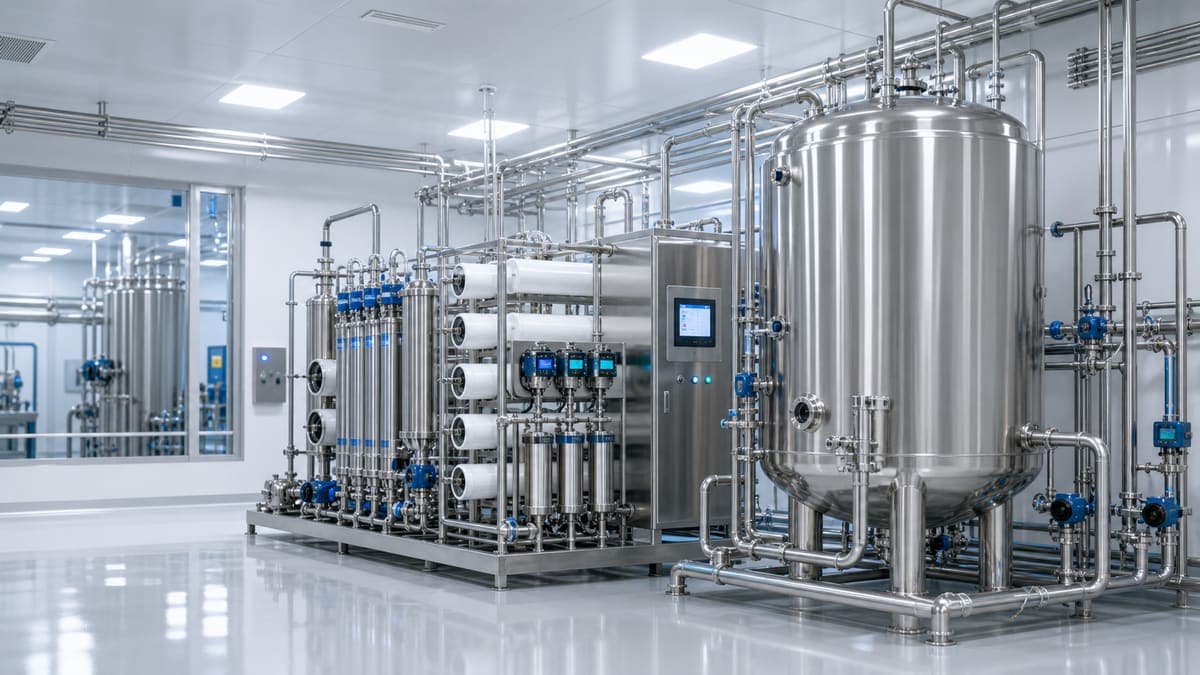
Solutions · Industry Solutions
Pharmaceutical grade water: GMP and pharmacopeia alignment
PW, WFI, and pure steam considerations: pretreatment, RO, EDI, distillation, sanitization, and documentation for validation-friendly systems.

Problem
Validation and change control make water systems expensive to fix after the fact; excursions hit batch release and audit observations.
Technology
URS-driven generation (RO/EDI vs distillation), loop sanitization strategy, instruments calibrated to pharmacopeia expectations, and clear sampling plans.
Results
Consistent compendial quality, defendable data packages, and reduced reactive CAPA on the water system.
Pharmaceutical Grade Water: GMP and Pharmacopeia Alignment
Pharmaceutical manufacturing demands water of exceptional purity, with regulatory bodies like the United States Pharmacopeia–National Formulary (USP-NF) and the European Pharmacopoeia (Ph. Eur.) setting stringent quality standards. This isn't merely "clean water"; it's a critical raw material and utility, subject to Good Manufacturing Practices (GMP) and rigorous validation. AquaChain understands that water generation in this sector is a validated process, not just equipment, requiring meticulous attention to biofilm control, endotoxin management, Total Organic Carbon (TOC) excursions, and comprehensive change control for all wetted components. Our solutions are designed from the ground up to align with regulatory expectations, supporting your Installation Qualification (IQ), Operational Qualification (OQ), and Performance Qualification (PQ) activities.
Water Quality Targets & Regulatory Compliance
AquaChain engineers systems to consistently deliver water quality meeting or exceeding pharmacopoeial requirements.
- Purified Water (PW): Often produced by a combination of membrane-based and deionization technologies. Key parameters include conductivity (e.g., not more than 1.3 µS/cm at 25 °C, as per USP <645>), TOC (e.g., not more than 500 µg/L, as per USP <643>), and microbial limits (e.g., not more than 100 CFU/mL, as per USP <1231>).
- Water for Injection (WFI): Historically produced by distillation, some pharmacopoeias now permit membrane-based processes (e.g., EU Ph. Eur. Monograph 0169 for WFI). WFI has tighter limits for bacterial endotoxins (e.g., < 0.25 EU/mL, as per USP <85>), in addition to meeting PW specifications for conductivity and TOC.
Our design philosophy starts with a detailed User Requirement Specification (URS), mapping specific compendial attributes, alert/action limits, and critical sampling locations beyond generic "DI water" specifications.
Advanced Process Train for Pharmaceutical Water Generation
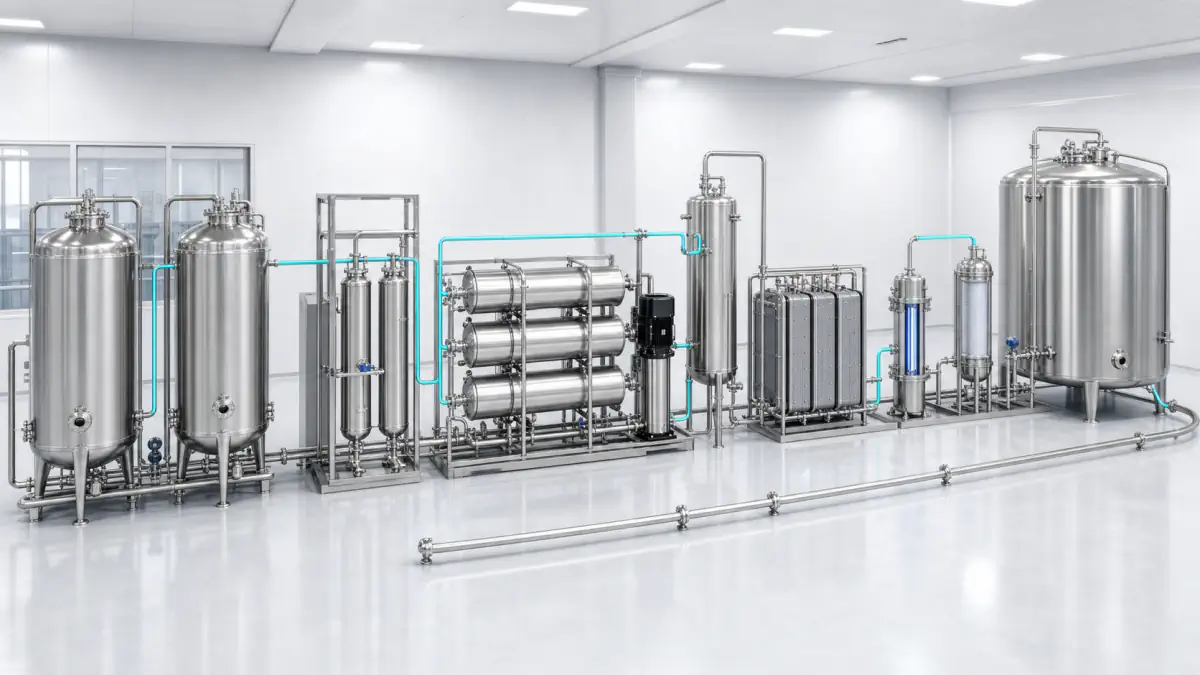
AquaChain leverages a multi-barrier approach, combining proven technologies into integrated stainless-steel skids with digitally modelled flow paths to minimize dead legs and optimize sanitization.
1. Pretreatment – Safeguarding Membrane Integrity
Raw water sources, whether municipal or borewell, vary significantly in quality. High levels of suspended solids, organic matter, and colloids can lead to rapid biofouling and scaling of downstream reverse osmosis (RO) membranes.
- Multimedia Filtration (MMF): Removes larger suspended solids and turbidity.
- Ultrafiltration (UF): For challenging surface water sources or where the Silt Density Index (SDI₁₅) of the raw water consistently exceeds 5, UF is mandatory to protect the RO membranes. UF systems remove suspended solids, colloids, and microorganisms down to typically 0.01-0.05 µm, significantly reducing the SDI and protecting against transmembrane pressure increases.
- Chemical Dosing: Antiscalants are typically dosed upstream of the RO to prevent scaling by sparingly soluble salts (e.g., calcium carbonate, silica) at high recovery rates. pH adjustment may also be employed for optimal RO performance and scale control, particularly for LSI management.
- Activated Carbon Filtration: Removes chlorine, chloramines, and certain organic compounds that can damage RO membranes.
2. Reverse Osmosis (RO) – The Primary Purification Barrier
Our RO systems are designed for high rejection and reliability, forming the core of the purification process. We employ multi-stage RO where necessary to achieve target permeate quality and optimize recovery rate.
- Membrane Selection: AquaChain selects high-rejection, low-fouling RO membranes, often thin-film composite (TFC) spiral-wound elements, specifically designed for pharmaceutical applications and sanitization compatibility.
- Flux and Recovery: We design with conservative RO flux rates (e.g., 10-15 L/(m²·h)) to minimize concentration polarization and mitigate fouling, extending membrane lifespan. System recovery rates are optimized (e.g., 75-85%) based on feed water quality and antiscalant effectiveness, while carefully managing the LSI (Langelier Saturation Index) in the concentrate stream to prevent scaling.
- Operation: The RO operates in a cross-flow configuration, continuously sweeping away rejected contaminants from the membrane surface.
3. Continuous Electrodeionization (EDI) – Post-RO Polishing
EDI technology continuously removes residual ions from the RO permeate without the need for periodic chemical regeneration of ion exchange resins, crucial for pharmaceutical environments.
- Continuous Regeneration: Within the EDI stack, ion-exchange resins are continuously regenerated by a direct current (DC) electric field, driving ions through ion-selective membranes into dedicated concentrate and electrode compartments. This eliminates hazardous chemical handling and waste associated with conventional mixed-bed ion exchange.
- High Purity Output: EDI consistently produces high-purity water (e.g., > 10 MΩ·cm resistivity, corresponding to < 0.1 µS/cm conductivity), suitable for PW and pre-WFI applications.
4. Post-Treatment and Distribution
- UV Sterilization: Ultraviolet (UV) reactors provide a non-chemical disinfection step, reducing microbial load and potentially oxidizing residual organic compounds (185 nm UV for TOC reduction, 254 nm for disinfection).
- Sub-micron Filtration: Final 0.2 µm absolute filtration ensures particulate and microbial control before storage.
- Storage & Distribution Loop: AquaChain designs pharmaceutical water loops with critical considerations:
- Loop Velocity and Slope: Maintained at specified minimum velocities (e.g., > 1.5 m/s) with continuous positive slope to prevent stagnation and ensure complete drainability, critical for biofilm control.
- Sanitization: Systems are designed for effective hot water (e.g., > 80°C), ozone, or steam sanitization regimes, validated to achieve microbial control.
Operations, Monitoring, and CIP Philosophy
Robust operational strategies and continuous monitoring are paramount for maintaining validated water quality.
- Instrumentation: Real-time monitoring of critical parameters is essential. We configure continuous online conductivity, TOC, and pressure measurements, trending these for early excursion detection and ensuring data integrity.
- CIP (Clean-in-Place): Effective CIP strategies are developed based on feed water characteristics, membrane type, and operational data. Our systems are designed for chemical CIP to remove both organic biofouling and inorganic scaling agents.
- Sanitization: Regular sanitization of the entire water system (generation, storage, and distribution) is critical for biofilm control. The frequency and method (hot water, ozone, or steam) are defined by the validation strategy and risk assessment, not vendor defaults. Ozone compatibility with loop materials and residual breakdown must be rigorously validated.
- Validation-Ready Documentation: AquaChain provides comprehensive documentation structured for seamless integration into your IQ/OQ/PQ processes, from Factory Acceptance Test (FAT) through Site Acceptance Test (SAT) and Performance Qualification.
Risks and Common Engineering Mistakes
Ignoring proper design principles in pharmaceutical water systems can lead to significant compliance risks and operational headaches.
- Biofilm Havens: Inadequate loop velocity, dead legs, and poor drainage create ideal environments for biofilm proliferation, leading to microbial excursions and elevated TOC. AquaChain's engineering tip is to align online TOC monitors with worst-case biofilm risks, not just at the generation outlet, as loops often fail at dead legs first.
- Premature Membrane Fouling: Insufficient pretreatment (e.g., not requiring UF for high SDI feeds) or improper RO design (e.g., too high flux, inadequate antiscalant dosing, or poor LSI management) leads to rapid biofouling and scaling, increasing transmembrane pressure and requiring frequent CIPs.
- Validation Gaps: Failing to account for change control on any wetted component or not generating comprehensive IQ/OQ/PQ documentation from the outset can cause major validation hurdles.
2026 Forward-Looking Context
AquaChain is committed to driving sustainability and digital transformation in pharmaceutical water systems.
Energy & ESG
Our designs prioritize energy efficiency. For large-scale RO systems, particularly those operating at higher pressures or with elevated feed water salinity, the integration of Energy Recovery Devices (ERD) on the high-pressure concentrate stream significantly reduces the specific energy consumption (kWh/m³ permeate) by recovering hydraulic energy, contributing directly to your ESG targets. Our systems are optimized to minimize energy consumption without compromising water quality.
Digital O&M
AquaChain's digital-first approach provides advanced remote monitoring capabilities. Our systems track real-time operational data including ΔP (pressure drop) across filters and membrane stages, normalized permeate flow, and system temperatures. These trends are continuously analyzed to predict maintenance needs, trigger CIP cycles based on membrane performance degradation rather than fixed schedules, and provide predictive insights into potential fouling or scaling issues, optimizing operational uptime and reducing manual intervention.
Modular RO Systems
For critical pharmaceutical applications, AquaChain offers the industrial RO product line. These robust, production-scale water purification systems are engineered for continuous, high-volume operation, featuring multi-stage RO, advanced EDI, and full SCADA integration for comprehensive control and data logging—essential for GMP compliance. For R&D, pilot studies, or small-scale prototyping, our pilot-scale RO units provide a compact, flexible solution for exploring novel water treatment chemistries or process optimizations before scaling up.
Frequently Asked Questions
Q: Can RO+EDI produce WFI in my region?
A: The acceptability of RO+EDI for WFI production depends on regional regulatory guidelines. For example, the EU Pharmacopoeia now permits membrane-based WFI, while the USP historically emphasized distillation. AquaChain assists in mapping specific regulatory expectations (e.g., EU, USP, ChP) to determine the appropriate architecture for your facility.
Q: How often must we sanitize our pharmaceutical water system?
A: Sanitization frequency is not a vendor default but is defined by your facility's validation strategy and risk assessment. This typically involves a combination of routine scheduled sanitizations and event-driven sanitizations, all supported by robust microbial monitoring data and trend analysis.
Q: Is ozone compatible with all water loops?
A: While ozone is a powerful biocide, its compatibility must be thoroughly validated for your specific water loop. This includes ensuring all wetted materials (e.g., seals, gaskets, piping) are resistant to ozone, and that adequate methods are in place for complete residual ozone breakdown before the water contacts drug products.
Call to action
Achieving compliant, reliable, and sustainable pharmaceutical water generation requires deep expertise. Need a customized process diagram for your Pharmaceutical facility? Consult AquaChain's engineering team today.
Related equipment & product lines
These categories typically support the approach above—open any line to compare brands and models.
- RO MembranesReverse osmosis membrane elements for municipal and industrial desalination.View category →
- Electrodeionization (EDI)EDI modules and systems for ultrapure water production.View category →
- UV DisinfectionUV systems and modules for pathogen inactivation and final disinfection barriers.View category →
- Ozone GeneratorOzone generation systems and peripherals for advanced oxidation processes.View category →
Looking for site-specific references or lab data? Contact us—we can share case material relevant to your feed and targets.