Solutions · Industry Solutions
Steel & metallurgy: high-temperature circulating water protection
Scale, corrosion, and fouling in caster and rolling mill loops: chemistry, side-stream filtration, cooling tower coordination, and sensors.
Use this guide within its scope
This page supports technical research and option comparison and is marked 2026. Illustrative values are not a quotation, completed process design, certification conclusion, or performance guarantee. Check current regulations, feed data, tests, and OEM records.
Problem
High heat flux and debris drive scaling and under-deposit corrosion; oil leaks foul heat exchangers.
Technology
Balanced inhibitor programs, side-stream sand or media filters, oil separation, and coordinated blowdown with CT systems.
Results
Longer campaign lengths between descales, fewer unplanned roll or caster cooling events.
Engineering decision card
Use when
High heat flux and debris drive scaling and under-deposit corrosion; oil leaks foul heat exchangers.
Evaluate first
Balanced inhibitor programs, side-stream sand or media filters, oil separation, and coordinated blowdown with CT systems.
Inputs still required
Feed source and variability, capacity, target quality, operating hours, discharge or reuse boundary, available space, and utilities.
Comparison output
Longer campaign lengths between descales, fewer unplanned roll or caster cooling events. The final decision still needs feed data, mass balance, and any necessary testing.
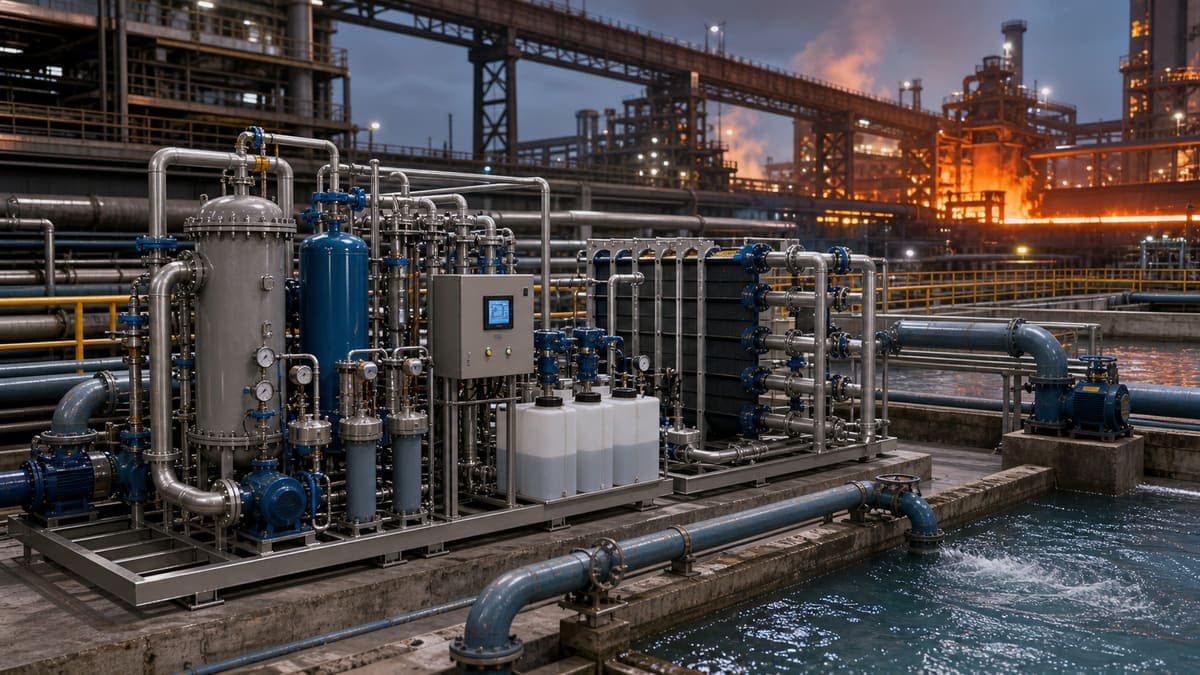
Steel & metallurgy: high-temperature circulating water protection
In the demanding environments of steel and metallurgy plants, reliable high-temperature cooling circuits are paramount for critical operations like casters, furnaces, and rolling mills. Unchecked water quality issues, such as scale formation from hardness, accumulation of iron particles, oil contamination from hydraulic leaks, and general biofouling, can severely compromise heat transfer efficiency in plate exchangers and other cooling components. This leads to reduced production rates, increased energy consumption, premature equipment failure, and unplanned downtime – directly impacting operational profitability and safety.
Industry Context & Regulatory/Compliance Drivers
The primary driver for robust water treatment in metallurgy is operational reliability and asset protection. Heat exchangers, cooling jackets, and furnace components operate under extreme thermal stress, where even thin layers of scale or fouling can create "hot spots," leading to material fatigue and failure. For instance, maintaining water quality that supports efficient heat transfer is crucial to prevent the thermal runaway in electric arc furnaces or ensure uniform cooling in continuous casting operations.
Beyond operational efficiency, environmental regulations for discharge play a significant role. Blowdown from cooling towers and other circulating loops must often meet strict local environmental codes regarding TDS, heavy metals, phosphorus, and other pollutants before being discharged or recycled. For example, many jurisdictions reference guidelines similar to those from the U.S. EPA or regional environmental agencies for industrial wastewater discharge permits, imposing limits on pollutants that can necessitate specific treatment strategies for blowdown.
Water Quality Targets for Circulating Water
- Hardness (Ca²⁺, Mg²⁺): Typically maintained below 50 mg/L as CaCO₃ for makeup, and managed with inhibitors in the circulating loop to prevent calcium carbonate or sulfate scaling (controlled by LSI between 0.5 and 2.0 depending on cycle of concentration).
- Suspended Solids: Less than 5 mg/L in the main circulating loop to minimize deposition and abrasion.
- Turbidity: Below 5 NTU, ideally below 1 NTU for optimal heat transfer.
- Conductivity / TDS: Managed to control cycles of concentration, typically below 2,000 µS/cm (or a specific TDS limit, e.g., 1,500 mg/L) to prevent excessive corrosion and scale.
- pH: Maintained between 7.5 and 9.0 to optimize corrosion inhibitor performance and minimize scale.
- Iron: Total iron often targeted below 0.5 mg/L to prevent deposition and corrosion.
- Oil and Grease: Non-detectable, or below 5 mg/L for critical systems.
- Microbiological Activity: Controlled with biocides to prevent biofouling and microbially induced corrosion (MIC).
1. Makeup Water Treatment
Depending on the raw water source (e.g., river water, municipal supply, well water), appropriate pretreatment is critical for makeup water to the circulating loop.
- Clarification & Filtration: For surface water sources with high suspended solids or turbidity, clarification (coagulation/flocculation/sedimentation) followed by multimedia filtration (MMF) is often the first step. These filters efficiently remove larger particulates, silt, and some organic matter, reducing the solids load on subsequent stages.
- Ultrafiltration (UF): If raw water SDI₁₅ (Silt Density Index over 15 minutes) is consistently above 5, or if extremely low turbidity is required for downstream membrane processes, ultrafiltration is essential. UF membranes provide a physical barrier for suspended solids, colloids, and microorganisms, producing a stable, high-quality permeate suitable for downstream RO.
- Softening: For makeup water with high hardness, ion exchange softening is crucial to prevent calcium carbonate scaling, especially in high-temperature applications or when using reverse osmosis to increase recovery rate. These systems exchange hardness ions (Ca²⁺, Mg²⁺) for sodium ions, reducing the scaling potential.
2. Side-Stream Filtration for Circulating Loops
To continuously remove suspended solids, iron oxides, and other particulates that accumulate in circulating loops, this approach implements robust side-stream filtration systems.
- High-Rate Multimedia/Sand Filters: These are sized based on system volume and anticipated solids ingress, often processing 5-10% of the total circulating flow. They are highly effective at removing particulate matter from the cooling water.
- Oil Separation: When hydraulic leaks are recurrent, dedicated oil separation technologies (e.g., coalescing plate separators, dissolved air flotation) are incorporated before fine filtration to prevent oily fouling from clogging polish steps and interfering with chemical treatments.
3. Chemical Dosing & Conditioning
A precisely managed chemical program is fundamental to preventing corrosion, scale, and biological growth. this approach's programs utilize advanced formulations chosen against alloy lists, operating conditions, and discharge limits.
- Antiscalants: Phosphonate, polymer, or blends are selected to inhibit the formation of calcium carbonate, calcium sulfate, and other mineral scales, often crucial for managing LSI in high-concentration loops.
- Corrosion Inhibitors: Zinc/phosphate, molybdate, or all-organic chemistries are deployed to protect mild steel, copper, and other metallic components from corrosion.
- Biocides: Oxidizing (e.g., chlorine dioxide, bromine) and non-oxidizing biocides are used in rotation to control microbial growth and biofouling, which can significantly impede heat transfer.
- Dosing control: A dedicated chemical dosing skid ensures precise, automated delivery of treatment chemicals, often linked to real-time water quality monitoring.
4. Advanced Membrane Systems (Where Applicable)
While the core of metallurgy circulating water is often chemistry and filtration, reverse osmosis (RO) may be incorporated for:
- Makeup Water Purity: To produce high-purity makeup water, significantly reducing TDS and hardness, thereby extending cycles of concentration and reducing blowdown volumes. This reduces the scaling potential and overall chemical consumption in the cooling tower. RO systems are designed with careful consideration of transmembrane pressure, rejection rates (typically 98-99% for common salts), and recovery rates (e.g., 75-85%). Proper pretreatment (MMF/UF, antiscalant dosing) is critical to prevent membrane fouling and concentration polarization. The LSI of the RO concentrate stream is carefully managed with antiscalants to prevent scaling on the membrane surface.
- Blowdown Treatment for Reuse: In water-scarce regions or for zero liquid discharge (ZLD) initiatives, RO can treat cooling tower blowdown, allowing for a significant portion to be reused, reducing fresh water demand and wastewater discharge volumes.
Operations, Monitoring, and CIP Philosophy
Continuous monitoring and proactive maintenance are cornerstones of this approach's approach.
- Instrumentation: Comprehensive real-time monitoring includes corrosion coupons, LPR (Linear Polarization Resistance) probes for instantaneous corrosion rates, turbidity sensors, and online analyzers for iron, pH, conductivity, and ORP.
- Performance Tracking: We track normalized permeate flow for RO systems (if applicable), differential pressures (ΔP) across filters and membranes, and chemical consumption to detect early deviations.
- Side-stream Filter Optimization: Filter backwash frequency is meticulously correlated with plant events, such as caster maintenance or furnace tapping, as these often correlate with spikes in refractory debris or scale ingress. This proactive approach prevents excessive solids buildup and maintains filtration efficiency.
- CIP (Clean-in-Place): For systems incorporating UF or RO membranes, automated CIP sequences are designed to periodically clean membranes, restoring flux and rejection. CIP timing is determined by trends in normalized permeate flow decline or increases in transmembrane pressure rather than fixed schedules. This approach minimizes chemical usage and extends membrane life, preventing irreversible biofouling or scaling.
Risks and Common Engineering Mistakes
Ignoring proper water treatment in metallurgy can lead to significant problems:
- Undersized Side-Stream Filtration: Leads to high suspended solids in the loop, accelerating fouling and reducing heat transfer.
- Inadequate Makeup Water Treatment: High hardness or turbidity in makeup water overloads the circulating system, leading to rapid scaling or fouling despite side-stream treatment.
- Incorrect Chemical Program: Using the wrong antiscalants or corrosion inhibitors for the specific water chemistry, metallurgy, or temperature conditions can lead to accelerated scaling or corrosion.
- Neglecting LSI Management: Failure to manage the Langelier Saturation Index in high-recovery RO systems or circulating loops can cause severe calcium carbonate scaling.
- Poor Biofouling Control: Inadequate biocide dosing or rotation can result in rampant microbial growth, leading to heat exchanger fouling and microbiologically induced corrosion.
- Lack of Monitoring: Without continuous monitoring of key parameters (ΔP, conductivity, pH, corrosion rates), problems develop unnoticed until they manifest as costly equipment failures.
Related equipment & product lines
These categories typically support the approach above—open any line to compare brands and models.
- ChemicalsAntiscalants, cleaners, and process chemicals for water treatment operations.View category →
- Cooling TowersCooling tower treatment and related process support equipment.View category →
- Filtration MediaGranular and specialty media for depth filtration and polishing stages.View category →
- Instrumentation & SensorsOnline measurement and control: flow, level, pressure, and water-quality sensors indexed from the Lenntech instrumentation hub.View category →
For a closer review, use the engineering inquiry form to share feed, capacity, target, and project stage. Submission does not constitute a completed design or performance commitment.