Back to Industry Solutions

Solutions · Industry Solutions

Textile dyeing & finishing: color, salt, and reuse

High COD, color, and salt from dyeing: coagulation, oxidation, MBR/UF pretreatment, and RO for high-quality reuse with antiscalant discipline.

2026textiledyeingwastewater reuseROCODTDS
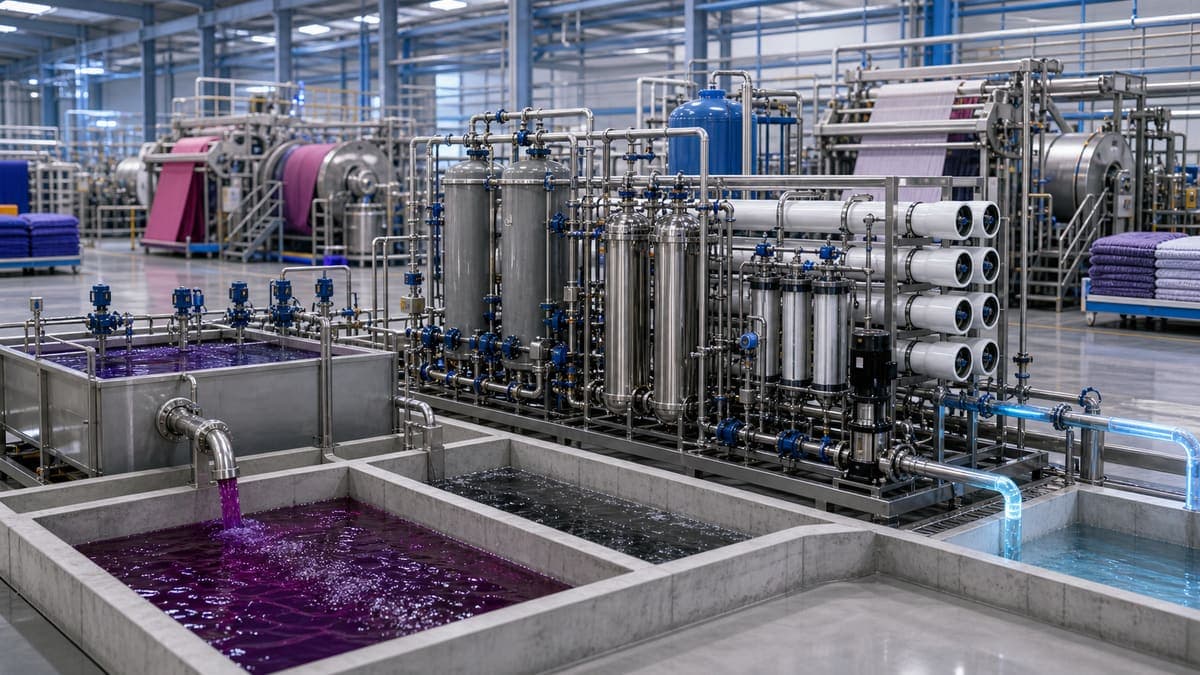
Textile dyeing & finishing: color, salt, and reuse water treatment solution illustration

Problem

Salt and dye hydrolysates foul membranes; reuse targets collide with variable batch discharges.

Technology

Primary color removal, biological steps where BOD allows, UF/MBR polish, and staged RO with chemistry tuned to sulfate/silica.

Results

Predictable permeate for wash steps, lower freshwater withdrawal, and compliance on discharge streams.

Textile Dyeing & Finishing Wastewater Treatment: A Sustainable Approach to Color, Salt, and Reuse

The textile dyeing and finishing industry is a critical global sector, yet it is highly water-intensive and generates complex wastewater streams. These effluents are characterized by significant concentrations of chemical oxygen demand (COD), color (chromaticity), high salinity (primarily chlorides and sulfates from reactive dyes and fixing agents), surfactants, and often heavy metals. The inherent batch variability in dyeing processes, driven by different fabric types, dye recipes, and production schedules, presents substantial challenges for consistent wastewater treatment and especially for water reuse initiatives.

Industry Context & Regulatory Compliance Drivers

Meeting stringent environmental regulations while maintaining operational efficiency is paramount for textile facilities. Regulatory frameworks, such such as regional Environmental Protection Agency (EPA) guidelines or national discharge standards (e.g., CPCB India, or specific EU Industrial Emissions Directive requirements), typically impose strict limits on parameters like COD, biochemical oxygen demand (BOD₅), total suspended solids (TSS), pH, color, and specific heavy metals (e.g., Chromium, Copper, Zinc) before discharge to municipal sewers or direct release to surface waters. Beyond compliance, the escalating cost and scarcity of freshwater, coupled with increasing environmental scrutiny, are powerful drivers for maximizing water reuse within textile operations. AquaChain provides engineering solutions that not only meet these compliance benchmarks but also position facilities for sustainable, circular water management.

Water Quality Targets for Reuse

Achieving robust water reuse demands specific water quality targets tailored to the intended application. Generic "reuse water" is often insufficient. AquaChain designs systems to meet precise specifications for various reuse points within a textile facility, including:

  • Dye Bath Makeup: Conductivity typically < 50 µS/cm, color < 10 ADMI units, TSS < 1 mg/L, and low COD (< 20 mg/L) to prevent interference with dye uptake and color consistency.
  • Washing & Rinsing: Conductivity < 20-30 µS/cm, color < 5 ADMI units, and zero suspended solids are often required to prevent staining or redeposition.
  • General Utilities (Cooling Towers, Boiler Feed): Conductivity requirements vary, but typically < 100 µS/cm for cooling and much lower, with hardness < 1 mg/L and silica < 0.1 mg/L, for high-pressure boilers (e.g., in accordance with ASME/IAPWS guidelines).
  • RO Feedwater Quality: A critical target is a Silt Density Index (SDI₁₅) < 3 and TSS < 1 mg/L to protect downstream reverse osmosis membranes.

AquaChain's Integrated Process Train for Textile Wastewater Reuse

AquaChain engineers robust, multi-barrier treatment trains specifically designed for the complex and variable nature of textile wastewater, ensuring high-quality permeate for reuse.

  1. Primary & Secondary Treatment:

    • Equalization: Critical for buffering the highly variable flow rates, pH, and pollutant loads from batch processes.
    • Physicochemical Treatment: Coagulation, flocculation, and sedimentation/dissolved air flotation (DAF) are employed for bulk removal of TSS, color, heavy metals, and a significant portion of COD.
    • Biological Treatment: Aerobic or anaerobic biological processes are implemented where biodegradable organic loads (BOD) are high and amenable to biological degradation, provided toxicity levels permit stable biomass.
    • Advanced Oxidation Processes (AOPs): For particularly recalcitrant organic compounds and persistent color, AOPs like ozone, Fenton, or photo-Fenton can be integrated to further reduce COD and improve biodegradability.
  2. Advanced Fine Filtration (Pre-RO): For challenging textile effluents, particularly those with high TSS, colloidal matter, or fluctuating organic loads, multimedia filtration (MMF) alone is often inadequate to meet the stringent SDI₁₅ requirements for RO. AquaChain mandates advanced fine filtration using either ultrafiltration (UF) or a membrane bioreactor (MBR) system prior to reverse osmosis. UF/MBR effectively removes suspended solids, colloids, and microorganisms, ensuring a robust and consistent SDI₁₅ < 3, preventing irreversible fouling of RO membranes.

  3. Reverse Osmosis (RO) for Desalination & Purification: After robust pretreatment, the core of the reuse system is the reverse osmosis (RO) unit. AquaChain's RO systems are designed to reject dissolved salts, remaining color, and trace organics, producing high-purity permeate.

    • Staged RO: Multi-stage RO configurations are employed to maximize recovery rate (permeate volume as a percentage of feed volume) while managing concentration polarization at the membrane surface and mitigating scaling risks in the concentrate stream.
    • Antiscalant Dosing: Precise antiscalant dosing is critical, carefully calculated based on the concentrate stream's water chemistry and Langelier Saturation Index (LSI) to prevent the precipitation of sparingly soluble salts (e.g., calcium carbonate, gypsum, silica). AquaChain validates antiscalant programs with advanced software modeling.
    • Membrane Selection: Low-fouling (LF) or fouling-resistant (FR) membranes are selected to withstand the residual organic load typical of treated textile wastewater. The cross-flow filtration principle used in RO ensures continuous sweeping of the membrane surface to minimize fouling.
  4. Post-RO Polishing (Optional): Depending on the specific reuse application, further polishing may be necessary.

    • Continuous Electrodeionization (EDI): For applications requiring ultrapure water, such as specific high-purity dye processes or boiler feed, EDI systems are integrated. AquaChain's EDI systems utilize an electric field to continuously regenerate ion-exchange resins, eliminating the need for chemical regeneration. Ions migrate through ion-selective membranes into concentrate and electrode compartments, ensuring consistently high-purity water with typical resistivity exceeding 10 MΩ·cm.
    • UV Disinfection: Where microbial control is paramount for health and safety or process integrity, UV reactors provide a non-chemical disinfection barrier.

AquaChain's systems feature digitally modelled flow paths and are built on integrated stainless-steel skids, ensuring optimal hydraulic performance, corrosion resistance, and simplified maintenance procedures.

Operations, Monitoring, and CIP Philosophy

Sustained high performance of membrane systems relies on vigilant monitoring and proactive maintenance. AquaChain's operational philosophy emphasizes digital oversight and intelligent cleaning strategies.

  • Continuous Monitoring: Key performance indicators (KPIs) such as normalized permeate flow, transmembrane pressure (TMP), and differential pressure (ΔP) across RO stages are continuously monitored. Conductivity of feed, permeate, and concentrate streams, along with pH, ORP, and temperature, provide crucial insights. SDI measurements of the RO feed are routinely performed.
  • Predictive CIP: Instead of fixed schedules, Clean-in-Place (CIP) events are triggered by trend-based algorithms. A decline of 10-15% in normalized permeate flow or a significant increase in ΔP often signals the onset of fouling, prompting a CIP. This proactive approach prevents irreversible membrane damage, extending membrane lifespan and reducing operational costs. AquaChain designs allow for efficient chemical cleaning protocols using acidic, alkaline, and enzymatic solutions to combat various types of biofouling and organic/inorganic scaling.
  • Data-Driven Optimization: AquaChain's digital platform provides operators with real-time data and predictive analytics, enabling informed decisions to maintain peak plant performance and optimize chemical dosing.

Risks and Common Engineering Mistakes

Several pitfalls can derail textile wastewater reuse projects:

  • Underestimating Batch Variability: The most common mistake. Designs based on "average" wastewater composition can fail spectacularly during peak load or high-color campaigns. AquaChain Engineering Tip: Sample dye house sump composites across dark color campaigns—your worst membrane week will look like that.
  • Inadequate Pretreatment: Failing to consistently achieve low SDI and sufficient organic load reduction before RO is a recipe for rapid and often irreversible membrane fouling.
  • Overly Optimistic Recovery Rates: Designing for very high RO recovery without accurately assessing LSI and scaling potential in the concentrate, or without proper antiscalant selection, leads to frequent scaling and downtime. It's crucial to understand the difference between salt rejection (%) (a membrane's ability to separate salts from water) and system recovery rate (%) (the volumetric ratio of permeate to feed).
  • Neglecting Pilot Studies: For complex effluents like textile wastewater, a well-executed pilot study is invaluable for validating process assumptions, optimizing chemical dosages, and confirming membrane performance under real-world conditions.
  • Biofouling Management: Insufficient attention to microbial growth in pretreatment and membrane systems can lead to rapid membrane degradation and performance loss.

2026 Forward-Looking Context: Sustainable & Digital Water Management

AquaChain is at the forefront of integrating cutting-edge technologies and sustainable practices into industrial water treatment, aligning with 2026 and beyond environmental, social, and governance (ESG) targets.

Energy & ESG Optimization

We prioritize solutions that minimize environmental impact and maximize resource efficiency. Our designs focus on reducing the specific energy consumption (kWh/m³ of permeate produced). For high-pressure RO applications with permeate production exceeding ~50 m³/h, AquaChain integrates energy recovery devices (ERDs). These devices recapture hydraulic energy from the high-pressure concentrate stream, significantly reducing the energy demand of the high-pressure pump, thereby lowering operating costs and enhancing the overall ESG profile of the facility.

Digital Operations & Maintenance (O&M)

AquaChain leverages advanced digital tools for smart, predictive O&M. Our systems offer real-time remote monitoring of critical parameters such as flow rates, pressures (including stage ΔP), conductivity, temperature, and chemical dosing. Predictive maintenance algorithms analyze trends in normalized permeate flow and transmembrane pressure to anticipate fouling and scaling events, allowing for proactive intervention. This data-driven approach optimizes CIP timing, extends asset lifespan, and ensures continuous, efficient operation, moving beyond reactive maintenance to a truly predictive paradigm.

AquaChain Modular RO System Integration

For the dynamic and complex challenges of textile wastewater, AquaChain offers two distinct product lines. The pilot-scale RO provides flexible pilot-scale and laboratory-based testing platforms, ideal for initial process optimization, new dye compatibility testing, or R&D into novel treatment chemistries. Its modular design allows for rapid prototyping of different membrane types and operating conditions. For full-scale production, industrial RO systems deliver robust, multi-stage reverse osmosis capabilities with comprehensive SCADA integration. These systems are engineered for continuous, high-volume operation and seamless integration into existing plant infrastructure, providing maximum reliability and efficient water reuse for demanding textile processing loads.

Frequently Asked Questions

Q: Can we achieve zero liquid discharge (ZLD) in textile dyeing and finishing?

A: Zero Liquid Discharge is technically possible as a comprehensive program, but it's crucial to understand that it involves managing highly concentrated brine. This typically requires significant investment in advanced technologies like mechanical vapor recompression (MVR) evaporators and crystallizers, which must be priced into the overall project. It is not merely an "add-on" to an RO system but a distinct, complex brine management strategy.

Q: Is a Membrane Bioreactor (MBR) mandatory for textile wastewater before RO?

A: While MBR offers excellent effluent quality, it's not always mandatory. However, ultrafiltration (UF), which provides similar physical separation benefits, is very common and often essential as a polishing step before RO on textile secondary effluents. The choice between UF and MBR depends on the specific raw wastewater characteristics, desired permeate quality, and overall project economics.

Q: What about recovering salts from the concentrated RO brine?

A: Recovery of valuable salts (e.g., sodium chloride or sodium sulfate) from RO concentrate is technically feasible through advanced evaporation/crystallization processes. However, the economic viability depends heavily on the purity of the recovered salt and the presence of stable byproduct markets. A thorough techno-economic evaluation is required to justify such an investment.

Q: How does AquaChain address the highly variable nature of textile wastewater?

A: AquaChain tackles variability through a multi-pronged approach: robust equalization basins to buffer fluctuations, adaptable physicochemical and biological pretreatment stages, selection of resilient membrane technologies (e.g., fouling-resistant RO membranes), and advanced digital control systems that can dynamically adjust operating parameters based on real-time influent quality.

Call to action

Need a customized process diagram for your Textile Dyeing & Finishing facility? Consult AquaChain's engineering team today.

These categories typically support the approach above—open any line to compare brands and models.

Looking for site-specific references or lab data? Contact us—we can share case material relevant to your feed and targets.