Solutions · New Technologies & Innovation
Targeted Fluoride Adsorption Media: nano-engineered sorbents from 5 mg/L toward 0.5 mg/L in complex matrices
Langmuir-style capacity thinking, competing anions, and bed life: when adsorption beats RO on carbon for decentralized fluoride compliance.
Use this guide within its scope
This page supports technical research and option comparison and is marked 2026. Illustrative values are not a quotation, completed process design, certification conclusion, or performance guarantee. Check current regulations, feed data, tests, and OEM records.
Problem
High TDS and competing ions frustrate simple precipitation; RO is power-heavy at small scale.
Technology
Selective nano-alumina / metal-oxide hybrids with engineered mass-transfer and regeneration strategy.
Results
Pilot-style breakthrough curves and operating cost sketches with stated assumptions.
Engineering decision card
Use when
High TDS and competing ions frustrate simple precipitation; RO is power-heavy at small scale.
Evaluate first
Selective nano-alumina / metal-oxide hybrids with engineered mass-transfer and regeneration strategy.
Inputs still required
Feed source and variability, capacity, target quality, operating hours, discharge or reuse boundary, available space, and utilities.
Comparison output
Pilot-style breakthrough curves and operating cost sketches with stated assumptions. The final decision still needs feed data, mass balance, and any necessary testing.
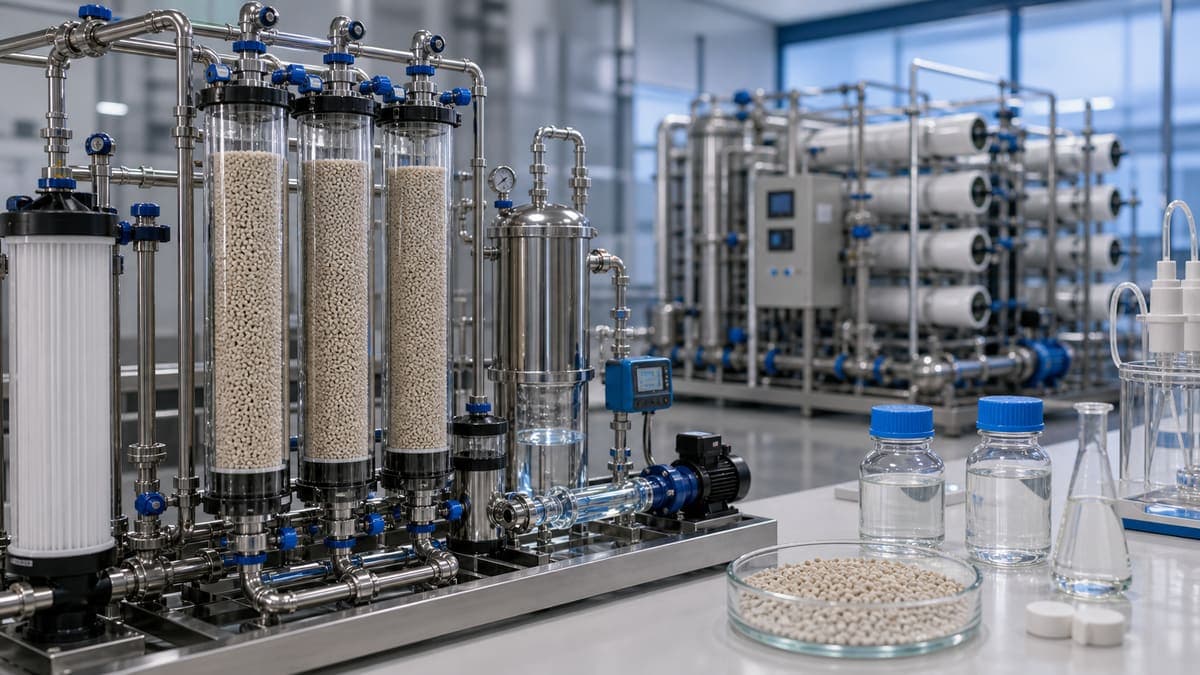
First-Principles Governing Fluoride Adsorption Mechanisms
The adsorption of fluoride onto solid media is fundamentally governed by surface chemistry, electrostatics, and mass transport phenomena. For many metal oxide-based adsorbents (e.g., activated alumina, cerium oxide, zirconium oxide), fluoride ions () exchange with surface hydroxyl groups or bind to Lewis acid sites. The efficiency of this process is influenced by the solution pH, temperature, and the presence of competing anions.
A common starting point for modeling adsorption equilibrium is the Langmuir isotherm, which describes monolayer adsorption on a homogeneous surface with a finite number of identical adsorption sites:
where:
- is the equilibrium adsorption capacity of the sorbent (e.g., mg F adsorbed per gram of media).
- is the maximum monolayer adsorption capacity (mg F / g media), representing the saturation limit.
- is the Langmuir constant (L / mg F), related to the affinity of the binding sites for the adsorbate.
- is the equilibrium concentration of fluoride in the solution (mg F / L).
This model assumes that adsorption occurs at specific homogeneous sites, and there is no interaction between adsorbed molecules. However, in industrial applications, particularly with complex matrices, these assumptions often break down. Competing ions such as sulfates (), phosphates (), silicates (), and even chlorides () can occupy active sites, reducing the effective for fluoride. Furthermore, pH changes can alter the surface charge of the adsorbent and the speciation of fluoride (e.g., vs. ), thereby modifying the value. For example, the optimal adsorption pH for many aluminum-based adsorbents is typically around , where surface hydroxyls are abundant and fluoride competition from is minimized.
Nano-engineered sorbents, in contrast, are designed to circumvent these limitations through tailored surface modifications, controlled pore size distributions, and specific binding site functionalities. By leveraging principles of coordination chemistry and surface engineering at the nanoscale, these materials exhibit enhanced selectivity for fluoride, even in the presence of high concentrations of interfering species. This translates to higher effective in real-world applications and a more stable performance profile across a broader range of operating conditions.
Illustrative pilot / lab comparison
| Parameter | Traditional process | engineering evaluation path innovative |
|---|---|---|
| Fluoride Outlet (mg/L, 5 mg/L feed) | 1.5 - 2.5 | < 0.5 |
| Operating Capacity (g F-/kg media) | 5 - 10 | 15 - 25 |
| Regeneration Frequency (cycles/year) | 12 - 24 | 4 - 8 |
| Regeneration Chemical Use (kg acid/base per kg media) | 0.8 - 1.2 | 0.4 - 0.7 |
| Footprint (m²/m³/hr treated) | 0.15 - 0.25 | 0.08 - 0.12 |
| Estimated Media Lifespan (years) | 1 - 3 | 3 - 5 |
| Competing Sulfate Tolerance (mg/L before 20% capacity drop) | < 500 | > 2000 |
Engineered Selectivity and Performance Stability
The core innovation in this approach's targeted fluoride adsorption media lies in their precisely engineered surface chemistry and nanostructure. Unlike conventional adsorbents that rely on non-specific surface interactions, these materials incorporate specific functional groups or metal sites optimized for fluoride complexation or ion exchange, significantly enhancing selectivity. This targeting mechanism is crucial in complex matrices where high concentrations of competing anions (e.g., sulfates, phosphates) would otherwise rapidly exhaust non-selective media.
The nano-scale structure further contributes by maximizing accessible surface area for active sites and optimizing diffusion pathways for fluoride ions within the porous network, leading to faster kinetics and higher utilization of the media's intrinsic capacity. This allows for smaller reactor volumes and higher superficial velocities, reducing system footprint and capital costs.
The operational benefit is clear: sustained performance with minimal fluoride breakthrough, even when influent compositions fluctuate. This translates to less frequent regeneration cycles, lower consumption of regeneration chemicals (typically dilute acid and base), and reduced waste volumes, offering a compelling economic and environmental advantage over traditional approaches.
A robust specialty adsorption vessel design is paramount for maximizing the performance of these advanced media. Ensuring uniform flow distribution across the media bed prevents channeling and guarantees that the entire volume of adsorbent is utilized effectively. The materials of construction must be carefully selected to withstand the corrosive nature of the feedwater and the regeneration solutions, particularly considering the potentially acidic conditions during fluoride loading and elution, as well as the presence of fluoride itself which can attack certain alloys.
The vessel's internal components, such as underdrains and distributors, require precise engineering to support the media, minimize pressure drop, and facilitate efficient backwashing and regeneration without media loss. Furthermore, the ability to monitor key parameters like pH, conductivity, and fluoride concentration in situ throughout the bed height during regeneration cycles is critical for optimizing chemical dosage and ensuring full media restoration, thus extending the media's operational lifespan and maintaining consistent effluent quality.
Limits and honest boundaries
While nano-engineered sorbents offer significant advantages, their optimal performance is contingent upon careful system design and operation. Neglecting critical pretreatment steps or chemistry control can severely compromise efficiency:
- pH Excursions: Operating outside the designed pH window can drastically reduce fluoride adsorption capacity and selectivity. Highly acidic or alkaline conditions can also lead to media degradation over time. Continuous pH monitoring and control are non-negotiable.
- Competing Ions: While designed for resilience, extremely high concentrations of highly competing anions (e.g., very high sulfates > 5000 mg/L, or phosphates > 100 mg/L) can still impact capacity. Accurate feedwater analysis is crucial for predicting performance and designing appropriate pretreatment if necessary.
- Suspended Solids & Turbidity: Particulates can physically foul the media bed, leading to increased pressure drop, flow channeling, and reduced mass transfer efficiency. Pretreatment via filtration (e.g., microfiltration or ultrafiltration) is essential to protect the sorbent and maintain hydraulic performance.
- Organic Fouling: High concentrations of dissolved organic carbon (DOC) can irreversibly foul the media surface, blocking active sites and reducing capacity. While some media have higher tolerance, a significant organic load may necessitate upstream organic removal (e.g., activated carbon, oxidation).
- Heavy Metals: Certain heavy metals can co-precipitate or strongly adsorb onto the media, consuming capacity and potentially leading to hazardous waste generation during regeneration. Pre-screening for these contaminants and appropriate upstream removal are important.
- Instrumentation and Control: Accurate, reliable instrumentation for fluoride, pH, and flow is vital for optimizing regeneration cycles and ensuring consistent compliance. Without robust control loops, the advantages of advanced media can be undermined.
FAQ
Q3: What are the regeneration requirements for these media, and what are the waste considerations? A3: The media are regenerable, typically using dilute acidic or basic solutions, depending on the specific media chemistry. Regeneration frequency is significantly reduced compared to traditional adsorbents due to higher operating capacity and selectivity (e.g., 4-8 cycles/year vs. 12-24 cycles/year). The spent regenerant stream contains concentrated fluoride and other eluted ions. Waste considerations involve neutralizing this stream and either discharging it to a suitable industrial wastewater treatment facility, sending it for off-site disposal, or further treating it for fluoride precipitation to meet discharge limits. The lower frequency and more efficient regeneration translate to smaller volumes of concentrated waste per cubic meter of treated water.
Related equipment & product lines
These categories typically support the approach above—open any line to compare brands and models.
For a closer review, use the engineering inquiry form to share feed, capacity, target, and project stage. Submission does not constitute a completed design or performance commitment.