Solutions · Sustainability & ESG
Bio-Enzymatic Wastewater Treatment: accelerating tough organics with targeted biology
Where enzymes and bio-augmentation help aeration efficiency—without replacing sound biology and F/M discipline.
Use this guide within its scope
This page supports technical research and option comparison and is marked 2026. Illustrative values are not a quotation, completed process design, certification conclusion, or performance guarantee. Check current regulations, feed data, tests, and OEM records.
Problem
Refractory organics inflate aeration kWh and sludge yield.
Technology
Pilotable dosing protocols with oxygen and sludge metrics.
Results
kWh/kg COD removed improvements in bounded cases.
Engineering decision card
Use when
Refractory organics inflate aeration kWh and sludge yield.
Evaluate first
Pilotable dosing protocols with oxygen and sludge metrics.
Inputs still required
Feed source and variability, capacity, target quality, operating hours, discharge or reuse boundary, available space, and utilities.
Comparison output
kWh/kg COD removed improvements in bounded cases. The final decision still needs feed data, mass balance, and any necessary testing.
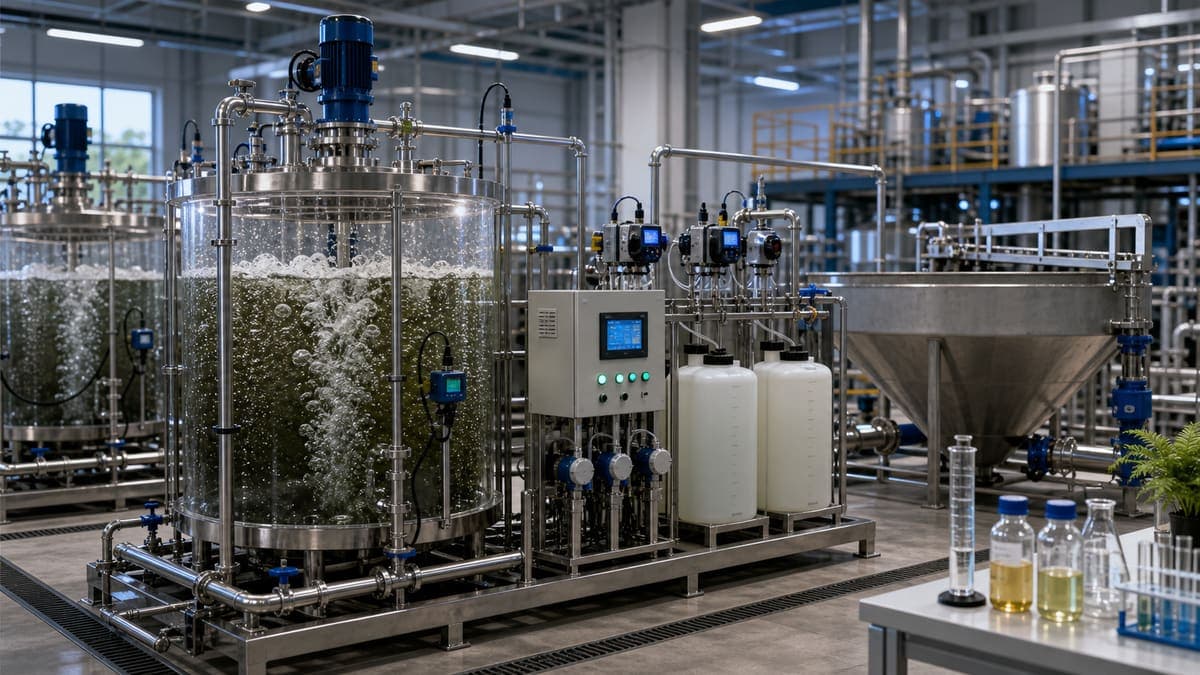
Bio-Enzymatic Wastewater Treatment: accelerating tough organics with targeted biology
The global industrial landscape faces increasing pressure to decarbonize operations and mitigate water-related risks. For manufacturers, particularly those supplying into the stringent UK and EU markets, these challenges are compounded by evolving ESG (Environmental, Social, and Governance) disclosure requirements. Wastewater, often rich in complex organic compounds, represents a significant operational cost, a potential environmental liability, and a substantial contributor to Scope 1 & 2 carbon footprints through energy-intensive treatment processes. Bio-enzymatic wastewater treatment offers a strategically targeted biological approach, harnessing nature's catalysts to break down tough organics, thereby reducing chemical consumption, energy demand, and overall environmental impact. This isn't just about compliance; it's about building resilience and unlocking a competitive edge through demonstrable sustainability.
Complex organic pollutants, common in sectors from food & beverage to pharmaceuticals and textiles, are notoriously difficult and costly to remove using conventional physical-chemical or even standard biological methods. These compounds often resist biodegradation, leading to extended retention times, higher energy consumption for aeration, increased chemical dosing for coagulation/flocculation, and greater volumes of hazardous sludge for disposal. Bio-enzymatic solutions introduce specific, naturally occurring enzymes and/or microbial consortia designed to accelerate the breakdown of these stubborn molecules into simpler, more readily treatable forms. This pre-treatment or in-situ enhancement optimizes existing infrastructure, transforming liabilities into opportunities for efficiency gains and improved environmental performance.
The precision of bio-enzymatic treatment is a key differentiator. Unlike broad-spectrum chemical oxidizers, enzymes are highly specific, targeting particular chemical bonds within complex organic structures. This specificity minimises undesirable side reactions and reduces the formation of harmful by-products. By efficiently converting recalcitrant organics into biodegradable substances, bio-enzymatic systems can significantly lower Chemical Oxygen Demand (COD) and Biological Oxygen Demand (BOD) upstream. The downstream benefits are profound: reduced load on activated sludge systems, meaning less energy expended on aeration; decreased demand for pH adjustment chemicals; and often, a substantial reduction in the volume and toxicity of sludge, leading to lower disposal costs and emissions. For industries navigating the complexities of modern supply chains, these quantifiable reductions are critical for meeting ambitious carbon reduction targets and satisfying the rigorous environmental criteria set by international buyers.
Worked energy / carbon sketch
Let's illustrate the potential impact of bio-enzymatic treatment on a typical industrial wastewater facility.
Assumptions (Illustrative only):
- Industrial Wastewater Flow: 2,000 m³/day (approx. 83 m³/hr).
- Operating Hours: 24/7 operation, 8760 hours/year.
- Baseline Aeration Energy Demand: 0.6 kWh per m³ of treated wastewater (typical for activated sludge treating moderate organic loads).
- Bio-Enzymatic Impact: 12% reduction in overall aeration energy demand due to pre-degradation of complex organics, leading to a lower load on the biological reactor.
- UK Grid Carbon Intensity Factor (Illustrative 2026): 0.18 kg CO₂e/kWh (reflecting ongoing grid decarbonization).
Calculation:
- Annual Wastewater Volume: 2,000 m³/day * 365 days/year = 730,000 m³/year.
- Baseline Annual Aeration Energy: 730,000 m³/year * 0.6 kWh/m³ = 438,000 kWh/year.
- Energy Saved by Bio-Enzymatic Treatment: 438,000 kWh/year * 12% = 52,560 kWh/year.
- Annual Carbon Emissions Saved: 52,560 kWh/year * 0.18 kg CO₂e/kWh = 9,460.8 kg CO₂e/year.
- Converted to Tonnes CO₂e: 9,460.8 kg CO₂e / 1,000 kg/tonne ≈ 9.46 tonnes CO₂e/year.
This back-of-envelope calculation highlights that even a seemingly modest percentage reduction in energy demand, when applied to continuous industrial operations, translates into significant annual energy and carbon savings, directly impacting Scope 2 emissions.
Traditional vs engineering evaluation path
| Topic | Conventional AS + chemicals | Bio-enzyme assist (engineering evaluation path) |
|---|---|---|
| Mechanism | Non-specific aeration and coagulant demand. | Targeted catalysis on refractory fractions ahead of biology. |
| Intensity | kWh/kg COD and sludge yield often high. | Piloted Δ in OUR, solids, and polymer when justified. |
| ESG | Hard to isolate “why” aeration dropped. | Dosing logs + energy meters build a bounded narrative. |
The implementation of robust metering and sophisticated data capture for water, chemicals, and energy is fundamental to demonstrating genuine progress in water stewardship. By tracking key parameters like influent and effluent COD/BOD, chemical consumption (type and volume), energy use for aeration, and sludge volumes, companies can build a documented mass and energy balance that substantiates environmental claims. This detailed data forms the backbone for completing comprehensive ESG questionnaires from frameworks like CDP (formerly Carbon Disclosure Project) or the Alliance for Water Stewardship (AWS) Standard. Rather than generic assertions, granular, measured data allows for transparent reporting of reductions in water abstraction, energy consumption, and associated greenhouse gas emissions, directly satisfying the increasing due diligence demands from UK and EU buyers and investors. Such data-driven reporting moves beyond mere compliance, enabling strategic decision-making and demonstrating a credible commitment to sustainability.
FAQ
Q1: What types of complex organics can bio-enzymatic treatment target? A1: Bio-enzymatic solutions are highly versatile and can be formulated to target a wide range of complex organic pollutants, including starches, proteins, fats, oils, greases (FOG), cellulose, and certain synthetic compounds often found in industrial effluents from sectors like food & beverage, pulp & paper, textiles, and petrochemicals. The key is identifying the specific recalcitrant compounds in your wastewater for a tailored enzymatic approach.
Q2: How does bio-enzymatic treatment integrate with my existing wastewater infrastructure? A2: One of the primary advantages is its compatibility. Bio-enzymatic products are typically dosed upstream of existing biological treatment stages (e.g., activated sludge, MBRs, anaerobic digesters) or even within collection systems. They act as a pre-treatment or enhancer, breaking down complex molecules into simpler forms that conventional systems can then process more efficiently, requiring minimal to no infrastructure modification.
Q3: What is the typical timeline for implementing a bio-enzymatic solution and observing results? A3: The typical process involves an initial assessment and treatability study, which can take a few weeks. Following this, pilot trials on-site often run for 1-3 months to optimize dosing and evaluate performance under real-world conditions. Once implemented at scale, noticeable improvements in parameters like COD/BOD reduction, energy consumption, and sludge volume can often be observed within weeks to a few months, depending on the specific application and wastewater characteristics.
Carbon savings calculator (illustrative)
Estimate annual electricity savings and avoided CO₂e when specific energy improves (e.g. after ERD, VFD tuning, or train optimization). Replace defaults with your meter data and your grid emission factor from your utility or ESG methodology.
ΔkWh/year ≈ Q(m³/h) × hours/year × (kWh/m³before − kWh/m³after) · tCO₂e ≈ ΔkWh × factor / 1000
Δ specific energy: 1.00 kWh/m³
Estimated electricity savings: 800,000 kWh/year
Indicative avoided emissions: 336 tCO₂e/year
Related equipment & product lines
These categories typically support the approach above—open any line to compare brands and models.
- ChemicalsAntiscalants, cleaners, and process chemicals for water treatment operations.View category →
- UF ModulesUltrafiltration modules for suspended solids and colloid removal.View category →
- Instrumentation & SensorsOnline measurement and control: flow, level, pressure, and water-quality sensors indexed from the Lenntech instrumentation hub.View category →
For a closer review, use the engineering inquiry form to share feed, capacity, target, and project stage. Submission does not constitute a completed design or performance commitment.